The Asia-Pacific region has become the dominant force in the global carbonated beverage industry — not just by volume, but by the pace of innovation and structural market change. APAC's carbonated soft drink market reached $162.16 billion in 2026 and is growing at a 9.84% CAGR through 2034, significantly outpacing North America and Europe.
The Asia-Pacific region has become the dominant force in the global carbonated beverage industry — not just by volume, but by the pace of innovation and structural market change. APAC's carbonated soft drink market reached $162.16 billion in 2026 and is growing at a 9.84% CAGR through 2034, significantly outpacing North America and Europe. The region accounts for more than 34% of global CSD market share, and within that massive footprint, the shift toward canned formats, functional ingredients, and localized product positioning is creating a significant window for global brands and OEM-led market entrants.
What you'll get from reading this: A country-by-country breakdown of APAC's carbonated canned drink trends in 2026, the packaging format dynamics favoring aluminum cans, and a practical guide to how international brands can use OEM manufacturing in the region to access this high-growth market without the capital exposure of building proprietary production infrastructure.
Key Takeaways
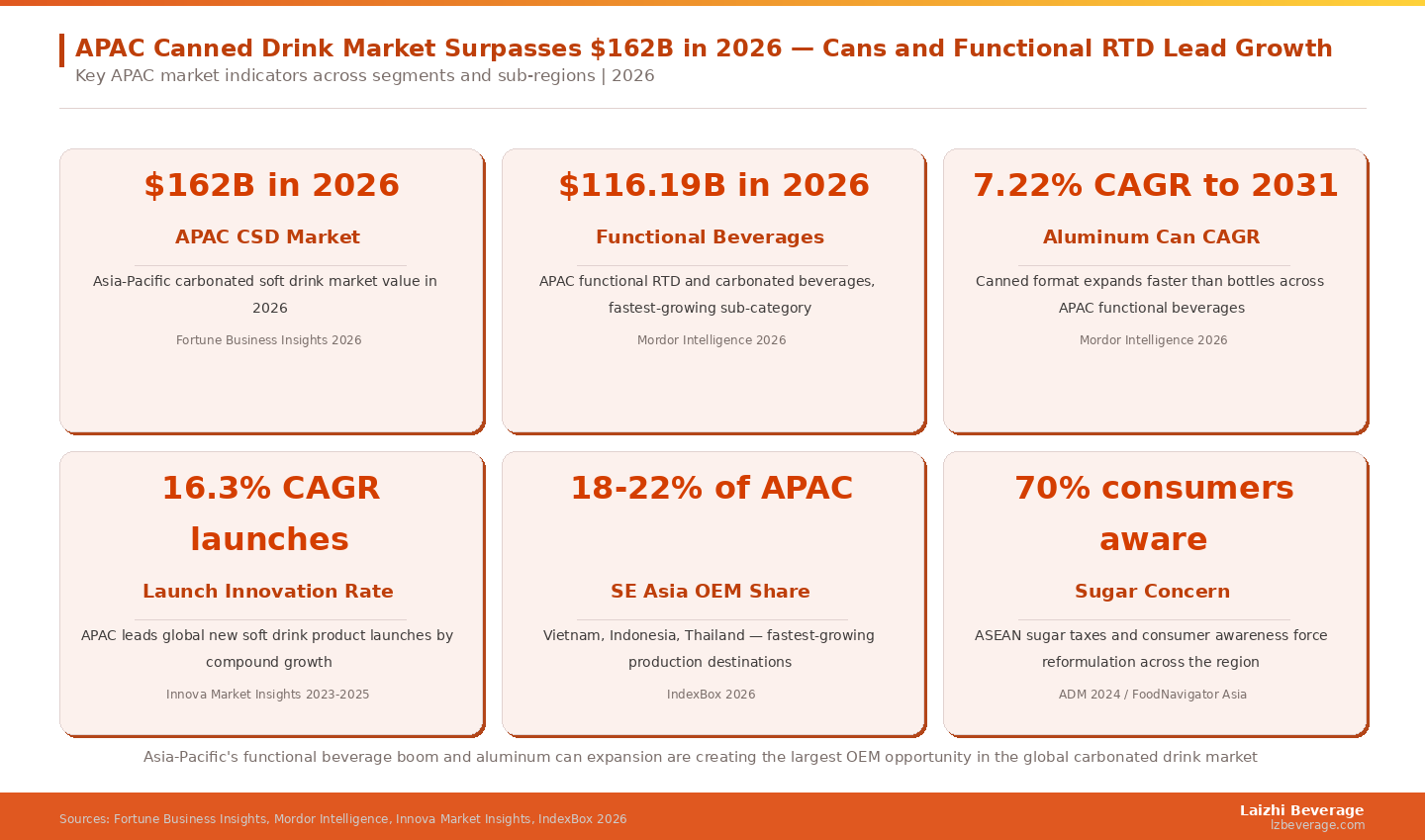
- APAC CSD market reached $162B in 2026 — the largest regional share globally, growing nearly four times faster than North American value growth.
- APAC functional beverage market is $116.19B in 2026, with aluminum cans growing at 7.22% CAGR — the fastest packaging format in the region's functional drink category.
- Soft drink product launches across APAC grew at a 16.3% CAGR between 2023 and 2025, with China leading the region in new SKU volume and innovation pace.
- Sugar-free reformulation is accelerating rapidly — 70% of APAC consumers express concern about sugar in beverages, and ASEAN-wide sugar taxes (Indonesia, Thailand, Malaysia, Philippines) are forcing active reformulation across the category.
- Southeast Asia (Vietnam, Indonesia, Thailand) accounts for 18-22% of APAC's drink can market and is receiving the largest share of new can manufacturing investment, with Ball Corporation's 1.2 billion unit capacity plant in Vietnam now operational.
The APAC Market: Not One Market But Five Distinct Dynamics
China: Volume Leader and Innovation Engine
China commands approximately 66.55% of the APAC functional beverage market in 2025 and is the single most active market for new carbonated drink product launches in the world. Soft drinks launches across Asia Pacific grew at a 16.3% CAGR between 2023 and 2025, with China leading the region in both local brand activity and multinational market adaptation. RTD coffee consumption in China is growing at 10–12% annually, and carbonated functional beverages — particularly those targeting cognitive performance, hydration, and sustained energy — are the fastest-growing sub-category. The 330ml standard aluminum can is the default format for carbonated drinks in China's convenience and modern retail channels, and this format dominates with a 65% volume share of APAC aluminum can consumption.
For OEM brand builders, China presents a high-entry-barrier but high-reward opportunity. The consumer environment rewards localized flavor innovation (regional botanicals, traditional Chinese medicine-adjacent ingredients), strong retail partnerships, and aggressive e-commerce presence on platforms like Tmall and JD. Brands entering China through OEM manufacturing need partners with established mainland distribution relationships and the ability to support Chinese-language regulatory filings.
Combining the 16.3% CAGR in APAC soft drink launches with the observation that China leads by volume suggests something important that aggregate market reports often miss: the product velocity in China is not driven by brand giants alone. A significant portion of new SKU activity is coming from small-to-mid-size domestic brands testing regionally differentiated formats — panda berry-flavored sparkling water, TCM-infused carbonated tonics, limited-edition city-themed cans — that global OEM manufacturers can produce at lower MOQ than traditional large-format production runs required five years ago. This democratization of product development is the structural shift that makes OEM-led brand creation viable at smaller investment scales in 2026 than at any prior point.
India: The Fastest-Growing Market in the Region
India is projected to expand at a 7.58% CAGR through 2031 in functional beverages, and the broader carbonated drink market is growing at double-digit rates driven by a 1.4-billion-person population with rapidly rising urban incomes and an under-25 demographic that significantly outspends older cohorts on branded beverages. Coca-Cola's $76.4 million investment in a new smart factory in Telangana signals the scale of committed capital entering the Indian beverage infrastructure in 2025–2026. PepsiCo launched the limited-edition Sting Blue Current carbonated energy drink in India in April 2024, directly targeting India's youth convenience segment.
The packaging dynamic in India differs meaningfully from China: PET bottles retain a higher share of the Indian CSD market than in most APAC peers, partly because of price sensitivity in rural and semi-urban channels. However, the premium convenience retail segment — 7-Eleven, Reliance Smart, D-Mart, and regional modern trade chains — is seeing rapid can adoption, particularly for energy drinks and functional sparkling beverages where the aluminum format supports both price premium positioning and portability marketing claims. Brands targeting India's urban youth through modern retail and quick-commerce channels (Zomato, Blinkit) should specify can formats from the outset of their product brief.
Southeast Asia: Vietnam, Indonesia, Thailand — The OEM Hotspot
Southeast Asian economies collectively account for 18–22% of APAC's drink can market value, and the region is receiving the largest share of new manufacturing investment in the APAC can supply chain. Ball Corporation's 1.2 billion annual unit capacity plant in Bac Ninh, Vietnam, commissioned in February 2023, and Crown Holdings' digital printing pilot in Shanghai (enabling limited-edition can customization) are two data points that confirm Southeast Asia's growing role as the OEM production base for the APAC carbonated drink market.
Thailand is particularly significant for international OEM brands: 78% of all canned beverages sold in Thai convenience stores fall within the 330ml-500ml capacity range, and Thailand functions as both a high-consumption domestic market and a regional export hub for ASEAN and the Middle East. Vietnam's growing middle class and expanding convenience retail network make it the fastest-emerging demand market in the sub-region. Indonesia, with its population of 280 million and a July 2025 sugar tax implementation that is forcing active reformulation of existing CSD portfolios, represents significant opportunity for brands entering with functionally differentiated, lower-sugar canned products.
Japan, South Korea, Australia: Mature Markets with Premium Differentiation
Japan and South Korea represent the most sophisticated consumer environments in APAC for premium carbonated beverages. In Japan, functional claims in carbonated drinks require substantiated scientific evidence under the country's FOSHU (Foods for Specified Health Uses) and FHMA (Function Claims for Food) regulatory frameworks — a higher bar than most APAC markets, but one that, once cleared, provides a significant competitive moat. South Korea's carbonated beverage market is shaped by intense domestic brand competition and rapid flavor innovation cycles, with new SKUs typically cycling in and out of convenience retail in 8–12 week windows. Australia functions as an effective test market for premium carbonated drink concepts before broader APAC rollout — the consumer base is health-conscious, sustainability-aware, and willing to pay a premium for functional positioning, making it a high-quality signal market for innovation.
Packaging Format Dynamics: Why Cans Are Winning in APAC
Aluminum cans are forecast to grow at a 7.22% CAGR in APAC functional beverages through 2031 — the fastest packaging format in the category. The drivers are structural: convenience store expansion (7-Eleven and Lawson are planning 10,000 new APAC outlets by 2026), which favors grab-and-go can formats; sustainability regulation (Extended Producer Responsibility mandates in Vietnam, the Philippines, and Singapore favor infinitely recyclable aluminum over single-use PET); and the premium branding association that slim cans carry in markets where consumers actively signal health consciousness through product selection.
In Southeast Asia, 65% of consumers prefer brands that demonstrate environmental transparency and ethical practices — a figure that has direct implications for packaging decisions in brand briefs. PwC's survey found 54% of Asia-Pacific consumers expect food and beverage companies to actively help them lead healthier lives. These are not survey findings that brand owners can defer to marketing — they need to be resolved at the formulation and packaging specification stage before production begins.
Sugar Taxes and Reformulation: A Market Forcing Function
70% of Asia-Pacific consumers report concern about sugar levels in beverages, and this sentiment is now backed by fiscal policy. Indonesia implemented a sugar tax in July 2025; Thailand, Malaysia, and the Philippines have similar frameworks in place. The Philippines' sugar-sweetened beverage tax has reshaped the domestic CSD market toward diet and zero-sugar variants, with new functional claims entering as brands seek differentiation beyond the commodity sugar-free positioning. For brands formulating canned carbonated drinks for ASEAN markets, a multi-tier sugar strategy — a conventional variant, a zero-sugar variant, and a functional variant with positive ingredient claims — is rapidly becoming the minimum viable product portfolio for retail listing applications in regulated markets.
OEM Strategy for APAC Entry: What Actually Works in 2026
The APAC market's complexity — five distinct regulatory environments, six primary languages, and significant variation in consumer income levels and flavor preferences between markets — makes a single-SKU, single-market approach the highest-risk strategy for new market entrants. The most commercially successful OEM-led brand launches in APAC in 2024–2025 share three structural characteristics: they entered with a market-specific formulation (not a global SKU localized for APAC); they used the aluminum can as both a functional packaging decision and a brand signal; and they partnered with OEM manufacturers capable of producing flexible MOQs across multiple can sizes (250ml, 330ml, 500ml) without minimum lot penalties that make test-and-learn market validation economically unviable.
Exploring the energy drink and carbonated beverage options available through flexible OEM production lines — and understanding which can formats each manufacturing partner can service — is a critical early-stage due diligence step for any brand planning APAC market entry in 2026. Factory-side capabilities, including HACCP certification, export documentation, and halal certification availability, determine whether an OEM partner can serve a single APAC market or whether they can support multi-market rollouts from a single production relationship.
Next Steps Action Plan
- This week: Map your priority APAC markets against their sugar tax and functional beverage claim regulatory requirements — Indonesia, Thailand, Malaysia, Philippines, Japan, and Australia each operate differently.
- This week: Confirm whether your target APAC entry markets are premium-can or volume-bottle markets — India's modern retail requires cans; rural India markets favor PET. Your format decision shapes your OEM specification.
- Next month: Develop at least two localized flavor variants per target market — citrus-forward for Southeast Asia, botanicals for Japan and Australia, functional adaptogens for South Korea — tested with in-market consumer panels before production commitment.
- Next month: Request HACCP certification documentation and halal certification status from any OEM manufacturer under consideration for Southeast Asia or Middle East market entry.
- Before launch: Build a minimum three-SKU portfolio for APAC retail listing (conventional / zero-sugar / functional) — most ASEAN modern retail buyers expect multi-variant brand architecture before granting permanent shelf placement.
Frequently Asked Questions
Which APAC country offers the best entry point for canned carbonated drink brands?
There is no single best entry point — the answer depends on the brand's formulation positioning and budget. For premium functional brands, Australia and Japan offer sophisticated consumers willing to pay for substantiated health claims. For volume growth, India's modern retail segment and Vietnam's expanding convenience market offer the fastest path to meaningful sales velocity. For balanced risk-adjusted entry, Thailand combines established retail infrastructure, halal-ready production capability, and proximity to both ASEAN distribution networks and Middle East export routes.
Why are aluminum cans gaining share over PET bottles in APAC functional beverages?
Three factors are driving the shift: consumer sustainability preference (65% of Southeast Asian consumers prefer brands with environmental transparency); convenience store format alignment (cans are preferred in grab-and-go retail channels that are expanding rapidly across APAC); and the premium branding premium (aluminum cans command 30–40% higher perceived value than equivalent PET formats in premium and functional beverage positioning). The 7.22% CAGR of canned formats versus slower growth in PET across APAC functional beverages reflects these structural drivers, not a temporary consumer preference trend.
How does the ASEAN sugar tax affect OEM brand development decisions?
Directly and immediately. Indonesia's July 2025 implementation, combined with similar frameworks in Thailand, Malaysia, and the Philippines, means that brands entering ASEAN markets with conventional sugar-sweetened formulations face additional tax burden that PET competitors may not face equally (some tax frameworks exempt small producers or certain distribution channels). More importantly, brands entering ASEAN with a zero-sugar or reduced-sugar formulation from the outset position themselves on the right side of a regulatory trajectory that is moving consistently toward higher sugar taxation across the region.
What is the minimum viable OEM production arrangement for APAC market entry?
This varies by market, but a practical framework: a sample production run (typically 500–2,000 units) for market testing and regulatory submission; a pilot production lot (10,000–50,000 cans) for retail buyer presentations and early e-commerce sales; and a first commercial run that covers initial retail placement across 50–200 store locations. OEM manufacturers with flexible MOQ structures — capable of producing at each of these volume levels without penalty pricing that makes market validation economically unviable — are the critical infrastructure for test-and-learn market entry in APAC in 2026. Understanding how beverage OEM manufacturers structure their trial and commercial production agreements is essential context before signing any production commitment.

