Hypertension is the leading risk factor for cardiovascular disease and premature death. As many as one-third of adults in the world suffer from hypertension. According to a survey, there are about 245 million hypertensive patients in my country, and the incidence rate continues to rise. It is worth noting that this disease is also approaching the middle-aged and young groups.
As one of the most common chronic diseases, hypertension is called the "silent killer". Data from the National Center for Cardiovascular Diseases show that the prevalence of hypertension among residents aged 18 and above in my country is 27.5%, that is, one in every four adults is a hypertensive patient.
Coffee, a life-saving artifact for contemporary people, is one of the most popular beverages in the world. Because it contains a lot of caffeine, it is often consumed by people to wake up and improve work efficiency. Many studies in the past have shown that drinking coffee regularly can bring a variety of health benefits.
On October 17, 2024, researchers from Southern Medical University published a research paper titled " Evaluation of the association between coffee consumption including type (instant, ground) and addition of milk or sweeteners and new-onset hypertension and potential modifiers " in the Journal of the Academy of Nutrition and Dietetics.
The study showed that regardless of the type of coffee and whether milk was added, as long as sugar was not added, it was associated with a lower risk of hypertension.
Specifically, there was a U-shaped association between the intake of unsweetened coffee and new-onset hypertension, and the risk of new-onset hypertension was lowest for 1-4 cups per day compared with those who did not drink coffee.
In addition, in people with inflammation (high C-reactive protein), moderate consumption of unsweetened coffee was more negatively correlated with new-onset hypertension.
In this study, the researchers analyzed 98,765 participants in the UK Biobank database, 63% of whom were women and had an average age of 54 years old. The participants' coffee intake was collected through questionnaires, and the association between coffee intake and new-onset hypertension was analyzed.
According to the amount of coffee consumed per day, participants were divided into: no coffee, 0-1 cup, 1-2 cups, 2-3 cups, 3-4 cups, and more than 4 cups. One cup of coffee is about 250 mL.
During an average follow-up of 12 years, a total of 7090 new cases of hypertension were recorded.
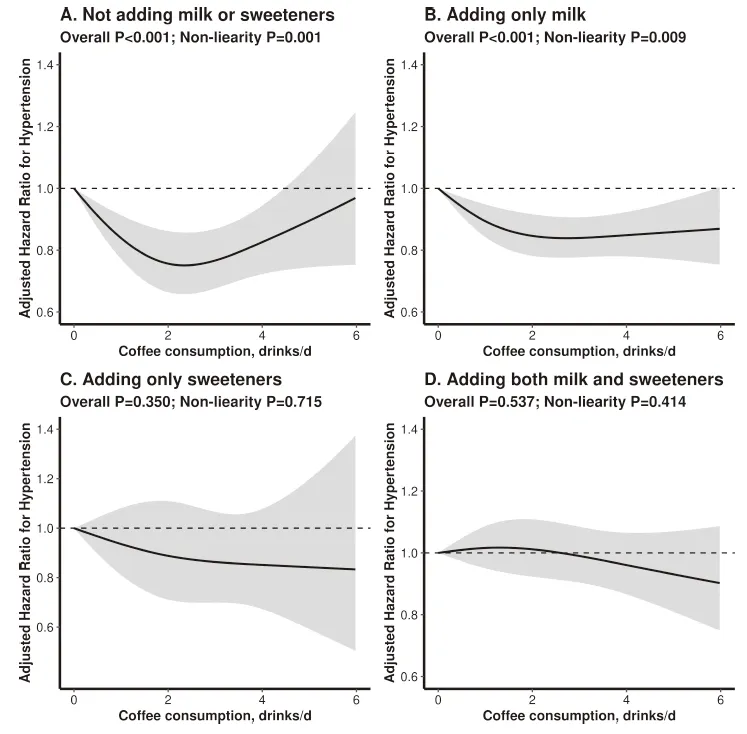
The analysis found that there was a U-shaped association between the intake of unsweetened coffee and new hypertension, regardless of the type of coffee and whether milk was added, while there was no association between sugared coffee and the risk of new hypertension.
Compared with non-coffee drinkers, participants who consumed 0-1, 1-2, 2-3, 3-4, and more than 4 cups per day were associated with a reduced risk of new hypertension by 8%, 18%, 14%, 14%, and 12%, respectively.
This means that people who drank 1-4 cups of unsweetened coffee per day had the lowest risk of new hypertension.
In addition, among participants with higher C-reactive protein levels, moderate consumption of unsweetened coffee was more negatively associated with new hypertension.
It is worth noting that no matter what a person's genetic factors for caffeine metabolism are, they do not change the relationship between unsweetened coffee and a reduced risk of new hypertension.
Coincidentally, in August 2024, researchers from Peking University published a research paper titled " Associations Between Different Coffee Types, Neurodegenerative Diseases, and Related Mortality: Findings from a Large Prospective Cohort Study " in the American Journal of Clinical Nutrition.
Studies have shown that consuming more unsweetened and caffeinated coffee is associated with a lower risk of Alzheimer's disease and related dementias and Parkinson's disease, and related mortality, while sugary coffee and unsweetened coffee are not associated.
Specifically, compared with people who do not drink coffee, ≥3 cups of unsweetened and caffeinated coffee per day are associated with a 25% lower risk of Alzheimer's disease and related dementias, a 29% lower risk of Parkinson's disease, and a 33% lower risk of death related to neurodegenerative diseases.

Taken together, the results suggest that unsweetened coffee may be better for your health, helping to reduce the risk of death from high blood pressure, dementia, Parkinson's disease, and neurodegenerative diseases.

