A private label functional soda manufacturer should be evaluated as a system partner, not simply as a company that can carbonate a flavored drink. The useful question is whether the proposed formula, production line, package, and target-market label can be evidenced together before a commercial purchase order is released.
That matters because an attractive bench sample can still leave key launch assumptions open: whether an ingredient fits its intended use, whether the liquid behaves consistently during filling, whether the selected can is appropriate for the beverage configuration, and whether the positioning is supportable in the destination market. Use the checklist below to turn those open assumptions into named records and decisions.
Four Questions That Separate a Concept Supplier From a Production Partner
Start by asking how the formula, line, package, and target-market claim will be evidenced together. This is an original supplier-qualification framework, not a regulatory determination, but it prevents a common sourcing error: treating a list of ingredients, formats, or past projects as proof that this exact launch can move forward.
- Formula: Can the manufacturer identify the formula version, the intended use of each functional ingredient, the sensory target, and the information still needed before the formula is commercial?
- Production line: Can it explain how the proposed carbonation, filling route, and verification activities relate to this product rather than offer a generic quality statement?
- Package: Can it match the actual beverage, can or bottle components, and intended conditions of use instead of saying that one package is suitable for every soda?
- Market claim: Can the buyer and manufacturer separate product development from the final review of label copy and functional positioning for the destination market?
A supplier may have strong category experience and still need to validate one of these four questions for a new brief. The point is not to demand certainty before development starts. It is to agree on what the pilot must prove, who owns each check, and which gap keeps the commercial order on hold.
Ask for Formula-to-Line Evidence, Not a Capability Deck
A functional soda capability claim is useful only when the supplier can show how the formula, line, and package fit together. Ask for a working evidence map rather than a presentation: formula specification and revision owner; ingredient documentation; proposed carbonation and filling route; package specification; pilot acceptance criteria; and a draft label or claim direction. That map reveals whether a supplier is ready to investigate the brief or is only describing its general catalogue.
For a functional soda, the formula conversation should go beyond “Which active can you add?” Ask how the ingredient will affect flavor, sweetness balance, solubility, visual appearance, and the intended process. Also ask what is known, what requires a pilot, and what the manufacturer needs from the brand. A 330 mL can, a citrus profile, and one target market are commercial constraints—not background details—because they shape the development route.
For U.S. examples, the relevant question is whether the ingredient is recognized as safe under its intended conditions of use. GRAS means “Generally Recognized as Safe”: a U.S. regulatory conclusion based on recognition by qualified experts for a specified intended use. The FDA’s GRAS notification guidance is a useful reminder that an ingredient name alone is not a launch-ready answer. A buyer should ask for the formulation record and the intended-use rationale relevant to the proposed product, while obtaining market-specific regulatory advice where needed.
When the product brief is ready for a supplier conversation, it can help to review the available beverage product categories before assuming that a published category automatically covers a new functional soda configuration. LZ Beverage can use a well-defined brief to discuss feasibility, sampling, and suitable production paths; the final formula and claim outcome should remain subject to the appropriate technical and market review.
Check the Controls That Protect the Formula During Production
Verification should match the food, facility, preventive control, and the role of that control in the system. The FDA’s preventive-controls guidance describes product testing and environmental monitoring as verification activities when appropriate to the food and facility. For a buyer, the practical question is: “Which checks apply to this formula and line, and what will their records show?” A useful reply names the control, the evidence, and the person who reviews it.
Carbonated products make this conversation more concrete. Confirm the intended carbonation range, the fill conditions, the sensory target after filling, and the observations that would trigger a formula or process adjustment. Do not ask a manufacturer to promise that every ingredient will behave identically in every line. Ask it to state the proposed process window, what the pilot will confirm, and how an out-of-range result will be handled before commercial release.
Package compatibility should be reviewed against the actual beverage and intended conditions of use, not as a universal can claim. A food contact substance is a packaging or processing-equipment material positioned at the point of contact with the drink, but not intended to alter it. FDA information on food packaging and other food-contact substances, together with its explanation of food types and conditions of use, supports a configuration-specific review. The buyer should therefore provide the beverage profile, process route, intended shelf-life context, and actual package components rather than accept a blanket “can compatible” answer.
Where the ingredients or shared line make it relevant, ask how the manufacturer controls allergen cross-contact. The FDA notes that cross-contact is addressed through applicable CGMP and preventive-controls requirements in its allergen labeling guidance. This is especially worth raising when the brief includes extracts, flavor systems, or a shared production environment. It is not a request for a generic certificate; it is a question about the controls relevant to the proposed formula.
Published factory information can provide useful context, but it should not replace product-specific evidence. LZ Beverage’s published information can support a first credibility check; the pilot record should still carry the decision for the individual soda. Before treating a capability statement as proof, check the published factory and certification context.
Use the Pilot as a Decision Gate
A pilot is a qualification event only when it produces a usable record for formula, line, package, and claim review. For sourcing purposes, a pilot run means a controlled production-scale trial that tests whether a proposed product and process work together. It should not be treated as a taste sample with a more expensive label.
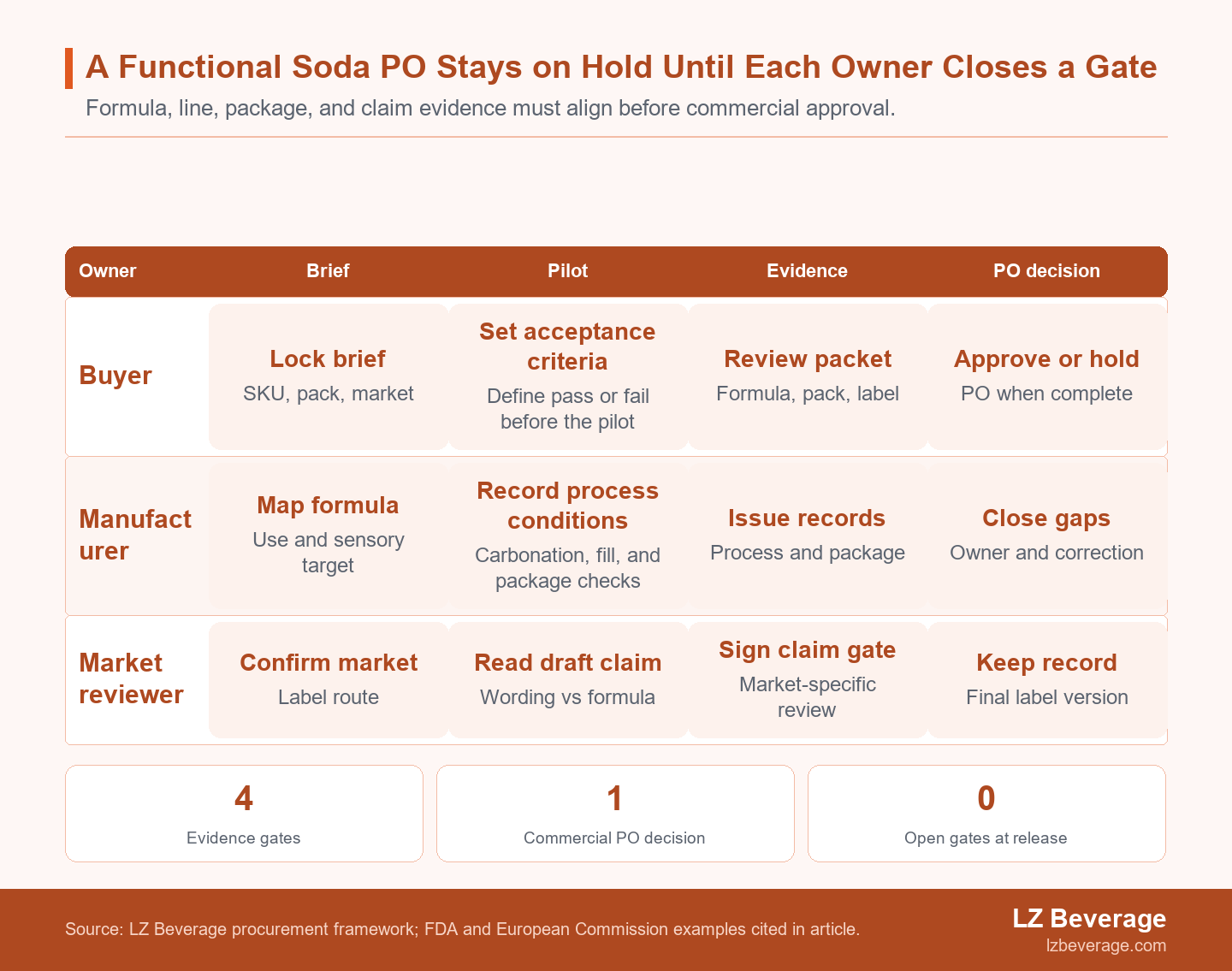
Use a four-gate rule. The formula gate confirms the version and intended-use questions. The line gate records the proposed carbonation, filling conditions, and agreed observations. The package gate confirms the components and configuration reviewed for the actual beverage. The market-claim gate identifies the target market, draft label direction, and owner of the final claim review. If one gate lacks a named record, the pilot has identified work still to do—not proof that the commercial order is ready.
This is the decision asset that keeps supplier discussions productive: one pilot run, one controlled formula, one production line, one package configuration, one claim-review route, and one commercial-approval decision. It also gives the buyer a practical way to compare commercial responses: ask each supplier to identify the record, owner, and acceptance point for every gate. Once those inputs are defined, buyers can compare the RTD beverage production options against the format they intend to launch rather than against an abstract idea of “functional soda.”
Illustrative Pilot: Hold the PO Until the Evidence Matches the Launch
Illustrative composite: this example is a sourcing scenario, not an LZ Beverage client result or a regulatory determination.
In the illustrative scenario, the commercial order stays on hold until the four evidence gaps are closed. The example shows why a sound-tasting sample is not, by itself, an approval event.
A sourcing manager is qualifying a private-label functional soda supplier for an export-market launch and needs an evidence-led answer before authorising the first commercial run.
The proposed launch is 1 citrus SKU in a 330 mL can for 1 target market, initially scoped to 1 20-foot-container order. The concrete scope makes it possible to judge the same launch configuration that will be quoted and labelled.
The bench sample is accepted for sensory direction, while commercial approval remains pending. This is a normal and useful point in development: the buyer has a concept but has not yet closed the production assumptions.
First, the bench sample tastes acceptable, but the ingredient sheet does not state the intended commercial use conditions.
Second, the can specification and final claim language have not been reviewed alongside the pilot process.
Those are not cosmetic paperwork gaps. Without them, the buyer cannot tell whether the sample represents the proposed launch configuration, whether the package review applies to this beverage, or whether the label direction belongs to the selected market.
The decision is a full hold on the commercial purchase order while the supplier maps formula, processing, packaging, and claim records to named owners. A full hold is more disciplined than a conditional verbal approval because the missing records affect the single SKU and its label.
The corrective action is to run a pilot with agreed process conditions, the intended package format, a draft label, and clear pass/fail release checks. The supplier and buyer can then distinguish a changed formula, a package question, and a claim-review question instead of merging them into one vague “sample feedback” request.
Release the commercial order only after formula, line, package, and market-claim records are complete and assigned to named reviewers. That gate turns a pilot into an auditable decision point rather than an optimistic milestone.
The scenario is illustrative and does not claim an LZ Beverage client result. The appropriate tests, documentation, and market review remain product- and destination-specific.
Separate Ingredient Permission From Marketable Claims
For applicable U.S. labels, added sugars are declared in grams and percent Daily Value. The FDA’s guidance on added sugars on the Nutrition Facts label gives a clear example of why formula and label work must move together. A sweetness adjustment may be a sensory decision, but it can also change the information that must be reviewed for a market-facing package. This is a U.S. example, not a universal rule.
A health claim describes a relationship between food and health, so it must be reviewed as a market-facing claim rather than inferred from an ingredient list. The European Commission’s nutrition and health claims guidance similarly distinguishes claims and points to the EU Register. For an export brief, that means the target market should be fixed before label artwork is treated as final. Ingredient status, product safety, nutrition labeling, and the permission to use a particular claim are separate decisions.
Give the manufacturer a claim direction early—for example, the positioning the brand hopes to explore—without asking it to convert that direction into a promise. Ask who will review the final wording, which market is in scope, and which formula version the review applies to. This keeps commercial language from running ahead of the product record and makes late-stage artwork changes less likely.
Send an RFQ Packet That Produces a Useful Feasibility Answer
A useful RFQ gives the manufacturer enough information to test formula, line, package, and label assumptions before it quotes the commercial route. An RFQ remains a purchasing method, not a promise that a supplier can approve a formula or market claim.
For a U.S. example, the FDA notes in its food-business overview that manufacturers are responsible for safe, sanitary, and appropriately labeled products. This general responsibility does not replace product- or market-specific review.
Send one version-controlled packet containing:
- the product concept, target consumer experience, functional ingredients, sweetness direction, and known exclusions;
- the target market, draft positioning, and any claim language that needs specialist review;
- the intended package format, fill volume, preliminary order quantity, and launch timing;
- the questions the pilot must answer, including carbonation, line behavior, package compatibility, and release checks; and
- the decision owner for formula, artwork, commercial terms, and final production approval.
This packet makes MOQ conversations comparable. A lower MOQ is not automatically a better offer if one quote excludes the formulation, pilot, package, or label work needed to make the launch decision. The most useful response will state what can be assessed now, what needs a sample, and which market or package details still need confirmation. Once the brief is ready, buyers can use LZ Beverage to request an OEM feasibility review for your functional soda brief.
Common Questions About Functional Soda Manufacturing
These questions address pilot scope, claim responsibilities, production documentation, and MOQ comparisons when selecting a manufacturing partner.
What should a functional soda pilot run prove?
A functional soda pilot should prove more than taste: it should show that the formula, carbonation, package, and proposed control checks can work together at the intended process conditions. Ask for the formula version, the line conditions used, the package configuration, the observations made, and the pass/fail decision. If those records do not describe the same product you intend to sell, treat the pilot as exploratory rather than commercial qualification.
Can a manufacturer make the health claim for my functional soda?
No manufacturer should treat an ingredient's presence as automatic permission to make a health claim, because the claim must be assessed against the rules and conditions of the destination market. A manufacturer can help identify the relevant formula and label dependencies, but the brand should establish who owns final claim review for the country or region in scope. Keep the reviewed wording tied to the approved formula and artwork version.
Which documents should I request before approving production?
Request the formula specification, ingredient documentation, proposed label copy, package specification, pilot results, and the agreed release checks before you approve a commercial purchase order. Also confirm the version number and named owner for each item. The purpose is not to create paperwork for its own sake; it is to make sure the quoted product, pilot product, packaged product, and labelled product are the same defined configuration.
How do I compare MOQ offers for a custom soda formula?
Compare MOQ offers only after confirming that each quote covers the same formula complexity, package format, testing scope, and market-label work, because a lower unit count may exclude the evidence needed for launch. Put the included pilot work, packaging assumptions, documentation, and exclusions beside the unit price. If the evidence path differs, the offers are not yet directly comparable.


