When a beverage brand places an OEM order with a Chinese factory, one question comes up faster than any other: "Does your factory have the right certifications to export?" It sounds simple, but the answer involves at least five distinct documents — some mandatory by Chinese law, some required by destination customs, and some only needed for specific retail channels. Getting any one of them wrong can hold your shipment at port for weeks or cost you a major retail listing.
When a beverage brand places an OEM order with a Chinese factory, one question comes up faster than any other: "Does your factory have the right certifications to export?" It sounds simple, but the answer involves at least five distinct documents — some mandatory by Chinese law, some required by destination customs, and some only needed for specific retail channels. Getting any one of them wrong can hold your shipment at port for weeks or cost you a major retail listing.
Why we wrote this: We work with import partners across Southeast Asia, the Middle East, and Europe, and the single most common delay we see at customs is a documentation gap — not a product problem. This guide maps every certification layer so your next order ships clean.
Key Takeaways
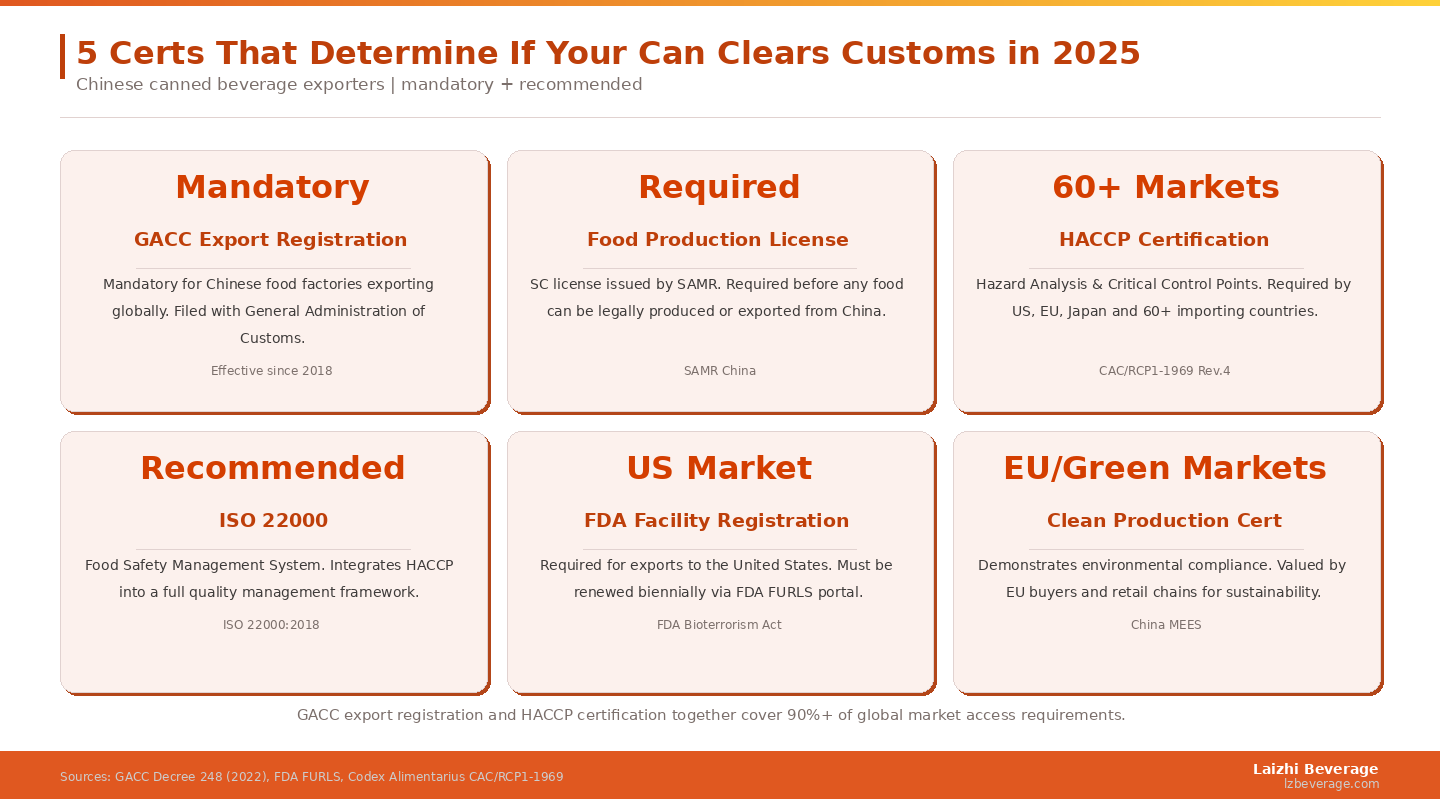
- GACC export enterprise registration and a valid SC (food production) license are non-negotiable starting points for any Chinese canned beverage manufacturer.
- HACCP certification is required by 60+ importing countries and is the most universally demanded quality credential from Chinese factories.
- ISO 22000 is not mandatory by law but is increasingly required by major retailers and can be the deciding factor in winning a private-label contract.
- FDA facility registration is a separate, biennial requirement for any factory shipping canned drinks to the United States.
- Market-specific certifications (HALAL, Kosher, organic) layer on top and must be verified per destination country.
Layer 1 — The Chinese Legal Foundation (Before You Export Anything)
Food Production License (SC License)
Every food manufacturer in China must hold a 食品生产许可证 (SC license) issued by the State Administration for Market Regulation (SAMR). Without it, a factory cannot legally produce food products, let alone export them. The SC license specifies the categories of food the facility is approved to produce — so a factory holding an SC license for carbonated beverages cannot use it to export energy drinks unless that category is included. When vetting a Chinese OEM partner, ask to see the current SC license and verify it covers your product category.
GACC Export Enterprise Registration
Any Chinese food enterprise exporting overseas must register with the General Administration of Customs of China (GACC). This registration — sometimes called 出口食品生产企业备案 — gives the factory an official export enterprise number used on customs declarations. The process involves GACC reviewing the factory's food safety management system, production facilities, and traceability records. Registration is valid for five years and requires regular surveillance. Detailed guidance on the GACC system, including the CIFER portal, is published and updated regularly by Chinese trade advisors.
Combining these two credentials — the SC license and GACC export registration — is what our team reviews first when onboarding any new OEM customer. In our experience, factories that keep both current and audit-ready are the ones that close deals fastest, because buyers can verify them online without waiting for paper copies. We obtained our export qualification in 2018, and the annual self-review process has since become part of how we build quality discipline across the production floor.
Layer 2 — HACCP: The Universal Market Access Credential
HACCP (Hazard Analysis and Critical Control Points) is the globally recognized food safety methodology built on seven principles for identifying and controlling hazards in the production process. While HACCP is technically voluntary under Chinese law, it is effectively required to export canned beverages to the United States, the European Union, Japan, Australia, Canada, and more than 60 other markets.
In China, HACCP certificates are issued by bodies accredited by CNAS (China National Accreditation Service). The China Quality Certification Centre (CQC) alone issues roughly 40% of all HACCP certificates issued domestically. Certificates reference the international standard CAC/RCP 1-1969 Rev.4 and are subject to annual surveillance audits. When a buyer requests a HACCP certificate, they should verify it against the CNCA database to confirm it is genuine — HACCP certificate forgery is a known problem in the Chinese supply chain.
Laizhi Beverage has held HACCP certification since 2017. In practice, this means every production run follows documented critical control points covering pasteurization temperature, can seam integrity, CO2 volume, microbiological testing and clean-in-place records.
Layer 3 — ISO 22000: The Retail Chain Gateway
ISO 22000 integrates HACCP principles into a full Food Safety Management System (FSMS) that also covers organizational management, communication across the supply chain, and continuous improvement cycles. It is not a legal requirement for export, but it has become a de facto baseline for supplier approval by global retail chains. A buyer sourcing private-label canned drinks for a European supermarket group will almost always require ISO 22000 certification from their Chinese OEM partner.
The certification process typically takes 6 to 12 months for a mid-size factory, and one documented benefit of integrating HACCP within an ISO 22000 system is a reduction in documentation overhead — one manufacturer reduced their compliance paperwork by 40% by eliminating redundant verification records. If your factory already holds HACCP certification, upgrading to ISO 22000 is a natural next step rather than a parallel effort.
Layer 4 — Market-Specific Certifications
FDA Facility Registration (United States)
Any overseas food facility shipping products to the United States must register with the FDA under the Bioterrorism Act. This registration must be renewed biennially (in odd-numbered years, October through December). Factories must also appoint a US-based agent who can receive regulatory communications on their behalf. The FDA has published guidance on registration requirements specifically for facilities exporting to the United States, including the steps for self-registration via the FURLS portal.
HALAL Certification (Middle East and Muslim Markets)
For exports to Saudi Arabia, the UAE, Malaysia, Indonesia and other markets with significant Muslim populations, HALAL certification from an internationally recognized body is required. The certification covers ingredients, processing aids, and production line segregation from non-HALAL products.
EU Compliance (European Market)
The EU does not require a single certification document, but food products must comply with Regulation (EC) 178/2002 (General Food Law), additives regulations, and GB-equivalent labeling in the target language. GACC's 2025 regulatory updates signal continued tightening of traceability requirements, which increasingly mirror EU RASFF standards.
Next-step checklist
- 1. Today: request the SC license and GACC export registration number from any factory you are evaluating and verify both online at SAMR and GACC portals.
- 2. This week: ask for the HACCP certificate including the certificate number and issuing body so you can verify authenticity via the CNCA database.
- 3. Before signing a contract: confirm whether your destination market requires FDA registration (US), HALAL (Middle East), or additional EU documentation and build those requirements into your factory selection criteria.
- 4. For retail channels: evaluate whether ISO 22000 certification is required by your buyer and factor the 6-12 month timeline into your product launch schedule.
FAQ
Is HACCP certification legally required to export canned beverages from China?
Not under Chinese domestic law — but it is effectively required by the customs and food safety agencies of more than 60 importing countries, including the United States, EU member states, Japan and Australia. Any factory without HACCP certification will be unable to clear customs in those markets.
How do I verify that a Chinese factory's HACCP certificate is genuine?
Search the certificate number on the CNCA certificate database at the SAMR website. If the certificate does not appear or shows a different company name, treat it as a red flag and request a fresh audit report directly from the issuing body.
Does Laizhi Beverage hold all the certifications discussed?
Laizhi holds HACCP certification (since 2017), China export qualification (since 2018), and Clean Production certification (since 2009). We are happy to share verification documentation with prospective partners. Review our factory credentials and certifications for a full overview.
What happens if a shipment arrives without the required certifications?
The most common outcome is a customs hold while additional documentation is requested, which can take 3 to 14 days and may involve product quarantine. In the worst case — particularly for markets with strict food safety rules — the shipment can be returned or destroyed at the importer's expense. The US Department of Commerce publishes detailed guidance on China export documentation requirements for US importers.

