Walk through any Chinese canned beverage factory's credentials and you are likely to see both HACCP and ISO 22000 certificates hanging on the wall. They look similar. Both reference food safety. Both involve audits. For buyers who need to quickly assess a supplier's compliance standing, the two standards can blur together into a reassuring backdrop of documentation — without revealing their very different functions or which one actually matters for a specific supply relationship.
Walk through any Chinese canned beverage factory's credentials and you are likely to see both HACCP and ISO 22000 certificates hanging on the wall. They look similar. Both reference food safety. Both involve audits. For buyers who need to quickly assess a supplier's compliance standing, the two standards can blur together into a reassuring backdrop of documentation — without revealing their very different functions or which one actually matters for a specific supply relationship.
You will gain the following from reading this article: A clear, non-technical explanation of what HACCP and ISO 22000 each guarantee in a canned beverage factory — so you can ask sharper audit questions, match certification requirements to your target market, and make the right decision about which standard to prioritize when evaluating a supplier.
Key Takeaways
- HACCP is a production-floor safety methodology — it controls biological, chemical and physical hazards at defined points in the canning process.
- ISO 22000 is a management system standard — it embeds HACCP principles within organizational governance, communication requirements and continuous improvement cycles.
- HACCP alone satisfies government customs requirements in 60+ countries; ISO 22000 is increasingly required by global retail chains and institutional buyers.
- The two are complementary, not competing — ISO 22000 contains HACCP, so a factory holding ISO 22000 automatically covers HACCP requirements.
- The right choice depends on your sales channel: government customs and food service typically require HACCP; major retail chains increasingly require ISO 22000 or GFSI-equivalent.
What Each Standard Actually Does
HACCP: The Production Floor Safety Framework
HACCP (Hazard Analysis and Critical Control Points) is a seven-principle methodology developed from the Codex Alimentarius Commission's international food hygiene guidelines. Its scope is deliberately narrow and operational: identify every point in the canning process where a hazard (biological, chemical or physical) could occur, establish measurable control limits at those points, monitor those limits in real time, and document every corrective action when a limit is breached. According to DNV, one of the world's largest certification bodies, HACCP is best understood as a scientific, systematic approach to hazard prevention — its strength is depth in a specific operational domain, not breadth across an organization's management systems.
In a canned beverage factory, HACCP typically governs pasteurization temperature, seam integrity, CO2 volume, metal detection, and microbiological testing. It does not govern supplier qualification, management review processes, customer complaint handling or strategic planning.
ISO 22000: The Organizational Food Safety Management System
ISO 22000:2018 is a certifiable international standard published by the International Organization for Standardization. It integrates HACCP principles — making HACCP a required component — within a broader management system framework that also includes top management commitment, stakeholder communication across the supply chain, risk-based thinking, prerequisite programs (PRPs) for general hygiene, and PDCA (Plan-Do-Check-Act) continuous improvement cycles. Implementation of ISO 22000 typically takes 6 to 12 months for a mid-size food manufacturer and requires active involvement from senior management, not just the production quality team.
In practice, the distinction becomes clear during supplier audits. Retail chain compliance teams ask questions that HACCP alone cannot answer — "What is your supplier qualification procedure for aluminum can stock?" or "Show us the record of your last management review and how it changed your quality objectives." These questions address the organizational management layer of ISO 22000, not the production-floor control layer of HACCP. Factories that hold HACCP but not ISO 22000 frequently struggle to satisfy these questions without having the system to support them. Data from one food safety consultancy indicates that integrating HACCP plans within an ISO 22000 system can reduce compliance documentation overhead by 40%, while simultaneously making that documentation more audit-defensible — because the management review process forces annual updates that keep records current.
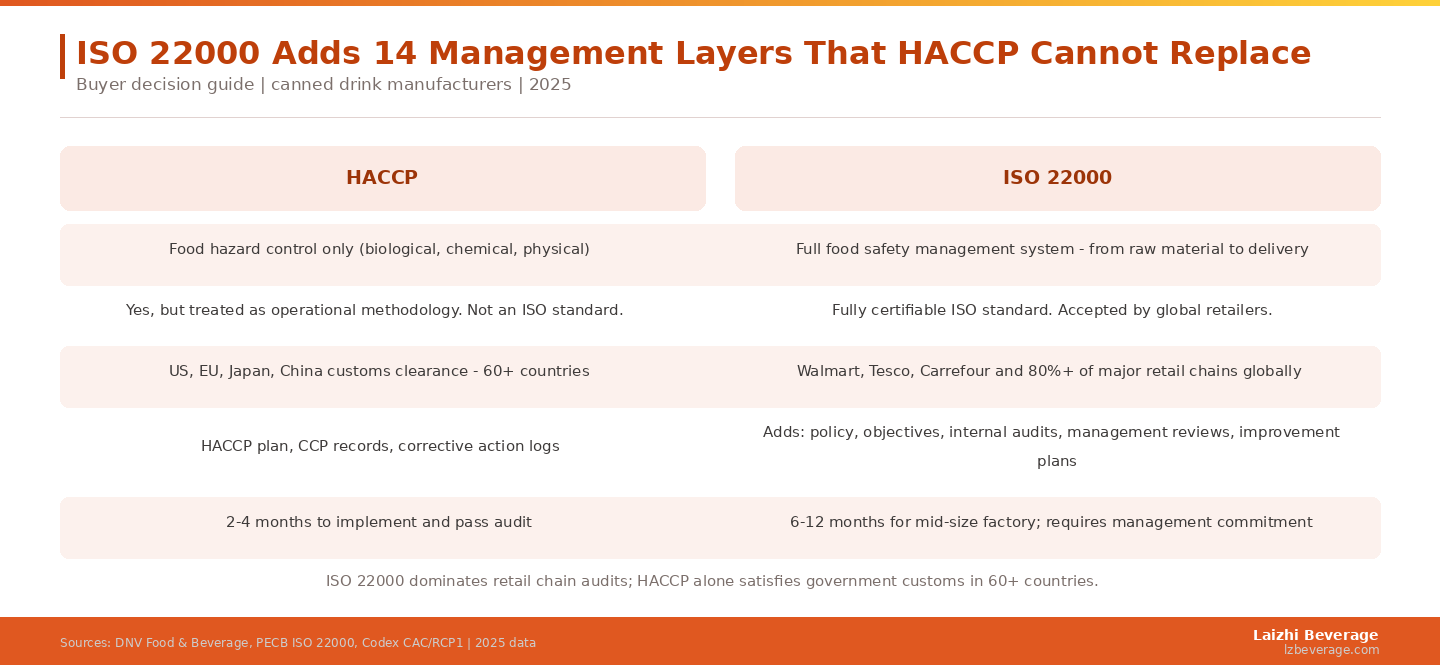
Side-by-Side Comparison: What Each Standard Covers
| Dimension |
HACCP |
ISO 22000 |
| Standard type |
Operational methodology (Codex) |
Certifiable management system (ISO) |
| Scope |
Hazard control at CCPs in production |
Full food safety management system from farm to fork |
| Management involvement |
Production team and quality manager |
Top management required; formal policy and objectives |
| Continuous improvement |
Corrective actions for CCP deviations |
PDCA cycle across the entire FSMS |
| Supply chain coverage |
Focused on in-house production hazards |
Requires communication with suppliers and customers |
| Typical audit timeline |
2-4 months to implement and certify |
6-12 months; annual surveillance required |
| Retail chain acceptance |
Partial — often required as component of ISO |
Widely accepted; foundation for GFSI-equivalent schemes |
Which Standard Is Legally Required for Export?
For Chinese canned beverage manufacturers, neither HACCP nor ISO 22000 is explicitly mandated by Chinese export law. However, HACCP is effectively required to export to the US, EU, Japan, Australia and Canada — because those markets' food safety regulations require that imported food come from facilities with documented hazard control systems equivalent to HACCP. A 2025 analysis of global food safety standards confirms that HACCP remains the baseline certification across the majority of regulated markets, while GFSI-benchmarked standards (of which ISO 22000 is a foundation) are increasingly specified by major international retailers.
ISO 22000 is not a legal customs requirement in any major importing country — but it has become a commercial gateway requirement. Sourcing from a factory without ISO 22000 is generally still legally permissible for customs clearance; it becomes a barrier when the buyer is a retail chain, institutional food service operator, or branded distributor that conducts its own supplier audits. For those channels, ISO 22000 (or an equivalent like FSSC 22000 or BRCGS) is effectively mandatory.
The Integration Advantage: Why "Both" Is the Best Answer for Export-Oriented Factories
The relationship between HACCP and ISO 22000 is not adversarial — ISO 22000 explicitly incorporates HACCP as a core component. A factory that holds ISO 22000 automatically satisfies HACCP requirements; the HACCP plan exists within the ISO 22000 management system. DNV's analysis of the two frameworks highlights that for companies adopting a food safety management system, the question is not "which one" but "at what level of comprehensiveness." Factories just beginning their export journey can start with HACCP (faster to implement, lower cost) and upgrade to ISO 22000 as their customer base and market reach expand.
For canned beverage manufacturers targeting global buyers, holding both a HACCP certificate and ISO 22000 certification sends a clear signal: the factory meets both the operational control requirements that customs inspectors look for and the management system requirements that retail buyers audit for. Verifying a manufacturer's certification stack — not just checking that a certificate exists, but confirming its scope, issuing body and currency — is the most reliable signal of a supplier's genuine compliance posture.
Next-step checklist
- Today: identify your target sales channel (government tenders, retail chains, food service, e-commerce) and map which certification each channel requires in your destination market.
- This week: when evaluating Chinese OEM suppliers, request both the HACCP certificate and ISO 22000 certificate — verify each against CNCA/IAF databases and confirm annual surveillance is current.
- If your supplier holds only HACCP: assess whether your retail buyer's supplier code requires ISO 22000; if yes, include an ISO 22000 upgrade timeline in your supplier development agreement.
- For factories beginning certification: implement HACCP first (2-4 months), then build toward ISO 22000 (add 6-8 months), starting with a gap analysis against ISO 22000:2018 requirements.
FAQ
If a factory has ISO 22000, do I still need to ask about HACCP separately?
No — ISO 22000 certification includes HACCP as a mandatory component. A factory holding a current, audited ISO 22000 certificate has a documented HACCP plan embedded within its food safety management system. Asking for a separate HACCP certificate from an ISO 22000-certified factory is redundant, though some factories maintain both for market-specific documentation requirements.
Is HACCP more rigorous than ISO 22000 for production-floor hazard control?
Not exactly. Both systems require the same hazard analysis and critical control point identification. ISO 22000 does not weaken HACCP requirements — it embeds them and adds organizational layers around them. For the specific question of whether a factory controls hazards at the production level, the HACCP component of an ISO 22000 system is equivalent to a standalone HACCP certification.
Can a Chinese factory earn HACCP certification in 2 months?
In principle, yes — if the factory has already implemented prerequisite programs (basic hygiene, pest control, sanitation) and has a qualified food safety team ready to develop the HACCP plan. In practice, 2 to 4 months is a realistic timeline for a prepared factory working with an experienced consultant and a CNAS-accredited certification body. Factories starting from scratch with minimal food safety infrastructure should budget 4 to 6 months for HACCP and 9 to 15 months for ISO 22000.
What about BRCGS and FSSC 22000 — are those more demanding than ISO 22000?
BRCGS (British Retail Consortium Global Standard) and FSSC 22000 are GFSI-benchmarked standards that build on ISO 22000 with additional sector-specific requirements. They are recognized by many of the world's largest supermarket chains as the preferred supplier certification. For Chinese factories targeting European or North American retail accounts, these standards represent the next level up from ISO 22000. Starting with ISO 22000 is the recommended path before pursuing GFSI-benchmarked certification.

