You've received a factory's credentials and the HACCP certificate is right there on page three. But what does it actually guarantee about the cans you're about to order? For many buyers, HACCP is a checkbox — a document that must exist before a purchase order is signed. That misunderstanding is what this article corrects.
You've received a factory's credentials and the HACCP certificate is right there on page three. But what does it actually guarantee about the cans you're about to order? For many buyers, HACCP is a checkbox — a document that must exist before a purchase order is signed. That misunderstanding is what this article corrects. HACCP is not a quality mark like a star rating; it is a systematic operational framework, and knowing what each of its seven principles requires lets you ask much sharper questions during factory vetting.
Why we wrote this: We have held HACCP certification since 2017 — nearly a decade of annual surveillance audits. We want buyers to understand what that credential actually commits us to, so they can use it as a meaningful sourcing tool rather than a formality.
Key Takeaways
- HACCP is a 7-principle preventive system — it addresses hazards before they occur, not after a can is filled.
- China's HACCP certificates must be issued by CNAS-accredited bodies — CQC alone issues 40% of all certificates in China.
- The certification covers biological, chemical and physical hazards — for canned beverages, the most critical control points are pasteurization temperature, seam integrity, and microbiological testing.
- Buyers should always verify certificates against the CNCA database — certificate forgery is documented in the Chinese food export supply chain.
- HACCP certification alone does not cover management system quality — that requires ISO 22000, which layers organizational governance on top of HACCP.
What HACCP Actually Is (and Is Not)
HACCP — Hazard Analysis and Critical Control Points — was developed in the 1960s by scientists at Pillsbury Company to guarantee food safety for NASA astronauts. It was subsequently adopted by the Codex Alimentarius Commission as the international standard CAC/RCP 1-1969, which is the reference standard used by Chinese certification bodies today. A HACCP certification confirms that a facility has identified every point in its production process where a hazard could occur, established measurable control limits at those points, and created a documented system to monitor, record and correct deviations.
What HACCP does not guarantee is overall management quality, supplier vetting practices, or continuous improvement. A factory can be HACCP-certified and still have inconsistent raw material sourcing or poor staff training outside the scope of the HACCP plan. This is why HACCP is the floor, not the ceiling.
Our HACCP implementation covers 12 critical control points across our canned beverage production lines — from raw water treatment and syrup preparation to seaming, pasteurization, and cooling. When a surveillance auditor from our CNAS-accredited certification body visits annually, they test those 12 CCPs against our documented critical limits. The audits have consistently reinforced something we've seen firsthand: factories that treat their HACCP plan as a living operational document — updated when formulas or processes change — produce far fewer customer complaints than those that treat it as a static compliance document filed in a drawer.
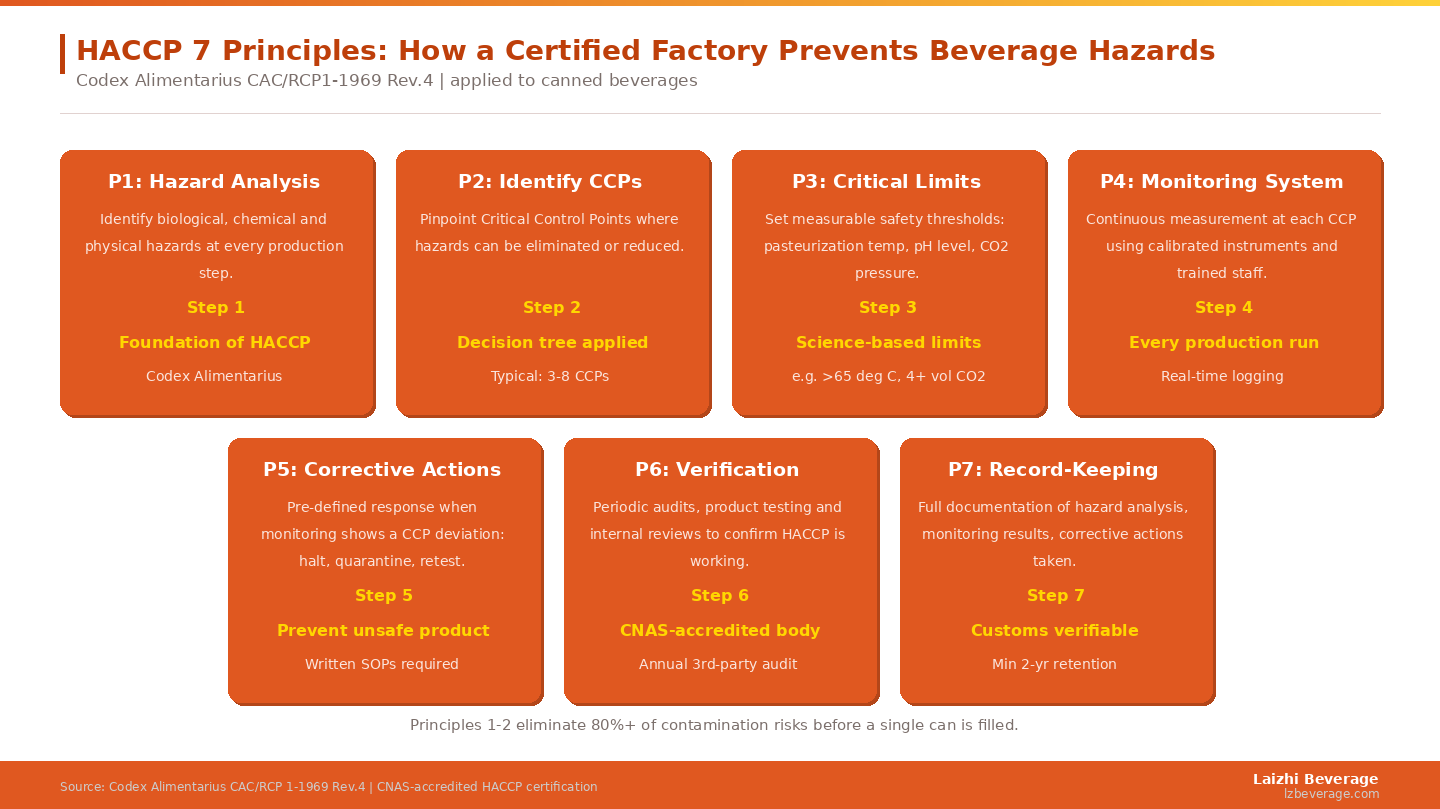
The 7 Principles of HACCP Applied to Canned Beverages
Principle 1: Hazard Analysis
The factory must identify every potential biological (bacteria, yeast, mold), chemical (cleaning agents, heavy metals, pesticide residues) and physical (metal fragments, glass, seal defects) hazard that could contaminate the product at any production step. For canned carbonated beverages, the hazard analysis begins with raw water quality and extends through can manufacturing, filling, seaming, pasteurization and warehousing.
Principle 2: Identify Critical Control Points (CCPs)
Not every risk is a CCP. A CCP is a step in the process where control is essential to prevent or eliminate a food safety hazard. In canned beverage manufacturing, typical CCPs include pasteurization (biological), metal detection (physical), and chemical dosing systems for preservatives or CO2 (chemical). The number of CCPs in a factory's HACCP plan typically ranges from 3 to 8; a plan with 20+ CCPs often signals that the team confused hazard monitoring with critical control.
Principle 3: Establish Critical Limits
Each CCP must have a science-based, measurable critical limit. For pasteurization of canned beverages, this is typically a minimum temperature and hold time (e.g., 85°C for 20 minutes for high-acid drinks). For CO2 volume in carbonated drinks, the limit depends on the formulation and target carbonation level. For seam integrity, the factory must specify the minimum seam overlap dimensions within tolerances set by the can manufacturer.
Principle 4: Monitoring System
The factory must continuously monitor each CCP using calibrated instruments and trained personnel. Temperature logs, seam thickness measurements and pressure records must be generated, timestamped and signed during every production run. Buyers visiting a factory should ask to see recent monitoring logs — a factory with genuinely embedded HACCP will produce them without hesitation.
Principle 5: Corrective Actions
When monitoring shows that a CCP is out of control — a pasteurizer that dropped below the critical temperature, for example — the factory must have a written corrective action procedure. This includes immediately quarantining the affected product, investigating the root cause, restoring control and documenting everything. The corrective action record is one of the documents most closely reviewed during a HACCP audit.
Principle 6: Verification
Beyond daily monitoring, the factory must periodically verify that the entire HACCP system is effective. This includes internal audits, product microbiological testing, calibration checks on measuring instruments and management reviews of CCP monitoring records. For Chinese manufacturers, the annual surveillance audit by a CNAS-accredited body is the external verification layer that certification buyers rely on.
Principle 7: Record-Keeping
The entire HACCP system depends on records. Every hazard analysis, every CCP monitoring log, every corrective action and every verification activity must be documented and retained — typically for a minimum of two years. These records are what customs authorities, importers and auditors examine when verifying that the HACCP system is real and operational, not theoretical.
How to Verify a Chinese HACCP Certificate
China's HACCP certificates can only be issued by bodies accredited by CNAS (China National Accreditation Service). The China Quality Certification Centre (CQC) is the largest single issuer, responsible for about 40% of domestic HACCP certificates. Other accredited bodies include SGS, Bureau Veritas and TÜV Rheinland operating through their China entities.
To verify a certificate: take the certificate number provided by the factory and check it against the CNCA certificate database on the SAMR website. The result should match the factory's name, address, and product scope. If it does not appear or shows different details, the certificate may be fraudulent and the relationship should be paused pending investigation. Our factory credentials are available for verification through the standard CNCA database check.
What HACCP Certification Tells You — and What It Doesn't
A valid, verified HACCP certificate from a CNAS-accredited body tells you that:
- The factory has formally identified hazards in its specific production process
- It has defined and is monitoring critical control points with documented procedures
- It has passed an independent audit within the past 12 months
It does not tell you:
- Whether the factory has strong supplier qualification for raw materials
- Whether management commitment to food safety extends beyond the production floor
- Whether the factory can meet the organizational requirements of retail chain supplier audits
For those broader assurances, ISO 22000 certification — which embeds HACCP within a full management system — is the appropriate next credential to request. Browse our full product range to understand how our HACCP framework applies across beer, energy drinks, juice and tea beverage production.
Next-step checklist
- Today: request a copy of the factory's HACCP certificate including certificate number, issuing body name, and product scope.
- Today: verify the certificate number on the CNCA/SAMR online database before proceeding to sample ordering.
- During factory audit: ask to see monitoring logs from the past 3 production runs for at least 2 CCPs — look for timestamps, signatures, and calibration records.
- Before final supplier selection: confirm whether your retail buyer or target market also requires ISO 22000, which adds management system governance on top of HACCP.
FAQ
Is HACCP the same as ISO 22000?
No. HACCP is a set of seven principles for controlling food safety hazards in the production process. ISO 22000 is a full management system standard that incorporates HACCP principles and adds organizational management, communication requirements, and continuous improvement cycles. Most experts recommend implementing HACCP first, then upgrading to ISO 22000 for broader recognition.
How often is a HACCP certificate renewed in China?
Chinese HACCP certificates are typically valid for three years, with mandatory annual surveillance audits conducted by the issuing body. If a factory fails a surveillance audit, the certificate can be suspended or withdrawn. Always confirm the certificate issue date and next surveillance audit date when vetting a supplier.
Do small canned beverage factories in China have HACCP?
Not all. HACCP certification is voluntary under Chinese law, and smaller factories without export customers may not have pursued it. For any factory you consider for export-facing orders, HACCP certification should be treated as a minimum requirement, not a nice-to-have. Factories that have invested in HACCP have demonstrated a level of operational discipline that typically translates into more consistent product quality.
Can a buyer audit a HACCP plan without visiting the factory?
Partially. A buyer can review the HACCP plan document, monitoring log summaries, and past corrective action records remotely. However, verifying that the documented plan is actually being followed in daily operations requires an on-site visit — either by the buyer's QC team or a third-party inspection service. Laizhi Beverage welcomes factory visits from prospective partners and provides access to our full compliance documentation upon request.

