The global hard seltzer market was estimated at USD 18.97 billion in 2023 and is projected to reach USD 60.16 billion by 2030, growing at an 8.5% CAGR. The aluminum beverage can market supporting this growth reached USD 46.8 billion globally in 2024, with cans expanding at 6.0% CAGR through 2033. Metal cans account for over 75% of all hard seltzer packaging, making it among the most can-dominant beverage categories globally.
The global hard seltzer market was estimated at USD 18.97 billion in 2023 and is projected to reach USD 60.16 billion by 2030, growing at an 8.5% CAGR. The aluminum beverage can market supporting this growth reached USD 46.8 billion globally in 2024, with cans expanding at 6.0% CAGR through 2033. Metal cans account for over 75% of all hard seltzer packaging, making it among the most can-dominant beverage categories globally. For brand owners evaluating entry into low-alcohol RTD beverages, hard seltzer via OEM production offers a well-established route to market with defined production steps, clear regulatory frameworks in most major markets, and a format that aligns with aluminum can capabilities of full-service OEM manufacturers.
Why we wrote this: We produce both non-alcoholic carbonated beverages and RTD beverages, and we regularly receive inquiries from importers exploring the low-alcohol category for the first time. The most common point of confusion is around ABV selection and its downstream regulatory implications — a decision that affects not just formulation but every compliance requirement for every target market. This guide covers what you need to know before submitting a hard seltzer OEM brief.
Key Takeaways
- Hard seltzer is an $18.97B global market growing at 8.5% CAGR — a proven category with room for private label entrants, particularly in Asia-Pacific and Europe.
- Metal cans hold 75%+ of hard seltzer packaging share — the format is non-negotiable for most channel and consumer positioning goals.
- The 1.0–4.9% ABV segment is growing fastest at 15.9% CAGR — "ultra-low" positions align with moderation trends and face lighter regulatory burdens in some markets.
- 80%+ of hard seltzer volume is flavored — a plain variant alone is not a viable launch strategy without strong distribution scale.
- Alcohol licensing requirements differ significantly by market — OEM partners cannot handle export compliance for alcohol products on behalf of the importer without specific agreements.
What Is Hard Seltzer and Why Is It a Strong OEM Opportunity
Hard Seltzer Defined: The Low-Alcohol RTD Category Explained
Hard seltzer is a carbonated alcoholic beverage typically produced by fermenting a sugar base (cane sugar, dextrose) or by diluting grain neutral spirit (GNS) with carbonated water, then adding natural or artificial flavor. The standard ABV range is 4–6%, with a calorie count of 80–110 kcal per serving. The defining consumer appeal is the combination of lightness (low calorie, low carbohydrate, often gluten-free), refreshment, and convenience in a can format that fits most on-the-go and social occasions. According to IMARC Group, over 69% of millennials prefer hard seltzers specifically for these attributes.
The Low-ABV Segment: Fastest-Growing at 15.9% CAGR
While the 5–6.9% ABV range accounts for the largest share of the hard seltzer market (approximately 51.8% of revenue in 2023 per Grand View Research), the 1.0–4.9% ABV segment is growing at 15.9% CAGR through 2030 — the fastest of any ABV tier. This growth reflects the "moderation" megatrend: consumers in North America, Europe, and increasingly Asia-Pacific are actively reducing alcohol intake while still seeking a social drinking experience. For OEM brands, the ultra-low ABV range also reduces regulatory barriers in several markets where beverages below 3.5% ABV are categorized differently from standard alcoholic beverages.
Looking at the hard seltzer market data alongside the non-alcoholic category trends — where volume grew 23% year-over-year — a nuanced conclusion emerges: the consumer isn't just moving toward "less alcohol." They are moving toward beverages that feel like a functional choice rather than a compromise. Hard seltzer brands that communicate a specific functional benefit (electrolyte replenishment, prebiotic fiber, low-glycemic formulation) alongside the low-ABV attribute are generating disproportionate purchase intent among health-oriented consumers, based on recent product launch velocity in 2024–2025. This matters for OEM briefs: a flavor-plus-function positioning requires more formulation work but creates a defensible niche that plain seltzer cannot occupy.
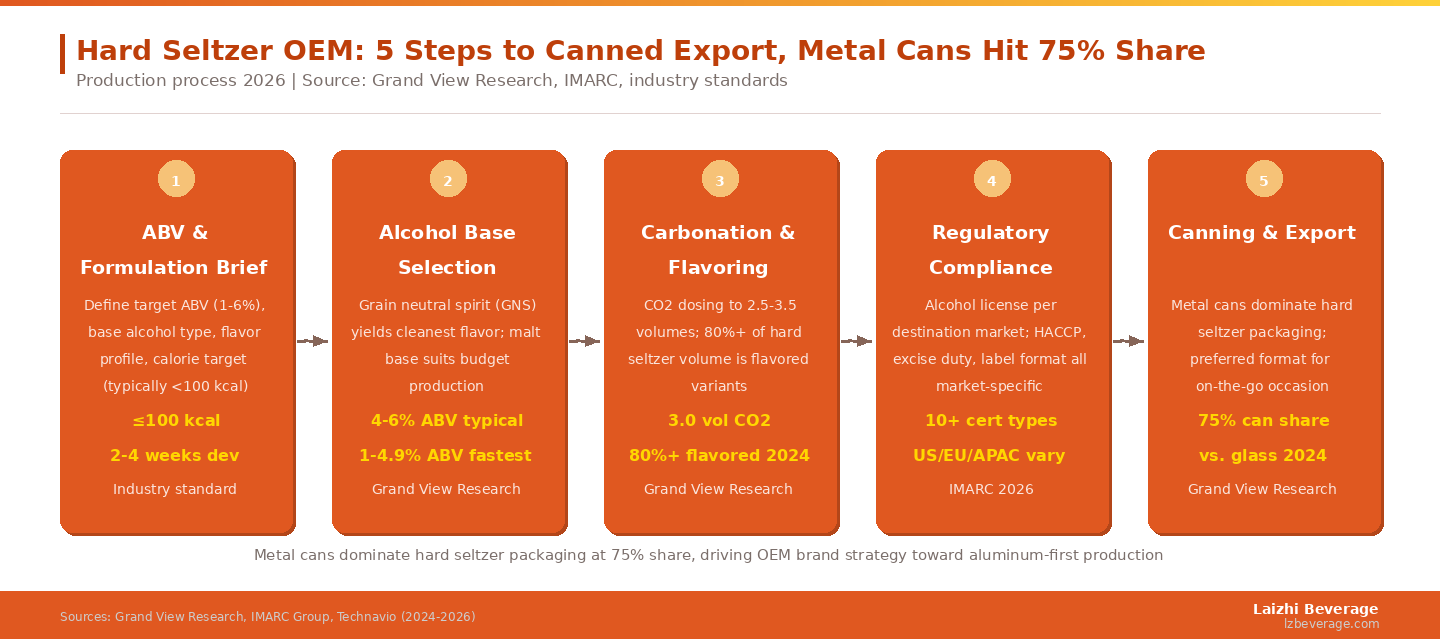
The 5-Step OEM Process for Hard Seltzer Production
Step 1: Define ABV, Base Alcohol, and Formulation Brief
The first and most consequential decision is ABV target and base alcohol type. The two primary production routes are:
- Grain Neutral Spirit (GNS) dilution: GNS is diluted to target ABV with purified water, then flavored and carbonated. This yields a cleaner, neutral flavor base and is the preferred route for premium flavor profiles. It requires the OEM manufacturer to hold an alcohol blending license.
- Malt base fermentation: A sugar or malt solution is fermented to the desired ABV. This is more analogous to beer production and may be required in markets (such as the US) where the "flavored malt beverage" (FMB) classification applies under distribution and tax regulations.
For most international export markets outside the US, GNS-based production is both simpler to produce and simpler to import-classify. Confirm your target market's regulatory classification before selecting the production route.
Step 2: Flavor and Carbonation Specification
Flavored hard seltzer accounts for over 80% of global category volume. The dominant flavor clusters for hard seltzer differ from sparkling water: fruit punch, black cherry, mango, lime, and tropical blends lead consumption. Botanical-leaning profiles from non-alcoholic sparkling water are increasingly crossing into hard seltzer, particularly elderflower-lemon and hibiscus-ginger combinations targeting premium on-trade channels. Carbonation for hard seltzer typically targets 2.5–3.5 volumes CO2 — slightly lower than standard sparkling water to prevent over-carbonation when chilled.
Step 3: Can Design and Packaging Specification
Given that metal cans hold over 75% of hard seltzer market share, can design is a critical marketing investment. The 250ml and 330ml slim/sleek can format is standard for hard seltzer in Europe and Asia-Pacific; the 355ml standard can is the North American norm. Shrink-sleeve labeling and direct digital printing both achieve the vibrant, lifestyle-focused aesthetics that hard seltzer brands require. Confirm minimum order quantities per label design variant, as four-color printing setups require minimum runs per SKU.
Step 4: Regulatory Compliance and Licensing
Hard seltzer is classified as an alcoholic beverage in all major markets and carries distinct compliance requirements from non-alcoholic RTD beverages. Key requirements include: alcohol import license in the destination country (held by the importer, not the manufacturer), excise duty calculation and payment, mandatory nutrition labeling with "contains alcohol" declaration, responsible drinking messaging (required in EU and Australia), and HACCP certification at the manufacturing facility. We recommend engaging a customs broker or regulatory consultant familiar with the destination market before committing to production quantities. We hold China export qualifications and can produce hard seltzer alongside our non-alcoholic carbonated beverage range.
Step 5: Production, Testing, and Export
Commercial production of hard seltzer on a dedicated filling line follows: alcohol blending → flavor addition → carbonation → filling and seaming → quality inspection (ABV verification, microbiological testing, carbonation measurement) → packaging and palletizing. ABV tolerance bands for export are typically ±0.2% on the declared label. Microbiological release testing is mandatory before shipment. Export documentation for alcohol products includes an Alcohol Content Certificate, Certificate of Origin, HACCP certificate, and a Certificate of Analysis (COA). Total lead time from production start to port departure is typically 10–15 business days for hard seltzer, slightly longer than non-alcoholic beverages due to additional testing requirements.
Market Positioning: Where Hard Seltzer Wins in 2026
Asia-Pacific: The Most Significant Expansion Opportunity
According to IMARC's market statistics, Asia-Pacific represents the fastest-growing hard seltzer region, driven by rising middle-class incomes, urbanization, and growing adoption of Western-style RTD beverages. China currently holds approximately 6.84% of the global hard seltzer market with strong growth trajectory. India is the fastest-growing country at 10.45% CAGR. For brands targeting Asia-Pacific, flavor adaptation is important: yuzu, lychee, and tropical profiles show stronger early adoption than traditional North American cherry and lime variants.
Europe: Premiumization and Low-ABV
Europe is the second-largest hard seltzer market and is characterized by premium positioning and a strong preference for ultra-low ABV variants. European consumers respond well to botanical-herbal flavor profiles and glass bottle presentations for on-trade channels, alongside canned formats for retail. Export from China to Europe requires compliance with EU food and alcohol labeling regulations and import certification, but the category is a growing and underserved segment relative to North America.
Explore our RTD production line for hard seltzer and low-alcohol carbonated beverage capabilities, or browse our full product portfolio to understand our OEM range.
Next-step checklist
- Today, define the target sales market, and confirm import classification and license requirements for low-alcohol/hard seltzer with a local importer or compliance advisor.
- This week, complete the ABV positioning decision (1-4.9% vs. 5-6.9%), and choose the production route accordingly (GNS dilution vs. malt fermentation).
- This week, confirm with the OEM factory whether it holds alcohol beverage production and export qualifications, and request copies of the relevant licenses.
- Next month, prepare sampling briefs for at least three flavor directions, prioritizing target market preferences (APAC: lychee/yuzu/tropical; Europe: botanical).
- Next month, commission a customs broker in the import country to estimate excise tax and tariffs for the target market, and include them in product cost calculations.
FAQ
What is the difference between hard seltzer and sparkling water for OEM production?
The key difference is the presence of alcohol. Hard seltzer contains 1–6% ABV and is legally classified as an alcoholic beverage in all major markets, triggering alcohol import licensing, excise duties, and labeling requirements that non-alcoholic sparkling water does not face. From a manufacturing perspective, the production process requires alcohol sourcing, blending capability, and ABV verification testing that adds time and complexity versus plain sparkling water production. The packaging, flavor, and carbonation steps are broadly similar.
Can a Chinese OEM manufacturer legally export hard seltzer?
Yes, provided the manufacturer holds the appropriate production and export licenses for alcoholic beverages under Chinese regulations and the destination country permits imports from China. China is a growing exporter of RTD alcoholic beverages including hard seltzer. Importers must hold valid alcohol import licenses in the destination country — this is the importer's responsibility, not the manufacturer's. Confirm this licensing requirement with a customs broker before proceeding.
How does the cost of hard seltzer OEM compare to non-alcoholic carbonated drinks?
Hard seltzer production costs are 25–40% higher than equivalent non-alcoholic carbonated beverages at the same volume, driven by three factors: the cost of the alcohol base (either GNS sourcing cost or fermentation cost), additional quality testing requirements (ABV verification, microbiological testing), and export documentation for alcoholic beverages. These higher costs are typically offset by higher retail pricing — hard seltzer commands a significant premium over sparkling water at retail in most markets.
What are the most popular hard seltzer flavors for export markets in 2026?
For North America and Europe, black cherry, lime, mango, and citrus blends are established volume leaders. For Asia-Pacific markets, yuzu, lychee, green tea-infused, and tropical crossover flavors show the strongest adoption. Botanically-infused variants (elderflower, hibiscus, ginger-lime) are growing across all regions and command premium shelf price positioning. Visit our industry blog for updated flavor trend data by region.

