Label compliance is not a post-production checkbox for energy drink brands — it is a market access requirement that determines whether a product can legally be sold in its target geography. The three major English-language export markets for canned energy drinks — the United States, the European Union, and Australia — operate under distinct regulatory frameworks with materially different caffeine disclosure obligations, warning statement requirements, and health claim restrictions.
Label compliance is not a post-production checkbox for energy drink brands — it is a market access requirement that determines whether a product can legally be sold in its target geography. The three major English-language export markets for canned energy drinks — the United States, the European Union, and Australia — operate under distinct regulatory frameworks with materially different caffeine disclosure obligations, warning statement requirements, and health claim restrictions. For OEM buyers and brand owners developing private label energy drinks for export, understanding these frameworks before label design begins is not just good practice — it is the difference between a product that passes customs and one that gets detained or recalled. This guide provides a clear, actionable summary of the current requirements in each market as of 2026.
Key Takeaways
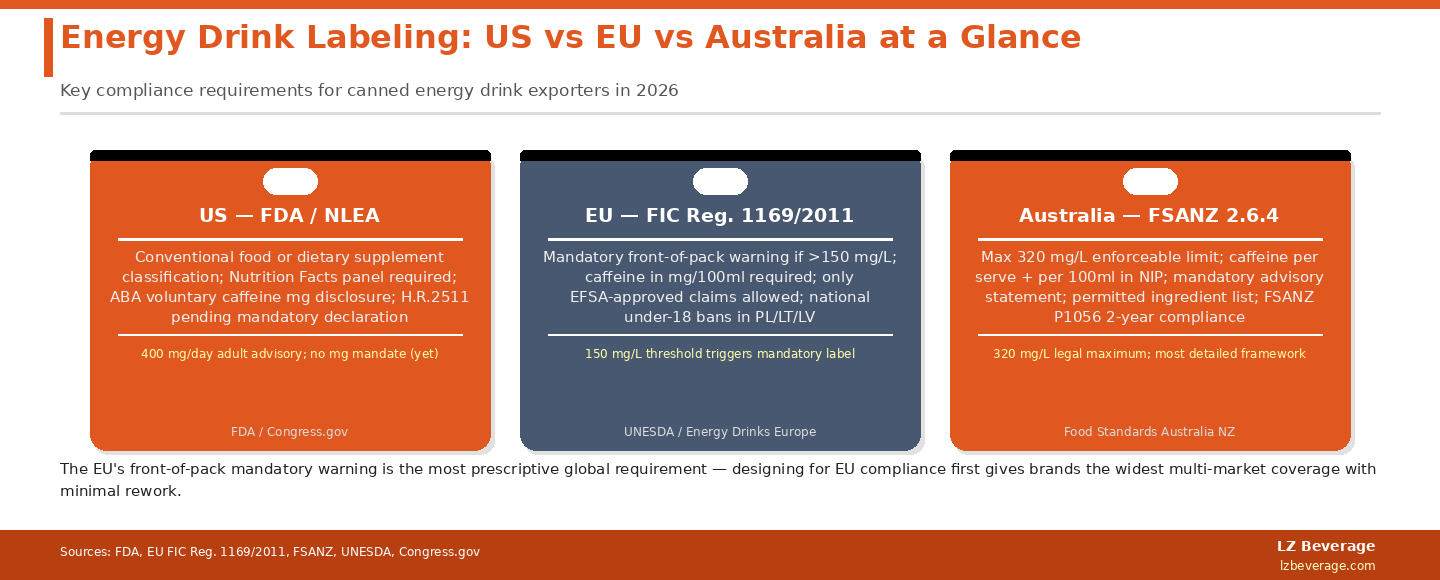
- The US (FDA) does not mandate caffeine mg declaration for energy drinks classified as conventional foods, but industry-wide voluntary commitments and a pending Congressional bill (H.R.2511) are moving toward mandatory disclosure.
- The EU mandates a specific warning statement on all drinks containing over 150 mg of caffeine per litre, with caffeine content expressed in mg per 100ml — on the front of the label, in the same field of vision as the product name.
- Australia's FSANZ Standard 2.6.4 is one of the most detailed energy drink frameworks globally, setting a maximum 320 mg/L caffeine limit, requiring mandatory advisory statements, and specifying the allowed functional ingredients.
- EU member states apply their own national rules on top of the EU baseline — Lithuania, Latvia, and Poland ban under-18 sales entirely, while Hungary applies a public health tax on high-caffeine beverages.
- All three markets require advisory statements directing that energy drinks are not recommended for children, pregnant women, or caffeine-sensitive individuals — though the exact wording, placement, and enforcement mechanism differ.
US Energy Drink Labeling: FDA Framework
Conventional Food vs. Dietary Supplement Classification
The first compliance decision for any US-bound energy drink is its regulatory classification. DigiComply's FDA regulation guide explains that energy drinks can be legally marketed as either conventional food (subject to the Federal Food, Drug, and Cosmetic Act / FFDCA) or dietary supplements (subject to DSHEA — the Dietary Supplement Health and Education Act of 1994). The practical distinction is significant. Conventional food energy drinks carry a standard Nutrition Facts panel and are governed by the Nutrition Labeling and Education Act (NLEA). Dietary supplement energy drinks carry a Supplement Facts panel and must include serving size recommendations and a "not intended to diagnose, treat, cure, or prevent any disease" disclaimer. FDA draft guidance suggests that products in cans or bottles greater than 8 oz (approximately 250ml) — particularly without resealable closures — are more likely to be treated as conventional foods.
What the FDA Currently Requires on US Energy Drink Labels
Under FDA rules as of 2026, canned energy drink labels for conventional food classification must include a Nutrition Facts panel (serving size, calories, macronutrients, vitamins, minerals), a full ingredients list (including caffeine if directly added), allergen declarations, and manufacturer identification. According to CTM Labeling Systems, there is currently no federal requirement to declare caffeine content in milligrams for conventionally classified energy drinks — although caffeine must appear in the ingredient list if directly added. Natural caffeine sources (guarana, green tea, green coffee extract) may be listed by source name without separately disclosing their caffeine contribution. However, the American Beverage Association's voluntary guidelines — followed by major producers — require disclosure of total caffeine content from all sources on every label.
2026 Regulatory Developments: FDA Guidance and H.R.2511
Two significant 2026 regulatory developments are changing the US caffeine labeling landscape. First, in April 2026, the FDA announced guidance on best practices for clearer caffeine content disclosure, covering both packaged beverages and restaurant-served drinks — a step toward standardized caffeine transparency across the category. Second, H.R.2511, the Sarah Katz Caffeine Safety Act, introduced in the 119th Congress (2025–2026), proposes mandatory labeling for any food containing more than 10 milligrams of caffeine — requiring the exact caffeine amount in milligrams, whether the caffeine is naturally occurring or added, and an advisory that 400mg per day is the recommended adult limit. If enacted, this would make explicit caffeine mg declaration mandatory on all US canned energy drinks. OEM buyers developing label designs for US-bound products should build mg-explicit caffeine declarations into their label architecture now — regardless of current mandatory status — to future-proof compliance.
EU Energy Drink Labeling: FIC Regulation 1169/2011
The 150 mg/L Threshold and Mandatory Warning Statement
The EU's energy drink labeling framework is anchored in the Food Information to Consumers Regulation, EU No. 1169/2011. Under this regulation, as confirmed by Energy Drinks Europe, all beverages containing caffeine in excess of 150 mg per litre must display the mandatory advisory statement: "High caffeine content. Not recommended for children or pregnant or breast-feeding women." This statement must appear in the same field of vision as the product name — on the front of the can — and must be followed by the caffeine content expressed in mg per 100 ml. A standard 250ml energy drink containing 80mg of caffeine per can (320mg/L) would therefore require the statement "High caffeine content. Not recommended for children or pregnant or breast-feeding women (32 mg/100 ml)" on the front label. For brands developing labels for European export, this front-of-pack placement requirement means the warning statement must be factored into can graphic design — it cannot be placed only on the back panel.
EU Nutrition Declaration and Health Claim Restrictions
UNESDA confirms that EFSA has established 400mg per day as the safe daily caffeine intake for healthy adults, and 200mg during pregnancy. For children and adolescents, the limit is 3mg per kilogram of body weight per day. The EU does not set a maximum caffeine content for energy drinks by regulation at the EU level, but industry standard is approximately 320mg/L (equivalent to 80mg per 250ml can). Regarding health claims, EU Regulation (EC) 1924/2006 severely restricts what can be stated on energy drink labels: only "bodily function" claims that have been positively assessed by EFSA and appear on the EU-approved claims list may be used. Caffeine's role in supporting alertness and focus has received positive EFSA assessment, but the European Parliament has blocked formal authorization of these claims. As a practical matter, most EU energy drink labels use descriptive product names and ingredient transparency rather than health claim language.
National Variations Within the EU
EU member states retain the right to apply national rules on top of the EU baseline, and several have done so significantly. DigiComply's regulatory analysis confirms that Lithuania, Latvia, and Poland have enacted complete bans on sales of energy drinks (defined by high caffeine and/or taurine content) to anyone under 18 years of age; Poland additionally prohibits sales in schools and vending machines with financial penalties for violations. Hungary has introduced a "public health tax" specifically on high-caffeine beverages. France and Italy require strong warning labels. For OEM brands planning EU distribution, label design and route-to-market planning must account for these national variations — a single pan-EU label may not be sufficient for all target markets.
Australian Energy Drink Labeling: FSANZ Standard 2.6.4
The FSANZ Framework: One of the World's Most Detailed
Australia regulates energy drinks under Standard 2.6.4 of the Australia New Zealand Food Standards Code, specifically as Formulated Caffeinated Beverages (FCBs). According to Food Standards Australia New Zealand, Standard 2.6.4 sets a maximum permitted caffeine level of 320mg per litre — consistent with EU levels — and requires specific mandatory labeling. Energy drink labels in Australia must include the average caffeine content per serving and per 100ml, an advisory statement that the product contains caffeine and is not recommended for children, pregnant or lactating women, or individuals sensitive to caffeine, and directions not to exceed the recommended daily intake when permitted substances are added. The Australian Beverages Council describes the framework as among the most stringent globally for energy drink regulation.
FSANZ P1056: 2025–2026 Regulatory Update
A significant development for Australian market access occurred in 2025–2026: FSANZ approved new restrictions under Proposal P1056 that introduce tighter controls on caffeine as a standalone ingredient in foods, new warning and advisory labeling requirements for high-caffeine coffee beverages, and continued maintenance of existing energy drink permissions under Standard 2.6.4. Food businesses have a two-year window from gazettal to comply with the new requirements. For OEM brands importing into Australia, it is critical to confirm that the energy drink formulation includes only the permitted functional ingredients specified in Standard 2.6.4 — caffeine, taurine, inositol, glucuronolactone, and six specified B-vitamins — and that the label documentation matches the requirements for each ingredient declared.
| Requirement |
US (FDA) |
EU (FIC 1169/2011) |
Australia (FSANZ 2.6.4) |
| Caffeine mg declaration |
Voluntary (ABA) / Pending (H.R.2511) |
Mandatory (mg/100ml) |
Mandatory (per serve + per 100ml) |
| Caffeine limit |
No legal max (400mg/day advisory) |
~320mg/L (industry standard) |
320mg/L (legally enforceable) |
| Warning statement |
Voluntary (not for children, pregnant) |
Mandatory front-of-pack |
Mandatory (not for children/pregnant/lactating) |
| Warning placement |
Not specified |
Same field of vision as product name |
Label (position not mandated) |
| Health claims |
FDCA-compliant structure claims allowed |
Only EFSA-approved "bodily function" claims |
FSANZ-approved claims only |
| Age restrictions |
None federal (voluntary: not for under-12) |
National: under-18 bans in PL/LT/LV |
No national ban; advisory-based |
OEM Export Compliance: Practical Checklist
Label Compliance by Market: What OEM Buyers Must Validate Before Production
For brands using an OEM manufacturer to produce energy drinks for multi-market export, the label compliance workflow must run in parallel with formulation development — not after it. The critical actions are: First, confirm the target market regulatory framework and identify which version of your label (US, EU, or FSANZ) governs your first production run. Second, have the formulation reviewed against permitted ingredient lists for each target market — FSANZ Standard 2.6.4's specific permitted ingredients list is the most restrictive and should be the baseline for globally exportable formulas. Third, commission third-party lab testing to verify caffeine content per serving and per 100ml, as these figures must match the declared label values with documented accuracy. Fourth, design front-of-pack label architecture with EU placement requirements as the baseline — a label designed for EU front-of-pack compliance will generally meet the less prescriptive placement requirements of the US and Australia. Fifth, obtain regulatory review of planned health claims in each target market before committing to label print. For OEM brands working with Laizhi Beverage, our export documentation support includes CoA provision for caffeine and key ingredient declarations, supporting both energy drink OEM clients and their downstream compliance teams. Browse our regulatory resource guides for more export compliance information.
Frequently Asked Questions
Is it mandatory to put caffeine mg on US energy drink labels?
Currently, no — caffeine mg disclosure is not federally mandated for conventional food energy drinks in the US. However, the American Beverage Association's voluntary guidelines require it, virtually all major brands include it, the FDA's April 2026 guidance pushes for clearer disclosure, and the pending H.R.2511 legislation would make it mandatory. Any energy drink brand building a US-market label should include total caffeine mg from all sources as a standard label element, regardless of mandatory status.
What exactly does the EU require on energy drink labels?
Under EU Regulation 1169/2011, any beverage with caffeine above 150mg per litre must display "High caffeine content. Not recommended for children or pregnant or breast-feeding women" — followed by the total caffeine content in mg per 100ml — in the same visual field as the product name on the front of the packaging. This warning must be legible, clearly visible, and not obscured by other design elements. The full standard nutrition declaration (energy, fat, saturates, carbohydrates, sugars, protein, salt) is also mandatory per EU FIC.
What are Australia's specific energy drink labeling requirements?
Australian energy drinks must comply with FSANZ Standard 2.6.4, which requires: declaration of caffeine content per serve and per 100ml in the Nutrition Information Panel; an advisory that the product contains caffeine and is not suitable for children, pregnant or lactating women, or individuals sensitive to caffeine; directions to not exceed daily recommended intake when permitted substances (taurine, B-vitamins, inositol, glucuronolactone) are included; and formulation within the permitted ingredient list. The 2025 FSANZ P1056 review updated adjacent requirements but left Standard 2.6.4 energy drink permissions unchanged. Brands have a two-year window to comply with any new requirements under P1056.

