For energy drink brands making their first OEM production decision or expanding an existing lineup, can size selection is more consequential than it might appear. Format choice determines retail channel fit, caffeine dose positioning, per-unit production cost, consumer usage occasion, and brand perception — all simultaneously.
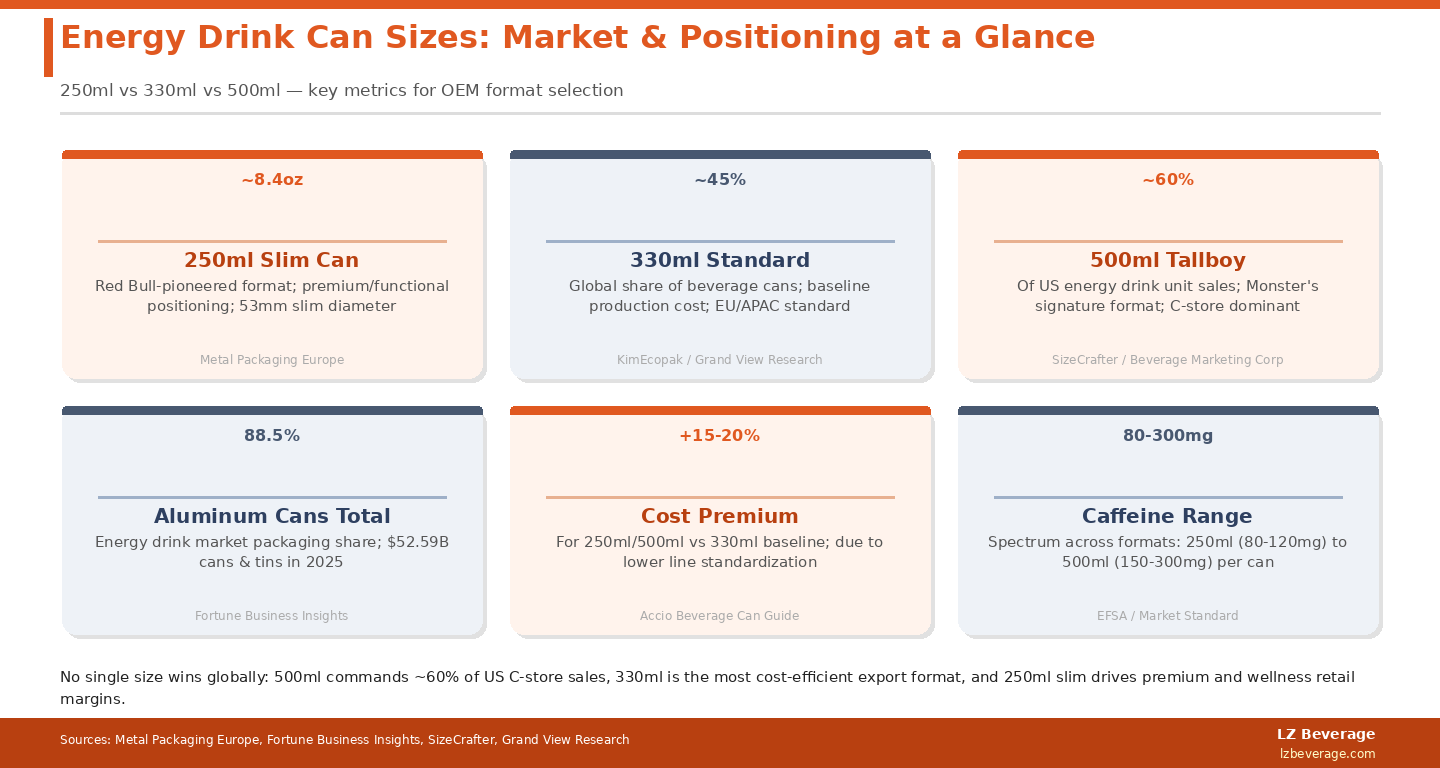
For energy drink brands making their first OEM production decision or expanding an existing lineup, can size selection is more consequential than it might appear. Format choice determines retail channel fit, caffeine dose positioning, per-unit production cost, consumer usage occasion, and brand perception — all simultaneously. According to Fortune Business Insights, the global canned energy drink segment generated USD 52.59 billion in 2025, with aluminum cans holding an 88.5% share of the entire energy drinks market. Within that market, the 250ml, 330ml, and 500ml formats serve distinct consumer occasions, regional preferences, and brand positioning strategies. This guide breaks down the commercial case for each.
Key Takeaways
- 250ml is the original energy drink format — pioneered by Red Bull in Europe, it dominates premium, wellness, and functional positioning across Asia-Pacific and European markets.
- 330ml is the global production standard — most cost-efficient to manufacture, dominant in European and APAC supermarket channels, and increasingly popular for zero-sugar and functional variants.
- 500ml (16 oz) accounts for approximately 60% of US energy drink unit sales, making it the dominant volume driver in North America's convenience store channel.
- 250ml and 500ml formats carry a 15–20% production cost premium over the standardized 330ml format due to lower production line optimization.
- OEM brands targeting multiple export markets typically launch with a 330ml core SKU and extend to 250ml for premium on-trade and 500ml for value/sports channels.
The 250ml Can: Premium Positioning and Portion Control
The Format That Defined an Industry
The 250ml can (8.4 fl oz in US measurement) has a specific origin story in the energy drink category. Metal Packaging Europe documents that the 250ml format became commercially established as an energy drink standard primarily because Red Bull launched in this format, making it the instantly recognizable signature size for the category in Europe. The slim, tall can profile — standing approximately 146mm high with a 53mm diameter — creates distinctive shelf presence that visually differentiates energy drinks from standard beer and soda cans. Since the 1990s, the 250ml format has grown steadily, not just as a Red Bull exclusive but as the de facto entry-level format for emerging brands globally.
When 250ml Wins: Market Positioning Advantages
According to industry analysis from Levapack, smaller can sizes (8–12 oz / 250–355ml) are strongly associated with health-conscious, premium, and portion-controlled beverage positioning — making them the natural format choice for functional energy drinks, nootropic-enhanced SKUs, and low-caffeine daypart-specific products. The format is also commercially significant for on-trade channels: bars, gyms, and specialty health retailers prefer the 250ml format because it delivers a complete single-serve experience without the caloric and caffeine load of larger formats. For OEM energy drink clients targeting European export markets, premium Asian convenience, or wellness retail, the 250ml format is typically the anchor SKU choice. Additionally, the January 2026 industry review by Powerhouse Journal notes that 8.4 oz formats are "becoming standard, not niche" — reflecting brands' prioritization of drinkability and repeat use over maximum volume.
250ml Production Considerations
For OEM clients, the 250ml slim can carries a 15–20% production cost premium over the standardized 330ml format, primarily due to lower line optimization and higher per-unit tooling amortization. However, this cost differential is frequently offset by the premium retail pricing that the format supports. The slim format also requires verified filling line compatibility — OEM manufacturers must confirm that their high-speed filling equipment is calibrated for the 250ml slim can diameter (53mm) rather than the standard 66mm diameter used for 330ml and 500ml formats.
The 330ml Can: The Global Production Standard
Why 330ml Became the Default
The 330ml can is the metric-system equivalent of the US 12 fl oz (355ml) standard — derived as a rounded "one-third of a liter" that fits metric packaging norms without requiring retooling of existing filling infrastructure. KimEcopak's packaging analysis explains that the 330ml format achieved global standardization through a combination of metric conversion practicality, filling line compatibility, and trade alignment between the US and European markets in the 1980s. Today, 330ml cans account for approximately 45% of global beverage can production by volume — making it the most cost-efficient format for energy drink brands producing at commercial scale.
When 330ml Wins: Channel and Cost Efficiency
According to Dimensions Chart, the 330ml format "dominates European and Asian markets" as the standard single-serve beverage can size. For energy drink brands targeting supermarket multipacks, hard discount retail, or convenience store value positioning, the 330ml format provides the best combination of per-unit production cost, retail shelf compatibility, and fridge-stacking efficiency. It is also the format most frequently used for zero-sugar and functional energy drink variants, where the brand needs to signal that the product is a health-considered purchase rather than an indulgence format. For OEM buyers building a cost-competitive private label energy drink range, the 330ml format is typically the first recommendation — it maximizes production volume per dollar while covering the broadest retail channel range.
330ml in Asia-Pacific and Emerging Markets
Wikipedia's drink can reference confirms that 330ml is the standard in New Zealand and is widely used across Asia-Pacific markets, with the format aligning with import container standardization for brands sourcing from Chinese OEM manufacturers. For energy drink brands building distribution in Southeast Asian markets — where modern retail, convenience store chains, and e-commerce are the primary channels — the 330ml format minimizes packaging complexity across distribution partners.
The 500ml Can: Volume Leadership in Sports and Convenience
The US Market's Format Champion
In North America, the energy drink market is dominated by larger formats. SizeCrafter's industry size guide reports that 16 oz cans (approximately 473ml) account for 60% of energy drink sales in the US market, making them by far the dominant format by volume in the world's largest single-country energy drink market. The 500ml / 16 oz "tallboy" format aligns with the US convenience store consumption occasion — a full-energy single-serve consumed during commute, workout, or extended activity — and delivers the caffeine dose range (150–250mg) that US energy drink consumers expect for a meaningful performance effect.
When 500ml Wins: Value and Performance Positioning
From a brand positioning perspective, the 500ml format signals value, performance, and high-stimulus energy delivery. Metal Packaging Europe notes that Monster Energy "has embraced the 500ml can to stand out on shelves" in Europe — deliberately choosing the larger format as a brand differentiation strategy against Red Bull's established 250ml positioning. The format works particularly well for sports-adjacent brands, gaming-focused energy drinks, and pre-workout products where the larger volume and higher caffeine content are presented as product features rather than indulgence markers. In Australia, energy drinks are typically sold in 250ml and 500ml formats — with the 500ml size serving the sports and outdoor leisure occasions that align with Australian consumer culture.
500ml Production and Export Considerations
The 500ml format uses the standard 66mm can diameter shared with the 330ml format, which means it is fully compatible with most commercial filling lines without requiring diameter changeover. The primary production distinction is height calibration. For export brands, the 500ml format should be validated against customs duty classification in the target market, as some markets apply different duty rates based on beverage volume thresholds. OEM buyers exporting to the US market from China should also verify that the energy drink formulation meets FDA caffeine disclosure requirements — which are particularly scrutinized for larger single-serve formats where total caffeine content per can can exceed 200mg.
| Dimension |
250ml (8.4oz) |
330ml (11.2oz) |
500ml (16.9oz) |
| Can Height |
~146mm |
~123mm |
~168mm |
| Diameter |
53mm (slim) |
66mm (standard) |
66mm (standard) |
| Dominant Market |
Europe, APAC |
EU, APAC, global |
US, Sports/C-store |
| Best Channel |
Premium on-trade, health |
Supermarket, value |
C-store, sports |
| Brand Positioning |
Premium / functional |
Standard / value-health |
Performance / value |
| Production Cost |
+15–20% vs 330ml |
Baseline |
+10–15% vs 330ml |
| Caffeine Range |
80–120mg |
100–150mg |
150–300mg |
Which Format Should OEM Buyers Choose?
The Three-Stage Decision Framework
The right can size decision for an OEM energy drink launch depends on three sequential questions: Which geographic market is the primary target? Which retail channel is the route to market? And what brand positioning is the product designed to occupy? For brands targeting European or APAC supermarket launch as the primary market, a 330ml anchor SKU with a 250ml premium variant is the standard two-SKU launch architecture. For brands targeting US convenience stores or sports retail as the primary channel, a 500ml/16oz format as the core SKU is essential — with the 330ml format available for multipack retail. For brands aiming to export to multiple markets simultaneously from a single OEM production run, the 330ml format minimizes production cost and regulatory complexity while covering the broadest channel range. Laizhi Beverage's 50-production-line facility can accommodate all three standard formats — 250ml slim, 330ml standard, and 500ml — enabling OEM clients to build multi-format product ranges from a single manufacturing partner. Explore our energy drink OEM capabilities to discuss your format requirements.
Format and Caffeine Dose: The Hidden Connection
Can size and caffeine dosing are inseparable decisions in energy drink product development. Regulatory frameworks in most markets use absolute caffeine content per serving — and since the "serving" for a canned energy drink is typically the full can, the can volume determines the maximum allowable caffeine in a single-serve context. The European Food Safety Authority (EFSA) has established 400mg per day as a safe upper intake for healthy adults, which shapes product development in European markets. A 250ml format with 80–100mg caffeine (the Red Bull standard range) is well within any regulatory comfort zone globally. A 500ml format with 200–300mg caffeine enters a different regulatory category in several markets, requiring specific front-of-pack caffeine declarations and, in some cases, minimum age purchase restrictions. OEM buyers should confirm the caffeine compliance requirements for each target market before finalizing the can size and formulation brief.
Frequently Asked Questions
What is the most popular energy drink can size globally?
There is no single global answer — the answer depends on the market. In the US, the 16 oz (approximately 473–500ml) format is most dominant by unit sales volume, accounting for roughly 60% of the market. In Europe, the 250ml slim can pioneered by Red Bull and the 330ml standard format are both significant. In Asia-Pacific, 250ml and 330ml formats dominate modern retail. For an OEM brand building a globally exportable product, the 330ml format provides the broadest retail compatibility across markets.
Is a 250ml or 500ml energy drink better for retail shelf impact?
The answer depends on the shelf environment and competitive context. The 250ml slim can has a distinctive vertical profile that stands out among standard 330ml and 500ml cans — which is why Red Bull's brand recognition is partly built on can shape recognition. The 500ml format has maximum label surface area and conveys a value-for-money signal in high-volume retail environments. In a crowded convenience store cooler, a well-designed 250ml slim can can outperform a generic 500ml can in premium channel context, while the reverse is true in a sports or discount retail setting.
Can I produce both 250ml and 330ml formats from the same OEM production run?
Not on the same production run, but from the same manufacturing partner with flexible line configuration. Because 250ml slim cans use a different diameter (53mm) to the standard 66mm used for 330ml and 500ml formats, they require different filling line tooling. A manufacturer with multi-format capability — like Laizhi Beverage's HACCP-certified production facility with 50 filling lines — can produce multiple can formats under one production contract across scheduled runs, significantly reducing the administrative complexity of dual-format sourcing. Minimum order quantities (MOQs) apply per format and run.

