In 2026, "energy drink" no longer describes a single product category — it describes a spectrum. At one end sits the traditional energy drink: a high-caffeine, high-sugar beverage positioned around immediate stimulation and marketed through sports and extreme-lifestyle branding. At the other end sits the functional canned drink: a formulation built around targeted health benefits, clean-label ingredients, and wellness-lifestyle marketing.
In 2026, "energy drink" no longer describes a single product category — it describes a spectrum. At one end sits the traditional energy drink: a high-caffeine, high-sugar beverage positioned around immediate stimulation and marketed through sports and extreme-lifestyle branding. At the other end sits the functional canned drink: a formulation built around targeted health benefits, clean-label ingredients, and wellness-lifestyle marketing. Between these poles lies an expanding middle market where the two product archetypes are converging. Understanding the commercial and formulation differences between these categories is essential for OEM buyers choosing their product development direction and brand owners deciding where to position a new SKU. This comparison covers market size, ingredient architecture, consumer demographics, claim strategy, and OEM production considerations for both categories.
Key Takeaways
- The broader functional beverages market is valued at USD 192–194 billion in 2026, with traditional energy drinks representing approximately 39–42% of that figure — the largest single sub-segment.
- Traditional energy drinks are growing faster by category value (CAGR 8.26% for energy drinks vs 5.4–8.5% for the broader functional beverage category), driven by scale, brand equity, and expanding distribution in emerging markets.
- Functional canned drinks are growing faster by volume of new product launches and are commanding premium retail pricing in health food, gym, and DTC channels.
- The fastest-growing brands are hybrids — products that combine the energy delivery of traditional formulas with the ingredient transparency, reduced sugar, and wellness claims of functional drinks.
- Energy is the fastest-growing functional benefit claim in new beverage launches globally, appearing in 29% of new functional drink introductions in 2025–2026.
Defining the Categories: What Separates Traditional From Functional
Traditional Energy Drinks: The Original Formula
Traditional energy drinks are characterized by a core ingredient architecture of caffeine (typically 80–200mg per can), sugar (20–40g per can), taurine (usually 1,000mg per 250ml), and B vitamins (B3, B6, B12). This formulation, established by Red Bull in 1987 and extended by Monster in 2002, delivers an immediate, recognizable energy effect that has proven commercially resilient across three decades. According to Fortune Business Insights, the global energy drinks market is valued at USD 83.31 billion in 2026 and projected to reach USD 157.21 billion by 2034 at a CAGR of 8.26%. Traditional energy drinks dominate this market — adults aged 25–44 account for 58.4% of global energy drink consumption, according to Market Data Forecast, reflecting the category's expansion beyond its original younger demographic.
Functional Canned Drinks: The Challenger Architecture
Functional canned drinks are defined by their ingredient-first formulation philosophy: each ingredient is selected for a documented physiological function, and that function forms the basis of the product's market positioning. The ingredient palette goes beyond caffeine and taurine to include adaptogens (ashwagandha, rhodiola, lion's mane), nootropics (L-theanine, citicoline, ginkgo biloba), probiotics, electrolytes (potassium, magnesium, sodium), collagen peptides, and plant-based caffeine sources (yerba mate, guayusa, green tea). According to Grand View Research, the global functional drinks market was valued at USD 164.68 billion in 2025 and is projected to reach USD 315.89 billion by 2033 at a CAGR of 8.5%. The energy drinks and shots segment holds the largest product-type share within this market at 51.8% — reflecting that the lines between "energy drink" and "functional canned drink" are already substantially blurred.
Market Size Comparison: How the Categories Stack Up
Market Share Within the Functional Beverage Ecosystem
Multiple research firms place the functional beverage market in the USD 164–194 billion range in 2025–2026 — significantly larger than the energy drink market figure viewed in isolation. This apparent discrepancy exists because energy drinks are classified as a sub-segment of functional beverages by most market research frameworks. Future Market Insights reports energy drinks command approximately 39% of the functional beverage sector in 2026, while FactMR's analysis places this at approximately 42%. The remainder of the functional beverage market is held by sports drinks, probiotic/prebiotic drinks, functional waters, nutraceutical drinks, and fortified juices. For OEM buyers, this means the competitive landscape for a functional canned drink launch is not just the energy drink shelf — it is the entire adjacent functional beverage shelf, where the most dynamic innovation and new brand creation is occurring.
Growth Rate Dynamics: Traditional vs Functional
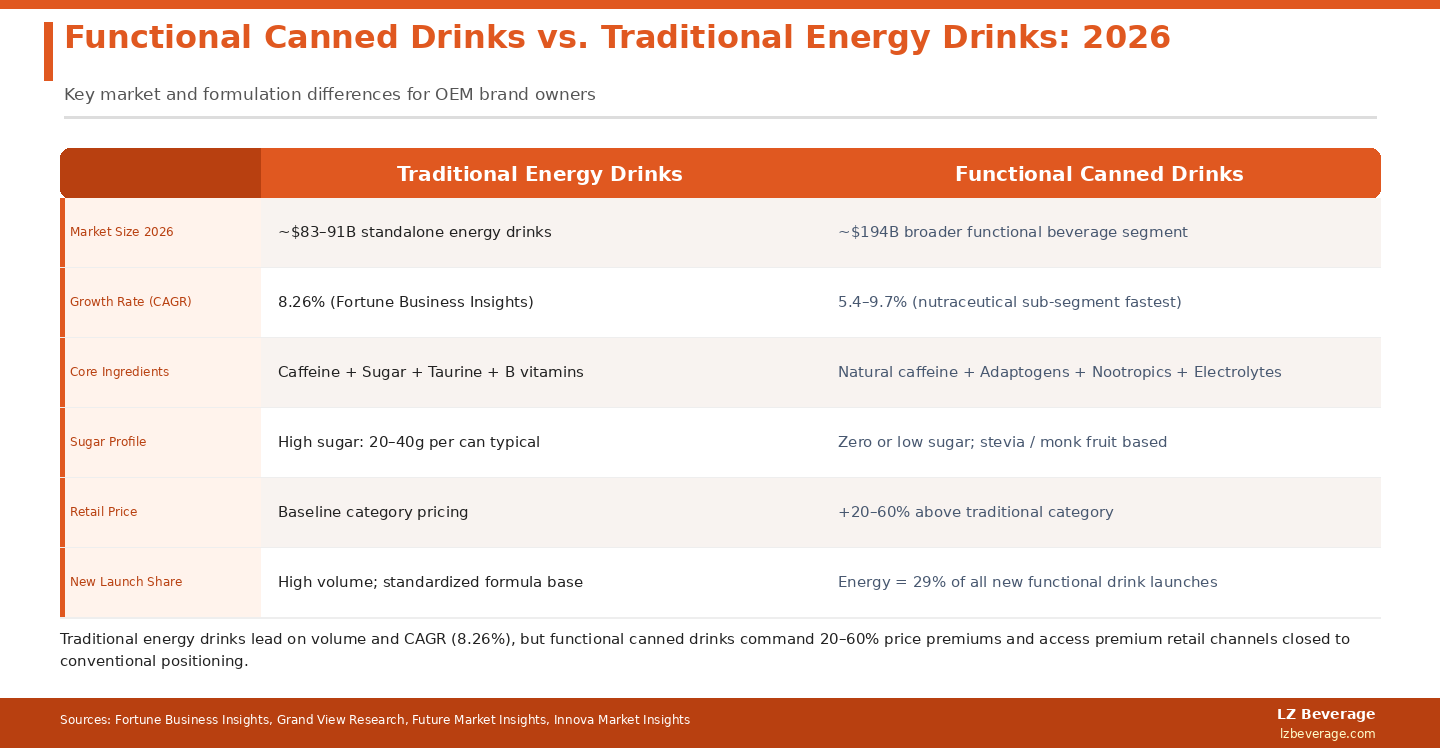
Traditional energy drinks are growing at a higher absolute CAGR (8.26% according to Fortune Business Insights) than the broader functional beverage category (5.4–8.5% depending on definition scope), primarily because scale advantages — massive brand investment, global distribution, and habitual consumption — compound more efficiently on a larger existing base. However, Innova Market Insights reports that functional beverages are experiencing double-digit year-over-year growth in the natural channel and DTC, with energy being the fastest-growing functional benefit in new drink launches globally — appearing in 29% of new launches. The nutraceutical drinks sub-segment is growing at the fastest CAGR within functional beverages at 9.7%, ahead of the overall functional category. For OEM brands, the highest absolute volume opportunity remains traditional energy drink private label; the highest premium pricing and margin opportunity is in functional canned drink formulations.
Ingredient Architecture: The Formulation Difference
Traditional Energy Drink Ingredients: Proven Efficacy, Regulatory Maturity
The traditional energy drink formula is optimized for production efficiency, regulatory predictability, and consumer familiarity. Caffeine is globally approved at commercially relevant doses; taurine has been extensively reviewed by EFSA and FSANZ and found safe at typical use levels; B vitamins are universally permitted. This formulation predictability makes traditional energy drink OEM production straightforward from a regulatory documentation perspective. The challenge for traditional energy drink brands in 2026 is differentiation: with hundreds of brands using virtually identical ingredient architectures, the product must compete on flavor, branding, format innovation, or price — ingredient innovation is constrained by the category convention.
Functional Canned Drink Ingredients: Higher Complexity, Higher Value Potential
Functional canned drinks use a more complex and varied ingredient palette that creates formulation opportunities but also introduces regulatory complexity. BevSource's 2026 trend analysis identifies "benefit stacking" — combining energy with gut health, hydration, or immunity — as the dominant innovation framework in functional beverages. However, the publication also cautions that benefit stacking only works when one benefit remains clearly primary and supporting benefits are credibly substantiated. Each functional ingredient introduces its own regulatory requirements: adaptogens may require novel food authorization in the EU; probiotic claims are subject to EFSA-approved strain-specific evidence; collagen claims require approved claim language. For OEM buyers, the formulation brief for a functional canned drink must include regulatory pathway documentation for each ingredient in each target market — not just a list of trending ingredients.
The Hybrid Convergence: Where Most Innovation Is Occurring
The most commercially successful new energy drink launches in 2025–2026 are hybrid products: traditional energy drink delivery mechanisms (aluminum can, carbonated, single-serve) combined with functional drink ingredient architectures (natural caffeine, zero-sugar sweeteners, adaptogens, named functional ingredients). FoodNavigator's April 2026 functional beverage trend report confirms that energy drinks are "heading towards the idea of a smoother, slower but sustained energy release" — incorporating ginseng, guarana, guayusa, green tea, and yerba mate as caffeine sources rather than synthetic caffeine — while maintaining the canned RTD format and convenience-channel distribution of traditional energy drinks. This hybrid architecture is the most commercially rational entry point for new OEM energy drink brands in 2026: it combines the proven retail positioning of the energy drink format with the premium ingredient narrative of functional beverages.
Consumer Demographics: Who Buys Each Category
Traditional Energy Drinks: The Expanding Base
The traditional energy drink consumer base has evolved significantly. While the category launched as a product for young adult males interested in extreme sports and late-night socializing, the 2026 consumer is broader: adults 25–44 are the dominant segment at 58.4% of global consumption, driven by working professionals and fitness-oriented consumers seeking productivity support during long working days. The traditional energy drink is now a commute, desk, and pre-workout beverage as much as it is a nightlife or extreme sports beverage. This demographic maturation reduces the marketing advantage of extreme-sports positioning and increases the relevance of clean-label, moderate-caffeine messaging even for traditional brands.
Functional Canned Drinks: The Premium Wellness Demographic
According to Grand View Research's US market data, 44% of US consumers chose beverages with hydration claims and 38% selected energy-boosting claims in recent purchase data — reflecting the dual benefit expectation that functional canned drink brands are built to serve. Protein claims influence over two-thirds of sports and energy drink purchase decisions, and 88% of consumers consider protein RTDs as healthy or neutral compared to just 30% for traditional energy drinks. This perception gap explains the premium pricing potential of functional drinks: the consumer attribution of "healthy" enables the brand to charge meaningfully more per unit and access retail channels (health food, fitness retail, premium DTC) that are closed to traditional energy drink positioning.
| Dimension |
Traditional Energy Drinks |
Functional Canned Drinks |
| Core Ingredient |
Caffeine + Sugar + Taurine + B vitamins |
Natural caffeine + Adaptogens + Nootropics + Electrolytes |
| Primary Claim |
"Energy" / Alertness / Performance |
Focus + Recovery + Immunity + Hydration |
| Sugar Profile |
High (20–40g per can typical) |
Zero-sugar / Stevia / Under 5g |
| Primary Channel |
Convenience store / Supermarket |
Health retail / Gym / DTC / Premium on-trade |
| Market Size 2026 |
~$83–91B (energy drinks standalone) |
~$194B (broader functional beverage market) |
| OEM Complexity |
Low: proven ingredients, standardized formula |
High: multiple ingredients, regulatory pathway per market |
| Retail Price Premium |
Baseline |
20–60% above traditional category |
OEM Strategy: Which Category to Launch First
Decision Framework for OEM Buyers
The choice between traditional energy drink and functional canned drink as a first OEM production brief depends on three business priorities. For brands prioritizing speed to market and production simplicity, the traditional energy drink formula — with its standardized ingredient architecture and well-documented regulatory requirements — can move from brief to first production sample in as few as 30–60 days with an experienced OEM partner. For brands prioritizing premium retail positioning and margin optimization, a functional canned drink formulation — with its more complex ingredient sourcing, regulatory pathway documentation, and consumer education investment — requires more time but commands meaningfully higher retail pricing and accesses channels with better margin profiles. For brands targeting both market positions simultaneously, the hybrid approach — a zero-sugar, natural-caffeine energy drink with one or two named functional ingredients — provides the fastest route to both shelf types. Laizhi Beverage's one-stop OEM/ODM service supports all three approaches, from traditional energy drink formulation to functional ingredient development and export compliance documentation. Explore our energy drink OEM options and review industry insights and trend guides on our website.
Frequently Asked Questions
What is the difference between a functional drink and an energy drink?
A traditional energy drink delivers energy primarily through caffeine and sugar, with taurine and B vitamins as supporting ingredients. A functional drink is formulated to deliver one or more specific physiological benefits — such as cognitive focus, gut health, immune support, hydration, or recovery — through bioactive ingredients beyond basic stimulants. In practice, the boundary is blurring rapidly: most successful new "energy drink" launches in 2026 include functional ingredient stacks alongside caffeine, making the functional drink the emerging standard for premium energy beverage positioning.
Is the functional canned drink market larger than the traditional energy drink market?
It depends on how the market is defined. If "functional beverage" is defined broadly to include all beverages formulated for health benefit (including traditional energy drinks, sports drinks, probiotic drinks, functional waters), the functional beverage market at USD 192–194 billion in 2026 is significantly larger than the standalone energy drink category at USD 83–91 billion. If the question compares only the "better-for-you functional" energy drink sub-segment against traditional high-sugar energy drinks, traditional energy drinks remain larger by volume but functional variants are growing faster in premium channels and are capturing a disproportionate share of new product launches.
What are the top functional ingredients in canned energy drinks in 2026?
According to multiple 2026 market intelligence sources, the leading functional ingredients being added to canned energy drink formulations are L-theanine (paired with caffeine for smooth energy), electrolytes (sodium, potassium, magnesium for hydration), ashwagandha and other adaptogens for stress-response support, lion's mane mushroom for cognitive focus, citicoline for memory and mental clarity, collagen peptides for skin and joint health (particularly in female-targeted products), and B-vitamin complexes (B3, B5, B6, B12) for energy metabolism support. Natural caffeine sources — guarana, yerba mate, green tea extract, and guayusa — are also increasingly classified as "functional ingredients" because they deliver caffeine with additional bioactive compounds not present in synthetic caffeine.

