One in three new energy drink launches now carries a zero-sugar or low-sugar claim, according to research tracking by Innova Market Insights, and that share is rising every quarter. The commercial logic is clear: approximately three-quarters of consumers globally report that they are actively limiting sugar intake, with reduced-sugar claims directly influencing energy drink purchasing decisions.
One in three new energy drink launches now carries a zero-sugar or low-sugar claim, according to research tracking by Innova Market Insights, and that share is rising every quarter. The commercial logic is clear: approximately three-quarters of consumers globally report that they are actively limiting sugar intake, with reduced-sugar claims directly influencing energy drink purchasing decisions. For brand owners and OEM buyers building new products or reformulating existing SKUs, the path to a market-ready low-sugar energy drink involves three distinct competencies — sweetener system design, functional ingredient architecture, and label-driven marketing. This guide covers all three.
Key Takeaways
- The zero-sugar beverages market is valued at USD 79.48 billion in 2026 and growing at approximately 7.8% CAGR — low-sugar energy drinks are a core growth segment within it.
- Stevia-erythritol blends are the dominant sweetener system for "naturally sweetened" low-sugar energy drinks; monk fruit and allulose are gaining traction.
- Europe's sugar-free energy drink market is growing three times faster than the overall energy drink category, driven by sugar taxes and Nutri-Score label policy.
- Taste parity — achieving the sweetness profile of a full-sugar formula without off-notes — is the primary formulation challenge and the single biggest differentiator between successful and unsuccessful launches.
- Female consumers and Gen Z are the fastest-growing demographics for low-sugar energy drinks, requiring distinct marketing narratives beyond traditional performance positioning.
The Market Case: Why Low-Sugar Wins in 2026
Global Zero-Sugar Beverages Market Momentum
Future Market Insights values the global zero-sugar beverages market at USD 79.48 billion in 2026, growing at an estimated CAGR of 7.8% through 2032. Within that figure, energy drinks represent one of the most dynamically expanding sub-segments. This is not a niche play. Major brands including Red Bull, Monster, and PepsiCo's Rockstar have restructured their product portfolios around zero-sugar variants as the primary growth driver rather than a defensive reformulation. Red Bull's global rollout of its zero-sugar zero-calorie classic and PepsiCo's Pepsi Zero Sugar posting 30.8% sales growth illustrate the commercial scale already achieved.
Europe: Policy Is Accelerating the Shift
In Europe, the transition to low-sugar energy drink formulations is not entirely consumer-voluntary — it is being mandated by policy. Mordor Intelligence reports the European sugar-free energy drink market at USD 5.28 billion in 2026, growing at a CAGR of 7.28% to reach USD 7.51 billion by 2031, with low-calorie variants expanding three times faster than the overall category. The 2023 Nutri-Score algorithm update, which downgraded most zero-sugar energy drinks from a B to C rating — because of concerns around artificial sweeteners — has accelerated reformulation toward plant-based sweetening systems among brands targeting EU retail shelves. The WHO's early-2026 reinforcement of its "3 by 35" push for excise taxes on sugary beverages adds further regulatory momentum. OEM buyers exporting to Europe should treat low-sugar formulation as a market entry prerequisite, not a differentiating feature.
Sweetener System Design: The Formulation Core
The Shift From Artificial to Natural Sweeteners
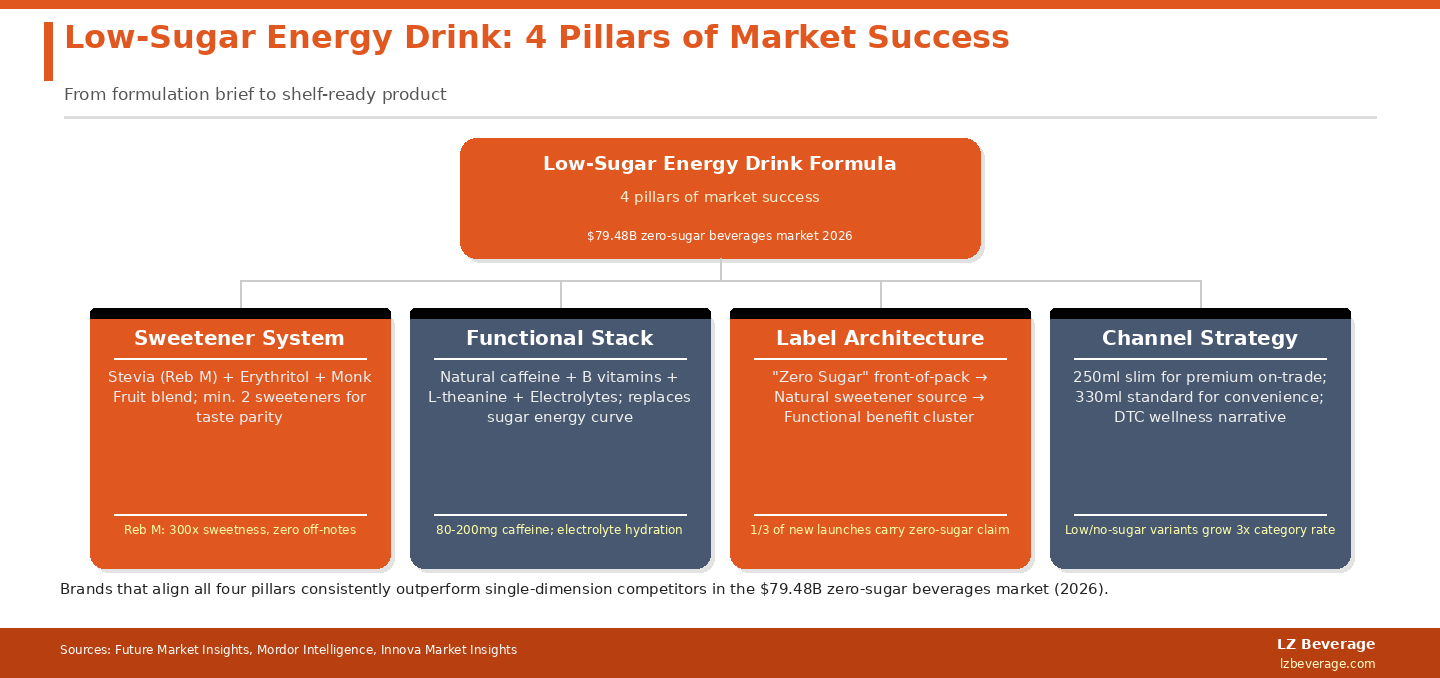
The trajectory from sucralose and aspartame toward stevia, monk fruit, erythritol, and allulose is well-documented in industry formulation literature. Beverage Industry Magazine reports that formulation experts are increasingly using multi-sweetener systems, with "the prevailing blends using erythritol, allulose, stevia and monk fruit" as the preferred combination for taste parity in low-sugar energy drinks. No single sweetener fully replicates the sweetness curve, mouthfeel contribution, and aftertaste neutrality of sucrose — which is why hybrid systems are now standard practice in professional formulation.
Understanding Your Sweetener Options
Stevia (Steviol Glycosides / Reb M): The most widely adopted natural sweetener in low-sugar energy drinks. Reb M, a next-generation stevia extract, has the most neutral flavor of any stevia variant, with minimal bitter aftertaste at energy drink pH levels. GRAS-certified in the US; approved in the EU. Clean-label credentials are strong. US Sweeteners notes that stevia source concentration in China requires supplier diversification for supply security. Erythritol: A sugar alcohol that provides bulk and mouthfeel that high-intensity sweeteners cannot replicate. Zero calories; very clean flavor. Some recent cardiovascular health discussion in scientific literature has prompted some formulators to reduce reliance on erythritol as the primary sweetener. Monk Fruit (Luo Han Guo): 150–250x sweeter than sugar; clean, almost sugar-like sweetness with no bitter aftertaste. Premium price point. Excellent for "no artificial sweeteners, no stevia" label positioning. Allulose: A rare sugar with near-sugar taste and mouthfeel, almost no calories, and the ability to participate in browning reactions. EU novel food review is ongoing; commercial availability in Europe is delayed. Ideal for North American and Asia-Pacific formulations targeting clean label and premium positioning.
Achieving Taste Parity: The Formulator's Checklist
Taste parity — the point at which a zero-sugar formulation is indistinguishable in palatability from a full-sugar baseline — is the defining challenge of low-sugar beverage development. Based on formulation guidance from Beverage Industry, the key levers are: sweetener combination (at minimum two complementary sweeteners); sweetness modulator addition (thaumatin at 1–2 ppm to smooth the onset curve); fiber addition (soluble tapioca fiber or inulin to restore mouthfeel and viscosity); acid balance (citric and malic acid ratios affect sweetness perception); and flavor amplifier selection (masking agents that suppress bitter aftertaste in stevia-containing formulas). For OEM clients, a detailed sensory evaluation panel — comparing the prototype against a full-sugar reference across at least three evaluations — is the minimum quality gate before a formula is approved for production.
Functional Ingredient Architecture for Low-Sugar Formulas
Replacing the Sugar Energy Curve
One formulation challenge unique to low-sugar energy drinks is the absence of the carbohydrate energy contribution that sugar provides. Consumers who switch from full-sugar to zero-sugar formulas sometimes report that the energy "feels different" — because it is. The functional ingredient layer must compensate for this. The standard approach is to combine caffeine (from a named natural source — green tea, guarana, or green coffee extract for clean-label positioning) with B vitamins (B3, B6, B12 for cellular energy metabolism support), L-theanine (to modulate the caffeine onset and reduce jitteriness perception), and electrolytes (sodium, potassium, magnesium for hydration feel and sustained energy perception). This combination positions the product not just as "sugar removed" but as "functionally upgraded."
The "Better-For-You" Functional Stack
In the female-focused and Gen Z-targeted low-sugar energy drink segments, functional claims beyond energy have become the primary purchase driver. Inc. Magazine documents that Alani Nu, a zero-sugar energy drink targeting female consumers, posted 78% retail growth before Celsius acquired the brand for USD 1.65 billion — and Monster's own FLRT zero-sugar line targets women aged 18–24 with collagen, immunity, and skin health claims stacked on top of the energy benefit. Bloom Nutrition's sparkling zero-sugar energy drink generated USD 8 million in sales within its first six months. For OEM clients targeting these demographics, the formulation brief must integrate wellness ingredients (collagen peptides, vitamin C, biotin, zinc) alongside the energy stack — the label needs to tell a complete wellness story at the functional ingredient level.
Labeling Strategy and Marketing Positioning
Front-of-Pack Hierarchy for Low-Sugar Energy Drinks
Label architecture for low-sugar energy drinks follows a consistent hierarchy in successful market launches. The primary claim — "Zero Sugar," "No Added Sugar," or "Low Calorie" — occupies the most prominent front-of-pack real estate. The secondary claim specifies the natural sweetener source ("Sweetened With Stevia" or "Naturally Sweetened") to address consumer wariness around the first-generation artificial sweeteners. The tertiary claim identifies the functional benefit cluster ("Focus + Energy," "Clean Energy," "Sustained Performance"). The ingredient transparency signal — listing the caffeine source (e.g., "200mg Caffeine from Green Coffee Extract") rather than just "caffeine" — functions as a trust-building device, particularly for health-literate consumers who actively read ingredient panels. According to PL Beverage's 2026 analysis of low-sugar beverage positioning, brands that invest in this three-layer label architecture are meaningfully better positioned for premium retail channel access compared to brands that simply state "Zero Sugar" without supporting the claim architecture.
Channel and Demographic Targeting
Mordor Intelligence identifies that premium glass bottle formats and slim can designs are gaining traction in the sugar-free energy drink segment, specifically for on-trade channels (gyms, yoga studios, premium foodservice) where the premium ingredient narrative can command higher per-serving margins than convenience store placement. For OEM buyers targeting multiple channels simultaneously, this means designing at minimum two can formats: a standard 250ml or 330ml aluminum can for convenience and multipack retail, and a slim 250ml format for premium on-trade and DTC positioning. Marketing messaging should be channel-calibrated: performance-oriented messaging for gym retail, wellness-ingredient narrative for health food retail, and lifestyle/taste focus for convenience store.
| Sweetener |
Sweetness Intensity |
Clean Label Score |
EU Status |
Best Use Case |
| Stevia (Reb M) |
200–350x sugar |
★★★★★ |
Approved |
Primary sweetener in most natural low-sugar formulas |
| Erythritol |
0.6–0.8x sugar |
★★★★ |
Approved |
Mouthfeel + bulk; blend with stevia |
| Monk Fruit |
150–250x sugar |
★★★★★ |
Approved |
Premium positioning; "no stevia" label differentiation |
| Allulose |
0.7x sugar |
★★★★★ |
Novel food (pending) |
Premium US/APAC; sugar-like mouthfeel |
| Sucralose |
600x sugar |
★★ |
Approved |
Cost-effective; Nutri-Score penalty in Europe |
OEM Partnership Considerations for Low-Sugar Energy Drinks
What to Require From Your Manufacturer
Launching a low-sugar canned energy drink through an OEM partner requires specific capabilities that not all manufacturers possess. The critical requirements are: validated experience with natural sweetener blends (especially stevia-based systems, which require precise dosing at production scale to avoid batch-to-batch bitterness variation); HACCP certification and food safety management systems aligned with the target export market; flexible production line capability to run both standard and slim can formats; and in-house or third-party analytical capability to verify caffeine concentration, sweetener dosage, and caloric content against label claims. For brands targeting European markets, the manufacturer must also be able to provide documentation supporting front-of-pack label claims and Nutri-Score calculation inputs. Laizhi Beverage's HACCP-certified production facility and one-stop OEM/ODM service model — covering formulation through aluminum can filling — positions it as a partner for low-sugar energy drink development across multiple export markets. Explore our custom energy drink options or review our production capabilities and export experience for more detail.
Frequently Asked Questions
What is the best natural sweetener for a low-sugar energy drink?
There is no single best sweetener — the optimal system depends on the target market, price point, and label positioning. For most markets, a stevia (Reb M) and erythritol blend provides the best balance of clean-label credentials, taste profile, and regulatory acceptance. Adding a small amount of monk fruit improves sweetness quality further. For premium North American formulations, allulose offers near-sugar performance. Always develop your sweetener system in a target-pH prototype with your specific flavor profile before committing to production, as sweetener interactions vary significantly by flavor chemistry.
How do I market a low-sugar energy drink to female consumers?
The most successful female-targeted low-sugar energy drink brands combine the zero-sugar energy positioning with wellness benefit claims (skin, immunity, collagen, hair health), aesthetically premium can design, and influencer marketing partnerships in health and lifestyle content rather than sports sponsorship. The label architecture should lead with the wellness narrative and support it with the zero-sugar, clean-ingredient message, rather than leading with "energy drink" as the primary category identifier. Social media channels — particularly Instagram and TikTok — with creator-driven content consistently outperform traditional advertising for this demographic segment.
What is the regulatory status of low-sugar claims for energy drinks?
This varies significantly by market. In the US, FDA definitions govern "low sugar" (less than 0.5g per serving), "no added sugars," and "zero sugar" claims, with associated nutrient content claim regulations. In the EU, Regulation (EC) 1924/2006 governs nutrition and health claims, and sugar content is scored against the Nutri-Score front-of-pack labeling system (noting that the 2023 update penalized artificially-sweetened beverages). In Australia, the Food Standards Code governs equivalent claims. For any OEM brand developing low-sugar formulations for export, a market-by-market regulatory review of planned claims — before label design is finalized — is mandatory, not optional.

