China remains the world's leading source of private-label and OEM canned beverages — but the same scale and diversity that makes Chinese manufacturing attractive also creates opportunities for unreliable operators to hide in plain sight. International due-diligence specialists note that fake companies, bait-and-switch suppliers, and payment fraud schemes are persistently common in Chinese B2B trade, and that most of these risks are avoidable with systematic verification.
China remains the world's leading source of private-label and OEM canned beverages — but the same scale and diversity that makes Chinese manufacturing attractive also creates opportunities for unreliable operators to hide in plain sight. International due-diligence specialists note that fake companies, bait-and-switch suppliers, and payment fraud schemes are persistently common in Chinese B2B trade, and that most of these risks are avoidable with systematic verification. This article covers eight warning signs specific to the canned beverage sector — patterns that experienced buyers have learned to spot before signing a contract.
Key Takeaways
- Most sourcing fraud is preventable — red flags almost always appear during the pre-contract phase if you know what to look for.
- Price-based red flags are the most common entry point — quotes dramatically below market signal quality shortcuts or outright fraud.
- Payment fraud is the highest-risk moment — always pay to a verified corporate bank account, never a personal one.
- Certification fraud is endemic — logos on a website mean nothing; always request the original document and verify with the issuing body.
- A legitimate factory welcomes scrutiny — audit requests, video tours, and reference checks should be met with confidence, not resistance.
Why Canned Beverage Sourcing Carries Specific Risks
Beyond the general risks of China sourcing, the canned beverage OEM sector has particular vulnerabilities. Regulatory compliance for canned beverages is complex — HACCP certification, export registration, and destination-market labeling requirements all need to be factory capabilities, not just sales talking points. Food safety audit professionals emphasize that certification verification requires reviewing actual audit reports, not just certification logos. Additionally, the bait-and-switch risk in food manufacturing is particularly consequential: a bad sample of electronics can be returned; a bad batch of beverages on retail shelves damages your brand and may trigger a product recall.
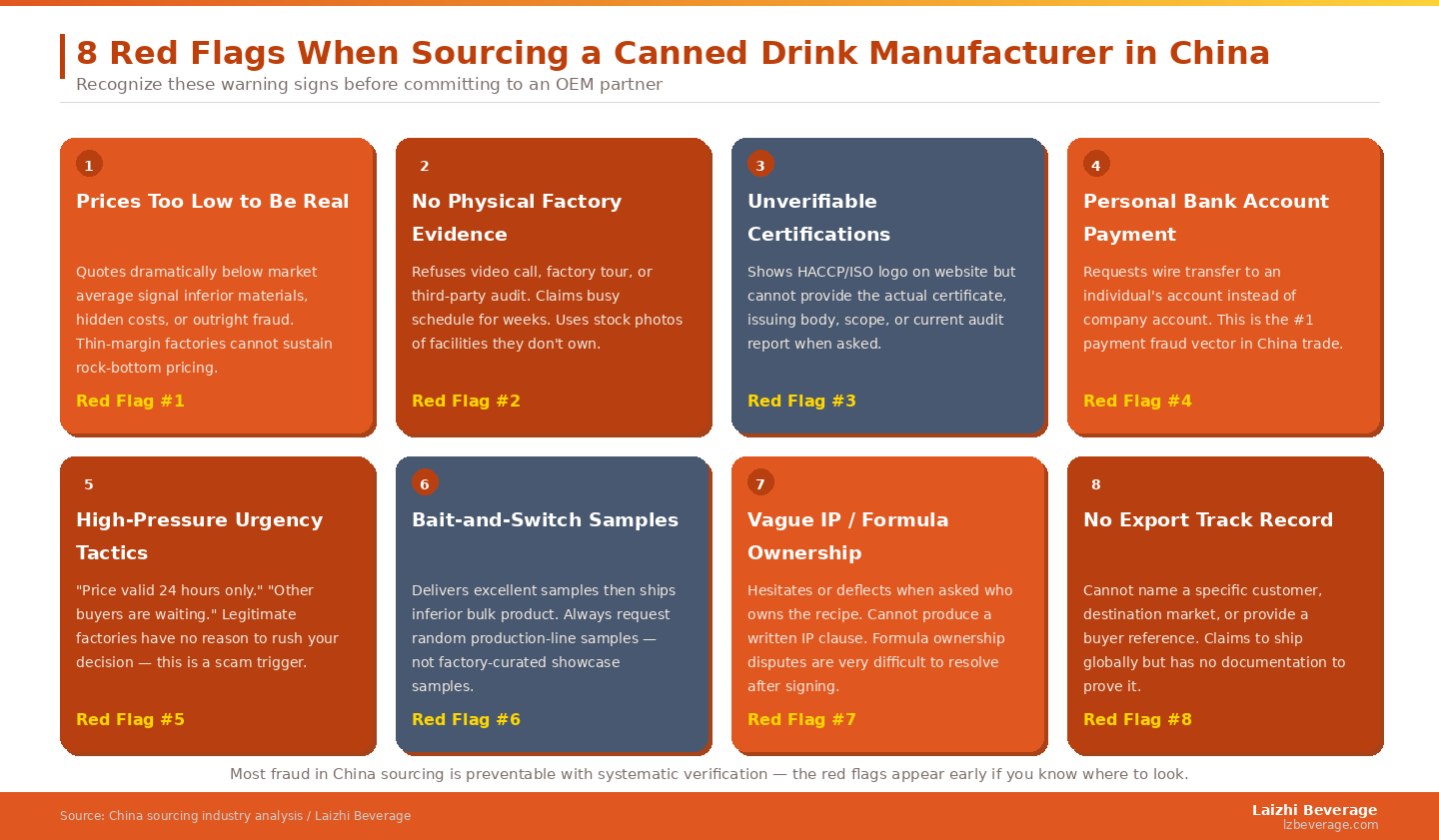
Red Flag #1: Prices That Are Dramatically Below Market Average
The most reliable early warning sign in any sourcing process is a price that seems too good to be true. Common China import risk guides consistently identify extreme price undercutting as the first red flag buyers encounter — and the one most often ignored in pursuit of cost savings. Legitimate beverage factories operate on thin margins. Their pricing reflects real costs: raw materials, certified ingredients, energy, labor, QC, regulatory compliance, and packaging. A supplier offering canned energy drinks or sparkling beverages at 40% below the average market quote is either using inferior ingredients, skipping compliance steps, cutting QC corners, or setting you up for a bait-and-switch. Request itemized cost breakdowns from any supplier quoting unusually low prices. A legitimate factory can explain precisely where the savings come from.
Red Flag #2: Refuses or Delays Factory Video Tours or Third-Party Audits
China sourcing specialists unanimously agree that a legitimate manufacturer welcomes video tours and third-party audits — these are an opportunity to demonstrate capability, not a burden. A factory that consistently delays a video call for more than 7–10 days, makes excuses about camera availability, or flatly refuses an on-site audit inspection is hiding something. The "something" might be substandard equipment, a facility much smaller than claimed, or in extreme cases, a fake factory that does not physically exist. For beverage buyers who cannot travel to China, a one-day third-party audit from SGS, Intertek, or a local Chinese inspection agency typically costs USD 300–600 and returns a written report within 48 hours. This is one of the most cost-effective risk reduction steps available in the pre-contract phase.
Red Flag #3: Cannot Produce Actual Certification Documents
Logos for HACCP, ISO 22000, or export qualification certificates displayed on a factory's website are marketing — they are not evidence of current certification status. A certified factory can instantly produce: the actual certificate (not a logo), the name of the issuing certification body, the certificate number, the scope of certification (which products and production lines are covered), and the expiry date. If a supplier responds to your certification request with a website link, a brochure, or a certificate image that lacks these details, that is a significant red flag. Go further — contact the certification body directly to verify that the certificate is current and has not been suspended or withdrawn since issuance.
Laizhi Beverage holds active HACCP certification and export qualification credentials, and buyers are welcome to request documentation before committing to any production order. This level of transparency is what a trustworthy OEM partner should offer by default.
Red Flag #4: Requests Payment to a Personal Bank Account
Payment fraud is the area where the largest financial losses occur in China sourcing. China business risk analysts describe personal account payment requests as the single most definitive indicator of fraud — legitimate Chinese businesses are required to use registered corporate bank accounts for commercial transactions. When a "factory" asks you to wire money to an individual's account, or when they send updated payment instructions mid-deal claiming a "bank account change," pause and verify through an independent channel before sending any funds. Verify the company's bank account details against their official business registration documentation. Business Email Compromise (BEC) scams — where fraudsters intercept emails and substitute their own account numbers — are particularly sophisticated and have cost beverage importers millions of dollars globally.
Red Flag #5: High-Pressure Urgency Tactics
Phrases like "price valid for 24 hours only," "we have another buyer for this slot," or "raw material prices increase tomorrow" are classic manipulation tactics designed to prevent you from conducting due diligence. Sourcing risk specialists note that reputable factories actually prefer buyers who conduct thorough due diligence — a serious, deliberate buyer is a reliable long-term partner. A factory that becomes irritated or evasive when you ask to slow down and verify credentials is signaling that they cannot withstand scrutiny. Any legitimate Chinese canned beverage manufacturer will give you the time you need to conduct background checks, visit the facility, and review documentation before committing to a purchase order.
Red Flag #6: Bait-and-Switch Samples
The bait-and-switch pattern is particularly common in food and beverage OEM: the factory sends excellent, carefully produced samples that win your approval, then delivers bulk production that is noticeably inferior in flavor, carbonation consistency, fill weight, or packaging quality. China sourcing advisors recommend that buyers request randomly selected production-line samples rather than factory-curated showcase samples. Better still, commission a pre-shipment inspection from a third-party agency that randomly pulls samples from the packed shipment and compares them against your approved golden sample specifications. This step costs far less than dealing with a rejected or recalled product.
Red Flag #7: Vague or Evasive Responses About Formula Ownership
When you ask directly "who owns the formula if your R&D team develops it?", a legitimate factory answers clearly and quickly. Hesitation, deflection ("we can discuss that later"), or refusal to put IP ownership in writing before sample development begins is a serious warning sign. This is not a hypothetical risk — formula ownership disputes have forced beverage brands to restart product development from scratch after relationship breakdowns with factories that claimed the recipe was proprietary to their facility. Always secure written confirmation of IP ownership before sharing any formulation details with an OEM factory, particularly for products where the formula is a brand differentiator.
Red Flag #8: Cannot Name a Single Export Reference
A factory claiming to export to "50+ countries" without being able to name a specific recent customer, destination market, or provide a contact reference has not actually done that business. Legitimate export-focused beverage factories have named clients they can reference — with permission — and can describe in detail the regulatory requirements they navigated for a specific market. Ask for one specific example: a country, a product type, a certificate required for that market, and a buyer reference. The inability to provide this with reasonable detail suggests the "global export experience" is a marketing claim rather than an operational reality. Browse Laizhi Beverage's full product range to understand the scope of OEM categories available from a verified, export-qualified China manufacturer.
A Practical Verification Checklist
| Verification Step |
How to Do It |
Cost / Effort |
| Business license check |
Verify on China's National Enterprise Credit Information system |
Free, ~10 min |
| Video factory tour |
Request 30-min live walkthrough via WeChat or Teams |
Free |
| Certification verification |
Contact issuing body directly with certificate number |
Free |
| Third-party factory audit |
Commission SGS, Intertek, or local agency for 1-day GMP/HACCP check |
USD 300–600 |
| Payment account verification |
Cross-check bank account against business registration documents |
Free |
| Buyer reference check |
Contact a named reference in your target region via LinkedIn/email |
Free, ~1 day |
Frequently Asked Questions
Are all low-priced Chinese beverage factories scams?
No — some factories genuinely offer competitive pricing due to lower labor costs, direct raw material sourcing, or simpler formulas. The red flag is a price that is inexplicably far below all other verified quotes. Always request an itemized cost breakdown to understand where the savings come from before dismissing or accepting a low quote.
What is the safest payment structure for a first order?
The industry standard is a 30% deposit upon order confirmation and 70% balance payment against a copy of the bill of lading before shipment. For first-time orders with a new supplier, some buyers use an escrow service or letter of credit for additional protection. Never pay 100% upfront with a new OEM partner.
How do I verify a Chinese food manufacturer's export license?
China's General Administration of Customs maintains a public database of registered food exporters. Ask the factory for their export registration number and verify it independently. For markets like the EU or USA, the factory must also be registered specifically with those regulators — ask for those registration numbers and verify them on the respective official databases.
Working with a verified, export-qualified OEM partner eliminates most of these risks at the source. Learn about Laizhi Beverage's HACCP certification, 50 production lines, and track record of international exports before starting your supplier evaluation process.

