Beverage brands and private-label importers have more OEM sourcing options in 2026 than at any point in the past decade. Tariff uncertainty, supply chain diversification strategies, and the rise of new manufacturing hubs in Vietnam, India, and Thailand are prompting many buyers to revisit a question that once had an obvious answer: does every canned beverage OEM order need to come from China? The honest answer is nuanced. Each manufacturing region has genuine strengths, meaningful limitations, and a specific buyer profile it serves best.
Reading this article will give you: a data-grounded comparison of China, Vietnam, India, and Southeast Asia as canned beverage OEM manufacturing sources, covering unit cost structure, certification depth, aluminum can supply chain, lead times, and the regulatory considerations that differ by origin country. The goal is to help procurement teams and brand founders make a well-informed sourcing decision rather than a reflexive one in either direction.
Key Takeaways
- China retains structural advantages in scale, integrated aluminum can supply, multi-category OEM capability, and certification depth — but US tariff exposure is a real cost variable in 2026.
- Vietnam is the strongest China alternative for canned beverages — 8% GDP growth in 2025, CPTPP and EVFTA trade agreements, mature export logistics, and a rapidly growing beverage can manufacturing base.
- India is best for brands targeting South Asian markets — a $15.5B non-alcoholic beverage market and strong functional beverage growth, but integrated aluminum can manufacturing is less developed than Vietnam or China.
- Thailand, Malaysia, and Indonesia offer specific category strengths (functional drinks, coconut-based beverages, beer) but typically at smaller production scale and higher per-unit cost than China or Vietnam.
China: Scale, Integration, and Certification Depth
Why China remains the baseline for comparison
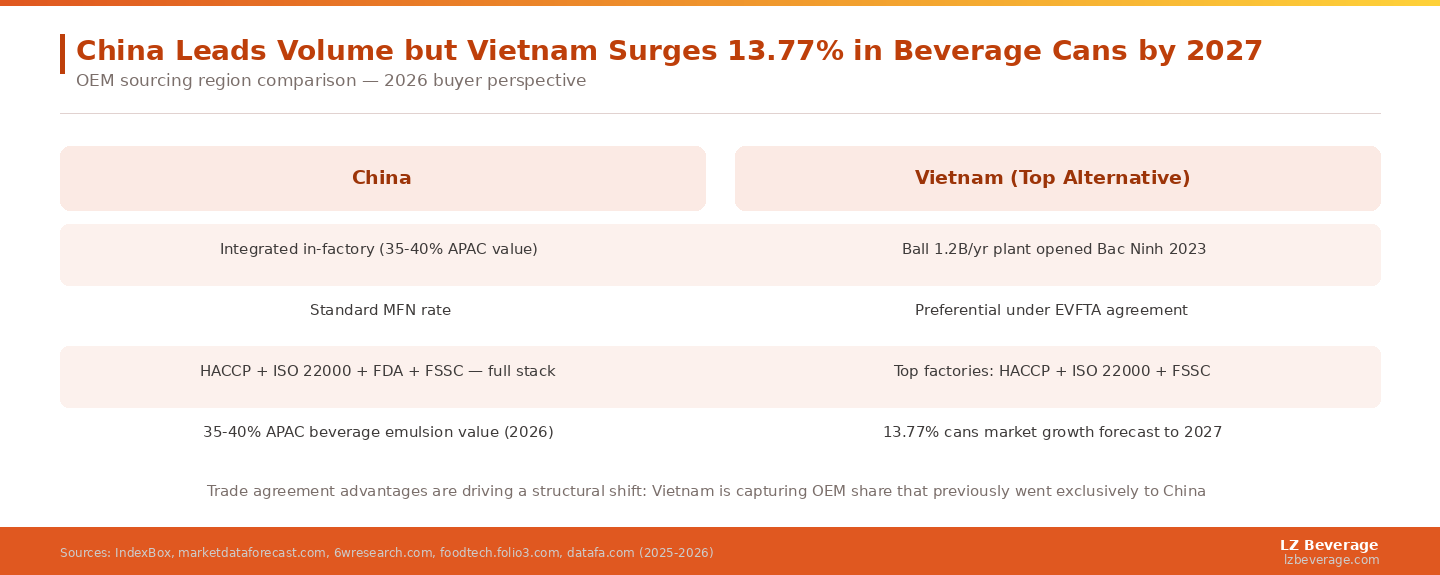
China's beverage OEM infrastructure represents decades of accumulated investment. Guangdong, Fujian, Shandong, and Anhui provinces host industrial clusters where ingredient supply, aluminum can manufacturing, filling lines, quality labs, and export logistics are all within proximity of each other. IndexBox's Asia-Pacific beverage market analysis estimates China at approximately 35-40% of Asia-Pacific regional beverage value — a dominance built on the vertical integration that enables competitive FOB pricing.
For buyers sourcing large volumes (50,000+ cases per production run), China-based OEM factories offer the widest range of can sizes and formats, the deepest certification stacks (HACCP, ISO 22000, export licensing, FDA facility registration, FSSC 22000), and the most established track record for complex multi-SKU private label programs. The caveat in 2026 is US tariff exposure: tariffs on Chinese goods entering the US market have added meaningful landed cost for brands selling into American retail, making the US-bound calculation more complex than a straight FOB price comparison.
What China OEM does best
Integrated aluminum can manufacturing and beverage filling under one facility is a capability that distinguishes China's largest OEM operations. When the can is produced in-house (rather than sourced from a separate supplier), the brand gets tighter quality control over the can gauge, coating, and print registration — all of which affect shelf life and label adhesion. Market Data Forecast's Asia-Pacific aluminum can report notes that Crown Holdings expanded digital printing capability in Shanghai in 2023, enabling full-body can customization for limited-edition runs — a service not yet widely available in other Asia-Pacific manufacturing hubs.
Industry practice shows that buyers who need multi-category OEM from a single supplier — energy drinks, juice, beer, and RTD coffee under one roof — are much more likely to find that integrated capability in China than in any alternative region. Vietnam's OEM factories are predominantly specialized in fruit juice, coconut water, and tropical beverages; India's contract manufacturers are strongest in functional beverages and RTD tea; Thailand's breweries lead in beer and malt beverages. China's top OEM facilities, by contrast, operate across all beverage categories with separate dedicated filling lines, making category expansion within a single factory relationship realistic. Brands considering a multi-category beverage OEM partner should weigh this capability before defaulting to diversification.
Vietnam: The Leading China Alternative for Canned Beverages
Why Vietnam's beverage OEM sector is accelerating
Vietnam has emerged as the most credible alternative to China for canned beverage OEM in 2026. Datafa's Vietnam manufacturing analysis documents GDP growth of approximately 8% in 2025, driven by strong export activity and manufacturing investment. Vietnam's agricultural exports reached a record $70 billion in 2025, with tropical fruit exports to the EU tripling over the past four years — giving fruit-based beverage OEM factories in Binh Duong and Hanoi access to abundant, nearby raw materials that Chinese factories cannot match on ingredient freshness and transport cost for tropical-origin inputs.
On the aluminum can side, Ball Corporation inaugurated a new aluminum can manufacturing plant in Bac Ninh, Vietnam in February 2023, with annual capacity of 1.2 billion cans — a direct signal that the global can manufacturing industry is investing in Vietnam's beverage production ecosystem. The Vietnam beverage cans market is forecast to achieve 13.77% growth by 2027, the fastest trajectory in Southeast Asia.
Trade agreement advantage: CPTPP and EVFTA
Vietnam's membership in the Comprehensive and Progressive Agreement for Trans-Pacific Partnership (CPTPP) and the EU-Vietnam Free Trade Agreement (EVFTA) provides preferential tariff access to key buyer markets that Chinese origin goods don't receive. For brands selling into Japan, Canada, Australia, or the EU, Vietnam-origin canned beverages may face meaningfully lower import duties than equivalent China-origin product — a structural cost advantage that compounds across large order volumes. This is the single most compelling reason for buyers with EU or Oceania distribution to evaluate Vietnam OEM seriously in 2026.
Vietnam OEM limitations to consider
Vietnam's beverage OEM ecosystem is younger than China's. The largest factories have the certification depth (ISO 22000, HACCP, FSSC 22000, Halal, Kosher for specific categories) needed for EU and US export, but the total number of factories that can handle complex multi-SKU programs at scale is more limited. Lead times may be slightly longer than China for buyers outside Southeast Asia, and the range of specialty functional ingredient suppliers within Vietnam is narrower than in China's Yangtze River Delta manufacturing corridor.
India: Strength in Functional Beverages and South Asian Distribution
India's beverage manufacturing landscape in 2026
India's non-alcoholic beverage market is substantial — industry data places it at $15.5 billion in 2024, growing at approximately 8.5% CAGR toward $2.4 trillion rupees by 2030. The functional beverage segment within India reached $6.9 billion in 2025 and is projected to grow at 10.74% CAGR through 2034, driven by rising health-consciousness and RTD demand among urban consumers. These are compelling domestic market numbers, but they don't automatically translate into strong OEM export capability for international buyers.
The certification landscape for Indian OEM manufacturers is evolving. The Food Safety and Standards Authority of India (FSSAI) is the domestic regulatory authority, and Indian contract manufacturers seeking export business typically supplement FSSAI licensure with FSSC 22000, ISO 22000, and BRCGS certification to meet international buyer requirements. FSSAI's beverage-specific rules include detailed requirements on caffeine thresholds (145-300 mg/L for energy drinks), permitted sweeteners and additives, and labeling — a regulatory environment that mirrors the specificity of EU and FDA requirements, which is positive for export-readiness.
Where India OEM makes sense — and where it doesn't
India is best positioned for brands targeting South Asian markets (India, Sri Lanka, Bangladesh, UAE with large Indian diaspora consumer bases), functional and Ayurvedic beverages, and RTD tea formats. The integrated aluminum can supply chain that China and increasingly Vietnam are building is less developed in India — most Indian beverage OEM operations source cans externally, which can add both cost and lead time variability compared to integrated operations.
Thailand, Malaysia, and Indonesia: Category-Specific Strengths
What Southeast Asia outside Vietnam offers
Thailand has a mature beer OEM and co-packing ecosystem, driven by decades of contract brewing for international brands. For beer-focused buyers, Thailand offers established quality systems and logistics corridors. The VDMA beverage machinery data shows Thailand among the most active Asian markets for food and beverage equipment imports — consistent with ongoing capacity investment.
Malaysia is a strong choice for Halal-certified canned beverage OEM, given its mature Halal certification infrastructure and JAKIM (Department of Islamic Development Malaysia) recognition, which is accepted in many Middle Eastern, African, and Southeast Asian import markets. Indonesia is growing as a fruit juice and coconut water OEM hub, with proximity to abundant tropical ingredient supply, but the export certification and logistics infrastructure is less mature than Malaysia or Thailand for complex international programs.
Comparison: How the Regions Stack Up by Decision Criteria
| Criterion |
China |
Vietnam |
India |
Thailand / Malaysia |
| Multi-category OEM depth |
Excellent |
Good (fruit-forward) |
Moderate (functional) |
Specialized (beer / Halal) |
| Integrated can supply |
Excellent |
Growing (Ball 1.2B/yr plant) |
Limited |
Moderate |
| Cert depth (HACCP/ISO/FSSC) |
Excellent |
Good (top factories) |
Good (FSSAI + ISO) |
Good (Halal-focused) |
| US market tariff exposure 2026 |
High |
Low (CPTPP) |
Low-Moderate |
Low-Moderate |
| EU market access |
Standard |
Preferential (EVFTA) |
Standard |
Standard |
| Tropical ingredient access |
Moderate |
Excellent |
Good |
Excellent |
| Min viable production scale |
Low MOQ available |
Moderate MOQ |
Moderate MOQ |
Higher MOQ typical |
Next Steps: How to Choose the Right OEM Region for Your Canned Beverage
- Define your primary distribution market first — the destination country's tariff schedule for your origin country often determines the answer before any other factor.
- Identify your beverage category — tropical fruit juice and coconut water favor Vietnam; functional RTD and Ayurvedic formats favor India; beer co-packing and Halal formats favor Thailand and Malaysia.
- Check trade agreement coverage — use the World Trade Organization's tariff database to compare actual import duties for your product HS code from each origin country into your target market.
- Shortlist factories with the right certification stack — confirm HACCP, ISO 22000, and your target market's preferred certification (FDA registration for US, BRCGS or FSSC 22000 for EU) before requesting quotes.
- Request samples from 2-3 factories in your shortlisted regions and evaluate not just product quality but documentation quality — how detailed is the Certificate of Analysis, how quickly do they respond to specification questions?
Frequently Asked Questions
Is China still competitive for canned beverage OEM despite US tariffs in 2026?
For brands selling into non-US markets (EU, Middle East, Southeast Asia, Africa), China remains highly competitive on unit cost, certification depth, and production flexibility. For brands with US as a primary market, the effective landed cost differential versus Vietnam or India needs to be modeled for each specific product — tariff rates vary by HS code, and some categories face higher rates than others. A straight FOB price comparison without the tariff overlay will mislead the sourcing decision.
What certifications should I require from a Vietnamese canned beverage OEM factory?
At minimum for EU export: ISO 22000 or FSSC 22000, HACCP documentation, and EVFTA-compliant certificate of origin. For US export: FDA facility registration and a documented Foreign Supplier Verification Program. For Middle Eastern buyers: Halal certification from a JAKIM or GCC-recognized certifying body. The top-tier Vietnam factories carry most of these by default; smaller operations may not — confirm before shortlisting.
Can a beverage brand source from multiple OEM regions simultaneously?
Yes, and many brands with global distribution do exactly this. A brand might source its tropical fruit juice from Vietnam (EVFTA access for EU), its energy drink from China (scale and integration for Asia-Pacific), and its functional RTD from India (South Asian distribution alignment). The complexity of managing multiple OEM relationships is real, but the risk diversification and market-specific cost optimization it enables can justify the overhead, particularly at scale.


