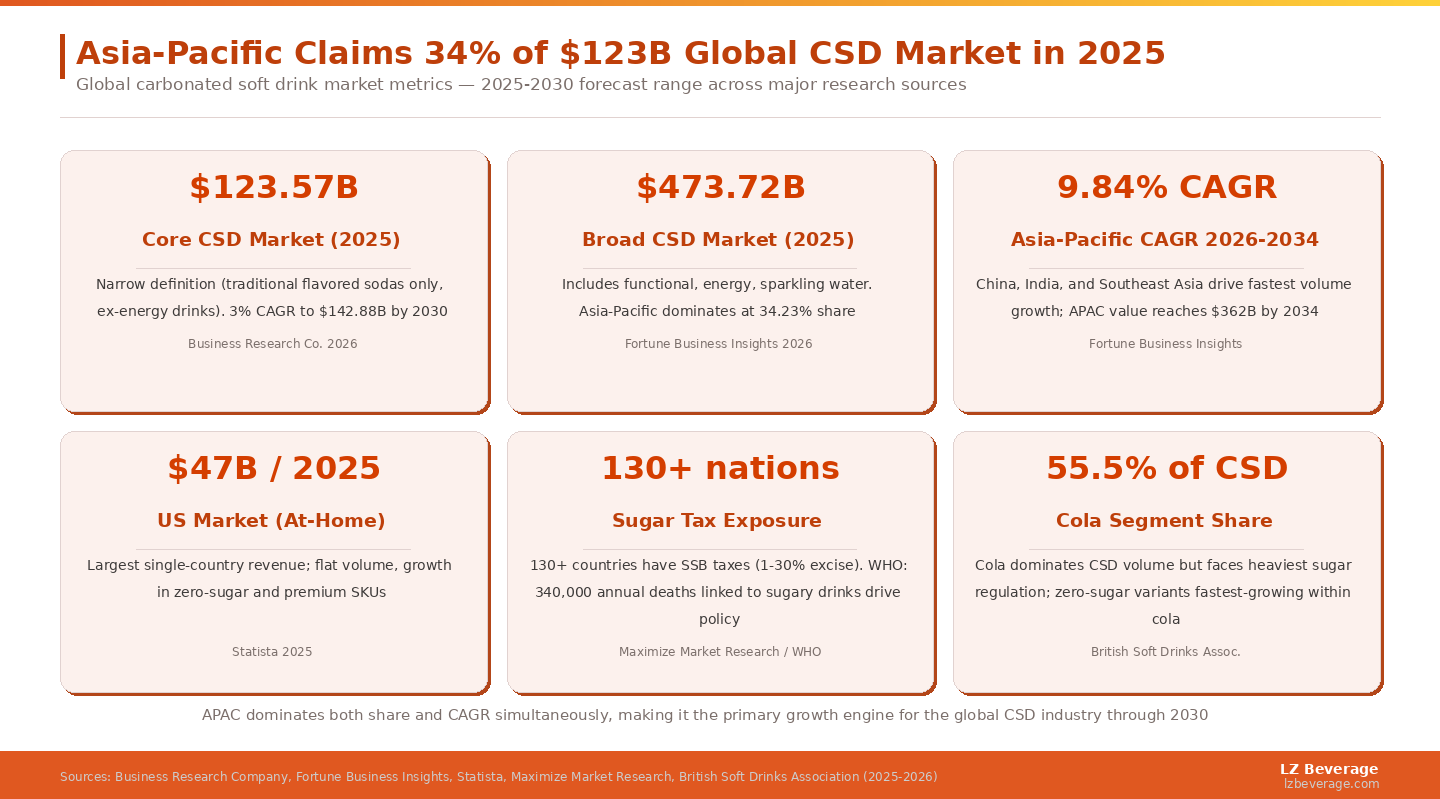
The global carbonated soft drink (CSD) market is one of the most analyzed segments in food and beverage — and also one of the most contested in its forecasts. Market research firms report widely different market size figures because they define the category differently: some include energy drinks and functional carbonated beverages; others restrict the definition to traditional flavored sodas. The Business Research Company places the core CSD market at $123.57 billion in 2025, growing to $142.88 billion by 2030 at a 3% CAGR. Fortune Business Insights, using a broader category scope that includes functional carbonated beverages, values the market at $473.72 billion in 2025 with an 8.9% CAGR through 2034. Buyers of this data should understand which definition underpins the number before using it in a business case.
Reading this article will give you: a structured view of what the credible data points actually say about CSD market size, where the growth is coming from regionally, which forces are reshaping the category, and what that means for brands and OEM manufacturers entering the space. Market data is compiled from publicly available industry research published between 2025 and 2026.
Key Takeaways
- Asia-Pacific is the largest and fastest-growing CSD region — Fortune Business Insights places APAC at 34.23% of global market share in 2025, with China, India, and Southeast Asia driving incremental volume.
- Sugar taxes are reshaping the category globally — more than 130 countries have implemented sugar-sweetened beverage taxes, accelerating demand for zero-sugar and functional carbonated alternatives.
- The cola segment holds 55.5% of CSD volume but faces the heaviest health regulatory pressure; lemon-lime and functional formats are the highest-CAGR sub-segments.
- Cans are gaining share within CSD packaging — sustainability trends and on-the-go consumption are driving aluminum can preference over PET bottles in urban markets.
Market Size: How to Read the Conflicting Forecast Numbers
Why CSD market estimates vary so widely between research firms
The range of CSD market size estimates in 2026 is striking. The Business Research Company pegs the category at $123.57 billion in 2025, while Fortune Business Insights reports $473.72 billion — nearly a four-fold difference. Market Data Forecast places the 2025 value at $242.91 billion, roughly in the middle. Knowledge Sourcing Intelligence estimates $323.13 billion.
These differences are not errors — they reflect different category boundary decisions. The narrower definitions (which yield the $123B range) typically include only traditional flavored sodas (cola, citrus, other flavors), excluding energy drinks and sparkling water. The broader definitions (yielding the $450-475B range) include energy drinks, functional carbonated beverages, flavored sparkling water, and mixer drinks. For strategic planning purposes, the most relevant definition depends on whether your brand or factory competes in the full carbonated beverage ecosystem or specifically in traditional flavored CSD. Statista's global CSD outlook places total combined volume at 190.71 billion liters in 2025, a volume figure that is more definitionally stable than value estimates.
The CAGR range — and what drives it
CAGR forecasts for 2026-2030 similarly range from 1.8% (narrow traditional CSD, Market Reports World) to 8.9% (broad CSD including functional and energy). The consensus across mid-range estimates points to approximately 3-5% CAGR for the broadly defined CSD category through 2030, with the fastest growth in functional carbonated formats (probiotic, vitamin-enriched, adaptogenic) and in emerging market volume rather than developed market value. Maximize Market Research places the 2025 base at $292.96 billion with a 4.7% CAGR through 2032, which represents a well-documented mid-range estimate.
A meaningful pattern emerges when reviewing multiple research methodologies: the high-CAGR forecasts consistently originate from the inclusion of energy drinks and functional beverages, categories that genuinely do grow at 8-12% annually in emerging markets. The lower-CAGR forecasts are anchored in mature markets (North America, Western Europe) where traditional cola CSD volume is flat or declining, offset only partially by zero-sugar reformulations and packaging innovation. Buyers sourcing for Asian markets or for emerging economies in the Middle East and Africa are operating in the faster end of that growth curve. Brands developing private-label carbonated drinks for RTD and carbonated formats in these markets should benchmark against the higher-growth regional data rather than the global average.
Regional Analysis: Where CSD Growth Is Concentrated
Asia-Pacific: the largest market and the fastest growing
Fortune Business Insights documents Asia-Pacific holding 34.23% of global CSD market share in 2025, with APAC value reaching $162.16 billion in 2026 and projected at $362.11 billion by 2034 — a 9.84% CAGR that outpaces every other region. China, India, and Southeast Asia are the primary incremental volume contributors. Rising disposable incomes in China's second and third-tier cities, the massive under-penetrated youth consumer base in India, and rapid urbanization across Vietnam, Indonesia, and the Philippines are all structural demand drivers that are not present in developed market CSD dynamics.
North America: high value, low volume growth
North America remains the highest-revenue CSD region in per-capita terms. Statista's data shows the US generating approximately $47 billion in at-home CSD revenue in 2025 — the single largest national market. However, volume growth is essentially flat. North American CSD brands are competing on value (premium and natural ingredients at higher price points) and format (larger can sizes, variety packs, zero-sugar alternatives) rather than volume expansion. The market dynamic favors private-label and OEM brands that can undercut national brands on price while matching them on formulation quality.
Middle East and Africa: the next frontier
The Middle East and Africa represent the most under-forecast CSD growth region in most 2026 reports. Urbanization rates, population growth, and improving cold chain infrastructure across GCC countries and Sub-Saharan Africa are creating new CSD consumption occasions that existing reports undercount because modern retail penetration data from these markets is often incomplete. For brands and OEM manufacturers targeting these markets, the combination of Halal certification requirements and the preference for locally relevant flavors (tropical fruit carbonates rather than Western cola) creates a product differentiation opportunity that international incumbents have not fully addressed.
Key Forces Reshaping the CSD Category Through 2030
Sugar taxes: the biggest structural disruption
Maximize Market Research documents that more than 130 countries and jurisdictions have implemented sugar-sweetened beverage (SSB) taxes as of 2026, with rates ranging from 1-3 cents per ounce in the United States to 20-30% excise duties in parts of the Middle East. The World Health Organization links excessive sugar intake to over 340,000 global deaths annually associated with sugary drink consumption — a public health framing that continues to drive regulatory action. The direct consequence for the CSD market is accelerating reformulation: zero-sugar and low-sugar variants are growing fastest within the cola segment, and brands that can deliver carbonated sweetness without sucrose are capturing disproportionate new distribution.
Functional carbonation: the fastest-growing sub-category
Probiotic carbonated beverages, vitamin-enriched sparkling drinks, and adaptogenic RTD sodas are the fastest-growing sub-segments within the broad CSD definition. Research and Markets identifies the functional carbonated beverages segment as a primary driver of the 2025-2030 growth forecast, alongside flavored sparkling water and carbonated mixer drinks. For OEM manufacturers, this means growing demand for custom formulations that go beyond sugar-and-flavor combinations — buyers are requesting specific probiotic strains, functional ingredients, and clean-label carbonation processes. Custom energy drink and functional carbonated OEM is one of the fastest-growing request categories across import markets.
Aluminum cans gaining share over PET bottles
Within CSD packaging, aluminum cans are gaining ground over PET bottles in urban markets, driven by single-serve consumption occasions, premium brand perception, and recycling rate advantages. Vietnam's beverage can market alone is forecast at 13.77% growth to 2027 — consistent with a broader Asia-Pacific trend of on-the-go CSD consumption shifting from family-size bottles to individual can formats. For brands and private-label buyers, this means the aluminum can OEM supply chain is receiving sustained investment across the region, with improved pricing, reduced lead times, and more packaging format options than were available three years ago.
Implications for Brand Owners and OEM Buyers
What the market data means for sourcing and product development
The consistent signal across multiple CSD market forecasts is that volume growth is happening in Asia-Pacific, the Middle East, and Africa — and that growth is increasingly driven by functional and zero-sugar formats rather than traditional cola. For brands sourcing canned carbonated beverages via OEM, this creates a clear product development directive: the formulations with the strongest demand tailwind are those that can deliver the familiar carbonated beverage occasion while addressing health positioning (lower sugar, functional benefit, or cleaner ingredient list). A private-label carbonated energy drink or probiotic sparkling water will face a more favorable market reception in 2026-2030 than a direct cola imitation.
Next Steps: Using Market Data in Your CSD Business Case
- Define your category scope — decide whether you are competing in traditional CSD (use the $120-130B estimate as your baseline) or the broad carbonated beverage ecosystem (use the $250-475B estimate range) and select research sources consistently.
- Identify your regional market — APAC at 34% share and 9.84% CAGR, versus North America at flat volume, are fundamentally different business cases; your sourcing and formulation strategy should reflect which market you are actually entering.
- Monitor SSB tax developments in your target market — a sugar tax introduction typically triggers 2-4% volume decline in traditional cola while accelerating zero-sugar variant adoption; building reformulation flexibility into your OEM contract is prudent.
- Evaluate functional format readiness — if your OEM factory cannot produce probiotic-stable or vitamin-fortified carbonated beverages, you may be locked out of the fastest-growing sub-segments; assess formulation capability during factory selection.
- Benchmark can vs bottle split in your distribution market — the can share trend varies significantly by country; confirming which format your retailer or distributor base prefers before committing to a packaging format with your OEM partner avoids costly retooling.
Frequently Asked Questions
Why do different research firms report such different CSD market sizes?
The primary cause is category scope definition. Research firms that include energy drinks, functional carbonated beverages, and flavored sparkling water in their CSD category report values of $400-475 billion. Firms that restrict the definition to traditional flavored sodas (cola, citrus, other fruit flavors) report values closer to $120-130 billion. Neither definition is wrong — they are measuring different things. When using market data in a business case, always verify what the research firm includes in its "CSD" definition before citing the number.
Which CSD segment is growing fastest in 2026-2030?
Functional carbonated beverages — including probiotic sodas, vitamin-enriched sparkling drinks, and adaptogenic RTDs — are the fastest-growing sub-segment within the broad CSD definition, with estimated CAGRs of 10-12% in emerging markets. Within traditional cola, zero-sugar and low-calorie reformulations are growing fastest, offsetting volume declines in full-sugar variants in sugar-taxed markets. Flavored sparkling water is also high-growth, particularly in North American and European markets.
How does Asia-Pacific's CSD market growth affect OEM sourcing strategy?
Asia-Pacific's position as the largest and fastest-growing CSD region strengthens the case for Asian-origin OEM manufacturing, since the production ecosystem is geographically closest to the incremental demand. China, Vietnam, and India all have manufacturing capacity that serves APAC distribution with shorter lead times and lower freight costs than Western hemisphere alternatives. For brands targeting APAC distribution, sourcing OEM from within the region reduces total landed cost and simplifies compliance with destination-country import requirements that may differ from FDA or EU standards.


