Alibaba connects buyers from 190 countries with more than 200,000 manufacturers and suppliers across Asia. For brand owners and private-label importers sourcing canned beverages, this reach is genuinely useful — but it also means sharing a marketplace with suppliers ranging from certified HACCP-compliant factories to outright scams. A 2026 analysis by ECOM.CARE found that most Alibaba fraud does not happen in a single moment — it unfolds as a sequence of smaller failures: fake profiles, vague specs, off-platform payments, and material swaps that only surface after the bulk order lands.
Why we wrote this: At LZ Beverage, we work daily with importers and brand owners who want to source canned drinks from China but aren't sure how to separate the real HACCP-certified factories from the trading companies pretending to be manufacturers. This guide walks you through the exact verification checklist we'd want every serious buyer to complete before placing a deposit — covering supplier type, food safety certification, sample protocol, and payment safeguards.
Key Takeaways
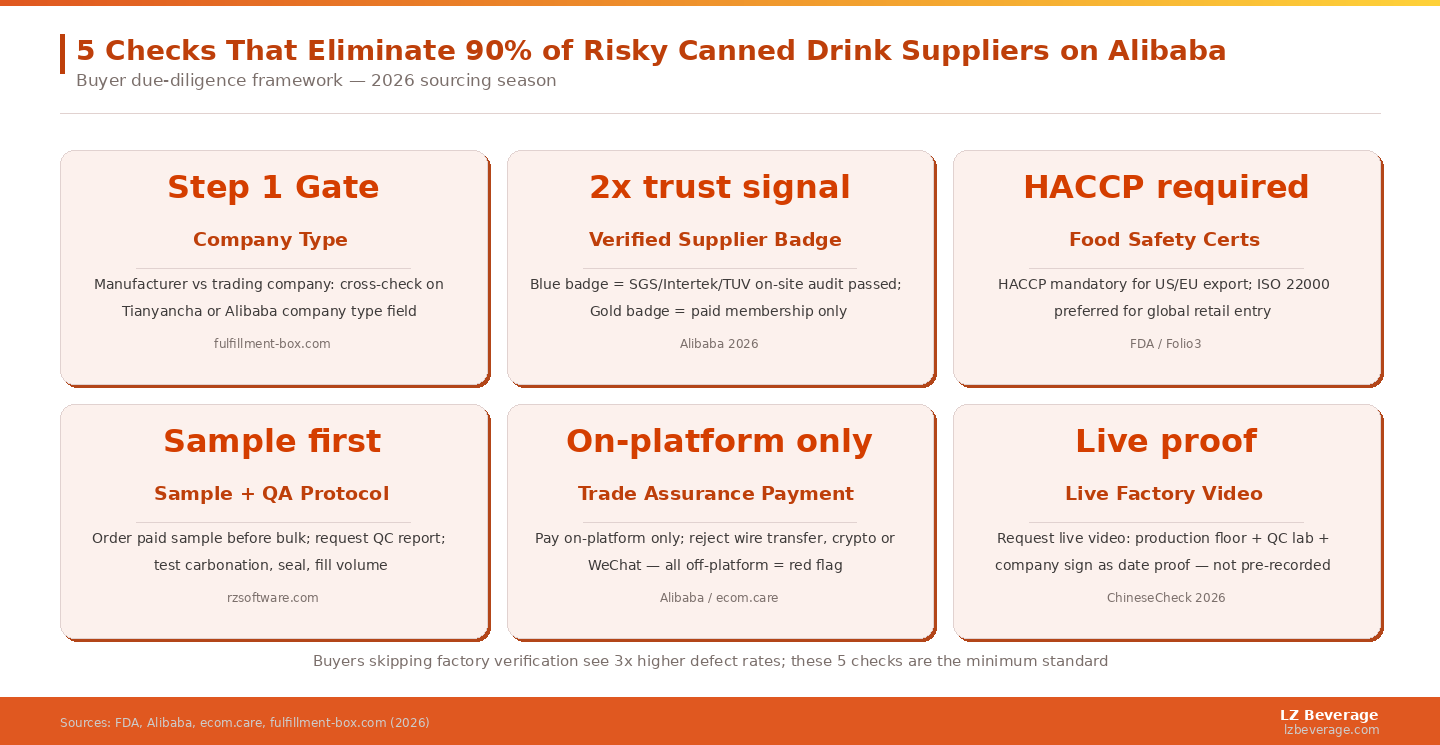
- Verify manufacturer status first — "Gold Supplier" on Alibaba is a paid membership badge, not a factory audit. The blue "Verified Supplier" badge means an independent auditor (SGS, Intertek, or TUV) actually visited the facility.
- HACCP is non-negotiable for most export markets — the FDA requires it for juice and beverages; EU and Middle East buyers increasingly demand ISO 22000 on top.
- Never pay off-platform — Alibaba's Trade Assurance holds funds until you confirm the order; wire transfers, crypto, and WeChat payments remove all dispute protection.
- Sample before you scale — factories that refuse samples, demand full payment upfront, or avoid showing a live factory video are flagging themselves as high-risk.
Step 1 — Determine Whether You're Talking to a Manufacturer or a Trading Company
Why this distinction matters more for beverages
In categories like electronics or textiles, buying through a trading company is sometimes acceptable. In canned beverage OEM, it usually isn't — because the trading company has no control over the formulation, the filling line hygiene, or the ingredient traceability that food-safety auditors will ask about later. Fulfillment Box's 2025 sourcing guide notes that Alibaba profiles clearly label suppliers as "Manufacturer" or "Trading Company" — but many trading companies describe themselves as manufacturers in their pitch text.
How to verify manufacturer status
The fastest cross-check is Tianyancha, China's public business registration database. Type the company's Chinese legal name into the search bar and confirm their business scope lists beverage or food processing — not just trading or export. Additionally, on Alibaba itself, the company type field in the supplier profile shows 制造商 (manufacturer) vs 贸易公司 (trading company). If these don't match the supplier's claims, walk away. For any shortlisted factory, also request a copy of their business license and production permit, then compare the registered address with the Alibaba profile address. Mismatches are a hard red flag.
A pattern we see repeatedly: a supplier lists dozens of unrelated beverage categories — energy drinks, fruit juice, beer, RTD coffee, alcoholic seltzers — all at suspiciously similar prices. Real beverage factories are specialists. Their pricing reflects the actual ingredient costs, filling-line setup, and MOQ minimums for each product type. When a supplier can apparently manufacture anything at the same rate, they are almost certainly brokering — not manufacturing. For buyers who need one-stop canned beverage OEM capabilities across multiple product lines, the right question to ask is: "What filling lines do you operate, and what is the per-SKU setup cost?" A real factory answers this precisely. A trading company deflects.
Step 2 — Decode Alibaba's Supplier Badges (and What They Don't Tell You)
Gold Supplier vs Verified Supplier
Alibaba uses two main trust signals that buyers frequently confuse. The Gold Supplier badge means the company has paid for a premium Alibaba membership — it is a commercial subscription, not a quality or factory audit. The blue Verified Supplier badge is substantially different: it means the supplier has paid for and passed an on-site inspection by an independent auditing company such as SGS, Intertek, or TUV Rheinland, which reviews manufacturing equipment, business licenses, and compliance documentation. According to Fulfillment Box, the verified supplier status comes with a detailed audit report and factory video that buyers can actually review.
For canned beverage sourcing, prioritize Verified Supplier status over Gold Supplier status. A Gold Supplier without factory verification provides no assurance of manufacturing capability. We recommend filtering search results to show only Verified Suppliers, then further screening by years on platform (prefer 5+ years) and response time (under 24 hours correlates with operational capacity).
How to use Alibaba's RFQ system effectively
The AliSourcePro Request for Quotation service lets buyers post detailed specifications and receive competing quotes within 24 hours. Wise's 2025 Alibaba sourcing guide recommends posting an RFQ with at least 10 to 15 specific technical questions — including fill volume, can gauge, carbonation level if applicable, ingredient sourcing, and which certifications the factory holds. A legitimate canned beverage manufacturer responds with precise, sourced answers. Slow or vague replies after 24 hours are a meaningful signal.
Step 3 — Require Food Safety Certifications Before Shortlisting
HACCP — the minimum floor for beverage export
The FDA defines HACCP as a systematic approach to identifying, evaluating, and controlling food safety hazards from raw material handling through to the finished beverage. Per FDA guidance, HACCP is mandatory for juice manufacturers selling in the US. Most EU member states and many Middle Eastern import authorities apply equivalent requirements. A canned beverage manufacturer without current HACCP certification is not export-ready for most major markets — full stop.
Beyond HACCP, look for ISO 22000 (which extends food safety management to the full supply chain), GMP certification (which covers hygiene and facility controls on the production floor), and export qualification from China's General Administration of Customs. Food technology consultancy Folio3 reports that 73% of global consumers are now willing to pay a premium for products with verified safety certifications — making your supplier's cert stack a commercial advantage, not just a compliance checkbox.
How to verify certifications are genuine
Fake or expired certificates are common. Request the original certificate PDF, note the certificate number and issuing body, then contact the issuing body directly to confirm validity. Do not accept screenshots or photos of certificates — only PDFs with a traceable certificate ID. NSF International, SGS, and Bureau Veritas all maintain online certificate verification portals. Any supplier who cannot provide a verifiable certificate number for a claimed HACCP certification should be removed from your shortlist immediately.
Step 4 — Run a Structured Sample and Quality Audit Before Placing Bulk Orders
Why sampling is the single most important step
Sampling is not a formality. Research on HACCP-certified facilities shows that manufacturers with structured quality systems reduce operational inefficiencies by up to 30% — and that gap becomes visible during sampling. Request a paid sample of your specific formulation (not a stock flavor), with your target can size and fill volume. Evaluate carbonation retention, flavor consistency, seal integrity, and label adhesion across at least five cans from the same production batch.
If the manufacturer delivers a perfect sample but then ships inferior bulk goods — a classic bait-and-switch — you'll want contractual recourse. Build your purchase agreement around three things: a detailed product specification sheet with tolerances, a pre-shipment inspection clause (use a third-party inspector like Bureau Veritas or QIMA), and phased payment milestones tied to production progress.
The video factory tour as a live verification tool
Before placing any deposit, request a live video call where the factory representative walks you through the production floor, shows the QC lab and raw material storage area, and holds up a sign with your company name and the current date as proof the call is live. ChineseCheck's 2026 scam guide documents cases where factory photos are systematically stolen from legitimate manufacturers and reused by shell entities. A live, unscripted factory tour is the fastest way to distinguish a real operation from a facade.
Step 5 — Protect Your Payment Through Alibaba's Trade Assurance
How Trade Assurance works for beverage orders
Alibaba's Trade Assurance is an escrow-style payment system that holds your funds and transfers them to the supplier only after you confirm receipt and quality of the goods. Wise's sourcing guide confirms that only orders placed and paid through Alibaba's platform are covered — payments made via PayPal, Western Union, bank wire, or cryptocurrency to accounts outside the platform carry no dispute protection.
For a first canned beverage order, the structure we recommend: 30% deposit through Trade Assurance to initiate production, 70% balance after a passed pre-shipment inspection report. This keeps your money protected and gives you a verification checkpoint before the goods leave the factory.
Red flags that should end negotiations immediately
Any supplier who insists on payment outside the Alibaba platform, offers prices dramatically below other quotes without explanation, refuses to provide a factory video or sample, or cannot produce a traceable food safety certificate is exhibiting red flags that warrant disqualification. The ECOM.CARE 2026 scam guide notes that bank account change requests close to final payment are a specific fraud pattern — always verify payment details independently before transferring any balance.
Working With Chinese Beverage Manufacturers Beyond Alibaba
What to look for in a long-term OEM partner
Alibaba is an excellent starting point for discovery and initial screening, but it is not the only path to a reliable canned beverage OEM manufacturer. International food trade shows (Anuga in Cologne, SIAL in Paris, or Canton Fair in Guangzhou) allow face-to-face factory meetings with pre-vetted exhibitors. Export databases maintained by China's General Administration of Customs list registered food exporters by product category and destination market.
For brands that need a one-stop canned beverage OEM partner with an integrated aluminum can supply chain — covering energy drinks, fruit juice, coffee, tea, and beer under one roof — the key evaluation criteria are annual output capacity, the number of dedicated filling lines, and whether the factory self-produces its own cans or sources them externally. We cover the full OEM/ODM capability framework in our factory overview. Factories with 20+ production lines and 200,000+ metric tons annual capacity are in a different reliability category than smaller operations, simply because their quality systems have to scale and be documented to maintain that throughput.
Next Steps: Your Alibaba Supplier Vetting Action Plan
- Today: Filter Alibaba results to Verified Suppliers only and run Tianyancha cross-checks on your top 5 shortlisted factories.
- This week: Send a 10-question RFQ covering certifications, filling line types, MOQ, and sample policy — eliminate any supplier that responds vaguely or after 24 hours.
- Before deposit: Request and verify certificate numbers for HACCP (and ISO 22000 if your target market requires it) directly with the issuing body.
- Before bulk production: Order paid samples in your exact can size and formulation; conduct a live video factory tour with a company-name sign as proof.
- At payment: Structure all payments through Alibaba Trade Assurance; use 30/70 milestone payments tied to a third-party pre-shipment inspection report.
Frequently Asked Questions
Is a Gold Supplier badge enough to trust a canned drink manufacturer on Alibaba?
No. Gold Supplier status is a paid Alibaba membership, not a factory audit or quality certification. For canned beverage OEM, the meaningful trust signal is the blue Verified Supplier badge, which requires an on-site inspection by an accredited auditor. Always pair that with your own certificate verification and a sample order.
What certifications should a canned beverage OEM factory hold for US or EU export?
At minimum, HACCP (required by FDA for juice and beverages) and GMP. For EU markets, ISO 22000 is strongly preferred and increasingly required by major retail chains. Middle East buyers typically additionally require Halal certification. Confirm all certificates are current, traceable, and issued by accredited bodies — not self-declared.
Can I use Alibaba's Trade Assurance for custom-formulated beverage orders?
Yes, Trade Assurance covers custom OEM orders on Alibaba when the order is placed and paid through the platform. The key is building detailed product specifications into the Trade Assurance order form so that quality disputes have a documented baseline. Without a specification sheet attached to the order, dispute resolution becomes much harder.
How do I know if a beverage manufacturer is actually a trading company?
Check the Alibaba profile's company type field (制造商 = manufacturer, 贸易公司 = trading company), cross-reference on Tianyancha using the Chinese company name, ask for their production permit and business license, and request a live factory video tour. A real manufacturer will answer questions about specific filling lines, capacity, and formulation process with precision — a trading company typically cannot.


