A canned beverage order that passes every quality check, hits every production milestone, and ships on time can still be stopped at customs for weeks — not because the product is unsafe, but because a single document is missing, incorrectly filled out, or mismatched against another document in the same set. Customs documentation for canned beverage exports from China is not complex in theory, but it requires meticulous consistency across nine distinct documents, each issued by different parties, on different timelines, with different validity windows.
Why we wrote this: After processing hundreds of export shipments across Southeast Asia, the Middle East, and Europe, our logistics team has mapped every documentation failure that causes customs delays. This guide gives you that map — so your first shipment is as clean as your hundredth.
Key Takeaways
- Nine documents are required for a standard canned beverage export from China — each serves a different customs function and is issued by a different authority.
- Document consistency is the most common cause of customs holds — the company name, product description, quantity, and HS code must match identically across all nine documents.
- The GACC export registration number must appear on customs declarations and must be current; expired registration is grounds for cargo hold.
- The Health/Sanitation Certificate is destination-market-specific — what GACC issues for an EU-bound shipment differs from what is required for Middle East or US-bound goods.
- A freight forwarder handles logistics but cannot replace a customs broker — for food product exports, specialized customs brokerage significantly reduces documentation error rates.
Before You Start: The Two Factory Prerequisites
No amount of documentation preparation will help if the factory itself is not export-qualified. Before initiating any shipment, confirm that the factory holds a current Food Production License (SC license) covering your product category and a valid GACC export enterprise registration number. Both are checked against Chinese government databases during customs clearance on the export side. The GACC registration framework, established under Decree 248 and its predecessors, requires that the factory's registration information in the system exactly matches the details on export declarations.
The 9 Export Documents — What Each Is and Who Issues It
Document 1: Commercial Invoice
The commercial invoice is the foundational export document and the reference point against which all other documents are checked. It states the seller (factory or trading company), the buyer (importer), the product description, unit price, total invoice value, currency, Incoterms (e.g., FOB Qingdao, CIF Dubai), and payment terms. Critical rule: every detail on the commercial invoice — company names, HS code, product description, quantity, unit — must be reproduced exactly and consistently across every other document in the set. A single discrepancy between the invoice and the packing list, for example, is sufficient for a customs query that delays clearance.
Document 2: Packing List
The packing list details every carton in the shipment: number of cans per carton, net weight, gross weight, carton dimensions, total pallet count and case markings. It is issued by the factory and cross-referenced against the bill of lading during loading. Chinese customs auditors compare the packing list to the physical cargo count during the outbound inspection process. Discrepancies — even minor ones, such as a declared weight that doesn't match the weigh-bridge ticket — can trigger a full container examination.
Document 3: Bill of Lading (B/L)
The bill of lading is both the contract of carriage and the title document for the goods. It is issued by the shipping line and describes the cargo, the port of loading, the port of destination, and the parties to the shipment. For canned beverage exporters, the description of goods on the B/L must match the commercial invoice exactly — generic descriptions like "food products" are acceptable for some markets but may trigger additional scrutiny for others. Most beverage shipments use a negotiable original B/L in three originals; the buyer surrenders an original to claim the cargo at destination.
Document 4: Certificate of Origin
The Certificate of Origin (C/O) certifies that the goods were produced in China. It is issued by the China Council for the Promotion of International Trade (CCPIT) or a recognized Chamber of Commerce, typically within 24 to 48 hours of application. The cost is modest — typically $10 to $50 per certificate. The C/O is required to claim preferential tariff treatment under China's free trade agreements (ASEAN-China, RCEP, bilateral FTAs with over 23 countries and regions). Even where no preferential tariff applies, many importing countries require a C/O for general customs classification purposes.
Document 5: Health/Sanitation Certificate
The Health or Sanitation Certificate is issued by the local GACC/CIQ (Customs and Quarantine Inspection) office and certifies that the canned beverages meet the food safety standards of the destination country. The specific format and content of this certificate varies by destination market — a certificate for EU-bound goods follows different templates than one for Middle East or US-bound shipments. Obtaining this certificate requires the factory to submit product test reports, production batch records and a request to the local GACC/CIQ office. Lead time is typically 3 to 7 business days; applications should be initiated immediately after production completion.
Document 6: GACC Export Enterprise Registration
The factory's GACC export enterprise registration number must be declared on the Chinese customs export declaration form. This registration number is the government's verification that the exporting facility has been assessed and approved for food export. It must be current — if registration has lapsed, Chinese customs will reject the export declaration and the shipment cannot clear the port. GACC's 2025 guidance reaffirms that all food factories must maintain active registration status and that any changes to production scope require updated registration before the new products can be exported.
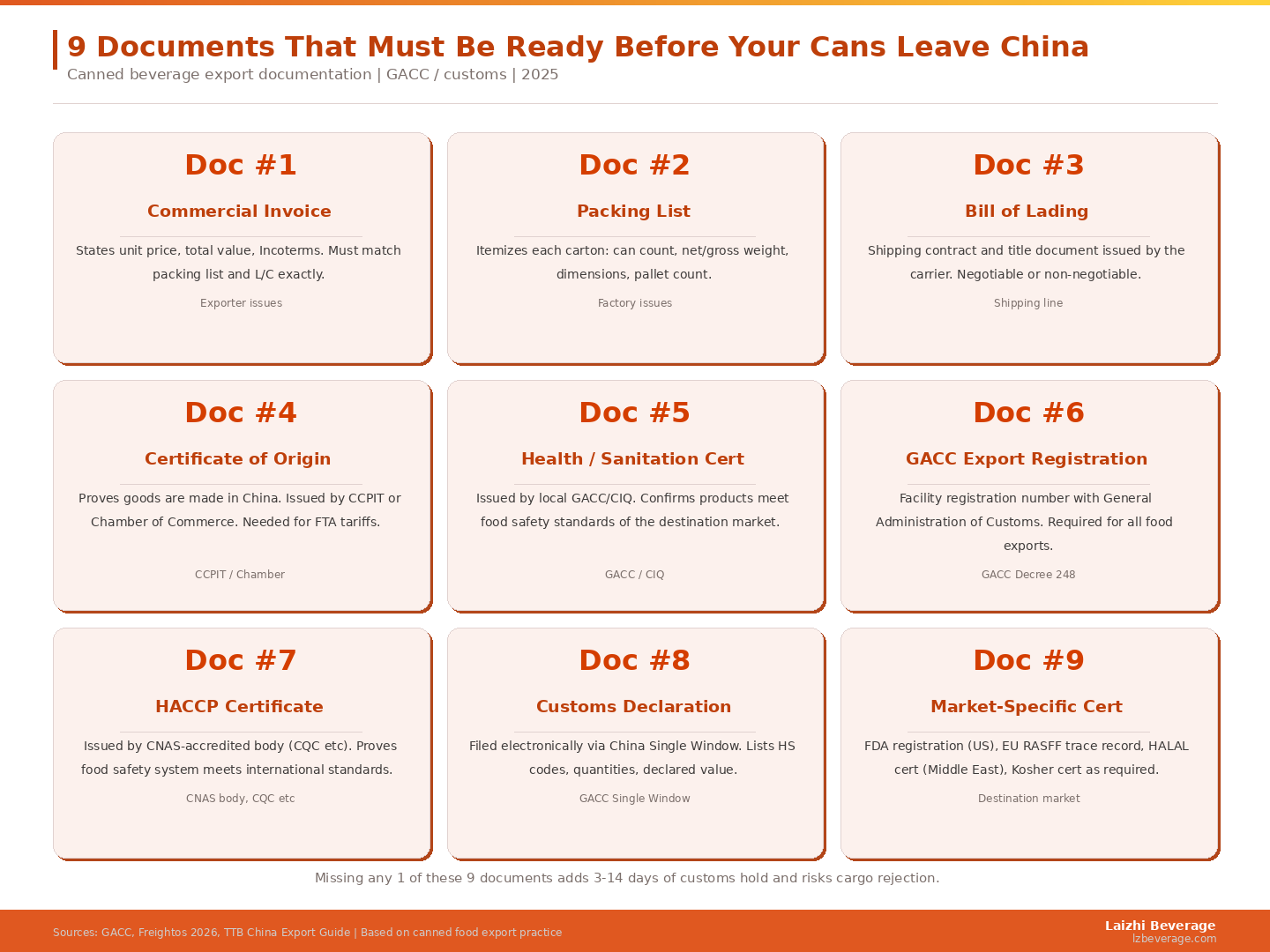
Document 7: HACCP Certificate
The HACCP certificate is not a one-time export document — it is a standing factory credential, issued by a CNAS-accredited certification body and typically valid for three years with annual surveillance audits. However, importing country customs authorities or destination-market importers often request a copy with each shipment to confirm the certificate remains valid. Some markets (Japan, certain EU ports) include HACCP certificate verification as part of their documentary clearance check. The factory should maintain a current, non-expired copy in the export documentation package for every shipment. Our HACCP certification, held since 2017, is available to share with prospective customers as part of standard supplier documentation.
Document 8: Customs Export Declaration
The Chinese customs export declaration (出口报关单) is filed electronically through China's Single Window (China International Trade Single Window, CITS). It declares the HS code, quantity, declared value, factory GACC registration number, consignee, port of destination and transport details. This declaration is filed by the factory's customs broker or freight forwarder and triggers the Chinese customs clearance process. Once accepted, customs may conduct a documentary review, a physical inspection, or allow direct release — typically within 24 to 72 hours for routine shipments from established registered exporters.
Document 9: Market-Specific Certificates
Depending on the destination market, additional certificates are required on top of the eight documents above:
- United States: FDA facility registration documentation (not a certificate per se, but the registration number must be declared). For alcoholic beverages, TTB approval documentation is additionally required.
- Middle East: HALAL certification from a recognized Islamic body, typically required for all food and beverage products exported to Saudi Arabia, UAE, Qatar and most other GCC markets.
- European Union: EU-format health certificate meeting Regulation (EC) 853/2004 standards where applicable; product label pre-approval in the target language may also be required by some EU member states.
- Australia: AQIS import permit for certain beverage categories; alcohol products require additional TGA/ABF documentation.
In our export operations, the documents that most frequently cause delays are the Health/Sanitation Certificate (application initiated too late relative to the shipment date) and the Market-Specific Certificate — particularly for new markets where neither the factory nor the freight forwarder has established the correct template or issuing authority relationship. Our recommendation for any first shipment to a new market: initiate the health certificate application and market-specific certification process at least 15 business days before the planned loading date, not after.
The Document Consistency Rule — The Most Overlooked Export Risk
All nine documents must be internally consistent on five dimensions: company name (seller and buyer), product description (must match HS code classification), quantity (units and gross weight), country of origin (China, always explicitly stated), and invoice value. A factory name that appears differently on the commercial invoice versus the GACC export declaration — even a trivial difference like "Co., Ltd." versus "Co. Ltd." — can trigger a customs query. Experienced logistics providers confirm that documentation inconsistency is one of the leading causes of Chinese food export customs holds, and that appointing a specialist food customs broker reduces error rates significantly compared to using a general freight forwarder for the declaration work.
Pre-Shipment Timeline: When Each Document Should Be Ready
A workable timeline for a standard canned beverage export shipment works backwards from the vessel departure date. By Day -14: confirm GACC registration and HACCP certificate are current. By Day -10: initiate Health/Sanitation Certificate application with local GACC/CIQ. By Day -7: complete production and quality release; finalize commercial invoice and packing list. By Day -5: submit Certificate of Origin application to CCPIT. By Day -3: confirm all documents received; brief the customs broker for declaration filing. By Day -1: submit electronic customs declaration through China Single Window. By Day 0: cargo loaded; Bill of Lading issued by shipping line. Any disruption in this sequence typically results in a missed vessel and at minimum a one-week delay to the next available sailing.
Next-step checklist
- Today: audit your export documentation checklist against the 9 documents in this guide — identify which ones your factory already has in standing file versus which require per-shipment application.
- Before your next shipment: verify that your GACC export registration is current and that the registration number in the system matches exactly what appears on your customs declaration template.
- For each new destination market: identify the specific Health Certificate format required and the correct issuing authority — do this research 30 days before the planned shipment, not 5 days before loading.
- This week: review your last three shipment documentation sets for consistency — company names, HS codes, quantities and product descriptions should be word-for-word identical across all documents in each set.
- For high-volume export operations: engage a specialist food customs broker who handles canned food and beverage declarations regularly, separate from your freight forwarder.
FAQ
What is the most common reason canned beverage shipments are held at Chinese customs?
Documentation inconsistency — specifically, mismatches between the commercial invoice, packing list and customs declaration on product description, quantity or declared value. The second most common cause is an expired or mismatched GACC export registration. Both are preventable with a pre-shipment documentation checklist reviewed by an experienced customs broker before declaration filing.
Can a freight forwarder handle all nine documents?
A freight forwarder handles the bill of lading, customs declaration filing, and logistics coordination. They cannot issue the commercial invoice (that is the factory's responsibility), the Certificate of Origin (issued by CCPIT or Chamber), the Health Certificate (issued by GACC/CIQ), or your factory's HACCP or GACC registration documents. A freight forwarder who promises to "handle all documents" is typically collecting and compiling documents issued by others — the responsibility for accuracy rests with each issuing party.
Do we need a new Health Certificate for every shipment?
Yes, for most destination markets. The Health/Sanitation Certificate is issued per shipment batch and references specific production dates, batch numbers and test results. It is not a standing certificate — it must be applied for and obtained fresh for each export consignment. This is one reason why the 10 to 14 day pre-shipment documentation window must be respected; the Health Certificate cannot be rushed through GACC/CIQ faster than their standard processing time.
What happens to a shipment if documents arrive after the vessel departs?
In most cases, the importer can use scanned copies for initial customs clearance, with originals to follow by courier. However, some markets — particularly those with strict letter-of-credit payment terms — require original documents to release payment. For new market entries or first-time trade relationships, establish whether originals are required before the shipment departs and arrange for DHL/FedEx delivery of original documents on the same day they are issued.
Where can I find Laizhi Beverage's export credentials?
Our GACC export enterprise registration, HACCP certificate (2017), export qualification (2018) and Clean Production certification (2009) are available as part of our standard supplier documentation package. Visit our factory overview page or contact our sales team directly to receive a full credential package before placing your first order. We also offer custom OEM production across our full beverage product range.


