The global private label beverages market was valued at USD 68.5 billion in 2024 and is forecast to grow to USD 121.7 billion by 2033 — a reflection of how seriously the industry has taken the shift from commodity production to brand-owned distribution. Within this market, every brand that does not own a factory faces the same foundational question before they can place a single order: should they build their canned drink around a manufacturer's existing formula (private label / ODM), or develop a proprietary formula that they own outright (custom OEM)? The answer has consequences for time to market, cost structure, long-term competitive advantage, and what happens when market conditions change. Getting this decision right at the outset saves months of wasted iteration later.
Why we wrote this: We work with both types of clients — those who want to launch a branded canned drink as quickly as possible and those who are building a long-term brand that requires a formula no competitor can replicate. Neither approach is universally better. What we observe is that the wrong choice is almost always made by clients who did not understand the implications of each model before signing a production agreement. This guide makes those implications transparent.
Key Takeaways
- Private label / ODM gets you to market 40% faster than custom OEM formulation, but the formula remains the manufacturer's IP — not yours.
- Custom OEM commands 30–50% higher profit margins on premium products because differentiation supports a higher price point that private label cannot sustain.
- The single largest risk of private label is formula discontinuation — if your manufacturer stops producing the formula, or is acquired, your entire product line depends on that outcome.
- Custom formula OEM requires 14–20 weeks and USD 20,000–100,000 in R&D costs depending on formulation complexity and number of sample rounds.
- Most successful long-term beverage brands start with ODM and migrate to custom OEM once they have validated the market and have the volume to justify proprietary formulation investment.
Defining the Two Approaches
Private Label / ODM: Speed Over Uniqueness
In the private label or ODM model, the manufacturer owns a pre-developed formula that has already been validated for shelf stability, taste, and regulatory compliance across relevant markets. The brand owner selects a formula from the manufacturer's existing range, customizes the packaging and label, and markets the product under their own name. Modifications to the formula are typically limited — sweetness level adjustments, mild flavor adaption, or fragrance additions in some categories — because the core formulation architecture belongs to the factory. Private label is the fastest way to get to market and the lowest-risk approach for first-time brand entrants testing a new product category or geography.
Custom OEM: Differentiation and IP Ownership
In the custom OEM model, the brand owner develops a unique formula — either in collaboration with the manufacturer's R&D team or through an independent formulation consultant — and the manufacturer produces it to specification. The formula belongs to the brand owner, documented in a formulation agreement. This means the brand can move production to a different factory, scale without renegotiating formula rights, and build product equity that is tied to the formula itself rather than merely to the packaging. Custom OEM typically commands 30–50% higher profit margins on premium products because the proprietary formula supports a price premium that a widely-available private label formula cannot.
Observing what happens to private label beverage projects when the manufacturer changes a base formula without notifying the brand — which happens more commonly than brands expect when an ingredient becomes scarce, is discontinued, or is reformulated for cost reasons — reveals the real cost of formula dependency. When this happens, the brand has no contractual basis to prevent the change, no technical documentation to recreate the original, and no alternative factory that can replicate it because only the original manufacturer knows the full specification. For brands that have invested significantly in marketing a "signature taste," this is an existential vulnerability. Custom OEM eliminates it entirely by transferring formula ownership to the brand at the point of production agreement.
The Five Dimensions That Should Drive Your Decision
1. Time to Market
Private label / ODM formulas typically move from agreement to first shipment in 8 to 12 weeks — the bulk of that time consumed by label design, regulatory review, and production scheduling rather than formula development. Custom OEM adds a formulation development and sampling phase that typically requires 4 to 8 weeks for standard formulations and up to 12 weeks for complex functional beverages with novel ingredients. The total timeline for custom OEM is generally 14 to 20 weeks. For brands with a specific launch window — a trade show debut, a seasonal campaign, or a retail listing with a hard activation date — the 40% time difference between ODM and custom OEM may be the deciding factor.
2. Upfront Investment
Private label / ODM has a low upfront investment because the manufacturer absorbs the R&D cost. The brand owner pays for production quantity (at agreed MOQ) and packaging tooling. Custom OEM formulation development involves laboratory time, raw material sourcing for prototypes, multiple sample rounds, and often third-party shelf-life testing — cumulative costs that typically range from USD 20,000 to USD 100,000 for beverage categories, depending on the complexity of the ingredient system and the number of iterations required.
3. Intellectual Property and Supply Chain Control
This is the most consequential long-term difference. If you use a manufacturer's existing formula (private label), you do not control that formula — if the manufacturer changes it, discontinues it, or closes, your product is at the mercy of that outcome. A brand that has built significant retail placement, consumer loyalty, and marketing equity around a product that uses a formula it does not own is in a fragile position. Custom OEM, by contrast, means the formula travels with the brand. A change of manufacturer — whether due to cost optimization, quality issues, or capacity constraints — does not require reformulation; it requires only transferring the specification document to a new factory.
4. Product Differentiation and Pricing Power
Private label formulas, by definition, are available to multiple brands through the same manufacturer. If your competitive strategy depends on a distinctive taste, a unique ingredient system, or a functional claim that no competitor can match, private label cannot deliver that. Custom OEM can — and that uniqueness supports a price premium at retail that feeds back into higher margins. McKinsey's analysis of CPG performance from 2002 to 2024 found that private labels and disruptors captured a growing share of incremental demand as national brands struggled to justify price premiums through generic product offerings. The implication for small and emerging brands is that differentiation — not just distribution — is what sustains margin over time.
5. Market Risk and Validation
Custom OEM investment is best justified by proven market demand. Before committing USD 20,000 to 100,000 to formula development for a brand that has not yet tested consumer response, it is worth asking whether a private label product could validate the market at lower cost first. Many successful canned beverage brands have followed exactly this path: launch with an ODM formula under their label, test price elasticity, collect consumer feedback, build distribution relationships, and then — once the market is validated — invest in a proprietary formula that locks in the product's identity and margin structure.
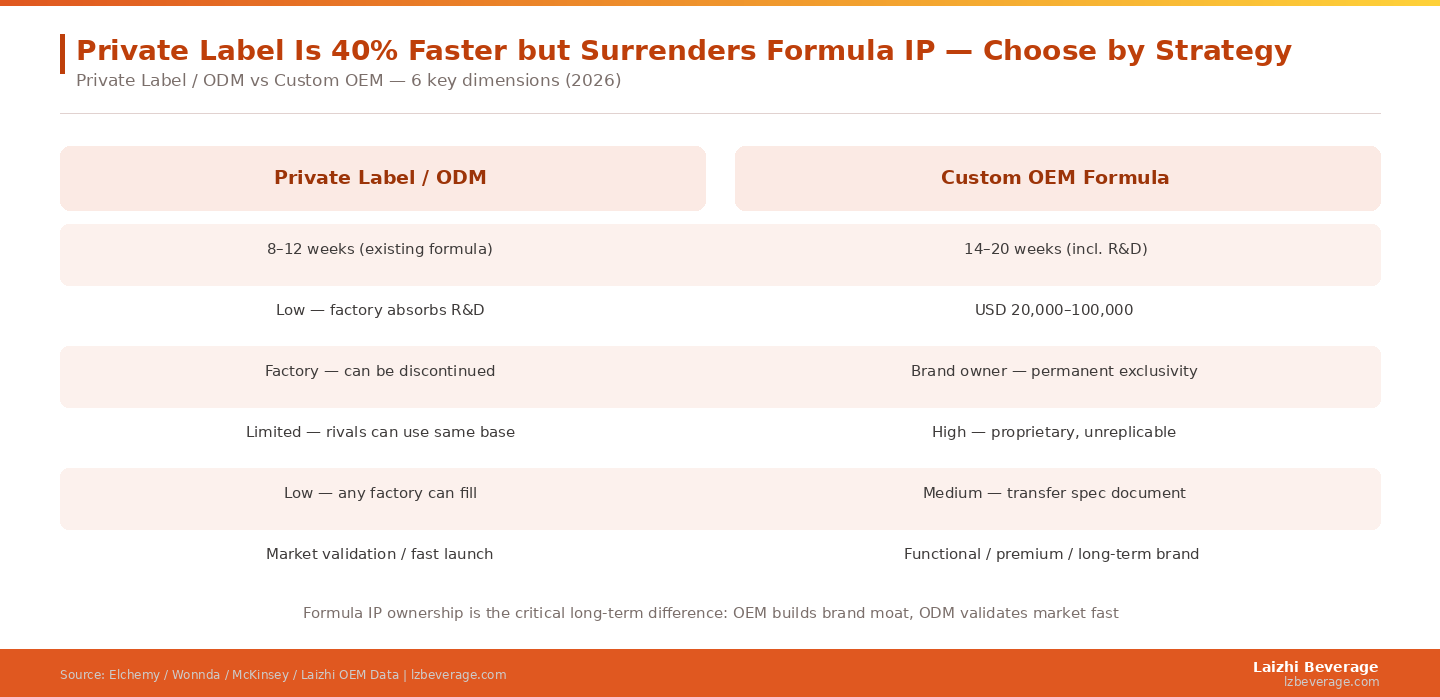
Side-by-Side: Decision Factors at a Glance
| Decision Factor |
Private Label / ODM |
Custom OEM Formula |
Recommendation |
| Time to first shipment |
8–12 weeks |
14–20 weeks |
ODM if launch window is fixed |
| R&D upfront cost |
Low (factory absorbs) |
USD 20,000–100,000 |
ODM for first-time market entry |
| Formula ownership |
Factory |
Brand owner |
OEM for long-term brand building |
| Product differentiation |
Limited |
High |
OEM for premium/functional segments |
| Margin potential |
Standard |
30–50% higher on premium tiers |
OEM if pricing power is the strategy |
| Supply chain risk |
Formula can be discontinued |
Formula portable to any factory |
OEM for resilient multi-sourcing |
| Market validation |
Use existing formula to test |
Invest after validation |
ODM first, OEM at scale |
Which Categories Should Default to Custom OEM
Functional and Health-Positioned Beverages
Energy drinks, nootropic beverages, sports recovery drinks, and adaptogen teas compete primarily on the basis of their ingredient story. A brand claiming a proprietary blend of ingredients for cognitive performance cannot credibly make that claim using a standard private label formula that any competitor can order from the same factory. Custom OEM is structurally necessary for this segment — the ingredient specification IS the product. It is also legally necessary in markets where health claims must be substantiated by documented ingredient levels, as a private label formula may not provide the level of ingredient documentation needed for regulatory compliance in target markets.
Premium RTD Categories (Coffee, Tea, Craft Beer)
Premium RTD coffee, specialty tea, and craft-style canned beer brands succeed in retail because they can tell a credible product story — specific origin, roast profile, tea variety, hop character. These stories are only credible if the brand controls the formula. A private label RTD coffee can carry beautiful packaging, but if the brand cannot answer questions about the sourcing, roast level, or processing method with specificity, the premium positioning becomes hollow under consumer scrutiny. Custom OEM gives the brand the technical ownership to make and defend specific product claims.
Export-Focused Brands Building Long-Term Market Presence
Brands entering new export markets — particularly the Middle East, Europe, or Southeast Asia — with a multi-year commitment should invest in custom OEM from the outset. Formula consistency across markets and over time is a brand equity driver. If a brand's taste profile is dictated by whatever private label formula the manufacturer currently offers, it is vulnerable to the supply chain disruptions, ingredient substitutions, and formula modifications that manufacturing realities produce over a 3 to 5 year horizon. Our export-certified OEM production supports both approaches, with documented formulation agreements available for custom OEM clients.
Next-step checklist
- Today: Define your brand positioning strategy – differentiation through the product formula itself (→ OEM) or through brand narrative + distribution channels (→ private label ODM can be implemented first).
- This Week: Assess your launch window – if less than 12 weeks until the target launch date, private label ODM is the only realistic option.
- Before Signing: Clarify the formula IP ownership agreement with the factory. For private label products, the contract must confirm a clause requiring "X days' written notice for formula changes".
- If choosing OEM: Reserve a budget of $20,000-$100,000 for R&D prototyping and include a 14-20 week formula development cycle in the project plan.
- Long-Term Planning: After validating the market with private label ODM, once annual sales exceed a certain threshold, initiate the migration to a custom formula to establish a true product barrier.
FAQ
Can I switch from private label to custom OEM later without losing market continuity?
Yes, but the transition requires careful planning. The new custom formula will not taste identical to the private label formula, which means existing consumers will notice a change. The transition is best managed as a product "upgrade" or "new formula" launch rather than a silent reformulation — framing the change as an improvement, with clear communication, is more effective than hoping consumers do not notice. The transition also requires a parallel production period where both formulas are available to avoid supply gaps during the switchover.
Does owning a custom formula mean I can produce it at any factory?
In principle, yes — if the formulation agreement clearly transfers formula ownership to the brand and includes complete specification documentation (ingredient specifications, processing parameters, quality standards). In practice, complex formulas with proprietary ingredients or specialized processing steps may require qualification at each new factory, which takes time. Simpler formulas — standard energy drink base, flavored sparkling water, fruit juice blend — transfer more easily. When negotiating custom OEM agreements, insist on receiving complete formulation documentation and retain it independently of the factory's records.
What if the private label formula I choose becomes very similar to a competitor's product?
This is a real risk and a common outcome. If the manufacturer's formula is available to multiple brands, and multiple brands order the same formula, the market may end up with similar-tasting products differentiated only by packaging. At that point, competition shifts entirely to price, distribution muscle, and marketing spend — not product quality. Brands in this position often find that margins compress over time as distributors play them against competing private label brands using the same base formula. If your category is prone to this dynamic, custom OEM is the insurance policy that protects your margin and your story.
Does Laizhi Beverage offer both ODM private label and custom OEM?
Yes. We offer pre-developed formula options across our product categories — energy drinks, juices, RTD tea, RTD coffee, beer, and carbonated beverages — for brands that want to move quickly with an ODM approach. We also offer full custom formulation development, including R&D sampling, ingredient sourcing, shelf-life validation, and complete formulation documentation for brands building proprietary products. Explore our product portfolio to see the categories where we have active ODM formulas, or contact us to discuss custom formulation for your target segment.


