The most common financial mistake in a canned beverage business plan is treating OEM manufacturing as a single line item rather than a structured cost category with multiple independent drivers. A client who plans for "production cost" without separately accounting for raw materials, packaging, filling fees, formulation R&D, compliance testing, and freight will almost certainly exhaust their initial budget before the first commercial shipment leaves the factory. Industry consultants typically estimate starting a beverage company at USD 100,000 to USD 300,000 — but that number is only useful if you understand what is inside it and where the highest variance lies.
Why we wrote this: We work with new brand clients at every stage of business planning, from initial inquiry to first commercial shipment. The clients who have the smoothest project trajectories are those who arrive with a realistic, structured budget. The clients who struggle most are those who planned a single production cost number without understanding its components. This guide breaks down every cost category you need to plan for before placing your first OEM order.
Key Takeaways
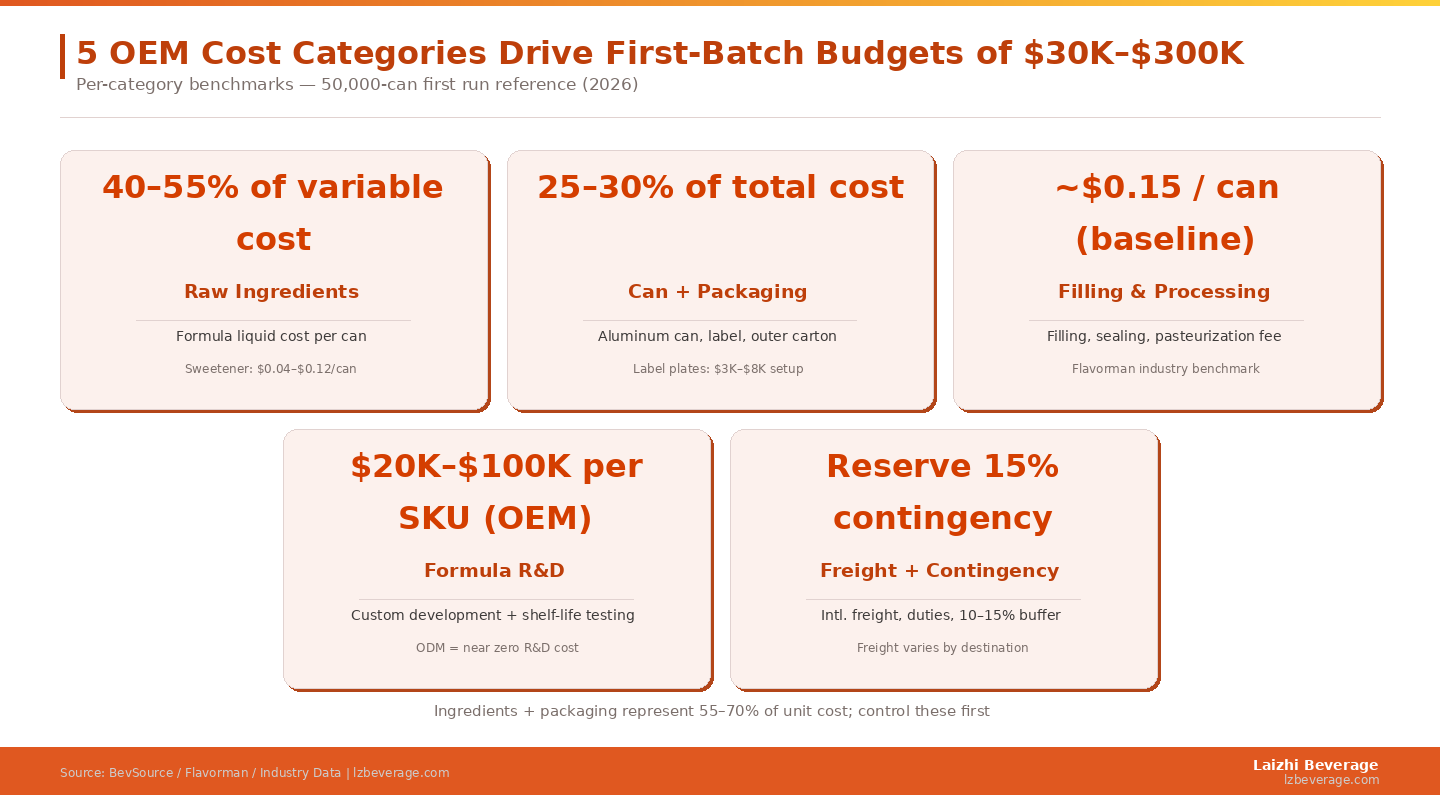
- A realistic first-batch OEM budget for a single canned beverage SKU ranges from USD 50,000 to USD 300,000 depending on formula complexity, can quantity, packaging customization, and target market regulatory requirements.
- Raw materials (ingredients) are the highest-variance cost category — standard sweetener-based formulas cost USD 0.04 to 0.12 per can, while organic or exotic ingredient formulas can be 3 to 5 times higher.
- Packaging (cans, labels, outer cartons) typically accounts for 25 to 30% of total per-unit cost — and at low production volumes, this is where economies of scale deliver the fastest improvement.
- Custom formulation R&D is a one-time investment of USD 20,000 to 100,000 per SKU that amortizes across the product's commercial lifetime — not a recurring cost.
- Plan for a 10 to 15% contingency buffer — ingredient price movements, additional sample rounds, and export documentation additions routinely exceed initial estimates by this margin.
The Five Core OEM Cost Categories
1. Raw Materials (Ingredients)
Ingredients are the largest and most variable cost component in a canned beverage OEM project. The cost of the formulated liquid per can depends entirely on what is in it. According to Flavorman's beverage formulation cost data, a standard sugar sweetener in a 12-oz energy drink costs approximately USD 0.04 to 0.05 per can; switching to a sugar-free, low-calorie sweetener blend pushes that specific line item to USD 0.11 to 0.12 per can — a 170% increase on sweetener alone. Every other ingredient in the formula has its own cost structure: fruit concentrates, caffeine sources, vitamins, botanical extracts, and minerals each add to the total. A functional RTD beverage with adaptogens, electrolytes, and a botanical flavor system can cost 3 to 5 times more per can to produce than a straightforward sugar-sweetened carbonated drink with standard flavoring.
2. Packaging: Cans, Labels, and Outer Cartons
Packaging is the second-largest cost category and the area where clients most often underestimate complexity. For canned beverages, packaging includes the aluminum can itself (which has a per-unit cost that varies with can size, finish specification, and order quantity), shrink-sleeve or direct print label artwork and production setup, and outer corrugated carton tooling and printing. Packaging supplies typically comprise 10 to 15% of total production costs at scale, but at low initial volumes the fixed setup costs — label printing plates, artwork origination, carton tooling — can inflate the packaging contribution significantly. Label printing plates alone can cost USD 3,000 to USD 8,000 per color, which is why brands launching with many label variants face non-trivial pre-production tooling expenses even before a single can is filled.
3. Filling, Sealing, and Processing Fees
The OEM factory's core service — filling the formulated liquid into cans, sealing, pasteurizing if required, and labeling — is typically priced at a per-unit filling rate. A useful baseline estimate for the canning or bottling process is approximately USD 0.15 per unit, with variations based on formula complexity, processing requirements (tunnel pasteurization, retort, or aseptic filling add equipment time and cost), and production speed. This filling fee does not include the cost of the liquid ingredients or the packaging materials — it is the factory's service charge for running the production line. For specialty formats — nitrogen-flushed RTD coffee, high-pressure-processed juice, or retort-sterilized protein drinks — the processing premium can add USD 0.05 to 0.15 per unit above the standard filling rate.
4. Formulation R&D and Compliance Testing
Custom formulation development — from initial brief through prototype iterations to final shelf-life validation — is a one-time investment that should be planned for separately from production costs. Beverage industry data suggests USD 20,000 to 45,000 for a single SKU commercial formula and a pilot production run, with the total depending on the number of ingredients, required sample rounds, and the extent of shelf-life testing required. Regulatory compliance testing — nutritional analysis, microbiological safety testing, heavy metals screening, and market-specific certification costs (HACCP audit, halal certification, export documentation) — adds a further USD 5,000 to 20,000 depending on target markets and product category. For brands targeting private label ODM (using the factory's existing formula), R&D costs drop to near zero but compliance testing for the specific target market still applies.
5. Working Capital: Freight, Warehousing, and Cash Flow Buffer
Working capital — the cash needed to fund production before the first sale revenue is received — is the most underestimated cost category in beverage business plans. The OEM model requires payment for production (and often for raw materials) before product ships. International freight from a China-based OEM factory to export markets adds 4 to 8 weeks of transit time during which capital is tied up in transit inventory. Import duties, warehousing fees at destination, and customs clearance costs all occur before the product reaches distribution and before any customer payment arrives. Financial modeling for beverage startups suggests holding a minimum cash cushion well above year-one expected revenue — the asymmetry between the speed of cash outflow (factory payment, freight, warehousing) and the speed of cash inflow (retail payment cycles of 30 to 90 days) is the most common source of early cash crises in OEM beverage businesses.
Sample Budget Framework for a First-Batch Canned Beverage Launch
| Cost Category |
Low Estimate (ODM, Basic Formula) |
High Estimate (Custom OEM, Premium) |
Notes |
| Formula R&D & sampling |
USD 0 (ODM) |
USD 20,000–100,000 |
One-time per SKU; amortized over commercial production lifetime |
| Compliance testing (target market) |
USD 5,000 |
USD 20,000 |
Nutritional analysis + microbiological + certification fees |
| Packaging tooling & artwork |
USD 3,000–8,000 |
USD 15,000–30,000 |
Label printing plates, can artwork origination, carton tooling |
| First production run (50,000 cans) |
USD 15,000–25,000 |
USD 40,000–80,000 |
Includes ingredients, filling, labels, outer cartons |
| International freight (to destination) |
USD 3,000–6,000 |
USD 8,000–15,000 |
Varies by destination, volume, and container type |
| Import duties & customs clearance |
USD 1,000–5,000 |
USD 5,000–20,000 |
Highly variable by product category and destination |
| Working capital buffer (10–15%) |
USD 3,000–8,000 |
USD 25,000–40,000 |
For timeline overruns, ingredient price movements, additional rounds |
| Total first-batch estimate |
USD 30,000–77,000 |
USD 113,000–305,000 |
Excludes brand marketing and distribution costs |
Where Costs Run Over Budget — and How to Prevent It
Ingredient Price Volatility
Commodity ingredients — sugar, fruit concentrates, caffeine, certain vitamins — have volatile procurement prices that fluctuate with agricultural output, currency movements, and supply chain disruptions. A formula budgeted at a certain ingredient cost in January may be 15 to 20% more expensive to source by July if key ingredients have experienced supply pressure. Locking in ingredient pricing through multi-month supply agreements or asking the OEM factory to quote with ingredient price validity dates is the practical way to limit this exposure.
Label Compliance Revisions
Label artwork approved at the design stage frequently requires revision when presented to a compliance reviewer — particularly for multi-market projects where each destination has its own mandatory fields, language requirements, and format rules. Each revision round adds time (1 to 3 weeks) and potential re-printing costs if plates have already been produced. Building a compliance review step into the label development process before artwork is committed to plate production avoids this. We assist clients in coordinating label pre-review as part of our OEM onboarding process for clients targeting export markets.
Additional Sample Rounds
Custom formulation projects budgeted for two sample rounds frequently require three or four. Complex functional formulas — particularly those involving botanical extracts, active ingredients with strong flavor contributions, or highly specific mouthfeel targets — often need additional iteration to land within the brand's quality brief while remaining shelf-stable at the target processing conditions. Each additional sample round adds USD 2,000 to 6,000 in material and shipping costs, and 2 to 4 weeks to the timeline.
MOQ and Volume Planning
For a commercial production run of 5,000 to 25,000 cans, total manufacturing costs typically range from USD 5,000 to 30,000 for one SKU. The per-unit economics improve substantially as volume increases — a production run of 100,000 cans may cost 30 to 40% less per unit than a run of 20,000 cans at the same formula and can specification. Budget planning should model both the minimum viable run (to validate market response) and the scale-up economics, with a clear threshold at which the per-unit margin justifies expansion. Our product portfolio spans multiple categories with flexible production line configurations that allow volume scaling without factory change.
The Hidden Cost Nobody Plans For: Re-Export Documentation
For brands planning multi-market distribution from a single production run — producing in China and distributing to the UAE, Germany, and Australia from the same inventory — the documentation requirements for each market are additive, not shared. A Certificate of Origin for the EU is a different document from a GCC export certificate, which is different from an Australian food safety certificate. These are separate fees, separate processing times, and separate paperwork obligations. Planning a single-market first launch and expanding to additional markets only after first-market validation reduces the documentation overhead and allows the business plan to scale documentation costs proportionally with revenue rather than incurring them all at the first shipment stage.
For clients who need export documentation support alongside OEM production, our export-certified facility has produced documentation packages for markets across Southeast Asia, the Middle East, Europe, and Africa. Contact us to discuss your target markets and we can advise on documentation requirements and timelines before your production brief is finalized.
Next-step checklist
- Today: Break down OEM costs into 5 major categories (raw materials/packaging/filling/R&D/logistics), estimating the minimum and maximum ranges for each, instead of combining them into a single figure.
- This Week: When requesting unit price quotations from OEM factories, explicitly request itemized quotes for "raw materials + filling + packaging," rather than a packaged total price, to track changes in individual costs.
- Budget: Reserve 10-15% of the total budget as a contingency reserve specifically for additional sampling rounds, raw material price increases, and label compliance modifications.
- Planning Phase: Model the cash flow timeline for the first batch of mass production—ensuring sufficient operating funds to cover 3-6 months of operating expenses from factory payment to the first sales receipt.
- Multi-Market Export: Validate a single market first, with documentation costs increasing as needed with revenue growth, avoiding incurring certification costs for all markets on the first shipment.
FAQ
What is the minimum budget to launch a canned beverage via OEM?
A realistic minimum for a private label / ODM launch — using an existing factory formula with standard packaging and a single target market — is approximately USD 30,000 to 50,000 for a first run of 50,000 cans. This includes tooling, testing, production, and freight. A custom OEM launch with proprietary formulation, premium can finish, and multi-market compliance documentation can range from USD 150,000 to 300,000 for the first production batch and accompanying pre-production costs. The lower end of this range should be considered a floor, not an average — surprises in formulation, compliance, or freight costs are far more common than surprises in the downward direction.
How does order volume affect per-unit cost?
Economies of scale in canned beverage OEM are significant and front-loaded. The transition from 20,000 to 100,000 cans per run typically reduces per-unit cost by 25 to 40%, driven primarily by spreading fixed setup costs (filling line changeover, label plate amortization, minimum batch chemistry charges) across more units. Above 100,000 cans per run, further savings are incremental — typically 5 to 15% per doubling — because variable ingredient and packaging costs become the dominant driver rather than fixed setup costs.
Should I factor in marketing and distribution costs in the OEM budget?
They should be in your overall business plan but kept as a separate budget line from OEM manufacturing costs. Conflating them leads to a common error: underestimating how much capital manufacturing consumes and underfunding either production or marketing as a result. Treat OEM manufacturing as your cost of goods, and plan distribution and marketing investment separately on a market-by-market basis. The OEM manufacturing budget should fund getting product to your first warehouse. The marketing and distribution budget funds everything that happens after that.
Are there OEM cost savings I am typically missing?
Several common cost savings are available to brands who ask for them: volume commitment discounts (agreeing to 3 to 4 production runs per year at a specified volume in exchange for per-unit price reductions), ingredient pre-purchasing for campaigns with predictable demand, and consolidating multiple SKUs onto a single production run to share line setup costs. Factories also often have preferred freight forwarding relationships that offer better rates than a brand sourcing freight independently on a per-shipment basis. Ask explicitly about these options — they are not always offered proactively.
We produce across energy drinks, fruit juices, RTD coffee, tea beverages, beer, and carbonated formats. Explore our energy drink OEM service or browse our RTD and carbonated beverage lines to understand the production categories where we have established cost structures and export documentation track records.


