When a brand asks us to manufacture a private-label canned drink for export distribution, shelf life is almost always the first technical question on the brief. How long does the product need to last at ambient temperature? Can it survive a 45-day sea freight voyage to the Middle East without refrigeration? What happens to flavor stability over six months on a retail shelf in a warm climate? The answers to all of these questions begin in the same place: the relationship between the pasteurization method chosen and the sealing integrity achieved during filling.
Why we wrote this: We run 50 production lines with HACCP certification and have manufactured canned beverages across virtually every thermal processing category. The single most common misalignment we see during OEM briefing is when a client specifies a target shelf life that is incompatible with the thermal processing method they have requested — not because they are wrong, but because this technical relationship is rarely explained clearly in one place. This article closes that gap.
Key Takeaways
- Pasteurization method is the primary driver of shelf life — not formulation alone. A well-formulated product processed by the wrong thermal method will still fail to achieve the intended shelf-life target.
- Retort sterilization delivers up to 24 months at ambient temperature — the benchmark for global export canned beverages.
- Tunnel pasteurization is the standard for canned beer, carbonated drinks, and certain RTDs — protecting against post-seal contamination while achieving 6 to 12 months shelf life.
- Double seam integrity is as important as thermal process — a microscopic seam defect can allow Clostridium botulinum entry and undermine even the most rigorous retort cycle.
- pH below 4.2 determines which process is appropriate — high-acid beverages (pH <4.2) can be pasteurized; low-acid beverages must be retorted or aseptically filled.
Why the Thermal Process Defines Shelf Life
The Science Behind Beverage Spoilage
Beverage spoilage happens through two mechanisms: microbial activity and enzymatic degradation. Microorganisms — including bacteria, wild yeasts, and moulds — consume nutrients, produce off-flavors, generate gas, and can render a product unsafe. Enzymes naturally present in fruit-based ingredients continue to react with the product after filling, changing color, flavor, and clarity over time. Both mechanisms accelerate with temperature and oxygen exposure. The role of the thermal process is to eliminate or reduce microbial load below the threshold at which these organisms can cause harm within the target shelf-life window, and the role of the hermetic seal is to prevent recontamination after that reduction.
pH as the Governing Variable
The most important formulation factor in selecting a thermal process is the product's pH. According to Eurofins' best practice guidance for shelf-stable beverage processing, high-acid beverages at pH below 4.2 can typically be shelf-stabilized through pasteurization at temperatures below 100°C because the acid environment inhibits the growth of the most dangerous heat-resistant spore-forming organisms, particularly Clostridium botulinum. Low-acid beverages above pH 4.6 — including most dairy-based drinks, protein shakes, and many tea formulations — require retort sterilization at temperatures above 121°C to achieve commercial sterility. Products in the 4.2 to 4.6 range require the most careful process design and formulation validation.
Combining Eurofins' acid-pH boundary (4.2) with the field data from retort processing logs, the real-world challenge for many energy drink and functional beverage OEM projects is that adding functional ingredients — electrolytes, amino acids, plant extracts — changes the pH in ways that were not anticipated in the original formulation brief. A product designed at pH 3.9 for HTST processing can drift to pH 4.4 after ingredient interaction, putting it in the retort-required zone. Catching this drift during the lab validation phase, before the production run, is the difference between a 6-week correction and a 6-month reformulation cycle.
The Five Main Pasteurization Methods for Canned Beverages
1. High-Pressure Processing (HPP)
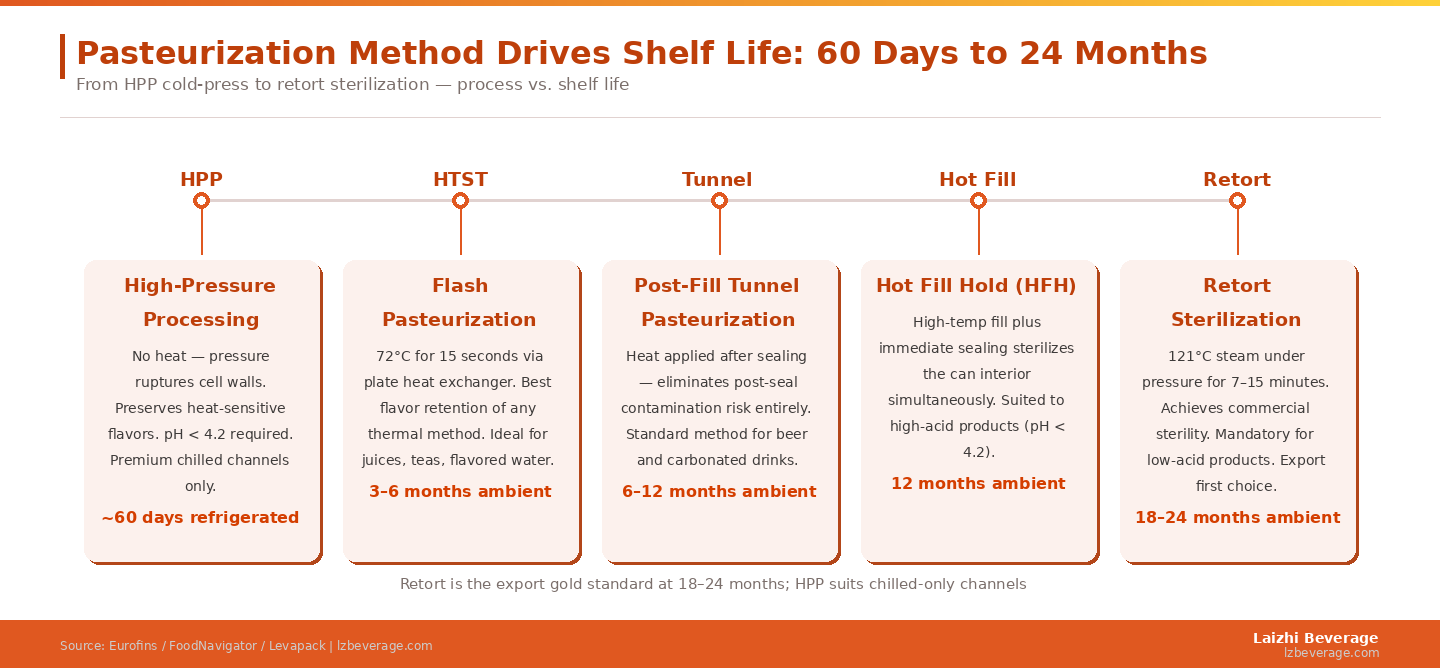
HPP uses intense water pressure — rather than heat — to destroy microorganisms by rupturing cell walls. It is favored for chilled products including cold-pressed juices, smoothies, and certain premium RTD beverages because it preserves heat-sensitive flavor compounds and vitamins exceptionally well. The resulting shelf life is approximately 60 days under continuous refrigeration, making HPP unsuitable for ambient-temperature export distribution. For brands targeting a premium chilled segment in retail channels with reliable cold chains, HPP delivers a clean-label, minimally processed product; for global export canning, it is not the right tool.
2. HTST — High Temperature Short Time (Flash Pasteurization)
HTST is the workhorse method for fruit juices, RTD teas, and certain energy drinks. The beverage is heated to approximately 72°C for 15 seconds as it passes through a plate heat exchanger — eliminating most pathogens without the extended heat exposure that degrades volatile flavor compounds. HTST achieves 3 to 6 months of ambient shelf life when paired with appropriate hermetic sealing into pre-sterilized cans. When paired with aseptic filling in a sterile environment, shelf life can extend to 12 months. A critical operational note: HTST requires the filling and seaming equipment to be pre-sterilized, as the beverage itself is sterile before filling — any contamination in the filling zone becomes a direct quality failure.
3. Tunnel Pasteurization (Post-Fill)
Tunnel pasteurization is particularly well-suited to canned beer, carbonated soft drinks, and certain energy drinks because the process occurs after the can has been sealed. Filled and sealed cans travel through a heated water-spray tunnel, where they are progressively warmed to the pasteurization target temperature, held there for a specified time measured in Pasteurization Units (PUs), and then slowly cooled. One PU equals holding the product at 60°C for one minute; in practice, breweries target 12 to 25 PUs for most beer styles. Because the product is sealed before the heat treatment, tunnel pasteurization eliminates the post-pasteurization contamination risk associated with HTST. The tradeoff is energy intensity and the need for precise thermal profiling to ensure every unit in the tunnel reaches the target PU without over-pasteurizing.
4. Hot Fill Hold (HFH)
Hot fill hold heats the beverage to a high temperature, fills it into pre-heated cans while still hot, seals immediately, and maintains a specified temperature for a defined duration. HFH simultaneously pasteurizes the beverage and sterilizes the internal surface of the can, making it an efficient two-in-one process. It achieves 12 months ambient shelf life for high-acid products and is widely used for juices and flavored waters. Its limitation is that the high-temperature fill is not suitable for packaging materials sensitive to heat, and for carbonated products the pressure dynamics during hot filling require careful equipment management.
5. Retort Sterilization
Retort is the gold standard for export shelf stability. Sealed cans are loaded into a retort vessel (autoclave), where they are treated with steam and/or pressurized water at temperatures above 121°C for 7 to 15 minutes. Retort delivers unmatched shelf life ideal for long-term storage and export — typically 18 to 24 months at ambient temperature. It eliminates all viable microorganisms including heat-resistant spores and is the mandatory method for any low-acid canned beverage. The tradeoff is flavor impact: the extended high-temperature cycle can accelerate Maillard browning in protein-containing beverages and soften certain delicate aromas. Formulation optimization for retort — including the selection of heat-stable flavor systems — is a technical service we routinely provide to OEM clients during the pre-production phase.
The Other Half of Shelf Life: Hermetic Sealing Quality
Why the Double Seam Is a Critical Control Point
Even the most precisely executed retort cycle cannot guarantee shelf life if the hermetic seal is compromised. The double seam that closes an aluminum can is a mechanical joint that interlocks five layers of metal — three from the can lid and two from the can body — through a two-operation rolling process. The result is an airtight, watertight barrier that prevents gas exchange, moisture ingress, and microorganism entry. A seam defect of just a few microns can create an entry pathway for aerobic bacteria — including Clostridium botulinum in low-acid products — that renders the entire thermal process irrelevant.
Seam Inspection: What HACCP-Certified Lines Do Differently
On a well-run canning line, double seam integrity is treated as a critical control point under HACCP, not simply a packaging quality check. Seam inspection covers both visual examinations at regular intervals and destructive teardown evaluations to measure actual seam geometry — seam height, body hook, cover hook, overlap, and tightness rating. On our production lines, seam teardown is performed at specified intervals during every production run, with results logged against control limits. Any seam dimension outside tolerance triggers an immediate stop and investigation before production resumes.
pH and Formulation as Shelf-Life Amplifiers
Beyond the primary variables of thermal process and seam integrity, formulation choices can meaningfully extend or limit shelf life within a given process window. Maintaining pH below 3.5 for pasteurized products adds an inhibitory layer against spoilage organisms beyond what heat alone achieves. Natural antioxidants such as ascorbic acid (vitamin C) slow enzymatic browning in fruit juice-based drinks, while also serving as label-friendly ingredient statements. Formulation decisions made at the OEM brief stage — including choosing heat-stable flavor systems and naturally occurring antimicrobials — compound the benefit of good thermal processing rather than compensating for poor processing.
Matching Process to Product: A Decision Framework
| Product Type |
Recommended Process |
Typical Shelf Life |
Storage Requirement |
| Premium cold-pressed juice, smoothie |
HPP |
~60 days |
Refrigerated throughout |
| Fruit juice, RTD tea, flavored water (high acid) |
HTST or HFH |
3–12 months |
Ambient |
| Canned beer, carbonated energy drink |
Tunnel pasteurization |
6–12 months |
Ambient; cool preferred |
| Dairy RTD, protein drink, low-acid coffee |
Retort |
12–24 months |
Ambient |
| RTD coffee, plant-based milk (export) |
Aseptic + UHT or Retort |
12–18 months |
Ambient |
We produce canned beverages across all of these categories on our 50 production lines. If your product brief includes a target shelf life and distribution territory, we can provide a process recommendation and estimated lead time as part of our OEM consultation. Browse our canned beverage product lines to see the categories we currently produce for private-label clients.
Next-step checklist
- Today: Measure the pH of your product formulation to confirm it is below 4.2 (pasteurization is feasible) or above 4.6 (autoclaving is required).
- This Week: Determine the target shelf life based on the shipping cycle and retail shelf life of the target market, then select the appropriate sterilization method according to the process comparison table in this document.
- Before Prototyping: Confirm with the OEM factory whether double-seal testing is listed as a HACCP critical control point, as well as the testing frequency and recording method.
- Formulation Stage: Jointly assess with the factory the possibility of adding natural antioxidants (vitamin C) to extend the flavor stability period without changing the process.
FAQ
Does pasteurization change the taste of a canned drink?
Yes, to varying degrees depending on the process and the product. HTST and tunnel pasteurization at lower temperatures and shorter dwell times have the least impact on flavor, making them preferred for delicate beverages like fruit teas and carbonated drinks. Retort at 121°C has a more pronounced effect, particularly on protein-containing beverages and those with heat-sensitive aromatics. Good OEM formulation practice accounts for this by selecting heat-stable flavor systems and, where appropriate, adding flavors post-pasteurization in an aseptic filling environment.
How long does a properly sealed aluminum can last?
A hermetically sealed aluminum can that has been retort-sterilized typically achieves 18 to 24 months of ambient shelf life when stored appropriately — away from direct sunlight and extreme temperatures. High-acid products processed by HTST or HFH typically achieve 6 to 12 months. The limiting factor is usually flavor quality rather than microbiological safety: the product remains safe long after flavor compounds have degraded, but it may no longer meet commercial taste standards.
What is the difference between pasteurization and sterilization in beverage production?
Pasteurization reduces microbial load by destroying pathogens and most spoilage organisms through heat, but does not necessarily eliminate all heat-resistant spores. Sterilization — as achieved through retort processing at above 121°C — eliminates all viable microorganisms including spores, achieving what regulators term "commercial sterility." The distinction matters because a pasteurized low-acid beverage is not microbiologically stable at ambient temperature over extended periods, whereas a retort-sterilized product can be stored at room temperature for 18 to 24 months without microbiological risk when the seal is intact.
Can I use the same filling line for both carbonated and still canned drinks?
Not easily. Carbonated beverages require cold-fill at controlled temperature and pressure to preserve carbonation, while still beverages processed by HFH or HTST require hot-fill or aseptic conditions. Tunnel pasteurization lines are adaptable across carbonated and some non-carbonated formats because the thermal treatment happens after sealing. For OEM clients producing multiple formats, it is worth discussing production line compatibility during the initial OEM brief to avoid scheduling conflicts and line-changeover costs.
Our HACCP-certified facility operates 50 production lines with the flexibility to accommodate different thermal processing requirements across product categories.


