A label mistake that costs pennies to fix at the design stage can cost tens of thousands of dollars once product is sitting in a port warehouse awaiting customs clearance. For brands looking to launch a canned beverage across multiple export markets simultaneously, the labeling compliance gap between the United States, the European Union, the Gulf Cooperation Council, and Australia is one of the most underestimated operational risks in the entire OEM process. Each jurisdiction has its own regulator, its own mandatory fields, and its own language rules — and none of them are fully interchangeable.
Why we wrote this: We work with OEM clients who are simultaneously developing canned beverages for distribution in three or four markets at once. The single most common delay we see is label artwork going back and forth between the factory and the client because a required field was missed or a language requirement was not understood early enough. This guide consolidates the key mandatory requirements so your artwork brief gets it right before first print.
Key Takeaways
- The US, EU, GCC, and Australia all have different mandatory fields — a label that is fully compliant in one market will almost certainly be non-compliant in at least one other.
- Arabic text is a legal requirement across all GCC markets, not a nice-to-have, and must be a genuine translation, not a transliteration.
- Australia's FSANZ amended its Food Standards Code in August 2025, adding new energy labeling mandates for alcoholic beverages with a 3-year transition window.
- Energy drinks with caffeine above 150 mg/L trigger EU mandatory warning text regardless of whether the drink is otherwise classified as food or supplement.
- Plan 4–8 weeks for GCC label approval cycles — stickering must be completed before export, not upon market entry.
US FDA Labeling Requirements for Canned Beverages
The Core Legal Framework
In the United States, the FDA mandates food labeling for virtually all prepared and packaged beverages under the Federal Food, Drug, and Cosmetic Act (FD&C Act) and the Fair Packaging and Labeling Act. For canned drinks specifically, the requirements are detailed in 21 CFR Part 101. The FDA does not pre-approve labels, which means the responsibility for compliance sits entirely with the manufacturer or importer — and enforcement is retrospective.
Mandatory Fields for Canned Drinks (US)
Every canned beverage sold in the US must carry: a statement of identity (the product name), net quantity of contents, a complete Nutrition Facts panel per 21 CFR 101.9, a full ingredient list in descending order of predominance, the name and address of the manufacturer or distributor, and allergen declarations covering the eight major allergens including milk, egg, fish, shellfish, tree nuts, wheat, peanuts, and soybeans. Juice content declarations are also required where relevant — beverages containing juice but labeled below 100% must carry a qualifying term such as "drink," "beverage," or "cocktail."
Caffeine and Energy Drink Considerations
The FDA currently imposes no federal caffeine limit on energy drinks and there is no federal age restriction on purchase. However, caffeine-containing drinks must disclose caffeine as an ingredient. Products classified as dietary supplements face a separate set of rules under 21 CFR Part 101.36. For OEM clients targeting the US energy drink market, the classification decision — beverage or supplement — shapes the entire label architecture.
Combining what the FDA Food Labeling Guide says about statement-of-identity prominence with what we see in import rejection records, a recurring issue is front-panel claims that imply juice content without a compliant juice percentage declaration. When a product name contains a fruit reference and no juice percentage appears on the label, the product is misbranded under 21 CFR 101.30. This is a detail that falls through the cracks when clients design for aesthetics first and compliance second — and it is far more disruptive to correct after artwork has been approved for print than before.
EU Regulation 1169/2011 — What Every Canned Drink Exporter Must Know
The FIC Regulation Unified Europe's Labeling Landscape
The European Union's Food Information to Consumers Regulation — EU Regulation 1169/2011 — has been the governing framework since December 2014 and has been strengthened by subsequent amendments. Unlike the US, a standard American label does not comply with EU requirements, and the differences are structural rather than cosmetic. The FIC Regulation mandates 11 categories of mandatory information: the food name, ingredient list, allergens (highlighted, not in a separate box), ingredient quantities where relevant, net quantity, date of minimum durability or use-by date, storage conditions, the food business operator's name and address, country of origin, usage instructions where applicable, and a full nutrition declaration.
Allergen and Nutrition Labeling Specifics
A critical difference from the US: EU allergens must be emphasised within the ingredient list itself — bold, italic, or underline are all acceptable methods — rather than declared separately. The standard nutrition declaration must cover energy, fat, saturates, carbohydrates, sugars, protein, and salt, all expressed per 100 ml for beverages. Font size rules require a minimum x-height of 1.2 mm; on cylindrical cans the calculation is based on 40% of the circumference as the principal display panel.
Caffeine Warning Threshold
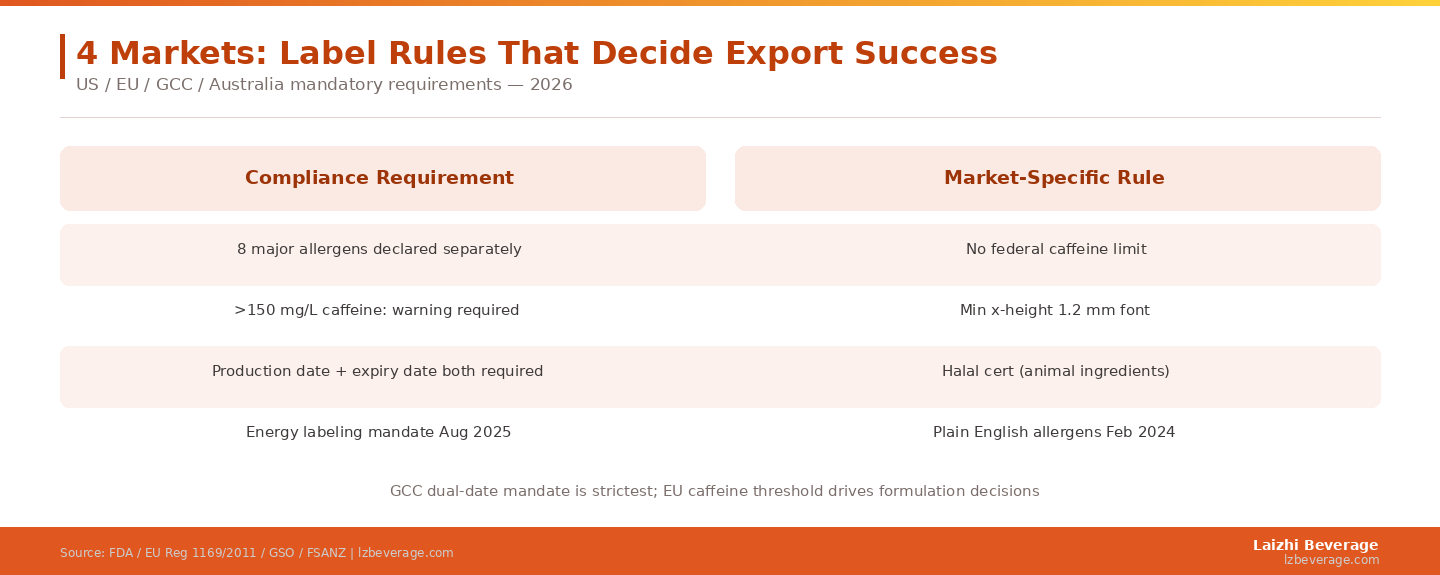
For energy drinks and any beverage containing more than 150 mg of caffeine per liter, EU Regulation 1169/2011 mandates a specific warning: "High caffeine content. Not recommended for children or pregnant or breast-feeding women." The exact caffeine amount per 100 ml must also appear on the front of the can. This applies regardless of how the product is otherwise classified. Individual member states may apply additional restrictions — Lithuania, Latvia, and Poland, for example, ban sales to minors — so market-by-market distribution planning matters even within the EU.
GCC and Middle East Labeling: Arabic, Halal, and Production Dates
Arabic is a Legal Requirement, Not a Design Choice
Across all GCC member states — Saudi Arabia, UAE, Kuwait, Qatar, Bahrain, and Oman — Arabic text on consumer food products is a legal requirement enforced at the municipal and federal level. This is not about translation as a courtesy: the Arabic label must include the product name, full ingredient list in descending order by weight, nutritional information per 100 ml and per serving, allergen warnings, storage and usage instructions, manufacturer and importer details, country of origin, and both production and expiry dates. Brand names may remain in English, but all descriptive and safety text requires genuine translation by a food-industry qualified translator familiar with GSO technical terminology.
Production Date and Expiry Date — Both Are Mandatory
A practical distinction that catches exporters off guard: the GCC requires both the production/manufacture date and the expiry date on the label. A best-before date alone is not sufficient. Saudi Arabia's SFDA additionally mandates country-of-origin labeling and prohibits the use of religious symbols or language that conflicts with Islamic values. Stickering in Arabic is permitted as an alternative to direct printing, provided the sticker is permanent and covers no required information on the original label — and critically, all stickering must be completed before export, not upon market arrival.
Halal Certification for Canned Beverages
For canned beverages containing any animal-derived ingredients — including certain permitted food additives, gelatine-based stabilisers, or processing aids — halal certification is functionally required across GCC markets. Plant-based and fully synthetic formulations are in a grey zone: not legally mandated, but many retailers will not list a product without halal certification. The GSO 2055-1:2015 standard governs halal requirements across the Gulf. The certification process typically takes 6 to 8 weeks through an accredited body, and this timeline must be built into the OEM project schedule before label artwork is finalized.
We assist clients exporting canned beverages to the Middle East with pre-export label assessment and documentation coordination. Learn more about our export-ready OEM process and HACCP-certified production standards.
Australia FSANZ: The Food Standards Code and 2025 Updates
The FSANZ Framework
In Australia, Food Standards Australia New Zealand (FSANZ) administers the Food Standards Code, which is enforced by state and territory authorities. The Code applies to imported products as well as domestically produced goods, and compliance is checked by the Department of Agriculture and Water Resources for imports. A Nutrition Information Panel (NIP) is mandatory on all packaged beverages, presented in a tabular format with per-serving and per-100-ml columns. Country of origin labeling has been mandatory since 2016 under Australian Consumer Law.
August 2025 Amendment: Energy Labeling for Alcoholic Beverages
On August 13, 2025, FSANZ gazetted Amendment No. 241, implementing Proposal P1059 on energy labeling for alcoholic beverages. Products packaged and labeled from August 13, 2028, must include an energy statement in a prescribed tabular format. For OEM clients producing canned beers and RTD alcoholic beverages destined for Australia, this timeline should be factored into label design briefs now — especially if initial label artwork is expected to have a multi-year shelf life. Carbohydrate and sugar declarations are now also permitted voluntarily for beverages with more than 1.15% ABV.
Allergen Labeling — Plain English Update (February 2024)
From February 25, 2024, FSANZ's allergen labeling standards require plain English declarations — terms like "sulphites," "egg," and "milk" must be written in full, not coded as E-numbers. For canned beverages not already updated, products packaged before the deadline may still be sold for a further two years (until February 25, 2026). Any new label artwork commissioned today must use the updated plain English terms.
Side-by-Side Comparison: Key Labeling Requirements
| Requirement |
US (FDA) |
EU (Reg 1169/2011) |
GCC/Middle East |
Australia (FSANZ) |
| Nutrition panel |
Nutrition Facts (mandatory) |
Nutrition declaration (mandatory) |
Nutritional info per 100ml (mandatory) |
Nutrition Information Panel (mandatory) |
| Allergen display |
Separate "Contains" statement |
Highlighted in ingredient list |
Ingredient list (Arabic) |
Plain English bold in ingredient list |
| Language |
English |
Language of sale country |
Arabic mandatory; English permitted alongside |
English |
| Date marking |
Best by / use by |
Best before or use by |
Production date AND expiry date both required |
Best before or use by |
| Country of origin |
Required for some foods; complex rules |
Required (extended 2014) |
Mandatory |
Mandatory since 2016 |
| Halal certification |
Not required |
Not required |
Required for animal-derived ingredients |
Not required |
| Caffeine warning |
No federal threshold warning |
Warning required if >150 mg/L |
Varies by country; align to EU >150mg/L as a baseline |
No specific threshold; disclose as ingredient |
Next-step checklist
- Today: Review each compliance field of your existing label design for each target market against the comparison table above, and mark any gaps.
- This Week: Collaborate with professional translators in the food industry to fully translate the Middle East/GCC version of the label into Arabic and confirm the halal certification status.
- This Month: Incorporate Australia's new energy labeling regulations of 2028 into the label design briefing to avoid the need for redesigning the label in 2-3 years.
- Before Placing an Order: Confirm the label approval cycle with the OEM factory; allow 4-8 weeks for sticker approval in the GCC market.
- Before Export: Confirm the caffeine content of the energy drink: If it exceeds 150 mg per liter, the EU label must include a legally mandated warning.
FAQ
Can I use one label design for all four markets?
Not in practice. While the core product information overlaps, the mandatory fields, language requirements, and layout rules differ enough that a single label that satisfies all four regulators simultaneously would be extremely difficult to design and would likely compromise readability. The most practical approach for multi-market OEM launches is a modular label design: a shared structural template with market-specific panels for language, date format, halal status, and nutrition layout.
Is it sufficient to add an Arabic sticker in the GCC rather than printing Arabic directly?
Yes, Arabic stickers are accepted across GCC markets as a legitimate alternative to direct print, provided the sticker is permanent (extremely difficult to remove), contains all required information, does not cover any original label content, and does not contradict the original label. Importantly, stickering must be completed before the shipment departs — re-stickering at the port or in-country warehouse is not permitted. UAE authorities must also pre-approve sticker artwork.
What happens if my energy drink exceeds the EU caffeine threshold?
If your canned energy drink contains more than 150 mg of caffeine per liter, the EU mandatory warning — "High caffeine content. Not recommended for children or pregnant or breast-feeding women" — must appear on the label along with the exact caffeine quantity per 100 ml. This text is not optional even if the product is otherwise fully compliant. Failure to include it means the product cannot legally be placed on the EU market.
How long before launch should I finalize label artwork for export markets?
For straightforward single-market launches, allow at least 6–8 weeks from label brief to approved print-ready artwork. For GCC markets specifically, add a further 4–8 weeks for Arabic review and sticker pre-approval. FSANZ-compliant Australian labels typically move faster, but if allergen updates or the new energy declaration rules apply, build in an additional review cycle. Our recommendation: treat label compliance as a parallel workstream to formulation, not a downstream step.
For brands ready to begin a canned beverage OEM project, browse our full product range to see how we support private-label development across all these markets, or learn about our HACCP certification and export qualifications.


