The global non-alcoholic beverage market reached approximately USD 1.09 trillion in 2024 and is projected to expand at a CAGR of over 6% through 2033. Inside that number is an enormous category of brands that do not own a single production line — and that is not an accident. The OEM model, in which a brand owner partners with a contract manufacturer to produce drinks under the brand's label, has become the dominant route to market for new entrants across every beverage sub-category from energy drinks to premium RTD teas. Understanding this model is not just useful if you are launching a brand — it is essential if you want to compete on shelf without the multi-million-dollar capital burden of building your own facility.
Why we wrote this: We operate as an OEM and ODM manufacturer for clients across Southeast Asia, the Middle East, Europe, and Africa. The questions we receive most often are not about production capacity or certifications — they are about the process itself. How does the OEM route actually work, step by step? What do I need to bring to the table, and what does the factory do? This guide answers those questions from the manufacturing side, where we can speak from direct experience.
Key Takeaways
- Building a beverage factory from scratch costs millions of dollars and takes years — the OEM route converts that fixed cost into a per-unit variable cost.
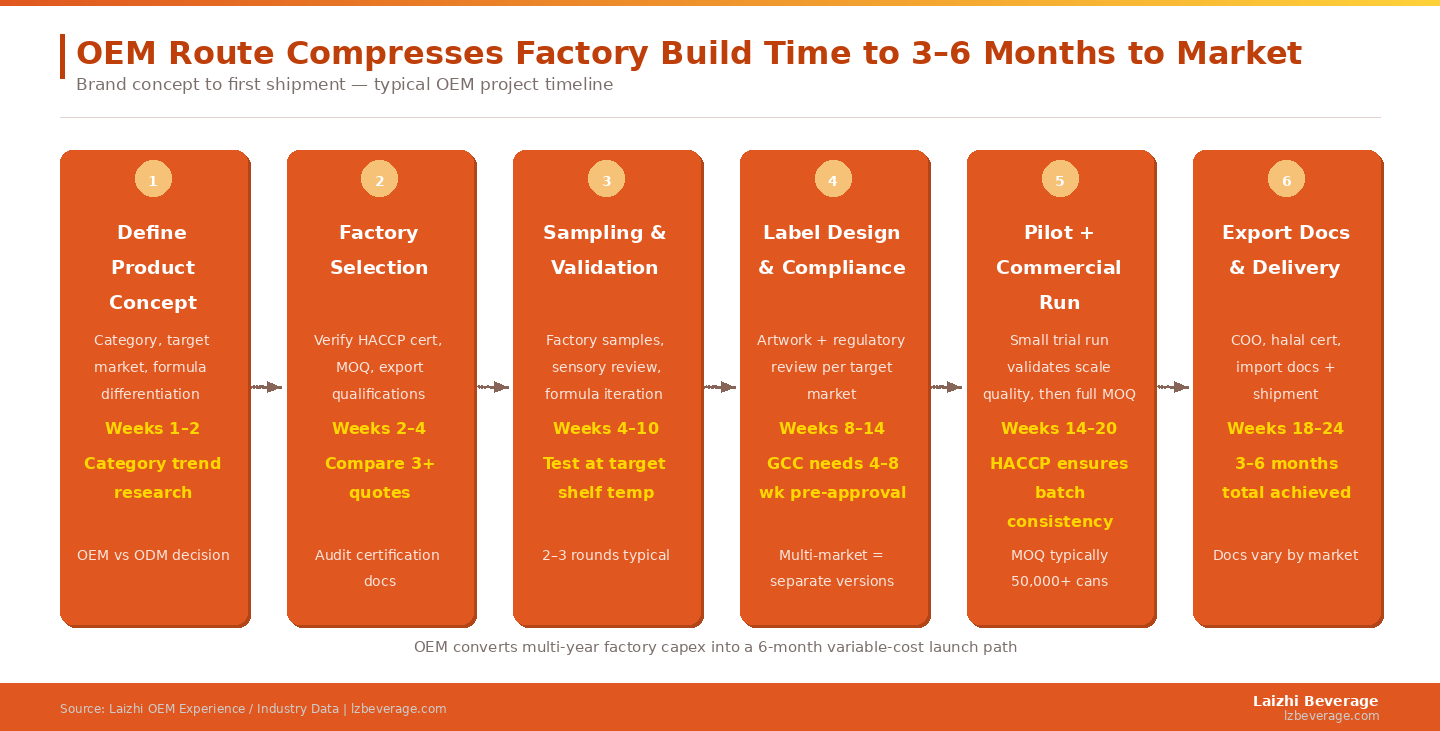
- A canned beverage brand can go from concept to first shipment in 3 to 6 months via OEM, depending on whether the formula is new or adapted from an existing base.
- OEM (custom formula) and ODM (manufacturer's existing formula) are different commitments — choosing correctly depends on your target market, timeline, and IP ownership goals.
- HACCP certification and export qualifications are non-negotiable for global distribution — your OEM factory must hold these before you can ship to most markets.
- Minimum order quantities for canned beverages typically start at 50,000 units, though manufacturers with flexible production lines can sometimes accommodate smaller pilot runs.
Why the OEM Model Exists — and Why It Works
The Economics of Factory Ownership vs. Contract Manufacturing
Setting up a beverage canning line requires mixing tanks, carbonation systems, pasteurizers, high-speed seamers, labeling equipment, quality control labs, and a facility large enough to house all of it — plus the regulatory approvals, workforce, and working capital to run it. Building a beverage facility can cost millions of dollars and establishing a manufacturing facility can take years due to construction, equipment installation, regulatory approval, and staff training. By contrast, partnering with an OEM manufacturer converts all of that fixed capital expenditure into a variable cost per unit produced. You pay for what you order, when you order it. This is why brands from retail store labels to celebrity-endorsed drinks choose the OEM route — not because they cannot afford factories, but because capital is better deployed on brand development, market entry, and distribution than on industrial real estate.
The OEM Model in Practice
In a canned beverage OEM arrangement, the brand owner brings the concept, the target market, and the brand identity. The manufacturer brings the formulation expertise, production equipment, raw material sourcing, quality control systems, and export documentation capability. The two parties align on specifications — formula, can size, label design, quantity — and the manufacturer produces to those specifications. The brand owner receives finished, labeled, shelf-ready product. The proper private label partner enables brands to bypass guesswork, avoid unnecessary expenses, and get to market quickly — concentrating resources on selling and brand development while manufacturing runs in the background.
What the process guides rarely mention is that the OEM relationship is most valuable when it starts before the brand brief is fully locked. When clients arrive with a complete specification and ask us to execute it verbatim, we can — but we often have relevant manufacturing knowledge that would change a decision if shared earlier. A formulation that uses a certain sweetener system, for example, may be completely standard in the brand's home market but prohibited or subject to heavy duty in the target export market. Knowing this during formulation development avoids an expensive reformulation cycle before the first commercial run. The best OEM relationships are collaborative from the start, not transactional at the end.
OEM vs. ODM: Choosing the Right Model
What the Terms Actually Mean
OEM (Original Equipment Manufacturer) in the beverage context typically refers to a manufacturing arrangement where the brand owner develops or specifies a unique formula, which the factory then produces. The brand owns the formula and the factory executes it. ODM (Original Design Manufacturer) refers to an arrangement where the factory provides a pre-developed, market-tested formula that the brand can purchase and label as its own, with limited or no formula modification. Private label in the strict sense often involves a manufacturer's house formula with minor tweaks, while custom OEM typically involves developing a completely unique formula from scratch.
When to Choose ODM (Speed to Market)
ODM is the right choice when your primary goal is speed and your differentiation lies in the brand, not the formula. If you are launching a premium energy drink for a Southeast Asian market where the competitive landscape rewards branding and distribution more than unique ingredients, choosing an ODM base formula can get your product to market in 8 to 12 weeks from brief to first shipment. The formula has already been validated for shelf stability, palatability, and regulatory compliance in major markets. Your investment goes into the can design, the brand story, and the distribution deal — not into months of sensory testing.
When to Choose Custom OEM (Differentiation and IP)
Custom OEM is the right choice when your competitive advantage is the formula itself — a unique ingredient, a proprietary flavour system, a functional ingredient combination that your target consumer cannot find elsewhere. It is also the right choice when you plan to build long-term brand equity around product quality and need formula IP ownership to support that investment. Custom formulation development adds 4 to 8 weeks to the timeline and requires more intensive sample rounds, but the result is a product that cannot be replicated by simply switching factories. For brands entering premium or functional beverage segments — nootropic drinks, adaptogen teas, sports recovery RTDs — custom OEM is almost always the right long-term decision even if it adds cost and time upfront.
The OEM Process: Step by Step
Step 1: Define Your Product Concept and Target Market
Before approaching a manufacturer, you need to define the product category (energy drink, fruit juice, sparkling tea, RTD coffee), the target consumer and market, the intended shelf life and distribution channel, and any non-negotiable ingredient requirements (natural only, no artificial colors, specific functional claims). The more specific your brief, the faster the factory can respond with relevant formulation options and realistic timelines. A vague brief ("we want a healthy energy drink") produces slow and expensive iterations. A precise brief ("250 ml slim can, natural caffeine from green tea, no synthetic sweeteners, 12-month ambient shelf life for Southeast Asian retail") produces an actionable response within days.
Step 2: Choose Your Factory Partner
The factory selection decision should be driven by three criteria above all others: does the factory hold the certifications required for your target market (HACCP at minimum; ISO 22000; relevant export approvals), can the factory's production capacity and MOQ fit your first-year volume projection, and does the factory have documented experience in your product category? Our factory holds HACCP certification (awarded 2017) and export qualifications (2018), with 50 production lines covering beer, energy drinks, fruit juice, RTD coffee, and tea beverages. For brands targeting global distribution, working with a HACCP-certified, export-qualified OEM partner is not optional — it is the minimum entry requirement for most retail and import channels.
Step 3: Sampling and Formula Validation
The sample round is where most timeline variance occurs. The factory produces bench samples based on your brief. You taste, evaluate, and provide feedback. A typical custom OEM project requires two to three sample rounds over four to six weeks. Evaluation criteria should go beyond taste: evaluate the formula at expected storage temperature, assess carbonation retention if applicable, and confirm that the label claims are substantiated by the ingredient levels in the formula. Do not approve a sample that tastes right in the lab if you have not confirmed it remains shelf-stable at your target distribution temperature and duration.
Step 4: Packaging and Label Design
Can size, finish (matte, gloss, embossed), and label design need to be finalized before production. Existing recipe production can begin in 8 to 12 weeks once specifications are finalized, while custom blends typically require 12 to 16 weeks. Label artwork must comply with target market regulations — a point explored in depth in our guide to canned drink labeling requirements by market. For multi-market launches, plan for market-specific label variants from the beginning rather than creating a universal label and trying to adapt it retroactively.
Step 5: Trial Production and Commercial Run
A pilot run — typically 500 to 5,000 cases depending on the factory — validates that the production process translates the bench sample to a commercial scale without quality variation. After pilot approval, the commercial run proceeds at full scale. Our production lines fill at up to 1 million cans per day across our 50 lines, giving clients the scalability to grow from a pilot into national distribution without changing factories. Browse our product categories to see the range of formats and beverage types we produce for OEM clients globally.
What a Good OEM Partner Provides Beyond Production
Export Documentation and Compliance Support
A factory that has produced your product is not automatically a factory that can help you ship it. Export documentation — including Certificates of Origin, phytosanitary certificates where applicable, halal certificates for Middle Eastern markets, and import-specific testing certificates — is a dimension of OEM service that many brands underestimate. Working with an export-qualified factory that has shipped to your target market before means access to a track record of documentation compliance, not just a willingness to try.
Aluminum Can Sourcing Integration
One of the less visible advantages of working with a canned beverage OEM manufacturer that produces its own aluminum cans is supply chain integration. When the filling line and the can supply are coordinated by the same production team, the risk of can specification mismatches, delivery delays, and quality inconsistencies between container batches is substantially reduced. This is particularly relevant for clients planning seasonal campaigns or short-cycle product launches where timeline slippage in can supply has direct consequences for campaign launch dates. Our energy drink OEM service includes full can and formulation coordination as part of the production brief.
Next-step checklist
1. Today: Clarify three things—target market, product category (energy drink/juice/tea/coffee), and core differentiation (unique formula vs. brand positioning). Then, write a product brief of no more than 300 words.
2. This Week: Send inquiries to target OEM factories, requesting confirmation of HACCP certification, export qualifications, MOQ, and sampling timeline. Compare and evaluate quotes from at least three suppliers.
3. Sampling Stage: Evaluate samples at the target sales temperature (non-refrigerated), not just in a laboratory environment, to confirm shelf-life stability.
4. Before Label Design: Determine the mandatory labeling requirements for all target markets to avoid rework due to compliance issues after design completion.
5. Before Initial Mass Production: Request pilot run records and quality inspection reports from the factory to confirm consistency between commercial production and samples.
FAQ
How much does it cost to launch a canned drink via OEM?
The cost structure has three components: OEM production cost per unit (which includes formulation, filling, sealing, and labeling), tooling or design costs (can artwork, label printing setup), and logistics costs (freight, customs, import duties). Unit production costs for canned beverages typically range from USD 0.20 to USD 0.80 per can depending on formula complexity, can size, and order volume. The key advantage of the OEM model is that you do not pay for factory construction, equipment, or overhead — only for the units you produce. This means your capital can go into marketing and distribution, where return on investment is more visible and more direct.
What is the minimum order quantity for canned beverages?
Standard MOQ for aluminum-can beverages at most factories ranges from 50,000 units per SKU and up, reflecting the economics of canning line setup, can procurement, and labeling. Some manufacturers with flexible lines can accommodate smaller pilot runs of 5,000 to 20,000 cans at a slightly higher per-unit cost. For brands entering a new market and wanting to test before committing to full commercial volumes, discussing a pilot run arrangement upfront is more efficient than negotiating it after you have already committed to a specification.
Do I need to develop my own formula, or can I use the factory's existing formulas?
Both options are legitimate and have different tradeoffs. Using the factory's existing ODM formula is faster and lower-risk — the formulation has already been validated for shelf stability and taste. Developing a custom OEM formula takes 4 to 8 additional weeks and requires more investment in R&D sampling, but gives you IP ownership and product differentiation that cannot be copied simply by ordering the same formula from the same factory. For most first-time brand launches, starting with an ODM base and adding brand-specific customization (flavor adaptation, naming, packaging) is the most practical way to test market response before investing in full custom formulation.
How do I verify that an OEM factory is export-qualified for my target market?
Request copies of the factory's current certifications — HACCP, ISO 22000 where applicable, and any market-specific approvals (US FDA registration for US imports, relevant EU food business operator registrations, SFDA registration documentation for Saudi Arabia). Ask for references from clients who have shipped product from that factory to your target market and request copies of existing export documentation as a sample of what the factory can produce. Do not rely solely on the factory's marketing materials — verify certification currency and scope against the issuing body's public records where possible.


