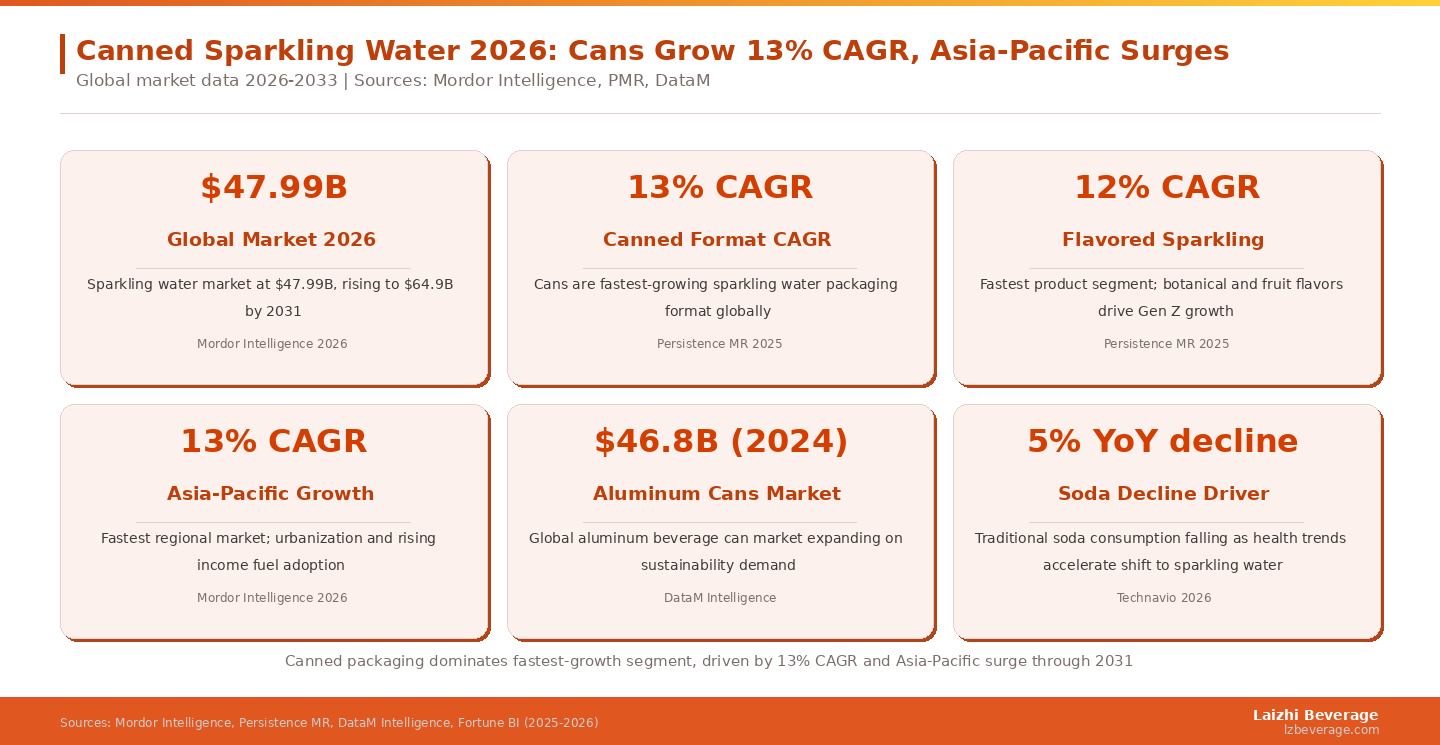
The global sparkling water market is valued at USD 47.99 billion in 2026 and is forecast to reach USD 64.9 billion by 2031, growing at a steady 6.22% CAGR. More importantly for brand owners, canned sparkling water is leading this growth wave: according to Persistence Market Research, the aluminum can format is the fastest-growing packaging type in the category, expanding at a 13% CAGR through 2033. If you are evaluating whether now is the right time to launch a private label sparkling water brand in cans, the market data gives a clear answer.
Why we wrote this: We work with brand owners and importers at every stage of bringing a canned beverage to market — from the first question about formulation to the first pallet leaving the warehouse. One of the most common gaps we see is that buyers understand demand trends but lack a clear picture of how the OEM process actually works end-to-end. This guide is designed to fill that gap with a practical, step-by-step view of launching a private label canned sparkling water brand through an OEM partner.
Key Takeaways
- Canned sparkling water is growing at 13% CAGR through 2033 — the fastest packaging segment in the category, making it a strong format choice for new private label brands.
- OEM production enables full brand control with no capital investment in equipment — your partner handles formulation, filling, and compliance.
- HACCP certification is non-negotiable for export — ensure your OEM partner holds valid HACCP and export qualifications before committing to a production run.
- Flavored sparkling water is the fastest-growing product segment at 12% CAGR — fruit and botanical SKUs offer stronger differentiation than plain variants for new entrants.
- Asia-Pacific is the fastest regional market at 13% CAGR through 2031 — brands targeting this region benefit from proximity to Chinese OEM manufacturing hubs.
Why Canned Sparkling Water Is the Right Format for Your Private Label Brand
Cans vs. Bottles: The OEM Advantage
For private label brands entering the sparkling water category, the choice of packaging format has downstream implications for cost, shelf life, logistics, and consumer positioning. Aluminum cans offer three concrete advantages that make them the preferred format for OEM production at scale.
First, cans deliver superior carbonation retention. Aluminum provides an impermeable barrier to oxygen and CO2 loss, preserving the effervescence consumers expect through the shelf life period — a quality that plastic PET bottles cannot match. Second, cans support full-surface custom printing, giving your brand 360 degrees of artwork space without the cost of separate label application. Third, and increasingly important in 2026, aluminum is the most recycled beverage packaging on the market, with recycling rates in Europe exceeding 75%. According to Grand View Research, the canned water segment is forecast to grow at 5.8% CAGR through 2033, outpacing the overall bottled water market — a reflection of this sustainability positioning.
Market Timing: Flavored Variants Capture Growth Premium
Plain sparkling water remains the largest product type by volume, but flavored sparkling water is where the growth premium lies. The flavored segment is projected to expand at 12% CAGR through 2033, driven by demand from younger demographics seeking low-calorie, no-sugar alternatives with variety. For private label entrants, launching with 2–3 flavored SKUs alongside a plain variant provides both category credibility and incremental volume from occasions where a plain format would not be chosen.
Putting the canned packaging growth data alongside the Asia-Pacific expansion trajectory reveals an insight that matters for sourcing strategy: brands targeting Southeast Asia, the Middle East, or export-oriented retail channels in emerging markets are best served by a China-based OEM partner, not a regional co-packer. A Fortune Business Insights 2026 report notes the Asia-Pacific sparkling water market is expanding at 13% CAGR through 2031 driven by urbanization and rising incomes — the same demographic shift that makes shorter supply chain distances from a Chinese OEM factory a structural cost advantage for regional distribution.
The 6-Step OEM Process: From Formula Concept to First Shipment
Step 1: Define Your Formulation Brief
The process starts with a formulation brief — a one-to-two page document that specifies your target flavor profile, carbonation level (typically 2.5–4.0 volumes CO2 for sparkling water), sweetener approach (zero-sugar, natural stevia, or light sugar), and any functional ingredient additions such as electrolytes or vitamins. You do not need a finished recipe to approach an OEM partner: most full-service manufacturers will develop formulations from a brief and submit samples for your approval.
Step 2: Sample Development and Approval
Your OEM partner produces lab-scale bench samples based on the brief, typically within 2–4 weeks. This stage involves iterative flavor adjustments before a pre-production prototype is made in a commercial filling line to confirm carbonation stability, color, and mouthfeel under real filling conditions. Plan for 2–3 rounds of review before final approval. Shelf-life accelerated testing (typically 4 weeks at elevated temperature to simulate 6–12 months ambient storage) should be conducted at this stage.
Step 3: Can Size, Design, and Artwork
Canned sparkling water is most commonly produced in 250ml, 330ml, and 355ml formats. Your brand artwork is applied either as a printed shrink-sleeve label or, for higher minimum order quantities, as a direct-to-can printed finish. A professional OEM partner will provide dieline templates and print specifications, and can coordinate with your designer or handle artwork preparation as part of the service. Confirm bleed zones, color separation requirements, and proof approval timeline before committing to can stock.
Step 4: Production Run and HACCP Compliance
Commercial production of canned sparkling water involves water purification, carbonation dosing, high-speed filling and seaming, pasteurization (for certain formulations), and packing. The single most important compliance requirement for export is HACCP certification. HACCP — Hazard Analysis and Critical Control Points — is the internationally recognized food safety management system required to access markets in the US, EU, Australia, and Canada. Verify that your OEM partner holds a valid, in-scope HACCP certificate from a CNAS-accredited certification body. According to China Quality Certification Centre, China's HACCP system has been officially recognized by the Global Food Safety Initiative (GFSI) since 2015, providing full mutual recognition for export supply chains.
We hold HACCP certification obtained in 2017 alongside China export qualifications, which means your products leave the factory with the documentation needed to clear customs in major import markets.
Step 5: Packaging, Labeling, and Regulatory Review
Labeling requirements vary significantly by destination market. Minimum requirements across most markets include: product name and category, ingredient list, nutritional facts panel, country of origin, net contents, and best-before date. For the EU, additional allergen declarations and recycling symbols are required. For the US, FDA nutrition label format must be followed. Many OEM partners will review your artwork against destination market requirements as part of the service — confirm this capability before finalizing your partner selection.
Step 6: Export Documentation and Logistics
A China-based OEM factory with export qualifications will handle the export customs declaration, produce a Certificate of Origin, Health Certificate, and any phytosanitary or quality inspection documents required by the destination country. Cargo for sparkling water is typically shipped in 20ft or 40ft reefer-capable containers (ambient temperature is standard for most still and sparkling water; chilled is only required for fresh juice blends). Lead time from production completion to port departure is typically 3–5 business days.
Browse our full RTD and carbonated beverage production capabilities to understand available can formats and current production capacity.
What to Look for in a Canned Sparkling Water OEM Partner
Non-Negotiable Qualifications
Before requesting a sample, verify these three qualifications for any OEM candidate: a valid HACCP certificate with scope covering carbonated beverage production; a China food export qualification/license confirming the factory is registered to produce and export food and beverages; and evidence of a commercial-scale filling line with a minimum of one dedicated carbonated beverage line. Factories without these qualifications cannot legally export to major markets, regardless of price.
Integrated Can Supply: The Cost Driver Most Buyers Miss
Aluminum cans represent 30–45% of the total cost of goods for a canned sparkling water product. OEM factories that source their own cans — rather than buying from a third-party can supplier — can offer significantly more competitive pricing and faster sample turnaround because the can supply chain is internal. Ask specifically whether your potential partner operates their own can manufacturing lines. Our production facility at Laizhi Beverage integrates aluminum can production and filling on a single site, which reduces lead time and provides cost advantages that external purchasing cannot match.
Next-step checklist
- Today, draft a two-page formula brief that defines the target flavor, carbonation level (2.5-4.0 vol CO2), and sweetener system.
- This week, ask the target OEM factory for a copy of its HACCP certificate, and confirm the certification body is CNAS-recognized and the scope covers carbonated beverage production.
- This week, confirm the target sales market (EU/US/Southeast Asia), and ask the OEM partner for a label-regulation compliance checklist for that market.
- Next month, complete integrated aluminum-can capacity checks for at least two suppliers, and compare cost differences between in-house can supply and outsourced can procurement.
- Next month, submit the product sample request, and ask for accelerated shelf-life test results (4 weeks at 40C) as evidence of product stability.
FAQ
What is the minimum order quantity for private label canned sparkling water from China?
Minimum order quantities for canned sparkling water from a Chinese OEM manufacturer typically range from 20,000 to 50,000 cans per SKU, depending on whether you are using a standard formula or a custom formulation. Factories with integrated can supply tend to offer more flexible MOQs because they do not need to meet third-party can supplier minimums. For new brands testing a formula before scaling, a pilot production run is worth negotiating before committing to a full commercial order.
How long does the OEM process take from brief to first shipment?
For a new formulation with custom can artwork, the typical timeline is 8–14 weeks: 2–4 weeks for sample development, 2–3 weeks for client approval and accelerated shelf-life testing, 2–3 weeks for production scheduling and bulk production, and 1–2 weeks for export documentation and logistics. Standard formulas with existing can artwork can compress this to 5–7 weeks.
Do I need to hold inventory, or can the factory manage warehousing?
Most Chinese OEM factories will hold finished goods for a short buffer period (typically 2–4 weeks) before shipment, but long-term warehousing is not a standard OEM service. If you need bonded warehousing, distribution logistics, or just-in-time delivery scheduling, discuss these requirements explicitly before finalizing your OEM agreement.
What flavors are trending for canned sparkling water in 2026?
The highest-growth flavor profiles in 2026 are botanical-fruit crossovers (cucumber-mint, elderflower-lime, lychee-rose), classic citrus variants with reduced sweetness (yuzu, blood orange, grapefruit), and functional-forward combinations pairing sparkling water with a light electrolyte or vitamin C addition. According to market research, the Asia-Pacific region shows the strongest adoption of unique flavor profiles, making it a productive target for brands launching innovative SKUs. Visit our industry news section for updated trend reports on carbonated beverage formulation.
Is aluminum canned sparkling water more expensive to produce than bottled?
At comparable volumes, canned production is typically 10–25% higher in unit cost versus PET bottle production, driven by higher aluminum material costs. However, cans command a 15–30% retail price premium over bottles in most markets due to sustainability positioning and carbonation quality perception, resulting in equivalent or better gross margin for the brand. The total landed cost calculation also needs to factor in logistics: cans are lighter per unit volume than glass and more durable than PET, reducing breakage losses and freight cost per pallet.


