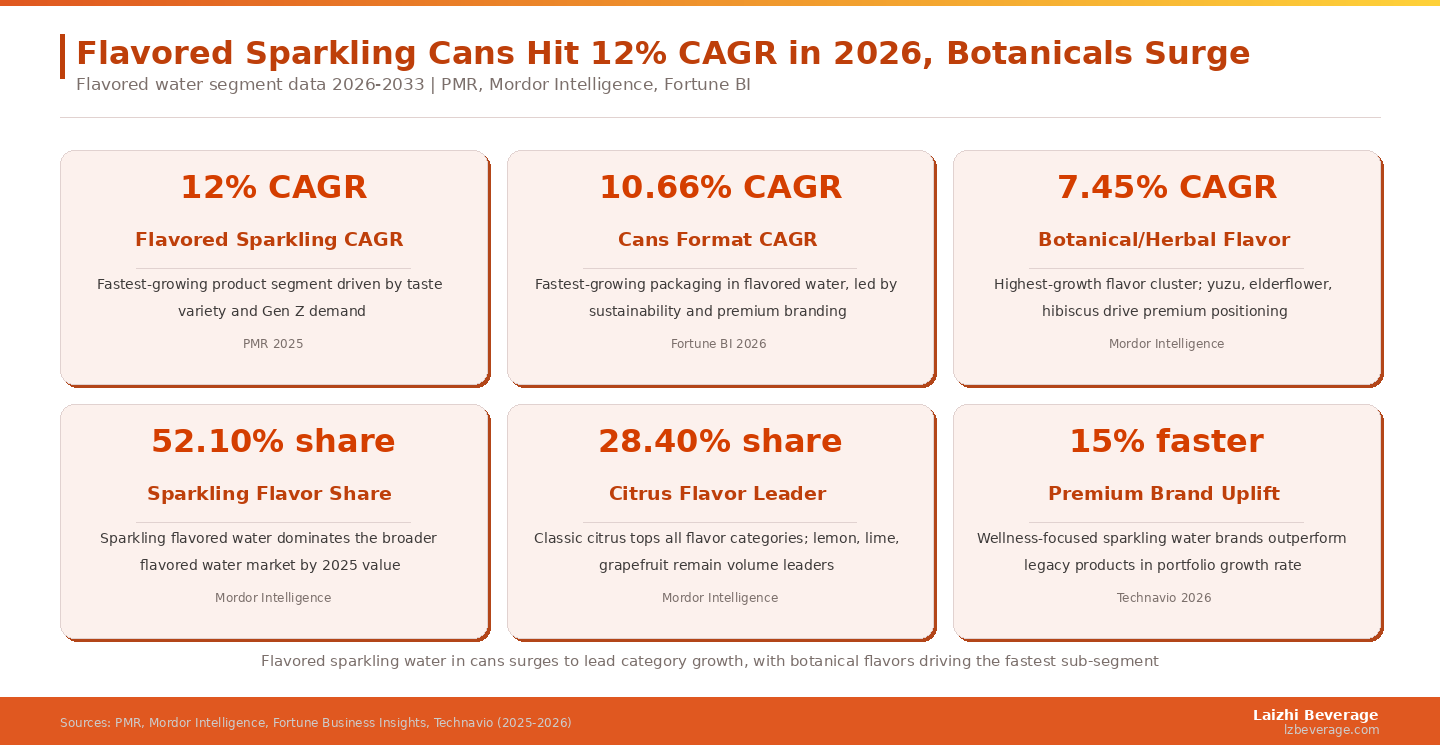
Among all segments within the global sparkling water market, flavored sparkling water delivered in aluminum cans stands out as the single fastest-growing intersection of product type and packaging format in 2026. According to Persistence Market Research, flavored sparkling water is expanding at a 12% CAGR through 2033 — roughly double the rate of the overall sparkling water market. Simultaneously, Fortune Business Insights reports that cans are the fastest-growing packaging format for flavored water, growing at 10.66% CAGR through 2034. The combination of these two growth vectors makes the flavored canned format the most compelling category entry point for new private label brands in 2026.
Why we wrote this: We monitor flavor and packaging trends closely because they directly affect the production volume mix on our lines and the formulation briefs our OEM clients bring to us. In our experience, brands that launch flavored canned sparkling water with a differentiated flavor profile consistently achieve stronger initial retail velocity than plain-water private labels. This article summarizes the market data and flavor trends that should inform your product brief before approaching an OEM partner.
Key Takeaways
- Flavored sparkling water is growing at 12% CAGR through 2033 — more than double the plain water segment's growth rate.
- Cans are the fastest-growing packaging format for flavored water at 10.66% CAGR, outpacing all other formats through 2034.
- Botanical and herbal flavor profiles carry the highest growth premium — yuzu, elderflower, and hibiscus command retail price premiums of 20–40% versus citrus standards.
- Citrus remains the highest-volume flavor family at 28.40% category share — a safe entry point for new brands but also the most competitive space.
- The sparkling segment now holds 52.10% of the global flavored water market — larger than still flavored water for the first time, signaling category maturity and sustained momentum.
Why Flavored Sparkling Water in Cans Is the Fastest-Growing Segment in 2026
The Convergence of Three Macro Trends
The outperformance of flavored canned sparkling water is not a coincidence — it is the intersection of three macro trends that are reinforcing each other simultaneously. The first is the ongoing substitution of carbonated soft drinks (CSDs) with zero-sugar alternatives. Technavio's 2026 market analysis documents a consistent 5% annual decline in traditional soda consumption across key markets. The second trend is premiumization: wellness-focused sparkling water brands are outperforming legacy product portfolios by up to 15% in growth rate, creating a clear incentive for retailers to expand their flavored sparkling water shelf space. The third is the aluminum can's ascendancy as the preferred on-the-go packaging, driven by recyclability credentials and the format's association with an active, health-conscious consumer lifestyle.
Sparkling Now Leads the Flavored Water Market
A notable structural shift occurred in 2025: the sparkling segment overtook still variants to hold 52.10% of the global flavored water market by value, according to Mordor Intelligence's flavored water report. This milestone reflects more than a decade of steady share gains by sparkling variants and suggests the category center of gravity has permanently shifted toward carbonated formats. For OEM brands entering now, this means a flavored sparkling positioning is both category-aligned and consumer-validated — not a niche bet.
Cross-referencing the botanical flavor growth data (7.45% CAGR through 2031) with the canned format adoption data (10.66% CAGR) produces a more specific conclusion than either data point alone: a flavored sparkling water brand that combines a botanical or fruit-botanical hybrid flavor with an aluminum can format is positioned at the intersection of both fastest-growing vectors in the category. Based on how we observe OEM production briefs evolving, brands that entered the market with exotic fruit or botanical flavors in 2024–2025 are already requesting production expansions at 2–3x their initial run sizes, a pattern that plain-water brands in the same cohort have not replicated.
The 2026 Flavor Landscape: Which Profiles Carry Growth Premium
Tier 1: Citrus — High Volume, High Competition
Citrus flavors hold the largest single share of the flavored sparkling water market at 28.40% by category (lemon, lime, grapefruit, blood orange, yuzu). Citrus is the safe harbor for OEM brands seeking retail placement quickly because buyers are familiar with the category and de-risking is straightforward. The tradeoff is competition: private label citrus sparkling water competes directly with established mass-market brands on price, and margin pressure is highest in this segment. Yuzu is a partial exception — its Japanese-heritage positioning and lower consumer familiarity still commands a flavor premium in premium retail channels.
Tier 2: Botanical and Herbal — Highest Growth, Best Margin
According to Mordor Intelligence's sparkling water report, botanical and herbal flavor variants are the fastest-growing flavor cluster within the flavored sparkling segment, expanding at 7.45% CAGR through 2031. The drivers are two-fold: consumers in the 25–40 demographic are seeking beverage "occasions" that feel more sophisticated than plain water but have no alcohol and no sugar, and botanical flavors (elderflower, hibiscus, lavender, chamomile, rose) fill this gap. OEM brands in this flavor tier consistently achieve a higher shelf price — retail data shows a 20–40% premium versus standard citrus SKUs in the same can format.
Tier 3: Tropical Fruit and Berry Crossovers — Emerging Velocity
Tropical-citrus and berry-botanical crossovers are gaining traction particularly among Millennial and Gen Z buyers seeking flavor novelty. Combinations such as watermelon-mint, lychee-rose, passion fruit-coconut, and mango-ginger are showing early-stage growth velocity in Southeast Asian and European markets. For brands targeting export into Asia-Pacific — the fastest-growing regional market at 13% CAGR through 2031 — tropical crossover flavors are significantly better-suited to local taste preferences than standard North American citrus profiles.
Functional Overlays: The Next Frontier
A growing number of new product launches in 2025–2026 are combining flavored sparkling water with functional additions: prebiotic fiber (Sprite's prebiotic launch in Chengdu in December 2025 is an early example), electrolytes (Powerade's Power Water launch in October 2025), and vitamins C and B. For OEM brands, functional overlays increase formulation complexity and regulatory review requirements but also justify a significant premium price point. We recommend approaching functional additions in round 2 of an OEM program, after establishing brand credibility with a cleaner-label flavored sparkling entry first.
Can Formats and OEM Flavor Production Considerations
Choosing the Right Can Size for Your Flavor SKU
The most common can formats for flavored sparkling water in 2026 are 250ml, 330ml, and 355ml. The 250ml "mini" can format has seen the strongest growth in the on-the-go and impulse purchase occasion, particularly for botanical and functional SKUs where the per-unit cost can be amortized across a shorter volume. The 330ml format remains the mass-market standard in Europe and Southeast Asia. The 355ml (12oz) format is standard in the North American market. Most full-service OEM facilities can run all three formats without equipment changeover constraints; confirm minimum order quantities per format before finalizing your SKU plan.
Natural Flavor Sourcing and Label Claims
Consumer scrutiny of "natural flavors" labeling is intensifying in 2026. Brands that can make verifiable claims about real fruit content — even a small percentage of real fruit juice — command significantly stronger consumer trust and social media engagement than "natural flavor essence" alternatives. When specifying your formulation brief to an OEM partner, explore whether a real-fruit content variant (with appropriate Brix and pH adjustments for carbonation stability) is feasible at your target price point, particularly for tier 1 flavors like lemon and lime where real-juice variants are established.
Explore our full range of RTD and carbonated beverage production capabilities, including flavored sparkling water formulation options, or view our production facility overview to understand how we support OEM partners from flavor brief to finished can.
Next-step checklist
- Today, lock 2-3 target flavor-positioning tiers (citrus/botanical/tropical fruit), and validate them against target sales-channel pricing.
- This week, ask the OEM partner for the latest flavored sparkling water formula menu, and confirm whether real juice-content options are available.
- This week, prepare a one-page competitor pricing analysis for botanical flavor SKUs, and verify whether a 20-40% premium target holds in the target market.
- Next month, complete sample development for at least three flavors, including one citrus, one botanical, and one tropical crossover flavor.
- Next month, confirm the target channel (convenience stores/supermarkets/e-commerce), and develop an SKU split strategy for 250 ml and 330 ml can formats.
FAQ
Which flavors are most popular for canned sparkling water OEM brands in 2026?
Citrus flavors (lemon, lime, grapefruit) dominate by volume at 28.40% category share, making them the safest entry point. However, botanical flavors (elderflower, yuzu, hibiscus) are growing fastest at 7.45% CAGR through 2031 and carry 20–40% retail price premiums versus citrus. New brands with flexibility should consider a portfolio split: one citrus SKU for volume and one botanical SKU for premium positioning.
How does flavored sparkling water formulation differ from plain water?
Flavored sparkling water requires additional formulation steps beyond water purification and carbonation: flavor preparation (natural essence, flavor concentrate, or real fruit juice), pH adjustment to ensure carbonation stability and shelf life, and color specification where applicable. The formulation process typically adds 2–3 weeks to the development cycle compared to plain water. Functional additions (prebiotics, electrolytes, vitamins) require regulatory review for each destination market.
Can I launch a flavored sparkling water brand with a small initial order quantity?
Most full-service OEM manufacturers can accommodate minimum run sizes of 20,000–50,000 cans for flavored sparkling water, depending on whether you use a standard formula from the factory's flavor library or a fully custom formulation. Standard formula runs can typically start at the lower end of this range. For new brands, starting with a standard formula from an OEM's existing portfolio reduces both time-to-market and minimum order risk while you validate consumer response.
What is the shelf life of flavored sparkling water in cans?
Properly produced and sealed flavored sparkling water in aluminum cans typically achieves a shelf life of 12–18 months at ambient temperature. Key factors affecting shelf life are the pH of the finished product (lower pH extends shelf life by inhibiting microbial growth), the quality of the can seal (double seam integrity), and the presence of any preservatives in the formulation. Accelerated shelf-life testing should always be conducted before launching a new flavor, particularly for botanical variants where natural compounds can interact with carbonation over time. Visit our industry news section for more on formulation and shelf-life topics.


