Citrus flavors hold 28.40% of the global flavored water and carbonated beverage market by volume, making the citrus family — and lime in particular — the single largest flavor cluster across sparkling drinks globally. The lime and lemon segment is identified as the fastest-growing sub-segment of the global citrus concentrate market, which is valued at USD 9.9 billion in 2026, growing at 5.2% CAGR through 2033. For brand owners exploring private label entry into carbonated beverages, a lime-forward formulation offers immediate consumer recognition, wide channel compatibility, and the highest baseline volume ceiling of any flavor profile.
Why we wrote this: Lime carbonated drinks are one of the most requested product categories we handle in OEM production — from classic lime soda to lime sparkling water to lime-chili functional drinks targeting Latin American and Southeast Asian export markets. The most common point where new clients lose time is at the can design stage: they have a flavor and a target market in mind but have not clearly specified the artwork requirements, printing method, or minimum order needed for each SKU. This guide covers the full journey from formulation brief to finished custom can, specifically for lime carbonated products.
Key Takeaways
- Citrus holds 28.40% of global flavored sparkling category volume — lime is the highest-volume individual sub-flavor and the safest entry point for new private label brands.
- Lemon & lime is the fastest-growing citrus concentrate segment according to market data — reflecting a shift from orange-dominant formulations to sharper, more refreshing citrus profiles.
- Custom can design is a competitive requirement, not an option — lime's green/yellow visual identity communicates freshness before a consumer reads the label.
- Digital printing enables short-run custom cans at lower minimum order quantities than traditional offset lithography — a critical capability for new brands testing multiple SKUs.
- Aluminum cans are growing at 5.5% CAGR globally through 2035, making them the right long-term packaging investment for a carbonated lime brand.
Lime as a Carbonated Drink Flavor: Why It Works Across Markets
Universal Consumer Appeal with Regional Variation
Lime's appeal in carbonated beverages is cross-cultural in a way that very few other flavors are. In North America, lime is synonymous with refreshment — the dominant flavor in Topo Chico, the leading note in many hard seltzers, and the base of countless classic cocktail mixers. In Southeast Asia, kalamansi and calamansi lime are embedded in food culture, making lime-based sparkling beverages a natural convenience store staple. In the Middle East and Latin America, lime is strongly associated with mealtime consumption alongside food. This geographic versatility means a single lime formulation, with minor adjustments to sweetness level and carbonation intensity, can serve five or six distinct export markets without a fundamental reformulation.
Citrus Leads Category, Lime Leads Citrus
Within the citrus flavor family, the balance has shifted in recent years. Orange juice and orange soda still dominate by total volume, but lime and lemon are gaining share in the carbonated segment specifically because of their compatibility with zero-sugar and low-calorie positioning. A lime sparkling water carries a sharper, cleaner sensory profile than orange, which consumers associate with a lighter, less-sweet product. According to Persistence Market Research, lemon and lime is now the fastest-growing sub-segment within the global citrus concentrate market — reflecting this trend in industrial buying behavior.
Looking at the citrus concentrate market data alongside the sparkling water flavor distribution data, a pattern emerges that is not obvious from either dataset alone: the divergence between orange (declining share in sparkling) and lime/lemon (growing share) is accelerating at the same time that premiumization is increasing retail price points across the sparkling category. This suggests that lime is functioning as a "premium signal" flavor — consumers are choosing it not just for the taste profile but because it signals the kind of light, sophisticated positioning that premium sparkling water brands embody. For OEM brands, this means a lime carbonated drink launched in a well-designed can with "natural lime" claims can target premium retail channels ($1.50–$2.50 per can) rather than value channels, improving margin structure significantly.
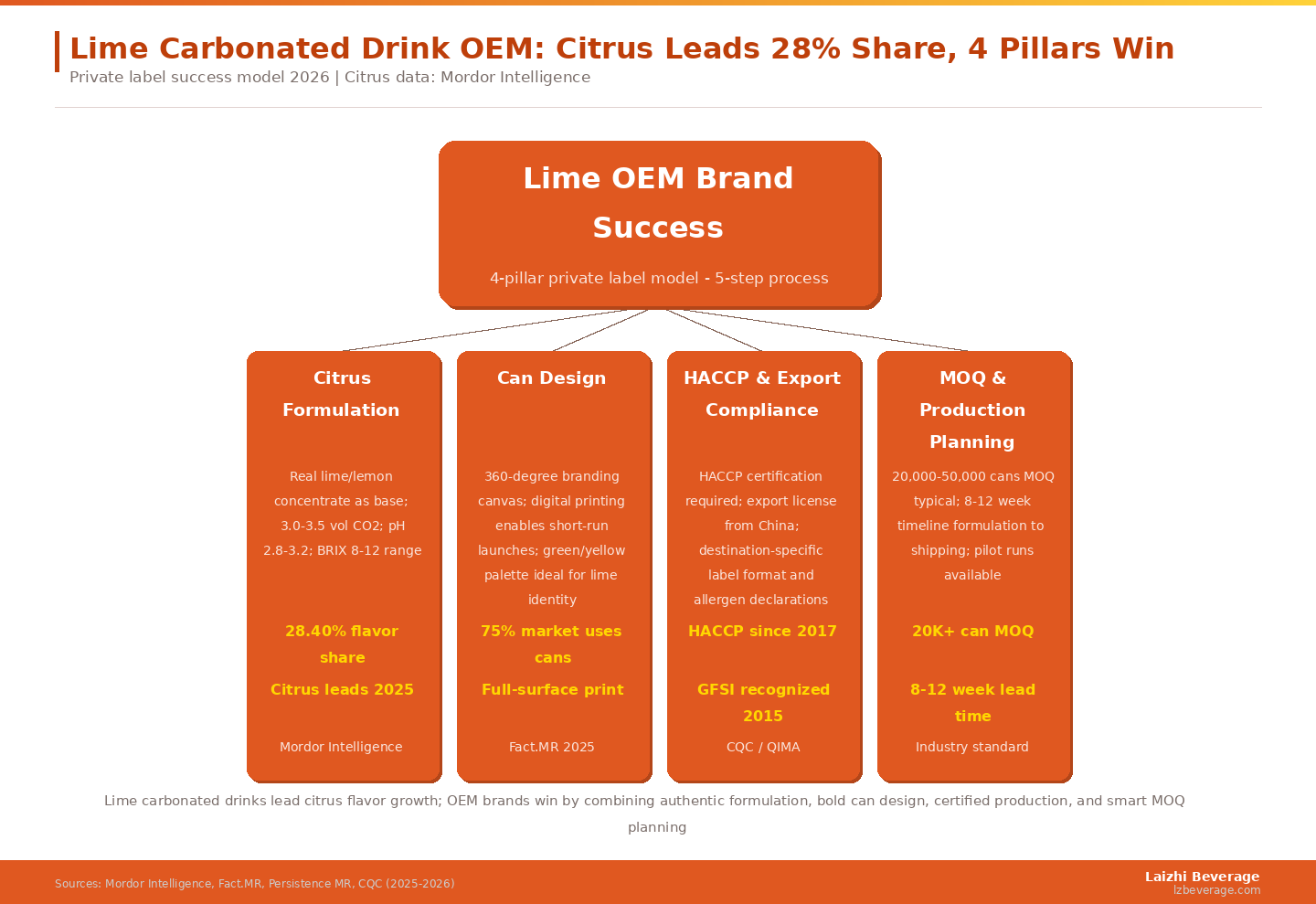
Lime Carbonated Drink Formulation: Key Specifications
Lime Flavor Source Options
Lime flavor for OEM beverage production can be delivered through three main routes, each with different cost and label claim implications:
- Natural lime flavor extract: The most common approach. A concentrated lime essence (cold-pressed or steam-distilled from lime peel) is blended into the base water. This enables a "natural lime flavor" label claim. Usage rate is typically 0.05–0.2% depending on the concentration of the extract.
- Lime juice concentrate: Adds genuine juice content and enables a "contains lime juice" or percentage-juice claim. Typically 3–8% juice content in the finished product. Adds natural acidity, reducing the need for separate acidulant addition. Higher material cost than extract but stronger label claim.
- Lime oil (cold-pressed): Delivers an intensely fresh, aromatic lime character preferred in premium formulations. More complex to emulsify into a water-based carbonated system without specialized emulsifiers. Higher cost per unit.
For OEM briefs targeting mass retail, natural lime flavor extract is the standard starting point. For premium positioning or any channel where "real ingredients" is a brand claim, 5–8% lime juice content is recommended.
Carbonation and pH Calibration for Lime
Lime juice concentrate is highly acidic (pH typically 2.4–2.8 for commercial concentrates), which means finished products formulated with meaningful juice content will have a low pH that must be managed carefully for carbonation stability and shelf life. A finished lime carbonated drink typically targets pH 3.0–3.4 and CO2 volume of 3.0–3.5. Higher acid products retain carbonation better over shelf life but may require buffering with potassium citrate or sodium citrate in markets where mineral additions are permitted. Sweetness level significantly impacts perceived acidity: zero-sugar lime drinks feel more acidic than the same formulation with 4g/100ml sugar, because sugar partially masks acidity perception.
Sugar and Sweetener Strategy
The major trend in lime carbonated drinks in 2026 is the zero-sugar or reduced-sugar segment. For a lime-flavored sparkling water, zero sugar is expected in premium retail. For a lime carbonated soft drink (CSD) or lime soda positioning, a light sugar level of 3–6g/100ml provides balanced sweetness without triggering sugar-tax thresholds in UK and EU markets (the UK SDIL threshold is 5g/100ml for the higher rate). Stevia and erythritol are the preferred natural sweetener options for zero-sugar variants; both work well with lime's acidic profile and do not leave the bitter aftertaste that some artificial sweeteners exhibit at low pH.
Custom Can Design for Lime Carbonated Drinks
Why Can Design Matters More for Lime than Other Flavors
For many beverages, the flavor communicates through the taste. For lime, the visual cue does significant work before the first sip — the green and yellow palette, the citrus imagery, the freshness signals in the typography all prime the consumer's expectation of what they are about to taste. This means that a lime carbonated drink with generic can artwork is at a structural disadvantage versus a well-designed competitor even at the same price point. According to research from packaging industry analysts, aluminum cans with digital printing and design innovations are increasingly being adopted by premium beverage brands specifically to achieve the high-resolution citrus imagery and color accuracy that lime branding demands.
Printing Methods: Digital vs Shrink Sleeve vs Offset
For OEM brands, the choice of printing method has both aesthetic and minimum order quantity implications:
- Shrink-sleeve labels: The most flexible option for new brands. Applied over a standard blank can, allowing full-color design across the entire can surface. MOQ can be as low as 10,000 labels. Color accuracy is high. The slightly raised edge of the sleeve is the only aesthetic limitation.
- Direct-to-can printing (offset lithography): The highest-quality and most visually seamless output. Printing is directly on the aluminum surface, with no sleeve edge. MOQ is higher — typically 100,000+ cans per SKU per design. Ideal for brands scaling to commercial launch.
- Digital direct can printing: An emerging option that bridges the two: lower MOQ than offset (as low as 5,000 cans per design variant) with near-offset quality. Industry data shows major brands like Crown adopted digital printing for botanical soda SKUs in 2025, validating the format for premium short-run applications.
For a lime carbonated drink launch, we recommend starting with shrink-sleeve labels for sample and test-market runs, then transitioning to offset printing at commercial scale when volumes exceed 50,000 cans per SKU. View our RTD production line for details on available can formats and printing capabilities.
Lime Brand Color Strategy and Can Artwork
The dominant color strategy for lime beverages globally is high-saturation green (Pantone 368C or equivalent) as the primary can color, with yellow-green accents for freshness signaling. White and transparent backgrounds are increasingly used in premium sparkling water lime SKUs to communicate purity and lightness. Avoid olive greens or muted greens — these read as "herbal" rather than "fresh citrus" in consumer recognition testing. The lime/lemon visual — either a halved lime or condensation droplets — is among the highest-performing imagery in sparkling beverage shelf impact testing. Specify these requirements in your artwork brief to your OEM partner's design team.
HACCP Compliance and Export for Lime Carbonated Drinks
Non-Alcoholic Carbonated Beverage Compliance Requirements
Lime carbonated drinks, as non-alcoholic beverages, carry lower regulatory barriers than alcoholic RTDs but still require specific compliance for export. The mandatory checklist for most major markets includes: valid HACCP certification (CNAS-accredited for China-produced goods), China export license, destination-market-specific nutrition label format, and ingredient/allergen declarations. Lime juice concentrate from third-party suppliers should be accompanied by COA confirming juice content, acidity, and pesticide residue compliance, particularly for EU and Japanese markets which have strict MRL (maximum residue limit) regulations for citrus products.
We have held HACCP certification since 2017 and China export qualifications since 2018, covering carbonated beverages including citrus-flavored RTDs. Our production capacity of 50 lines ensures we can accommodate both pilot runs and commercial-scale orders for lime carbonated drink OEM clients. Contact us via our product pages to request a production capability overview for lime carbonated drinks.
Next-step checklist
- Today, complete target market research, confirm target sales channels (premium supermarkets/convenience stores/e-commerce), and use that to define the product price range (entry $0.80/premium $1.80+ per can).
- This week, submit a lime/lemon carbonated drink formula brief to the OEM partner, specifying: real juice content % / sweetener system (zero sugar/sugared) / CO2 target (3.0-3.5 vol).
- This week, from the OEM factory's available can formats and printing options, confirm: shrink sleeve label (recommended for first-batch testing) vs. digital direct printing (premium short runs) vs. traditional offset printing (scaled production).
- Next month, complete the packaging design brief, with key specs: high-saturation green (Pantone 368C) as the main color, a half-lime or water-drop visual element, and a white or transparent background.
- Next month, check the OEM factory HACCP certificate validity and export qualification scope (confirm it covers citrus carbonated beverages), and request copies of the HACCP certificate and export license.
FAQ
What is the difference between lime-flavored sparkling water and lime carbonated soft drink (CSD)?
The key difference is sweetener content and product category positioning. A lime-flavored sparkling water typically contains 0g sugar, only natural lime flavor, and is positioned as a hydration product. A lime CSD contains sugar (typically 4–10g/100ml), often natural lime flavor plus acid, and is positioned as a refreshment or social beverage. For OEM production, the formulation brief, manufacturing process, and labeling requirements differ mainly in the sweetener/sugar specification — the carbonation process and can production are identical for both. Regulatory classification may differ by market, affecting labeling requirements.
How does lime carbonated drink can design affect minimum order quantities?
Yes, significantly. Offset lithography (the traditional high-quality printing directly on the can) requires minimum runs of 100,000+ cans per artwork design because of plate setup costs. Shrink-sleeve labels can be produced in runs as low as 10,000 labels per design, making them the recommended route for first-launch SKUs. Digital direct printing sits in between, enabling 5,000–50,000 cans per artwork variant. For new brands testing 2–3 flavors of lime carbonated drinks simultaneously, shrink-sleeve labels on a standard blank can format is the most practical approach.
Can I use real lime juice in a carbonated canned drink and still achieve 12+ month shelf life?
Yes, with proper formulation management. Key techniques for extending shelf life of real-juice carbonated canned drinks include: pH targeting below 3.2 (which inhibits most microbial growth), pasteurization before filling (tunnel pasteurizer or flash pasteurization for heat-sensitive flavors), Velcorin (dimethyl dicarbonate) addition as a cold-chain-free preservative where permitted, and hermetic aluminum can sealing with oxygen-barrier can liners. Accelerated shelf-life testing under controlled temperature and light conditions is always required before commercial launch. A 12-month ambient shelf life target is achievable with 5–10% real lime juice content using these techniques.
What is the standard timeline for launching a lime carbonated drink via OEM from China?
For a lime sparkling water using a standard formula from the factory's flavor library with shrink-sleeve label printing, the timeline is typically 5–7 weeks: 1–2 weeks for sample production and shipping, 2–3 weeks for client approval, and 2 weeks for production scheduling, bulk production, packaging, and export documentation. For a fully custom formulation with new artwork development and offset can printing, plan for 10–14 weeks. Explore our industry resources for more on OEM production timelines for carbonated beverages.


