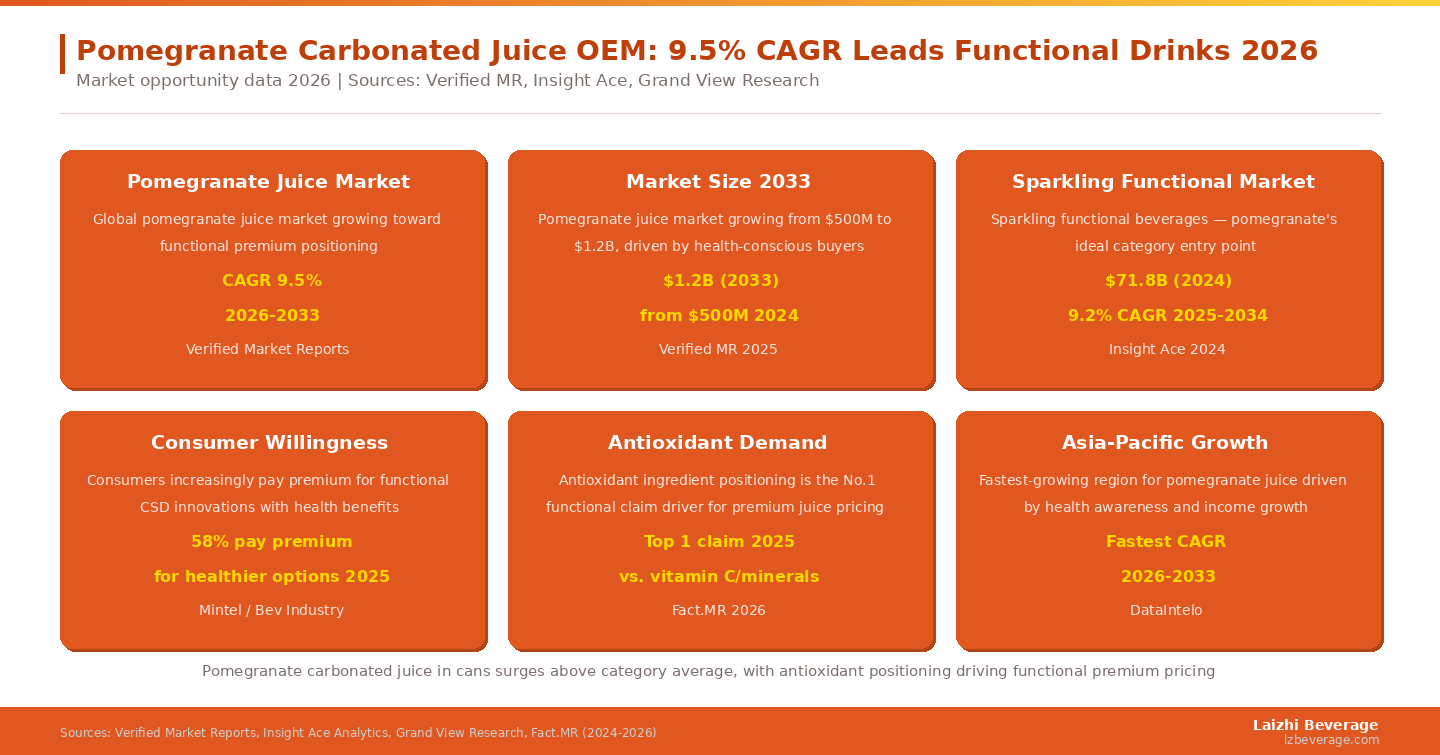
The global pomegranate juice market is projected to grow from USD 500 million in 2024 to USD 1.2 billion by 2033, at a CAGR of 9.5% — significantly above the overall juice category average. When positioned as a carbonated functional beverage in an aluminum can, pomegranate juice enters an even higher-growth segment: sparkling functional beverages reached USD 71.8 billion in 2024 and are forecast to grow at 9.2% CAGR through 2034. For OEM brand owners seeking a differentiated entry point in the carbonated category, pomegranate-based formulations offer one of the strongest combinations of market growth, antioxidant health positioning, and flavor distinctiveness currently available.
Why we wrote this: We produce fruit-based carbonated beverages across a range of formats and frequently work with clients developing functional juice-sparkling water hybrids. Pomegranate is one of the most requested flavors in functional OEM briefs we receive, yet many buyers underestimate the formulation complexity of carbonating a high-antioxidant juice and maintaining both flavor integrity and carbonation stability. This guide addresses that gap directly.
Key Takeaways
- Pomegranate juice market growing at 9.5% CAGR — well above the broader juice category average, driven by functional health positioning.
- Antioxidant claims are the strongest price justification for pomegranate-based beverages — brands that communicate polyphenol content command 20–50% retail price premiums over standard fruit juices.
- Carbonation adds a key consumption occasion — positioning pomegranate as a sparkling mocktail or social beverage expands beyond the health-supplement occasion that still juice occupies.
- 58% of consumers will pay more for functional CSD innovations, according to Mintel data — meaning the premium for carbonated pomegranate formulations is consumer-validated, not speculative.
- Formulation complexity is higher than standard sparkling water — pomegranate juice concentrate's low pH and high antioxidant content require careful carbonation calibration.
Why Pomegranate Carbonated Juice Is a Compelling OEM Opportunity in 2026
The Functional Beverage Premium: Where Pomegranate Fits
Consumer willingness to pay a premium for functional beverages is well-documented. According to Beverage Industry's 2025 soft drink report, 58% of consumers are willing to pay more for healthier alternatives, and 32% specifically express interest in functional carbonated soft drink innovations. Pomegranate is uniquely positioned to capture this willingness-to-pay because it has broad consumer recognition as a "superfood" — most buyers already associate pomegranate with antioxidants, immunity support, and cardiovascular health, without requiring extensive education at the point of purchase.
A Premium Gap That Private Labels Can Fill
The global functional drinks market reached USD 164.68 billion in 2025 and is projected to grow at 8.5% CAGR through 2033. Within this market, carbonated functional juice represents a relatively underserved segment compared to energy drinks and sports drinks. Most large-format supermarkets carry still pomegranate juice (POMWonderful and Minute Maid dominate the still category) but carry very few carbonated pomegranate SKUs. This gap is an OEM brand opportunity: a private label carbonated pomegranate juice in a 250ml or 330ml aluminum can fills a visible shelf gap in premium retail channels globally.
Cross-referencing the pomegranate juice CAGR (9.5%) with the sparkling functional beverage growth rate (9.2%) reveals a productive formulation strategy: a lightly carbonated pomegranate juice — rather than a heavily carbonated soda with pomegranate flavoring — occupies the intersection of both growth curves. The distinction matters for OEM briefs. A "pomegranate juice with natural sparkling" formulation (containing a meaningful percentage of real pomegranate juice concentrate with light carbonation at 2.0–2.5 volumes CO2) delivers health credentials that a "pomegranate-flavored sparkling water" cannot, while remaining more approachable than still 100% pomegranate juice for everyday consumption occasions. This positioning also justifies a higher price point than flavored sparkling water.
Pomegranate Carbonated Juice: Formulation Considerations
Pomegranate Juice Concentrate: Key Specifications
Commercial pomegranate juice for beverage production is typically sourced as 60–65 Brix concentrate, which is then diluted to 10–30% juice content in the finished product depending on the target taste intensity and price point. Key specification parameters for OEM procurement include: Brix range (typically 60–65 for concentrate), titratable acidity (expressed as % citric acid equivalent, typically 2.5–4.0% for high-quality concentrate), color (deep ruby red, ICUMSA units verified), and polyphenol content (typically 5,000–8,000 mg/L punicalagin for premium quality concentrate). Insist on a Certificate of Analysis (COA) from your OEM partner specifying polyphenol content if you intend to make antioxidant health claims on the label.
Carbonation Calibration for High-Acid Juice
Pomegranate juice concentrate is highly acidic (pH typically 2.8–3.2) which creates two specific formulation challenges for carbonation. First, high-acid beverages lose carbonation more rapidly during shelf storage than near-neutral-pH water, meaning finished products need to be carbonated to a slightly higher initial CO2 level (typically 2.5–3.0 volumes CO2 for a 12-month shelf life target at 2.0–2.5 volumes retained). Second, the interaction of polyphenols with CO2 in solution can affect flavor over time — accelerated shelf-life testing should include sensory evaluation at 6-month and 12-month intervals, not just microbiological testing.
Sugar and Sweetener Strategy
The natural sugar content of pomegranate juice concentrate is high (primarily fructose and glucose). Finished product sugar content for a 10–20% juice formulation will typically range from 4–8g per 100ml without additional sweetener. For health-positioning brands targeting zero-sugar or reduced-sugar claims, stevia or erythritol can be blended to achieve 0-sugar status while maintaining flavor. Note that in some markets (EU, UK), beverages with any added sugars require specific labeling, and the HFSS (High Fat Salt Sugar) classification can affect shelf placement in UK retail. Confirm labeling requirements for your target market before finalizing formulation.
Color Stability and Labeling
Pomegranate's ruby-red color is one of its most powerful merchandising assets in a can format (shrink-sleeve labels and direct-to-can printing both showcase the vibrant red effectively). However, pomegranate anthocyanins (the pigments responsible for the red color) can fade under UV exposure and with prolonged storage. For canned products, this is less of a concern than for glass or PET, as aluminum cans provide full opacity to light. Ensure your OEM partner tests color stability (L*a*b* color measurement) as part of the shelf-life testing protocol.
Target Markets and Channel Strategy
Asia-Pacific: The Priority Expansion Region
According to DataIntelo's pomegranate juice market report, Asia-Pacific is the fastest-growing region for pomegranate juice globally. In China, Japan, South Korea, and Southeast Asian markets, pomegranate is widely recognized for its health associations and is frequently used in traditional medicine contexts. A carbonated pomegranate juice in a premium-design aluminum can is well-suited to convenience store and premium grocery channels in these markets — the same channels that have driven sparkling water and functional RTD growth. We produce our RTD and juice range for export to these markets with full export qualification support.
Middle East and Europe
The Middle East has strong historical consumption of pomegranate products (Iran and Turkey are among the world's largest pomegranate-producing countries), and the regional premium beverage market is underserved by functional juice innovations. Europe, particularly Germany, the UK, and the Netherlands, has a growing functional beverage retail segment where carbonated fruit juice hybrids at premium price points ($2.50–$4.00 per 330ml can equivalent) are a growing shelf segment. Organic certification is a strong differentiator in European retail for this product category — confirm whether your OEM partner can support organic-certified pomegranate juice sourcing.
View our full beverage product portfolio to understand our fruit juice and carbonated beverage OEM capabilities, or visit our about page to review certifications and factory overview.
Next-step checklist
- Today, confirm target juice-content positioning (10% / 20% / 30% real pomegranate juice), and ask the OEM factory for sample quotes at each corresponding ratio.
- This week, ask the OEM partner for the COA of the pomegranate juice concentrate, and confirm polyphenol content (target: >=5000 mg/L anthocyanin equivalents).
- This week, confirm the label-claim strategy (antioxidant function claim/no added sugar/organic certification), and check the regulatory requirements in the target sales market.
- Next month, complete accelerated shelf-life testing for 2.0-2.5 vol CO2 (4 weeks at 40C), focusing on carbonation retention and sensory stability.
- Next month, determine the packaging style (330 ml aluminum can + shrink sleeve label vs. direct printing), and complete the packaging design brief around a deep pomegranate-red color palette.
FAQ
What percentage of real pomegranate juice should a carbonated pomegranate drink contain?
There is no universal regulatory minimum for juice content in a carbonated fruit juice drink, but consumer expectations and labeling requirements vary significantly by market. The EU requires that a product labeled "fruit juice drink" contain a minimum of 25% juice for most fruits; in the US, any juice content must be declared on the label as a percentage. For premium brand positioning, we recommend 15–30% juice content as the target range — sufficient to deliver a recognizable pomegranate flavor and color, justify antioxidant claims, and maintain carbonation stability without the cost constraint of 100% juice formats.
How does carbonated pomegranate juice compare in production complexity to plain sparkling water?
Production complexity for carbonated pomegranate juice is moderately higher than plain sparkling water. The additional steps include juice concentrate sourcing and quality verification, dilution mixing (requiring precise Brix calibration), pH adjustment prior to carbonation, and additional quality tests (juice content verification, polyphenol measurement, color measurement). Lead time for carbonated juice production typically adds 1–2 weeks to the standard sparkling water timeline. The formulation cost per unit is also higher, reflecting juice concentrate material cost — typically 20–40% higher than a comparably-sized flavored sparkling water.
Can pomegranate carbonated juice make antioxidant health claims on the label?
This depends entirely on the target market's regulatory framework. In the EU, food health claims are regulated under Regulation (EC) No 1924/2006, and only pre-approved health claims linked to specific nutrients or substances may appear on labels. Claims linking pomegranate or its polyphenols to specific health outcomes are generally not approved under EU law. In the US, structure/function claims are permitted under FDA guidance but must be carefully worded (e.g., "antioxidants support immune function" rather than "treats or prevents disease"). In many Asian markets, nutraceutical and functional claims have different approval pathways. Engage a regulatory consultant for each target market before finalizing label copy. Visit our industry resources section for guidance on beverage labeling topics.
What are the best can sizes for carbonated pomegranate juice?
The 250ml slim can is the preferred format for carbonated pomegranate juice in Asia-Pacific and Middle Eastern premium retail — it aligns with a single-serve premium consumption occasion and keeps the per-can price point accessible (USD 1.20–2.00 at consumer retail). The 330ml standard can is preferred for European retail shelves. A 180ml mini can works for impulse purchase and airline/hospitality channel placement. For first-time OEM orders, starting with a single 250ml format reduces minimum order complexity while you validate consumer response.


