Organic certification transforms a carbonated fruit juice from a premium beverage into a market-access credential. For brands targeting the US, EU, Canada, or Japan, the USDA Organic seal or its equivalent is increasingly a prerequisite for premium retail placement — not just a marketing add-on. At the same time, organic OEM production carries specific formulation constraints and supply chain requirements that standard beverage manufacturing does not. This guide maps both dimensions for OEM buyers who want to launch an organic sparkling juice.
Why we wrote this: We receive a growing number of inquiries from brands that want to launch organic-certified sparkling juice but are unclear on which certification they need, what it will cost in production complexity, and how to align their OEM partner's capabilities with their target markets. This guide provides the framework — grounded in current regulatory requirements and our production experience — to make that decision confidently.
Key Takeaways
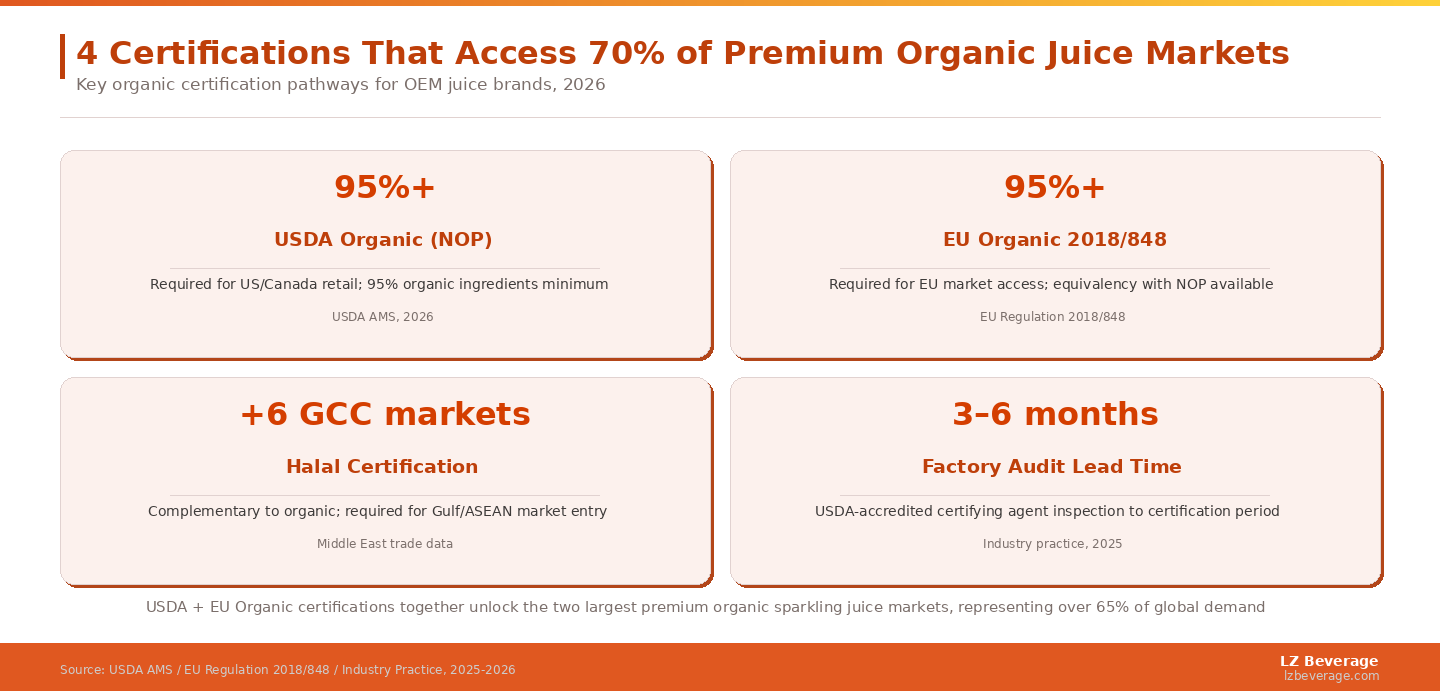
- USDA Organic certification is the gateway for the US and Canada — products must contain at least 95% certified organic ingredients to carry the seal.
- EU Organic (EU Regulation 2018/848) is the equivalent credential for European markets — same 95% threshold, with equivalency arrangements covering some foreign certifications.
- The certification must apply to both the ingredients AND the manufacturing facility — a factory without organic processing certification cannot produce an organic-labeled product regardless of ingredient sourcing.
- CO₂ used in carbonation is counted as an ingredient under USDA NOP rules — it must be food-grade and sourced appropriately.
- The formulation constraints are real but manageable — the prohibited substances list limits preservatives and some flavor compounds, but natural alternatives exist for every excluded ingredient.
Which Certification Do You Need?
USDA Organic (United States and Canada)
Governed by the USDA's National Organic Program (NOP), the USDA Organic certification requires that a product contain at least 95% certified organic ingredients, with the remaining 5% limited to substances on the National List of Allowed and Prohibited Substances. According to the USDA Agricultural Marketing Service, both the agricultural inputs and the processing facility must be certified by a USDA-accredited certifying agent. For an OEM arrangement, this means the manufacturing factory must hold organic processing certification — not just the brand.
The NOP has specific provisions for beverage production. As noted by BevSource's certification guidance, water and salt are excluded from the organic percentage calculation, but gases — including the CO₂ used for carbonation — are included. Food-grade CO₂ derived from natural sources (fermentation or geological) meets the requirement; synthetic industrial CO₂ that does not meet purity standards for organic use does not. This distinction requires confirmation with your CO₂ supplier during OEM contracting.
EU Organic Regulation
The EU Organic Regulation (EU 2018/848) imposes the same 95% organic ingredient threshold as the USDA NOP. Imported organic products require certification by an approved control body. The EU and US have a bilateral equivalency arrangement that allows USDA-certified operations to access EU markets, though specific documentation is required. For brands targeting both markets simultaneously, working with a certifying agent accredited by both the NOP and EU standards is the most efficient path.
Other Market Certifications
Japan (JAS Organic), Australia/New Zealand (Australian Certified Organic), and the Gulf Cooperation Council markets each have distinct organic certification frameworks. Many global OEM brands begin with USDA + EU certification and add market-specific certifications in year two once the formula and supply chain are established. Our team at LZ Beverage supports multi-market certification planning as part of the OEM project scoping process.
Combining the USDA regulatory data with what we observe across OEM onboarding processes, the most common certification delay is not the ingredient sourcing but the factory audit timeline. USDA-accredited certifying agents require an on-site inspection, and the waiting period from application to certification is typically 3–6 months. Brands that factor this timeline into their product launch plan — rather than discovering it at the sourcing stage — launch on schedule. For OEM buyers, asking the factory for its current organic certification status and renewal date is the first question to answer, before any discussion of formula or pricing.
Formulation Requirements for Organic Sparkling Juice
Ingredient Sourcing
The fruit juice base — the primary ingredient — must come from certified organic fruit or concentrate. Organic fruit costs typically run 40–100% higher than conventional equivalents, with tropical fruits (mango, pineapple, guava) at the higher end of that premium. The flavor and shelf-life stability of organic concentrates is comparable to conventional, but lot-to-lot variability in Brix and acidity is slightly higher due to more restricted use of standardization agents.
As Flavorman's certification guide notes, "Made with Organic Ingredients" labeling (requiring 70% or more organic content) is available as a lower-cost entry point, though it does not permit use of the USDA Organic seal. For brands where the seal is important for retail positioning, the full 95% threshold is required.
Prohibited Substances and Alternatives
The NOP's prohibited substances list eliminates several conventional beverage ingredients. Sodium benzoate and potassium sorbate — common preservatives in non-organic juice — are not permitted. Natural alternatives include rosemary extract, tocopherols (vitamin E), and ascorbic acid, all of which appear on the National List. Synthetic colorings and artificial flavors are excluded; certified organic natural flavors meeting NOP guidelines are permitted. Carbon dioxide for carbonation must meet food-grade standards appropriate for organic use.
Process Requirements at the Factory
An organically certified factory must maintain physical separation between organic and conventional production lines, implement documented cleaning protocols between runs, and maintain a complete audit trail from ingredient sourcing to finished product. As Food Research Lab's USDA guide explains, the Organic System Plan (OSP) — submitted to the certifying agent — must document all production processes, ingredients, and preventive measures against contamination with non-organic materials.
Target Markets and Their Opportunity Profiles
United States
The largest premium sparkling juice market. Natural/organic channels (Whole Foods, Sprouts, Natural Grocers) and club stores (Costco, Sam's Club) have been the primary retail entry points for organic sparkling juice SKUs. The category grew significantly during 2022–2025 as consumer demand for clean-label beverages accelerated. Sparkling juice market data from WiseGuy Reports places the CAGR at 5.9% through 2035 across the full category, with organic and exotic variants growing at the higher end.
European Union
The EU's mature organic consumer base — particularly in Germany, France, and the Nordic countries — supports premium pricing for certified organic sparkling juice. Grocery chains including REWE, Carrefour, and Systembolaget (Sweden) have active organic beverage programs. The EU's stricter labeling requirements around front-of-pack nutrition information apply to imported products. Beverage Daily's 2026 analysis notes that clean-label and organic positioning is among the strongest growth vectors in the EU non-alcoholic category.
Southeast Asia and Middle East
Fastest-growing import markets for premium organic beverages. Halal certification — which is compatible with and complementary to organic certification — opens Gulf Cooperation Council markets. Southeast Asian importers in Singapore, Malaysia, and Thailand are increasingly requesting organic certification alongside HACCP and export documentation.
Next-step checklist
- Today, confirm the target market (US/EU/Southeast Asia) and choose the corresponding certification system (USDA NOP / EU 2018/848 / JAS).
- This week, ask the OEM factory for its organic processing certificate and expiration date, and confirm whether it already holds certification for the target market.
- This week, assess the cost premium for organic juice ingredients (typically +40-100%) and calculate the product cost structure at the target retail price.
- Next month, contact the certification body and start the brand organic certification application (audit cycle: 3-6 months, so plan ahead).
- Browse the LZ Beverage Full Product Line to understand OEM product capability coverage, and contact us to discuss organic carbonated juice project needs.
- Visit LZ Beverage Industry Insights for the latest organic-certified OEM industry updates and export compliance updates.
FAQ
Can a non-certified OEM factory produce an organic-labeled carbonated juice?
No. Under USDA NOP rules, both the ingredients and the processing facility must be certified. A factory without organic processing certification cannot produce product labeled as "organic" or "USDA Organic" regardless of ingredient sourcing. This applies to imported products sold in the US market. Verifying factory certification before formula development is the first step for any organic OEM project.
How much does organic certification increase OEM production costs?
Organic ingredients typically carry a 40–100% cost premium over conventional equivalents. Additional costs include the certifying agent's annual inspection fee (typically USD 1,000–5,000 depending on operation size), documentation management, and the premium for food-grade CO₂ appropriate for organic use. On a per-unit basis, the ingredient premium is the dominant cost driver — the certification overhead amortizes across volume.
Can CO₂ used for carbonation disqualify a product from organic certification?
CO₂ counts as an ingredient under USDA NOP rules. Food-grade CO₂ derived from fermentation or naturally occurring geological sources is generally permitted. Industrial-grade CO₂ not meeting NOP purity standards would need to be substituted. Your OEM partner's CO₂ supplier should be able to provide documentation confirming suitability for organic production. This detail is consistently overlooked in early-stage OEM planning and is worth confirming explicitly with the factory.
What is the difference between "Made with Organic Ingredients" and full USDA Organic?
Products with 70–94% organic ingredients can use the "Made with Organic [ingredient name]" claim without the USDA Organic seal. Products with 95% or more organic content qualify for the full seal. For retail positioning in premium channels, the seal is significantly more powerful than the text-only claim. As detailed by Food Research Lab, brands targeting natural specialty retail should prioritize achieving the full 95% threshold from the start rather than planning a later upgrade.


