Traditional carbonated soft drinks are losing ground.FoodNavigator's analysis of Coca-Cola's portfolio strategyconfirms that soda volumes have stagnated in developed markets, with growth now concentrated in zero-sugar, functional, and natural beverage categories. Into this gap, carbonated fruit juice — sparkling juice — has emerged as the category brands are betting on in 2026. For any OEM buyer considering a private-label launch, the strategic question is not just "how do I make it?" but "how do I position it?"
What you will get from this article:A structured comparison of sparkling juice versus soda across the dimensions that matter most for OEM buyers — ingredients, consumer perception, pricing power, and market trajectory — plus a clear framework for choosing your brand positioning before you place a production order.
Key Takeaways
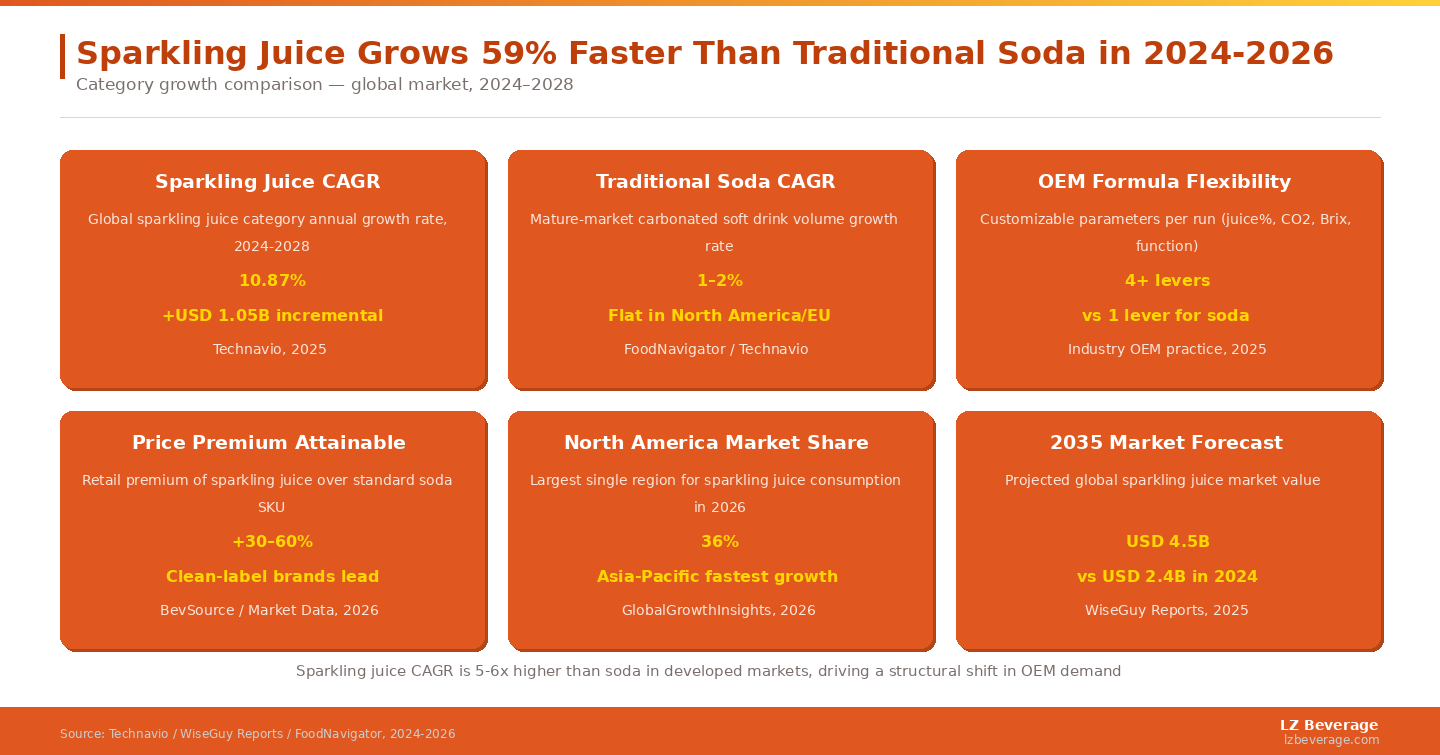
Sparkling juice is growing at 5.9–10.87% CAGRwhile traditional soda volume in mature markets is flat-to-negative.
The ingredient story is the positioning story— real fruit juice content is the primary claim that separates sparkling juice from soda in consumer perception.
Pricing premiums of 30–60% over standard soda are attainablefor sparkling juices positioned around natural ingredients and clean-label claims.
OEM flexibility is higher for sparkling juice— juice content, carbonation level, sweetness, and functional additives can all be customized per production run.
Category Definitions: Where Each Product Sits
Traditional Soda
A standard carbonated soft drink is built from carbonated water, high-fructose corn syrup or sugar, natural or artificial flavors, and preservatives. Fruit juice content is typically absent or below 5%. Carbonation levels are high — 3.5 to 5 volumes of CO₂. Consumer perception in 2026 is increasingly negative among health-conscious demographics: according toBeverage Daily's 2026 trend analysis, scrutiny of artificial ingredients and colors has accelerated, directly hurting traditional soda's growth outlook.
Sparkling Juice
Sparkling juice is carbonated juice — beverage containing measurable fruit juice content (typically 10–100%) combined with carbonated water and minimal processing. Thecarbonation processdissolves CO₂ under pressure, creating effervescence without artificial flavor compounds. Carbonation levels for juice-based products are typically lower (1.5–2.5 volumes) to protect delicate fruit aromatics. The result is a drink that delivers the sensory experience of fizz while maintaining a "real ingredient" label story.
Industry practice shows a clear pattern: brands that enter the better-for-you soda category with a "less artificial" position consistently outperform those that lead with a "healthier-than-soda" message. As reported byFood Dive's coverage of the BFY soda wave, Spindrift's decision to lead with "real fruit juice" rather than functional claims proved to be its key shelf differentiator. The implication for OEM buyers: ingredient transparency — not health buzzwords — is the more durable positioning.
Side-by-Side Comparison: OEM Buyer's Lens
Dimension
Traditional Soda
Carbonated Fruit Juice
Primary ingredient
Carbonated water + flavor
Fruit juice + carbonated water
Juice content
0–5%
10–100%
CO₂ volumes
3.5–5.0
1.5–2.5
Label claim potential
Limited
Natural, real fruit, no artificial flavor
Market CAGR 2024-2028
~1–2% (mature markets)
5.9–10.87%
Retail price premium vs. standard soda
Baseline
+30–60% achievable
OEM formula customization
Limited (commodity space)
High (juice %, Brix, flavor, CO₂ level)
Target consumer
Mass, price-driven
Health-conscious, millennial/Gen Z
Market Momentum: Numbers That Define the Opportunity
The sparkling juice category's growth trajectory makes the positioning decision easier.WiseGuy Reportsplaces the 2024 global sparkling juice market at USD 2.4 billion, growing to USD 4.5 billion by 2035.Technavio's forecastputs the 2024–2028 incremental gain at USD 1.05 billion — a 10.87% CAGR. North America holds 36% of global volume, but Asia-Pacific is growing fastest, making it particularly relevant for OEM buyers sourcing from China-based factories for export.BevSource's 2026 trend reportidentifies exotic and functional fruit combinations as the highest-velocity subcategory for OEM innovation.
Choosing Your Positioning Framework
Position 1: Juice-First ("Real Fruit, Real Fizz")
Lead with high juice content (50–100%), minimal processing, and transparent ingredient sourcing. This position commands the highest price premium and targets health-driven, premium retail channels. It requires a larger ingredient cost base from your OEM partner but delivers stronger brand equity.
Position 2: Occasion-Based ("The Better Celebration Drink")
Target the non-alcoholic celebratory occasion — parties, Dry January, corporate events — by positioning sparkling juice as a festive alternative to champagne or sparkling wine. Mid-range juice content (20–50%), elegant can design, and larger formats. Retailers in Europe and Southeast Asia have been most receptive to this angle.
Position 3: Functional Hybrid ("Sparkling Juice + Wellness Claim")
Add a functional layer — probiotics, vitamins, adaptogens, or electrolytes — to the juice base. This is the highest-complexity OEM path but commands the widest margin. Ourtechnical teamspecializes in custom formulation that meets both taste and functional claim requirements.
Next-step checklist
Today, determine your target channel (supermarket/convenience store/online); channel type directly determines juice-content requirements and packaging style.
This week, complete target consumer research: health-conscious consumers (Position 1) vs. occasion-led consumers (Position 2), then fill out the OEM brief.
This week, ask the OEM factory for comparison samples at three juice-content levels (20%/50%/100%) to support price and mouthfeel tradeoff decisions.
Next month, based on sample test results, lock one positioning framework and submit the formal custom-formula request toLZ Beverage Product Lines.
Subscribe toLZ Beverage Industry Insightsfor the latest OEM export trends and policy updates in the carbonated beverage market.
FAQ
Is there a specific juice content threshold that makes a product qualify as "sparkling juice" versus "soda" for labeling purposes?
Regulatory definitions vary by market. In the EU, "fruit juice drink" requires a minimum juice content defined per fruit type (generally 6–30%). In the US, FDA requires front-label disclosure of juice percentage when below 100%. The operative question for most OEM buyers is what claim they want to make — if "made with real fruit juice" is the anchor claim, a minimum 10–15% juice content is typically sufficient to defend it credibly. Our team provides market-specific labeling guidance as part of the OEM onboarding.
Does higher juice content always mean a better product for OEM positioning?
Not necessarily. Higher juice content raises ingredient costs, increases pH sensitivity, and can shorten shelf life if not handled correctly. For OEM buyers targeting mass retail, a 20–30% juice content often delivers the optimal balance of ingredient authenticity, cost management, and production stability. Positioning determines the juice percentage threshold — not the other way around.
How does carbonation level affect consumer perception between sparkling juice and soda?
Higher CO₂ volumes (3.5+ volumes) are associated with the aggressive fizz of traditional soda. Sparkling juice at 1.5–2.0 volumes delivers a gentler, more refined effervescence that consumers associate with premium or natural products. Research onbeverage acidity and buffering capacitysuggests that fruit juice's natural acid composition helps retain this lighter carbonation character over shelf life — a built-in quality advantage that OEM buyers can leverage in positioning.
An alumnus of Jiangnan University —China’s top-ranked institution for Food Science and Technology—Nobel Liu is a veteran Beverage Engineer at Hainan Laizhi Industry with over a decade of expertise in functional formulation and processing technologies. Specializing in private label energy drinks, botanical infusions, and tropical fruit flavor stabilization, he bridges the gap between innovative liquid development and high-speed commercial production.
Nobel Liu
Senior Beverage Engineer
A graduate ofSouth China University of Technology , a premier institution for Food Engineering, Elena Chen serves as the Lead Beverage Process Engineer at Hainan Laizhi Industry. With over 8 years of industrial experience, Elena specializes in manufacturing scale-up, automated aseptic cold-filling technologies, and production line optimization for complex functional beverages.
Elena Chen
Lead Beverage Process Engineer
SUBSCRIBE OUR NEWSLETTER
Receive exclusive offers and news that will brighten up your day!