Flavor selection is the single most consequential OEM decision for a canned sparkling juice launch. In 2026, the global non-alcoholic beverage market is projected to surpass USD 157 billion, with sparkling juice as one of its fastest-accelerating categories. But within that growth, flavor performance is bifurcating sharply — some profiles are compounding their lead, others are declining, and a set of emerging flavors is beginning to command the attention of buyers who want to be ahead of the next demand wave. This report maps all three zones.
Why we wrote this: As an OEM partner to juice brands across Southeast Asia, the Middle East, Europe, and North America, we see the actual order books — not just trend reports. This article combines industry trend data with what we observe in OEM inquiries and production orders in 2026, to give our brand clients a more grounded picture of which flavors are worth prioritizing for a private-label launch this year.
Key Takeaways
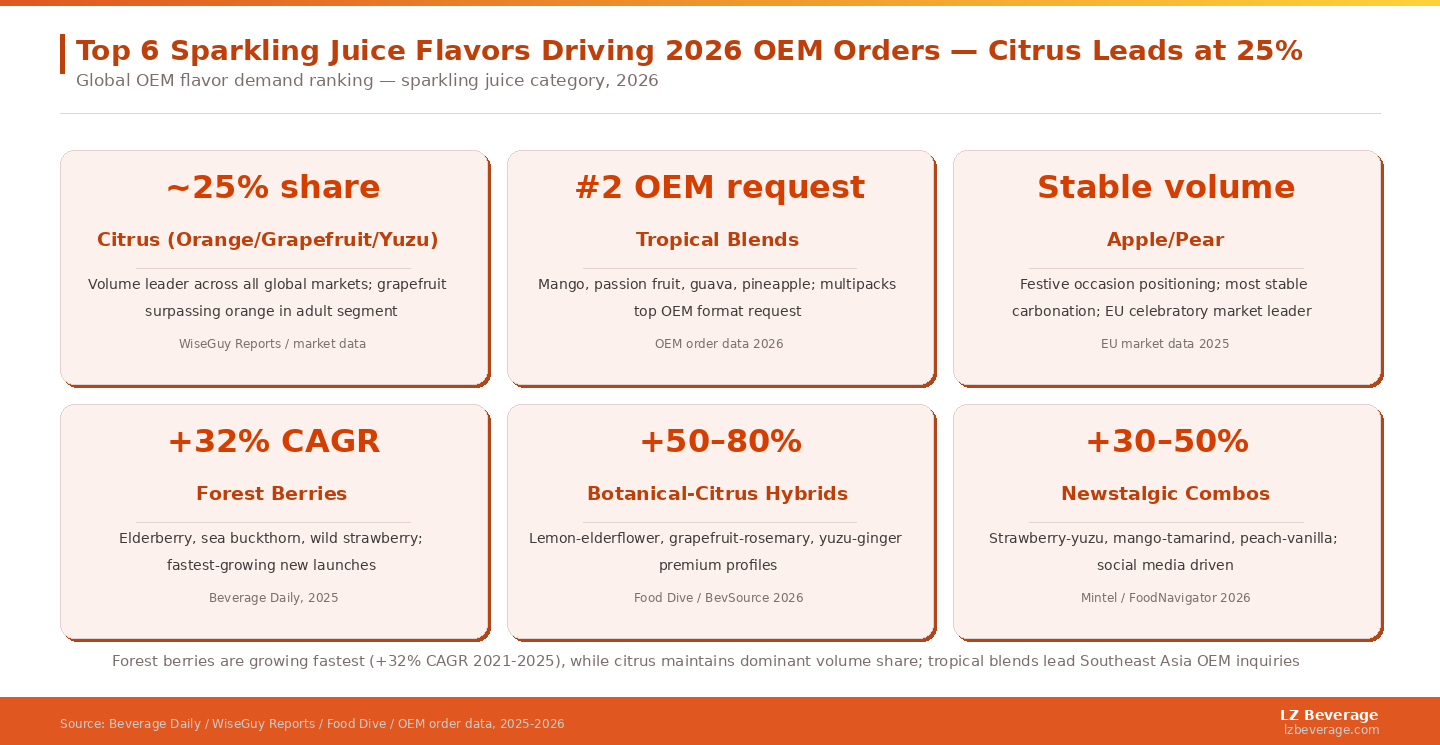
- Citrus remains the dominant flavor category at an estimated 25% share of global sparkling juice sales — orange, lemon, grapefruit, and yuzu lead the order volume.
- Forest berry flavors (elderberry, sea buckthorn, wild strawberry) are the fastest-growing segment, with a documented +32% CAGR in global product launches from 2021 to 2025.
- Tropical multipacks are the top OEM format request in 2026 — mango, passion fruit, and guava combinations in 330ml or 250ml cans.
- Newstalgic flavor blends — familiar profiles with an unexpected twist (strawberry-yuzu, lemon-elderflower, mango-chili) — are commanding a measurable price premium in premium retail.
- Cola, cranberry, and basic coconut are declining in sparkling juice formats as consumers seek more specific, origin-authentic flavor stories.
The Leading Flavors: What's Driving Volume
Citrus — The Durable Leader
Citrus flavors — orange, lemon, grapefruit, blood orange, and lime — collectively remain the backbone of global sparkling juice demand. The citrus sub-segment of the sparkling juice market reached a valuation of USD 600 million in 2024, with projections from WiseGuy Reports pointing to USD 1.05 billion by 2035. The appeal is structural: citrus flavors are universally recognized, inherently refreshing, compatible with functional additions (vitamin C fortification is natural to the profile), and cost-competitive from a concentrate sourcing standpoint.
In our OEM order data for 2026, grapefruit has surpassed orange as the top single-fruit inquiry for brands positioning toward adult or health-conscious demographics. The slight bitterness profile of grapefruit aligns with the "sophisticated adult beverage" positioning that non-alcoholic sparkling brands are increasingly targeting. Yuzu — the Japanese citrus — is moving from premium novelty to a mainstream order, particularly for buyers serving Japanese, Korean, and Taiwanese markets.
Apple and Pear — The Reliable Core
Apple and pear sparkling juice maintain strong volume, particularly in the European celebratory occasion segment (Martinelli's-style positioning) and in Halal markets where they offer a festive non-alcoholic sparkling option. In OEM terms, apple juice base is one of the most stable to carbonate: its natural malic acid content aids CO₂ retention, and the concentrate supply chain is the most mature and price-stable of any juice type. Pear blends well with elderflower and lychee for the "botanically elevated" segment.
Tropical Blends — The Volume Growth Engine
Single-serve tropical blends — mango, passion fruit, guava, pineapple, and their combinations — are the fastest-growing OEM inquiry category in 2026. Beverage Daily's 2026 trend report cites guava and huckleberry as the emerging fruit flavors to watch alongside the established tropical base. For OEM buyers targeting Southeast Asia and Middle East markets, tropical multipacks (4 or 6 SKUs in the same multipack, each a different tropical fruit) have shown strong sell-through in convenience retail. The visual variety of tropical flavors also performs well in social media-driven purchase decisions.
Combining what BevSource's 2026 trend data shows about regional flavor discovery with our own order patterns, an underappreciated dynamic is visible: brands that enter with a single-flavor launch at commercial scale consistently lose shelf space to brands that launch with a 3-SKU flavor range. Buyers in modern trade channels want a planogram story, not a single product. For OEM clients, this means designing for a range from the start — even if only one flavor goes into the first production run. It fundamentally changes the can design brief and the formula development sequence.
The Emerging Flavors: Where the Margin Is
Forest Berries: Elderberry, Sea Buckthorn, Wild Strawberry
According to Beverage Daily's flavor trend analysis, forest berry flavors showed +32% CAGR in global product launches from 2021 to 2025 — one of the highest sustained growth rates in any fruit beverage subcategory. The driver is dual: hedgerow and forest berries carry strong terroir associations (origin storytelling) and genuine functional credentials (antioxidant content, polyphenol profiles). Sea buckthorn — tart, orange-hued, rich in omega-7 — is emerging most rapidly in European markets. Elderberry, accelerated by its immune-support positioning during the pandemic period, has retained above-category retention.
Botanical-Citrus Hybrids
The "swangy" and "swavory" trend documented by Food Dive's 2026 flavor analysis — sweet, spicy, tangy, savory combinations — is influencing the sparkling juice category through botanical-citrus hybrids. Lemon-elderflower (tart + floral), grapefruit-rosemary (bitter + herbal), and yuzu-ginger (aromatic + warm) are the leading combinations. These profiles are more complex to formulate for OEM production but command retail prices 50–80% above standard fruit flavors.
Newstalgic Combos
As identified by Mintel's 2026 food and drink predictions — cited by FoodNavigator's market analysis — "newstalgia" describes the combination of familiar, comfort-associated flavors with unexpected modern twists. In sparkling juice, this manifests as strawberry-yuzu, peach-vanilla, mango-tamarind, and passion fruit-lychee. The formula complexity is moderate; the marketing story is strong; and the willingness-to-pay premium is documented at +30–50% versus standard tropical SKUs. Our RTD product line includes OEM support for these hybrid flavor formulations.
The Declining Flavors: What to Avoid in 2026
Cola-flavored sparkling juice — a category that existed briefly in Southeast Asia — has essentially exited from premium retail consideration. The cola flavor profile is too closely associated with traditional soda to work in a "real fruit juice" positioning context. Cranberry, once a strong performer in the US and EU, is declining as its antioxidant claim loses novelty against a field of competitors with more specific functional profiles. Basic coconut water carbonation has also softened; the novelty period has passed and the category is consolidating around a smaller number of premium brands.
Format and Pack Considerations for Flavor Launches
For OEM buyers, flavor selection is inseparable from format selection. In 2026, 250ml slim cans are the preferred format for premium, newstalgic, and botanical-hybrid flavors — the smaller serve size reduces the perceived risk for consumers trying a new flavor. Standard 330ml cans work best for core citrus and tropical flavors where brand loyalty is already established. Technavio's market analysis confirms that packaging format significantly influences consumer purchase decisions in the sparkling juice category, with premium positioning correlating strongly with slim-can formats in North America and Europe.
For a deeper look at the full range of OEM production capabilities at LZ Beverage — across flavor formats, can sizes, and custom formulations — our product team is available to discuss your 2026 launch brief.
Next-step checklist
- Today, evaluate the main flavor range for your target market: EU priority on berry/elderflower; Middle East/Southeast Asia priority on tropical fruit; US priority on citrus/functional flavors.
- This week, design a 3-SKU flavor matrix (1 core flavor + 1 growth flavor + 1 emerging flavor) as the OEM sampling requirements list.
- This week, confirm the target achievable price range and whether plant extracts or functional ingredients are needed to support a premium (botanical-citrus combinations can command a 50-80% premium).
- Next month, based on market test results, choose either a 250 ml slim can or a 330 ml standard can, and submit the formal OEM custom-formula request.
- Visit LZ Beverage Industry Insights and subscribe to the latest 2026 beverage flavor trends and OEM production updates.
FAQ
Which sparkling juice flavors have the best shelf life in aluminum cans?
Citrus flavors (especially those with higher natural acid content) generally have the most stable shelf life in carbonated can formats, because the low pH environment slows microbial activity and retards CO₂ loss. Tropical flavors with higher sugar content and lower acidity (mango, guava, passion fruit) are more susceptible to color changes and Maillard browning over time; these formats benefit from added ascorbic acid and careful pasteurization controls. All shelf-life claims should be validated through accelerated shelf-life studies on actual production samples.
What is the minimum order quantity for a multi-flavor sparkling juice range?
MOQ varies by production line and format. For a 3-flavor launch, brands typically negotiate a combined MOQ across the three SKUs rather than requiring minimum volume per flavor individually. This flexibility is particularly important at launch, when forecast confidence per individual flavor is lower. Contact us through the LZ Beverage about page to discuss your specific volume and flavor mix requirements.
Are newstalgic and botanical-hybrid flavors more expensive to produce in OEM?
Ingredient cost for botanical-hybrid flavors is typically 15–30% higher than standard fruit flavors due to more expensive botanical extracts. The formulation development time is also longer — typically 4–6 weeks for initial sampling versus 2–3 weeks for standard fruit profiles. However, the retail price premium these flavors command (50–80% in most markets) makes the OEM cost increment easily justifiable for brands targeting premium positioning.
How should I decide between a single-flavor launch and a multi-flavor range?
The channel determines the answer more than the brand's preference. Convenience retail typically requires a single hero SKU with strong visual impact. Modern trade (supermarkets, online retail) rewards range breadth — retailers want multiple facings and a category story. Premium gifting or e-commerce channels support variety packs. For brands new to sparkling juice, launching with a 3-SKU range allows faster learning about which flavor drives repurchase, informing the decision to expand or concentrate production.


