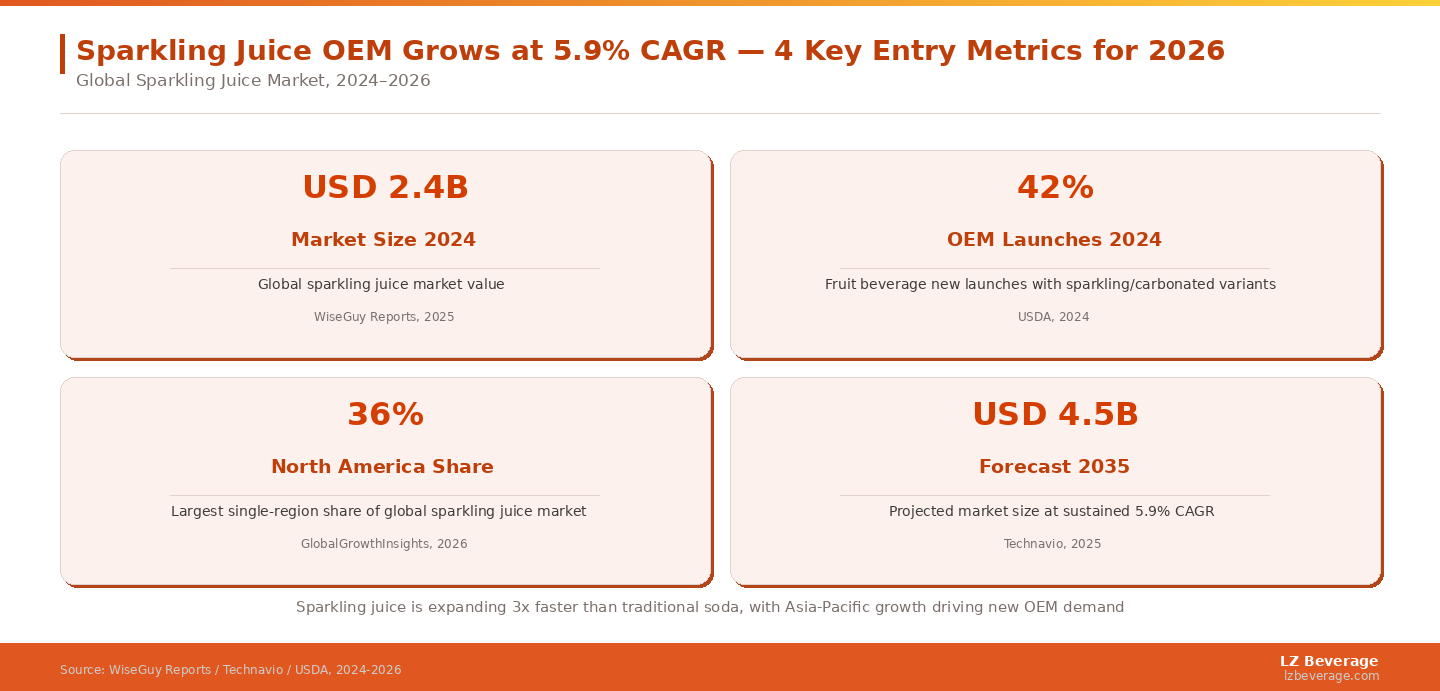
Canned carbonated fruit juice — sometimes called sparkling juice or fizzy juice — sits at the fastest-growing intersection of the beverage market. According to WiseGuy Reports, the global sparkling juice market was valued at USD 2.4 billion in 2024 and is forecast to grow at a CAGR of 5.9% through 2035. For juice brands looking to tap into this momentum, understanding the product category and the OEM pathway is the essential first step.
Why we wrote this: We work with beverage brands at every stage of product development, and canned sparkling juice is consistently among the most-asked-about categories. Many brands understand the demand but aren't sure where to start: Is it really "juice"? How is it different from soda? Can a small brand afford to produce it? This guide answers these questions and maps out the OEM path from concept to can.
Key Takeaways
- Carbonated fruit juice is not soda — it uses real fruit juice content combined with CO₂ gas, producing a healthier, cleaner-label alternative to traditional carbonated soft drinks.
- Cans are the OEM-friendly format — aluminum cans offer better CO₂ retention, longer shelf life, and lower per-unit costs than glass for high-volume production.
- The global market is growing at 5.9% CAGR, with Asia-Pacific emerging as the fastest-growing region for OEM buyers.
- A HACCP-certified OEM partner handles the technical complexity — formula development, carbonation, pasteurization, and canning are all managed factory-side.
- MOQ flexibility matters — reputable OEM partners support private label launches from small-batch sampling to full-scale production.
What Exactly Is Carbonated Fruit Juice in a Can?
The Science Behind the Fizz
Carbonated fruit juice is produced by dissolving carbon dioxide gas into a fruit juice mixture under pressure. The process follows Henry's Law: the amount of CO₂ that dissolves into a liquid is directly proportional to the pressure applied. By chilling the juice below 10°C and pressurizing the carbonation vessel, manufacturers can force 1.5–3.5 volumes of CO₂ into the liquid, creating the characteristic effervescence consumers recognize.
Unlike traditional sodas — which use flavored water plus sweeteners — carbonated fruit juice contains measurable fruit juice content, typically 10–100% depending on the product positioning. The natural acidity of fruit juice (pH 3.0–4.0) actually aids CO₂ retention, as a lower-pH environment helps keep carbonation stable over the product's shelf life. Research published in PMC/NCBI confirms that fruit juice acidity significantly affects the buffering capacity and preservation properties of carbonated beverages.
How Does It Differ from Soda?
The key distinctions are ingredient origin and perception. Soda derives its flavor primarily from synthetic or nature-identical flavor compounds mixed with carbonated water. Carbonated juice starts with actual fruit — whether NFC (not-from-concentrate), reconstituted juice, or juice concentrate — which then undergoes a carbonation step. This distinction matters enormously for labeling, consumer trust, and market positioning. As Beverage Daily reports, 2026 beverage trends are strongly shaped by demand for natural, clean-label products — a space where carbonated juice holds a structural advantage over soda.
Combining data from the USDA (which reports that 42% of fruit beverage launches in 2024 included a sparkling or carbonated variant) with the sustained CAGR figures from market research, a clear picture emerges: brands are not experimenting with sparkling juice — they are repositioning their core lineup around it. For OEM buyers, this means the question is no longer whether to add a canned sparkling SKU, but when and how to do it efficiently.
Why Cans Are the OEM-Optimal Format
Aluminum cans offer several structural advantages for carbonated juice production. They provide a fully opaque, oxygen-free environment that protects sensitive fruit pigments and ascorbic acid from light degradation. The sealing integrity of aluminum eliminates the micro-permeation risk that affects PET bottles over extended shelf periods. For high-volume OEM production, cans also run faster on filling lines — a standard carbonated drink production line typically achieves 1,000–15,000 liters per hour, with can lines generally outpacing bottle equivalents at the same SKU volume.
For the brand, cans carry a practical cost-per-unit advantage at scale, and the 360° printable surface makes them a high-impact canvas for premium and co-branding projects. Our one-stop OEM/ODM service at LZ Beverage includes in-house aluminum can supply integrated with the filling line — eliminating the sourcing gap that frequently slows private-label launch timelines.
The OEM Production Pathway: From Formula to Finished Can
Step 1 — Juice Sourcing and Blending
OEM production begins with selecting the juice base: NFC, concentrate, or a blend. The juice content percentage, natural sweetness level, and pulp profile all determine the downstream carbonation parameters. Our technical team works with each brand client to set these specifications during the sampling phase.
Step 2 — Deaeration
Before carbonation, dissolved oxygen must be removed from the juice. Oxygen is the primary driver of oxidative degradation — browning, off-flavors, and vitamin C loss. Vacuum deaeration reduces dissolved O₂ to below 1 ppm, extending shelf life and protecting the product's sensory profile.
Step 3 — Pasteurization
Flash pasteurization heats the juice to 71–82°C for less than one minute, per protocols outlined by industry process guides. This brief heat treatment eliminates pathogenic microorganisms while preserving the volatile flavor compounds that give fresh juice its characteristic aroma. Alternatives include tunnel pasteurization post-fill, which is preferred for higher-acid formulas.
Step 4 — Carbonation
The chilled, deaerated juice passes through a carbonation unit where food-grade CO₂ is injected under controlled pressure. Carbonation levels for fruit juice typically target 1.5–2.5 volumes of CO₂ — lower than cola (3.5–4.0 volumes) to preserve fruit flavor and aroma character. The science of CO₂ solubility is described in depth by Agriculture Institute's food engineering resource: lower temperature and higher pressure maximize CO₂ absorption.
Step 5 — Canning and Sealing
The carbonated juice is filled into pre-washed, sanitized aluminum cans under counter-pressure conditions that minimize CO₂ loss during the fill. The can is double-seamed at the top within seconds of filling. Finished cans pass through an online checkweigher and leak detector before entering the palletizing station.
Next-step checklist
- 1. Today, submit target formula requirements to the OEM factory (juice percentage, target Brix, flavor direction) and request a sampling quotation.
- 2. This week, confirm target-market import certification requirements (HACCP, export license) and check whether the factory certifications match.
- 3. This week, compare MOQ differences between 330 ml and 250 ml can formats, and select the capacity based on the first-batch budget.
- 4. Next month, after receiving samples, use Henry's law parameters (carbonation volumes/temperature) to run blind tasting comparisons at room temperature and chilled conditions.
- 5. Read LZ Beverage Industry Insights to learn the latest OEM certifications and export trends for carbonated drinks.
FAQ
What is the minimum juice content required to label a product as "juice" in export markets?
Requirements vary by market. In the EU, a product must contain at least 100% juice to use the word "juice" without qualification; lower percentages must be labeled "juice drink" or "nectar." In the US, FDA rules require front-of-label disclosure of juice percentage for beverages containing less than 100% juice. Our team at LZ Beverage's factory provides labeling guidance aligned with your target export market as part of the OEM onboarding process.
How long is the shelf life of canned carbonated fruit juice?
When produced with proper pasteurization, deaeration, and hermetic sealing, canned carbonated fruit juice typically achieves 12–18 months at ambient temperature. Shelf life is influenced by Brix level, pH, CO₂ volume, and the presence or absence of preservatives. We recommend conducting an accelerated shelf-life study on the first production batch to confirm parameters for your specific formula.
Can I order a private-label canned sparkling juice with a small initial MOQ?
Yes. We offer flexible production runs that accommodate brands at the early testing phase, not just large-scale orders. Browse our product lines or contact us directly to discuss your project scope and budget range.
What certifications does a HACCP-certified OEM factory hold?
HACCP certification verifies that the factory maintains a systematic Hazard Analysis and Critical Control Points program at every stage of production. This is the international benchmark for food safety in beverage manufacturing. LZ Beverage has held HACCP certification since 2017 and holds Chinese export qualification, both required for shipping product to regulated markets including the EU, ASEAN, and Middle East.


