Carbonating fruit juice is deceptively simple in concept but technically demanding in execution. Unlike carbonating plain water, adding CO₂ to fruit juice means managing the interaction between the gas and a complex biological matrix — sugars, organic acids, proteins, and volatile aroma compounds — each of which affects carbonation retention, flavor stability, and shelf life. For brands working with an OEM partner, understanding these process parameters ensures better product outcomes and more productive conversations with your factory.
Why we wrote this: We produce millions of cans of carbonated fruit juice annually across 50 production lines. The most common source of product-quality variation we see in new client launches is not the formula — it's a mismatch between the brand's expectations and the process parameters that determine CO₂ stability and flavor integrity. This guide closes that knowledge gap so that OEM buyers make better decisions at the specification stage.
Key Takeaways
- Deaeration before carbonation is non-negotiable — dissolved oxygen causes browning, off-flavor, and vitamin C loss that no carbonation step can reverse.
- Flash pasteurization at 71–82°C for under 60 seconds is the industry standard for preserving fruit flavor while ensuring microbial safety.
- Target 1.5–2.5 volumes of CO₂ for juice-based products — aggressive carbonation levels (3.5+) damage delicate aromatics and impair the fruit flavor profile.
- Temperature during filling is the single biggest lever on carbonation efficiency — filling below 4°C maximizes CO₂ absorption and retention per unit.
- Counter-pressure filling is required for canned carbonated juice — standard gravity fill causes excessive CO₂ loss and inconsistent fill levels.
The Science Foundation: Why Juice Is Different from Water
The carbonation process follows Henry's Law: dissolved CO₂ concentration is proportional to applied pressure and inversely proportional to temperature. In pure water, this is straightforward. In fruit juice, the matrix complexity introduces additional variables.
Natural fruit acids (citric, malic, tartaric) lower the juice pH, which actually aids CO₂ retention over shelf life — a lower-pH environment reduces the rate at which dissolved CO₂ escapes to the headspace. However, the same acids interact with the can's internal lining over time, making the choice of can liner specification critical for high-acid products. Research published via PMC/NCBI on beverage buffering capacity confirms that titratable acidity is a more reliable predictor of carbonation stability than pH alone — a finding that directly influences how we set carbonation targets for each formula.
Pulp and fiber content pose a separate challenge: suspended particles act as nucleation sites, triggering premature CO₂ release (gushing) during the fill. Clarified or low-pulp juice bases are substantially easier to carbonate consistently. For cloudy or high-pulp formats, our production team adjusts filling pressure and temperature parameters accordingly.
Step-by-Step Carbonation Process for Canned OEM Production
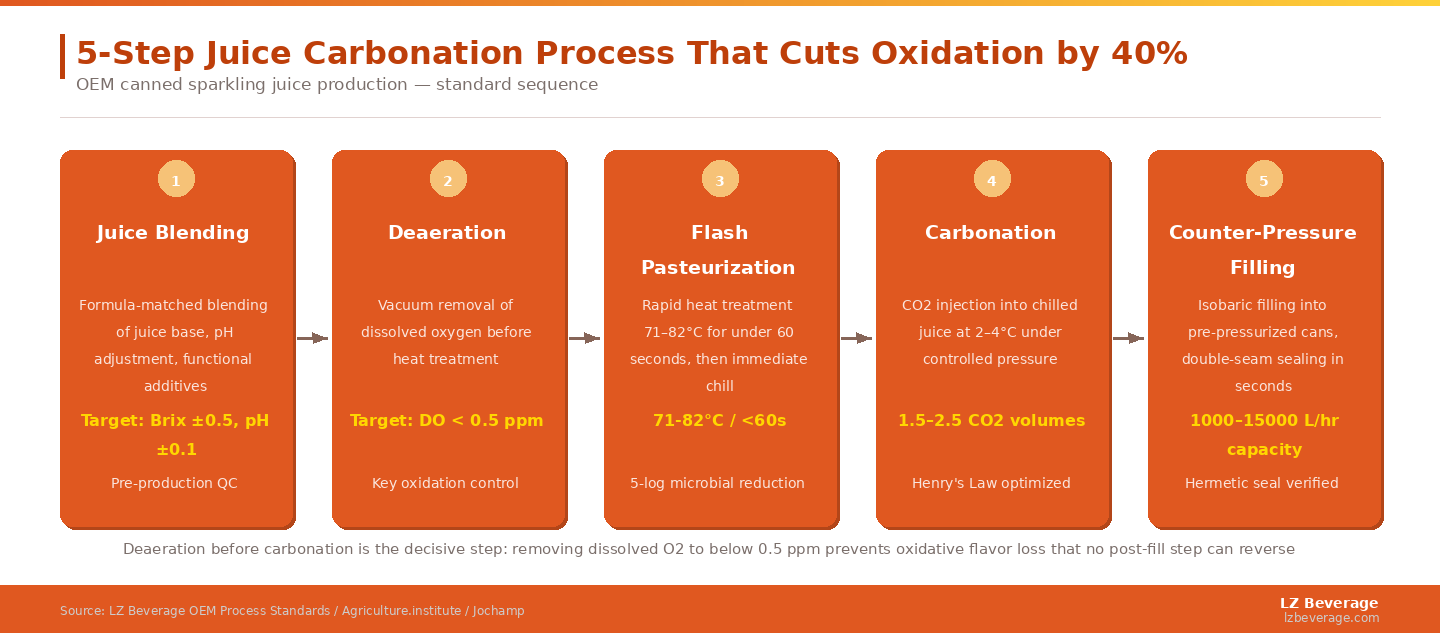
Step 1 — Juice Preparation and Blending
The process begins with recipe-matched juice blending. Whether using NFC juice, concentrate, or a blend, we target the approved Brix (sugar concentration), pH, and natural color profile. Any added ingredients — natural flavor, citric acid, ascorbic acid as antioxidant, functional additives — are incorporated at this stage. Getting the blend right before deaeration avoids re-blending steps that would re-introduce dissolved oxygen.
Step 2 — Deaeration
Vacuum deaeration removes dissolved oxygen from the juice blend before any heat treatment or carbonation. This is the most underappreciated step in the process. Oxygen at levels above 1 ppm will react with ascorbic acid, phenolic compounds, and flavor volatiles during pasteurization and storage, producing the characteristic "cooked" or "flat" off-notes that consumers associate with poor-quality juice. Our target is dissolved O₂ below 0.5 ppm post-deaeration.
Step 3 — Flash Pasteurization
The deaerated juice passes through a plate heat exchanger where it is rapidly heated to 71–82°C and held for less than 60 seconds, then immediately chilled. This flash pasteurization protocol, as described in process engineering references, achieves the 5-log microbial reduction required for commercial sterility while minimizing thermal degradation of fruit volatiles. For high-acid formulas (pH below 4.0), the temperature-time combination can be modestly reduced; for lower-acid products, slightly more aggressive treatment may be specified based on hazard analysis.
Step 4 — Pre-Chilling
After pasteurization, the juice is chilled to 2–4°C before entering the carbonation stage. This is critical: carbonation efficiency improves significantly at lower temperatures because CO₂ solubility increases as temperature decreases. A product chilled to 2°C requires approximately 30% less operating pressure to achieve the same dissolved CO₂ level compared to the same product at 10°C. This temperature discipline directly impacts the consistency of carbonation level in the finished can.
Step 5 — In-Line Carbonation
Food-grade CO₂ is injected into the chilled, moving juice stream via a carbonation unit. We target 1.5–2.5 CO₂ volumes for standard juice formats — sufficient to deliver perceptible effervescence without overwhelming the fruit flavor character. The exact target is specified during formulation based on the product's flavor profile and market positioning. Higher CO₂ volumes are achievable but require additional pressure management and can cause aroma compounds to be stripped from solution alongside the gas.
Step 6 — Counter-Pressure Canning
The carbonated juice reaches the filler under isobaric (counter-pressure) conditions. The can is pre-pressurized to match the product pressure before the fill valve opens, preventing CO₂ from escaping during the fill cycle. The high-speed filling lines we operate handle 1,000–15,000 liters per hour depending on the SKU format. After filling, the can is double-seamed within seconds, creating a hermetic seal that maintains carbonation throughout the product's shelf life.
Combining the food science evidence on CO₂ solubility with what we observe across production runs, a consistent pattern emerges: brands that specify carbonation level in terms of CO₂ volumes (not colloquial descriptors like "lightly sparkling") get more consistent results at scale. A 2.0-volume target, validated at 4°C filling temperature, produces a reliably reproducible mouthfeel in the finished can. Brands that leave this to factory discretion get batch-to-batch variation that affects consumer experience. Precision at specification stage is the cheapest quality investment available to an OEM buyer.
Critical Quality Control Points
Quality assurance in carbonated juice production focuses on four measurable checkpoints. First, dissolved oxygen after deaeration — target below 0.5 ppm. Second, CO₂ volume in the finished can — verified by pressure measurement at standardized temperature, typically targeting ±0.1 volumes of the specification. Third, fill weight and headspace — checkweigher and X-ray inspection on every unit. Fourth, seal integrity — vacuum or leak detection on a statistical sample from each production run.
For brands seeking OEM partners, asking your factory directly about these checkpoints — and requesting process capability data (Cpk values) for CO₂ volume and fill weight — is the most practical way to assess production quality before you place a first order. Our factory at LZ Beverage provides process specification sheets and QC protocol documentation as standard for all OEM clients.
Common Formulation Pitfalls to Avoid
Over-carbonating to compensate for a weak flavor
Higher CO₂ creates a stronger bite sensation that can mask flavor intensity in early tasting panels. However, it accelerates off-note development in storage, since CO₂ acts as a carrier for volatile flavor compounds that escape from the can over time. The right approach is to achieve the target flavor intensity in the base formula before setting the carbonation level.
Ignoring the can liner specification for high-acid products
Fruit juices with pH below 3.5 — citrus, berry, tropical — require a specifically rated can liner to prevent corrosion and metal migration. This is a supplier specification, not a formula issue, but it must be confirmed with your OEM partner's can supply chain before production. Exploring our RTD and carbonated product line can give you a sense of the formats we routinely produce in this pH range.
Skipping the accelerated shelf-life study
Given the complex interaction between fruit acids, CO₂, and can materials, an accelerated shelf-life study at elevated temperature (37°C / 14 days as a 12-month analog) is essential for any new formula. It catches color fading, CO₂ loss curves, and off-note development before a full production run. Beverage Daily's 2026 clean-label trend report notes that consumer complaints about oxidized flavor are the leading cause of sparkling juice category returns — an entirely preventable problem with proper shelf-life validation.
Next-step checklist
- Today, ask the OEM factory for its carbonation technical specification sheet, and confirm the target CO2 volumes and filling temperature standard.
- This week, define the juice content and target pH in the formula; high-acid formulas (pH < 3.5) require advance confirmation of the can liner specification.
- This week, ask the factory for dissolved oxygen control data (target < 0.5 ppm after deaeration); this is a key indicator of product oxidation risk.
- Next month, after receiving the first samples, commission a third-party lab to run a 37C accelerated shelf-life test to verify 12-month stability.
- Refer to LZ Beverage Industry Insights for the latest carbonated beverage production standards and technical updates.
FAQ
What CO₂ level should I target for a fruit-juice-forward sparkling product?
For a juice-forward, clean-label product, 1.8–2.2 CO₂ volumes is the range that delivers perceptible but gentle effervescence without suppressing fruit character. This is sometimes described as "lightly sparkling" on the label. Higher targets (2.5–3.0) are appropriate for bolder flavor profiles or when the product is competing directly with the soda segment on carbonation intensity.
Can the carbonation process damage vitamin C (ascorbic acid) in the juice?
The pasteurization step poses the greater risk to ascorbic acid than carbonation itself. Flash pasteurization at 71–82°C causes some ascorbic acid degradation, though significantly less than tunnel or hot-fill methods. Oxygen exposure before pasteurization is the biggest driver of vitamin C loss — which is why deaeration comes before heat treatment in the correct process sequence. If a specific ascorbic acid claim is important for your product, an addition of pharmaceutical-grade ascorbic acid post-pasteurization is the standard approach.
What is the typical production minimum order quantity for a first batch of canned carbonated juice?
MOQ varies by factory and format. We work with clients at various scales, from initial sampling runs to full commercial production. Browse our product range or contact us with your target volume and SKU format to receive a specific production schedule and pricing.


