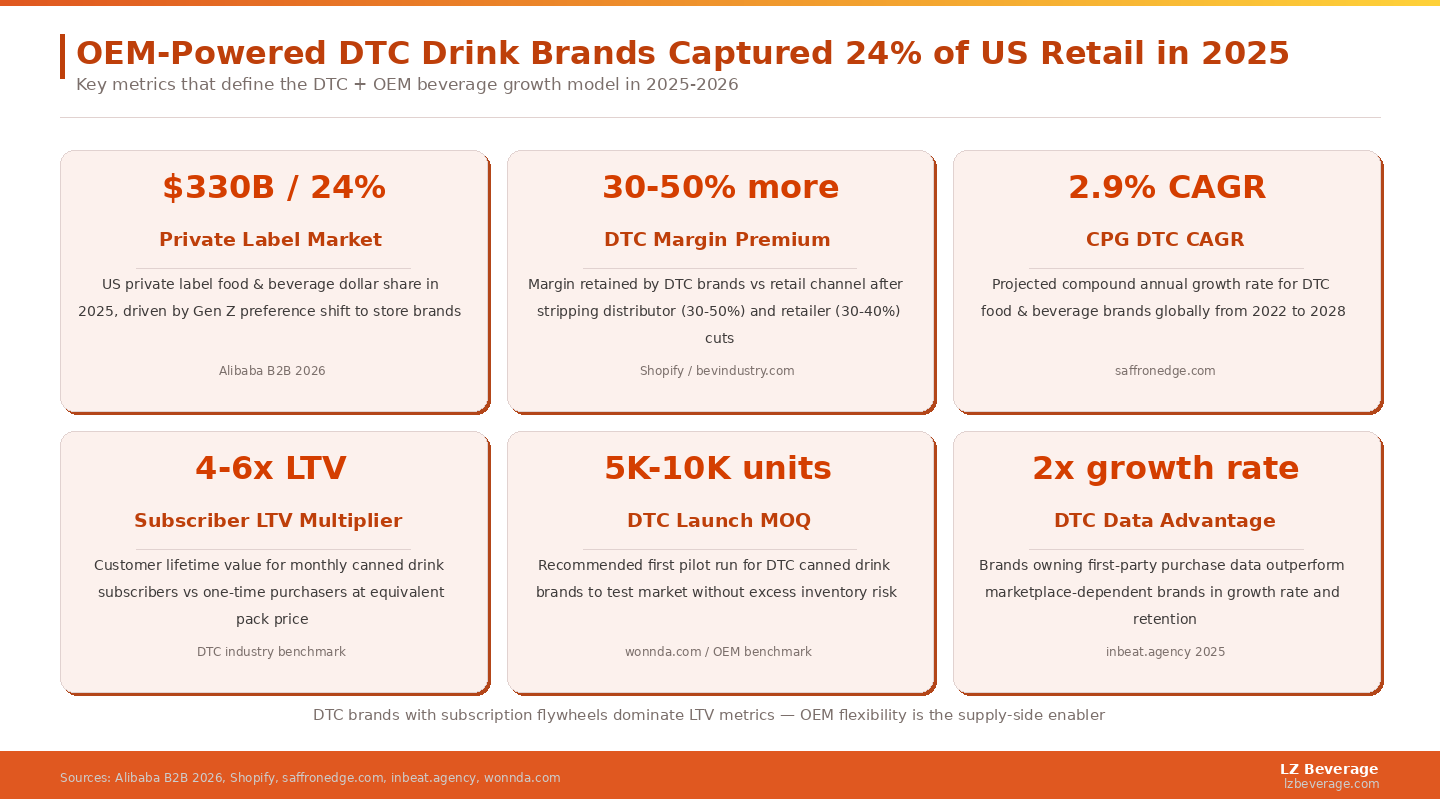
Private label food and beverage sales reached $330 billion in 2025, representing 24% of total US retail food and beverage dollar share, according to Alibaba's B2B market analysis. Gen Z consumers are now actively preferring private-label products, viewing them as quality alternatives to name brands rather than budget substitutes. For DTC canned drink founders, this creates a structural opportunity: OEM manufacturing lets you put a compelling brand in customers' hands without owning a filling line, while controlling formulation, packaging, and the direct customer relationship that traditional retail never allowed.
Why we wrote this: At LZ Beverage, we partner with DTC brands across their entire OEM journey — from first-batch sampling to multi-SKU scale. The strategic mistakes we see most often happen not at the product level, but at the production architecture level: brands choose factories that can't grow with them, negotiate MOQs that lock them into unsellable inventory, or launch without the brand-building flywheel that turns one-time buyers into repeat customers. This guide covers the OEM-to-DTC growth model from strategy through execution.
Key Takeaways
- OEM is the fastest path to a brand — not just a product — the right contract manufacturer handles formulation, canning, and compliance, freeing the brand team to focus entirely on customer acquisition and retention.
- MOQ negotiation is a growth strategy — starting with a flexible-MOQ factory allows market testing before committing to a volume that strains cash flow.
- DTC margins are structurally higher than retail — brands that own the customer relationship capture 30-50% more margin per unit than brands selling through distributors at 30-50% trade discounts.
- Subscription is the DTC beverage flywheel — a $35 case of 12 cans at 25% subscriber discount with 60% repurchase rate generates LTV 4-6x a one-time purchase.
The OEM Advantage for DTC Beverage Brands
Why OEM manufacturing beats building your own facility
The capital cost of setting up a compliant canned beverage filling line — sterilization equipment, carbonation systems, HACCP-certified facility build-out, regulatory approvals — runs into the millions before a single can is filled. For a DTC brand, that capital is almost always better deployed in customer acquisition, brand creative, and subscription infrastructure. Torg's private label beverage guide frames the OEM model clearly: the manufacturer handles formulation, production, and logistics; the brand handles marketing, customer relationships, and product positioning.
The DTC model adds a critical advantage on top of this: by selling direct, the brand captures retail margin that would otherwise go to distributors (typically 30-50% of the retail price) and retailers (another 30-40%). Shopify's DTC brand analysis documents that brands owning their distribution channels and customer data outperform those dependent on third-party marketplaces for both growth rate and margin. A canned drink selling at $4 retail through grocery leaves the brand with roughly $1.40-1.80 after distribution costs. The same can sold DTC at $4 through a Shopify store with owned fulfillment leaves the brand with $2.50-3.00 — before factoring in the first-party data from every order.
The DTC beverage brand playbook in 2026
Beverage Industry's DTC platform analysis identifies the three core advantages of DTC over traditional distribution: direct relationships with end purchasers, first-party data visibility into who is buying and where, and immediate access to product feedback. For a canned drink brand, this translates into concrete operational advantages — you know within days whether a new flavor is converting; you can email your entire subscriber base with a new SKU and get purchase data in 48 hours; you can adjust pricing without negotiating with a distributor sales rep.
A structural observation worth naming: the DTC brands that scale fastest with OEM manufacturing are not those with the most differentiated formulations — they're those with the tightest feedback loop between customer purchase data and production decisions. When a brand knows that 60% of its monthly subscribers choose the mango-chili flavor over the original, they can walk into their next OEM production conversation with actual sales data to justify a MOQ increase for that SKU and a smaller batch for the underperformer. This is the flywheel. The OEM factory provides the production flexibility; the DTC channel provides the real-time market signal. Together, they let a small brand make production decisions with the confidence of a large one.
MOQ Strategy: How to Negotiate Production Volume for a DTC Launch
Understanding the real cost structure of beverage MOQ
MOQ in canned beverage OEM is driven by three factors: minimum batch sizes for the filling line (determined by setup, sterilization, and cleaning costs), minimum packaging print runs for the aluminum can itself, and minimum ingredient purchase quantities from raw material suppliers. Wonnda's private label beverage guide puts typical canned beverage small-run MOQs at 500 to 5,000 units for bottle formats and higher for aluminum cans, where the can printing process requires larger minimum plate runs.
For a DTC launch, the right MOQ strategy is to start with the minimum the factory will accept for a test run — even if the unit cost is higher — and use real DTC sales data to negotiate down on unit cost in subsequent orders. A first order of 5,000-10,000 cans at a premium unit cost is a market research investment; a second order of 50,000 cans at a lower unit cost is a business decision backed by real conversion data. The brands that over-commit to large first runs to get better unit economics often end up with warehouse inventory and cash flow problems that offset the per-unit savings.
How to build scale milestones into your OEM contract
The best OEM contracts for DTC brands include tiered pricing schedules: unit cost at the launch MOQ, and pre-agreed unit costs at 2x, 5x, and 10x that volume. This gives the brand a clear financial model at each growth stage and locks the factory into a commitment before you've built the demand. It also signals to the factory that you're a long-term partner worth investing in — factories often dedicate production line time and R&D resources to brands they believe will grow, and showing them your DTC growth roadmap at the contract stage opens that conversation. For brands looking at custom energy drink or RTD canned beverage OEM, multi-SKU tiered pricing becomes particularly important as the brand expands its flavor lineup.
Building the DTC Brand Flywheel: Subscription, Retention, and Reorder
Why subscription is non-negotiable for DTC beverage economics
A customer who buys one case of 12 cans at $35 is a transaction. A customer who subscribes to monthly delivery is a business. For canned beverages — consumed regularly, replenished predictably — subscription aligns naturally with the consumption pattern. Subscription economics in DTC beverage typically look like: 15-25% subscriber discount on unit price (which the brand can afford because it eliminates churn-related customer reacquisition cost), 55-70% 3-month retention rate, and LTV 3-8x a single purchase. InBeat's DTC brand analysis shows that brands owning their customer data and loyalty programs grow faster than those dependent on marketplace traffic — subscription is the mechanism that creates that owned data and loyalty.
Content and community as brand infrastructure
Saffron Edge's DTC F&B analysis identifies social media and community engagement as the primary brand-building tools for DTC beverage brands: Instagram and TikTok for product discovery, subscription and referral programs for retention. The brands that succeed are not spending the most on paid acquisition — they're building a content infrastructure that makes the product genuinely worth following. For a canned drink brand, this means showing the formulation story (where the ingredients come from, what the health benefit is), the production process (a factory tour builds trust), and the customer community (user-generated content from real subscribers).
From OEM Partner to Product Portfolio: The Multi-SKU Scale Strategy
When to add a second SKU
A common DTC scaling mistake is adding a second flavor before the first one has proven repeatable demand. The right signal for adding a SKU: your hero product has at least three consecutive months of growing subscription revenue, your reorder rate is above 50%, and customer survey data shows specific flavor preferences for the next addition. At that point, the OEM factory conversation becomes easy — you come with real purchase data and a clear volume commitment for the new SKU. Adding a second SKU without that data means doubling your inventory risk without a demand signal to support it.
For brands working with a one-stop OEM partner — one factory producing multiple beverage formats across energy, tea, juice, and coffee — the multi-SKU expansion is structurally simpler because the quality documentation, the certification stack, and the relationship are already established. Adding a new SKU is a new product spec, not a new due diligence process. LZ Beverage's factory overview outlines how a 50-line, 1-million-can-per-day production setup supports both startup-scale test runs and full DTC catalog expansion across multiple categories.
Next Steps: Your DTC OEM Launch Checklist
- This week: Define your one-sentence differentiation — what is the functional, ingredient, or experience benefit that makes your canned drink worth subscribing to?
- Before factory engagement: Set your launch MOQ target (suggest 5,000-10,000 cans for a DTC pilot) and your 12-month volume milestone for tiered pricing negotiation.
- During sampling: Test with 20-30 real target customers before committing to a production run; use their qualitative feedback to finalize formulation and packaging.
- Before launch: Build your subscription infrastructure (Recharge, Skio, or equivalent) before your inventory arrives — not after your first orders come in.
- At Month 3: Review 90-day cohort retention data and use it as the data foundation for your next OEM production conversation and SKU expansion decision.
Frequently Asked Questions
What is the minimum realistic budget to launch a DTC canned drink brand using OEM?
A realistic launch budget — covering a 5,000-unit first production run, FDA-compliant label design, freight, basic DTC website, and initial paid marketing — typically runs $25,000-60,000 USD depending on formulation complexity, can size, and freight origin. This does not include ongoing marketing spend. The biggest variable is the OEM unit cost, which ranges widely based on ingredient specification, factory location, and MOQ. Building a financial model before approaching any factory is essential.
How do I protect my formulation when working with an OEM manufacturer?
Standard OEM contracts include a non-disclosure agreement (NDA) and a non-compete clause covering your specific formulation and brand identity. Ensure the contract explicitly states that your formulation, recipe, and packaging design are proprietary and cannot be produced for other buyers. For beverages with genuinely novel functional ingredients or processing methods, a patent may be worth considering, but most DTC canned drink differentiation comes from brand positioning rather than patentable formulation — making contractual protection the practical priority.
How long does it take to go from OEM concept to first DTC sale?
A realistic timeline for a first-time DTC canned drink launch: 2-4 weeks for factory selection and NDA signing, 4-8 weeks for formulation and sample iteration, 2-4 weeks for label design and regulatory review, 4-6 weeks for production and quality control, and 3-5 weeks for freight and customs. Total: approximately 4-6 months from concept to first sale. Brands that have done it before typically compress this to 3-4 months by running regulatory and label work in parallel with sampling.


