Launching a private-label canned drink on Amazon is one of the fastest ways to build a beverage brand without owning a factory — but the path from OEM sourcing to a live listing involves more regulatory and operational checkpoints than most sellers expect. FDA Registration Assistance confirms that FDA compliance for food and beverage products sold on Amazon FBA is a legal requirement, not optional. Amazon now actively requests facility registration numbers and FSVP documentation before allowing imports to enter fulfillment centers.
Why we wrote this: We work with brand owners across Southeast Asia, the Middle East, and Europe who want to enter the Amazon US market with custom canned drinks. The questions we hear most often are not about formulation or flavor — they're about compliance: what does the label need to say? What certifications does my factory need? What happens when customs holds my shipment? This guide answers those questions in the order you'll encounter them.
Key Takeaways
- FDA facility registration is mandatory — your OEM factory must be registered with the FDA before your canned drinks can legally enter the US and be sold on Amazon.
- Amazon's 2026 FBA prep policy shift — as of January 1, 2026, Amazon no longer provides FBA prep or labeling services, meaning all FNSKU labeling and packaging compliance must be done before the goods leave the factory.
- Canned beverages need ≥50 days shelf life at FBA check-in, plus compliant Nutrition Facts panels, English-language labeling, and allergen disclosure.
- OEM flexibility is the key advantage — a capable OEM factory can produce custom formulations with your ASIN-specific labels and Amazon-ready packaging in a single production run, eliminating the need for downstream prep.
Step 1 — Choose Your OEM Factory with Amazon Compliance in Mind
Why factory selection determines your Amazon readiness
The single most consequential decision for an Amazon beverage seller is which OEM factory they choose — because that factory's certifications, documentation practices, and packaging capabilities either clear or block every subsequent compliance checkpoint. A factory with active FDA facility registration, HACCP certification, and experience exporting to the US already has the compliance infrastructure your Amazon listing will rely on. A factory without these carries risk at every stage: customs, FBA check-in, and Amazon's own compliance review.
Key factory selection criteria for Amazon canned beverage sellers: FDA facility registration (searchable on FDA's public database), HACCP or FSSC 22000 food safety certification, documented Foreign Supplier Verification Program (FSVP) support, and an established track record of exports to North America or the EU. PSC Software's compliance guide confirms that Amazon and major retailers may require FSMA documentation, Certificates of Analysis, and proof of FDA registration — meaning you want a factory that already produces these documents routinely, not one that will be doing it for the first time for your order.
A practical pattern worth knowing: when sourcing canned beverages from China for Amazon, the most efficient operations we encounter treat FDA facility registration as a baseline, not a premium. Factories with 20+ filling lines and annual output above 100,000 metric tons have built their quality documentation systems to handle export markets by necessity — because their order volumes come from buyers who require it. For Amazon sellers sourcing at smaller MOQs, the advantage of working with a larger certified factory (even if unit cost is slightly higher) is that the paperwork burden on your side is dramatically lower. The factory already knows what a Certificate of Analysis looks like, has audit reports on file, and can generate your co-manufacturing documentation correctly the first time. Explore the OEM energy drink capabilities as a reference for what a compliant production setup looks like.
Step 2 — Design Labels That Meet FDA Requirements Before Production
What the FDA requires on a canned beverage label for US import
US Imports' Amazon seller guide confirms that all imported food and beverage labels must be in English and comply with FDA labeling requirements. For canned drinks, the mandatory elements include: a Nutrition Facts panel in the FDA's required format (updated 2020 format for most products), complete ingredient list in descending order by weight, net quantity statement in both metric and US measurements, country of origin, manufacturer or distributor name and address, and allergen declaration for the nine major allergens if applicable.
The label must be designed and approved before production — not added as a sticker after. For Amazon FBA sellers, this matters because the FNSKU barcode (Amazon's fulfillment network SKU) must also appear on every unit. Since Amazon discontinued its FBA prep and labeling services as of January 1, 2026, per Brandwoven's 2026 policy guide, this barcode must now be applied at the factory before the shipment is created. This makes it essential to build the FNSKU placement into your label artwork file and confirm it with your OEM factory before the production run.
Shelf life requirements for Amazon FBA beverages
Red Stag Fulfillment's Amazon categories guide documents that beverages and food products must have at least 50 days of remaining shelf life when received at FBA facilities. For canned beverages with typical 12-24 month shelf lives, this is rarely a limiting constraint — but it does matter for the production-to-shipment timeline. Make sure your OEM contract specifies the production date, expected manufacturing completion, and maximum transit time so that the goods arrive at the Amazon warehouse with adequate shelf life documented on the label.
Step 3 — Navigate US Customs and Prior Notice Requirements
The Prior Notice requirement for imported food
The FDA requires Prior Notice — a formal advance notification — for all food and beverage imports entering the US. This must be submitted electronically through the FDA's Prior Notice System Interface (PNSI) before the shipment arrives. Your freight forwarder typically handles this, but you need to confirm: your OEM factory's FDA registration number must be included in the Prior Notice. If the factory is not registered, the shipment will be held at port. FDA compliance guidance further notes that you, as the importer of record, need to have a Foreign Supplier Verification Program in place — a documented system confirming your overseas factory meets US food safety standards equivalent to FSMA requirements.
Working with a freight forwarder experienced in food imports
Not every freight forwarder has the FDA import expertise that food and beverage shipments require. When selecting a freight forwarder for your canned drink imports, confirm they have experience with FDA Prior Notice filings, can handle commodity-specific FDA examination at ports of entry if selected for inspection, and understand the DDP (Delivered Duty Paid) Incoterm structure that delivers goods to Amazon's warehouse with all customs duties already paid. Red Stag Fulfillment recommends DDP for FBA sellers specifically because it ensures all clearance happens before the goods reach Amazon's receiving dock, preventing detention holds that would delay your listing launch.
Step 4 — Create Your Amazon Listing While Production Is Running
How to build an Amazon listing for a custom OEM beverage
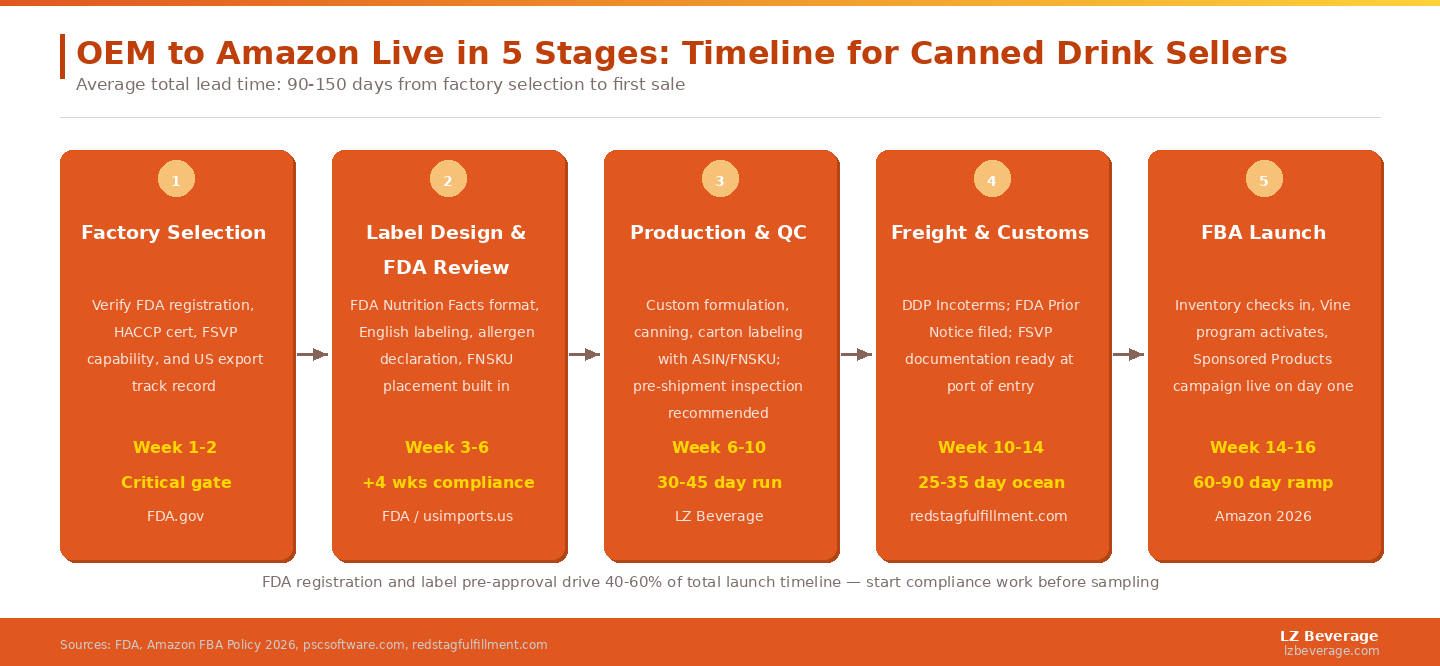
The lead time for canned beverage OEM production — from order confirmation to goods arriving at Amazon FBA — typically runs 60-120 days when you factor in formulation approval, label design, production scheduling, ocean freight, and customs. Use this time to build your Amazon product listing. Key elements that matter most for canned drink listings: main images that clearly show can size, flavor, and serving suggestion; a bullet-point feature list that leads with the specific benefit (energy, relaxation, hydration) before the ingredient claim; and backend search terms that capture how buyers actually search for the drink category.
Amazon's algorithm weights conversion rate heavily in early listing performance, which means your product detail page needs to be complete and compelling before you request the first inventory push. Set up your FBA shipment plan in Seller Central as soon as your FNSKU is assigned — this generates the shipment ID your OEM factory needs to label cartons correctly before they leave the warehouse. Confirm the carton label format with your factory well before production begins, as reprinting carton labels in China is fast and cheap; reprinting them after arrival in the US is expensive and delays check-in.
Step 5 — Launch Strategy: From First Shipment to Reviews
How to build early review velocity for a new canned drink listing
A new private-label canned drink on Amazon launches with zero reviews, which suppresses organic rank. The fastest legitimate path to early reviews is Amazon's Vine program (available to sellers enrolled in Brand Registry), which invites trusted Vine Voices to review your product in exchange for a free unit. For a canned beverage, Vine is particularly effective because the reviewers can evaluate taste, packaging quality, and the practical experience of receiving a perishable product through FBA — giving you detailed, credible early reviews. Enroll in Vine before your inventory checks in so the program activates as soon as stock is confirmed available.
Pair Vine with a Sponsored Products campaign targeting your top three or four category keywords from day one — not to generate immediate sales (early ACOS will be high) but to generate click-through data that Amazon's algorithm uses to understand your product's relevance. Budget for a 60-90 day ramp period before organic traffic becomes meaningful for a new canned beverage ASIN. For a custom energy drink or functional canned beverage, the differentiation story — specific functional benefit, unique flavor, cleaner ingredient list — needs to be visible in the first three bullet points, before the buyer has to click "read more."
Next Steps: Your Amazon Canned Drink Launch Plan
- This week: Confirm your shortlisted OEM factory holds active FDA facility registration — search the FDA's food facility registry using the factory's registration number before signing any contract.
- Before label design: Brief your label designer on FDA Nutrition Facts format requirements and build FNSKU placement into the artwork from the start.
- Before production: Assign your Amazon ASIN and generate the FNSKU barcode; send the file to your factory for label and carton printing.
- During production lead time: Build your Amazon product listing, enroll in Brand Registry, and set up a Vine enrollment to activate on day one of inventory availability.
- Before shipment departs: Confirm your freight forwarder has submitted FDA Prior Notice and that DDP terms are documented in your incoterm agreement.
Frequently Asked Questions
Does my OEM factory need to be FDA-registered to sell canned drinks on Amazon?
Yes. Any facility that manufactures, processes, packs, or holds food for US consumption must be registered with the FDA. Amazon may request the registration number when you list in certain food and beverage categories. If your factory is not registered, your shipment can be detained at US customs, and your Amazon listing may be suppressed or removed. Confirm FDA registration before placing any production order.
What happens if my canned drink shipment arrives at Amazon without compliant labeling?
As of January 1, 2026, Amazon no longer provides FBA prep or labeling services for new inbound shipments. Items that arrive without proper prep — including FNSKU barcodes, required packaging, and compliant labels — may be rejected, returned, or disposed of without reimbursement. The cost and delay of a rejected FBA shipment is substantial, making factory-level label compliance non-negotiable.
Can I source canned drinks from a Chinese OEM for Amazon EU as well as Amazon US?
Yes, but EU requirements differ from US requirements. EU canned beverages require labels in the official language of the destination country, EU Nutrition Declaration format (different from FDA), and in some categories additional compliance documentation under the EU Food Information to Consumers regulation. If you plan to sell on both Amazon US and Amazon EU, brief your OEM factory early — different label files will be needed for each market, and some certifications (like ISO 22000) will be more relevant for EU buyers.


