If you are evaluating an OEM manufacturer to produce your canned carbonated drink, the filling line is not a black box you hand off and trust blindly. Understanding how the production process works — what each stage does, where quality risks are introduced, and what separates a competent OEM facility from a compromised one — gives you the practical knowledge to ask the right questions, evaluate the right answers, and make a production decision that protects your product rather than gambles on it.
Why we wrote this: We explain our production process to every new client we work with, because brands that understand how their drink gets made are better partners throughout the entire project — from formulation sign-off through to first container delivery. This guide is the version we wish more clients had read before their first factory visit.
Key Takeaways
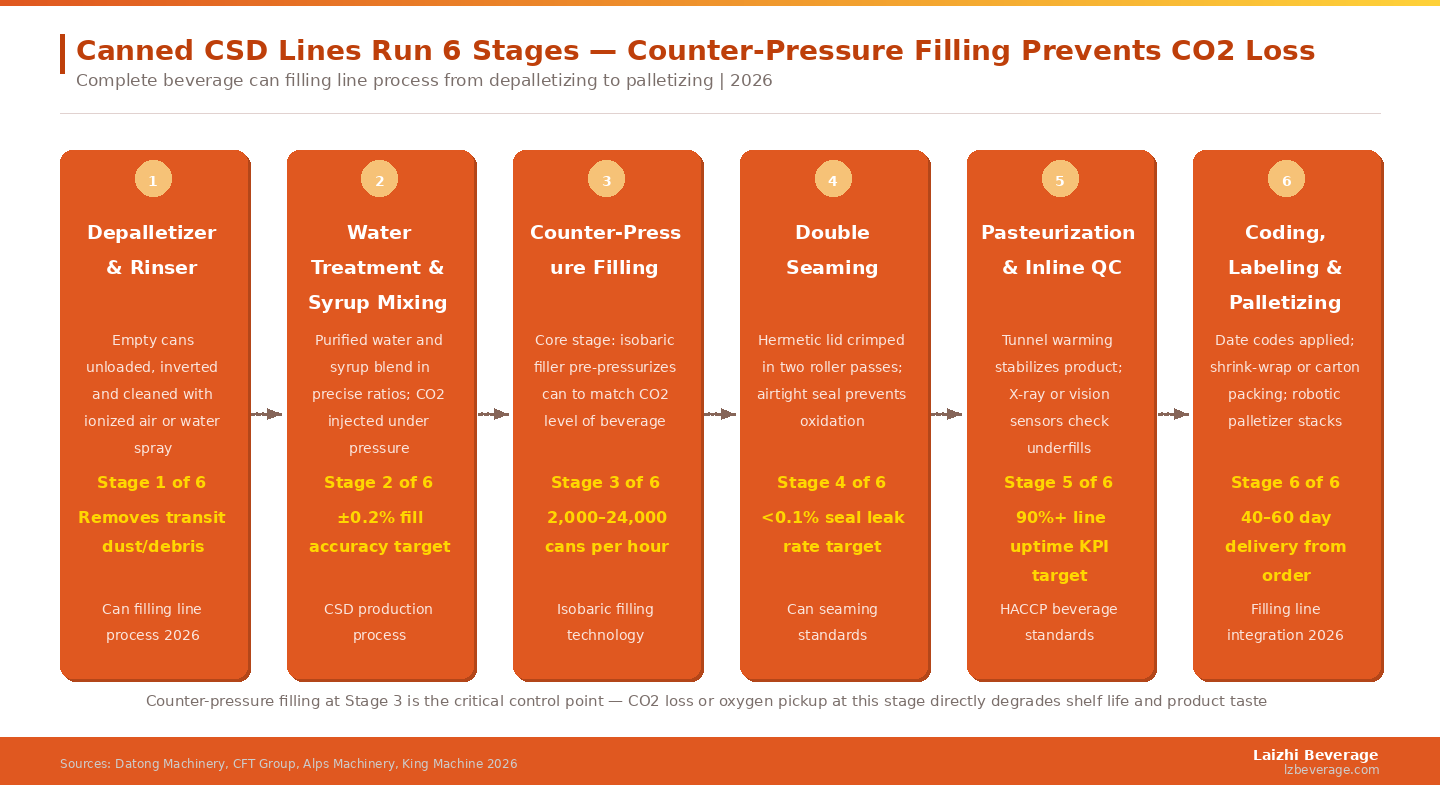
- A canned carbonated filling line has 6 core stages: depalletizing, mixing/carbonation, counter-pressure filling, double seaming, pasteurization/QC, and coding/palletizing.
- Counter-pressure filling is the critical control point for carbonated beverages — any gap between can pressure and beverage CO2 level causes foaming, oxidation, or short-fill defects.
- Modern high-speed lines run 2,000–24,000 cans per hour and achieve over 90% line uptime with CIP (Clean-in-Place) cycles averaging 30–45 minutes between product changeovers.
- HACCP compliance is built into the line design, not added after the fact — CIP systems, hygienic zoning, and inline inspection stations are structural requirements for export-grade production.
- Your product quality is locked in at formulation and filling specification — the filling line executes the spec; it cannot compensate for a poorly designed formulation brief or wrong carbonation target.
Stage 1: Depalletizing and Can Rinsing
Every canned carbonated drink production run begins before a single drop of beverage is involved. The journey of a beverage can begins at the depalletizer, where bulk quantities of empty cans are fed onto a conveyor system. Automated depalletizers handle the mechanical unloading at speeds of 20,000–60,000 cans per hour, transferring empty cans from their transport pallets onto the production conveyor in a continuous, synchronized flow.
Even new aluminum cans accumulate dust, lubricant particles, and manufacturing debris during transport and storage. Modern can washing machines invert cans and subject them to high-pressure ionized air or water rinsing to remove any contaminants before they enter the filling zone. This step seems simple but is critical for HACCP compliance: any particle that survives the rinse stage enters the beverage directly. Export-grade OEM facilities typically operate continuous-monitoring pressure gauges on their rinser systems — a drop in rinse pressure flags a blocked nozzle immediately, before contaminated cans reach the filler.
The conveyor design through this stage matters more than brands typically realize. Because aluminum is highly conductive and flexible, conveyor systems must be designed to prevent denting or scratching, which could lead to structural failure during the carbonation phase. A dented can does not always fail visibly — it may pass through the filling line and seamer, only to bulge or leak at the retail level due to the internal pressure of carbonation. We check conveyor alignment and can integrity at this stage on every production run.
Stage 2: Water Treatment, Syrup Preparation, and Carbonation
Before any liquid reaches the filling machine, it must be precisely formulated. This stage involves three parallel systems that feed into each other: water treatment, syrup mixing, and carbonation.
Water Treatment
Municipal water is never used directly in beverage production. The water treatment system — typically multi-stage filtration, reverse osmosis, UV sterilization, and activated carbon filtration — removes dissolved solids, chlorine, minerals, and microorganisms that would alter taste, carbonation stability, and shelf life. For carbonated beverages, vacuum degassing removes dissolved oxygen from the treated water before it enters the mixing stage. Dissolved oxygen is the primary driver of flavor degradation in finished canned carbonated drinks, and its removal at the water treatment stage is the most cost-effective quality protection a manufacturer can implement.
Syrup Mixing and Proportioning
The syrup is prepared in dedicated mixing tanks, filtered, and pumped into the carbonated beverage mixer where it is blended with treated water through a proportioning system that targets ±0.2% accuracy. For a 250ml energy drink containing 10% juice and specific sweetener concentrations, the proportioning system controls the ratio to within 0.5ml per can — a level of precision that prevents Brix variation (sweetness) and caloric labeling inaccuracy simultaneously.
Carbonation
The blended syrup-water mixture is carbonated in a dedicated carbonation tank under controlled CO2 pressure, typically 3.0–4.0 volumes of CO2 for energy drinks and 3.5–4.5 volumes for carbonated soft drinks. The CO2 dissolves into the chilled liquid under pressure — the colder the liquid, the more CO2 it retains. Most high-performance filling lines pre-chill the carbonated beverage to 0–4°C before it enters the filler, minimizing foaming during the filling process.
We have found from our own production experience that carbonation level inconsistency — batches varying by more than 0.2 volumes of CO2 — is almost never a filling machine problem. It is invariably traced upstream: to water temperature variation in the carbonator, to syrup concentration drift from ingredient Brix variation, or to CO2 supply pressure fluctuation. Brands that focus exclusively on the filling machine when investigating carbonation quality issues often spend months troubleshooting a symptom rather than its cause. The diagnostic logic runs backward from symptom to root cause: if carbonation is inconsistent, check water temperature first, then CO2 supply pressure, then syrup Brix, before touching the filler valves.
Stage 3: Counter-Pressure Filling — The Critical Control Point
Counter-pressure filling (also called isobaric filling) is the stage that defines whether a canned carbonated beverage maintains its intended carbonation level from the production line to the consumer's hand. It is the stage most brand owners understand least and most quality problems trace back to.
The primary function of the counter-pressure filler is to maintain the carbonation level while swiftly and precisely filling containers. Here is how it works mechanically: the empty can is first pressurized with CO2 gas to match the pressure of the incoming carbonated beverage. The beverage then flows into the can against this back-pressure — rather than flowing into an atmospheric-pressure container, which would cause immediate foaming and CO2 loss. Once the target fill level is reached, the CO2 pressure is gently released (snifted), the fill valve closes, and the can moves to the seamer.
The speed at which the pressure is released during snifting is itself a precision control parameter. Too fast, and dissolved CO2 comes out of solution inside the filled can, creating a foam head that either causes underfill or forces the seamer to crimp a lid onto a foaming can, compromising the seal geometry. The speed at which the filler transitions to the seamer is vital to prevent oxygen pickup, which can degrade the flavor profile and shorten shelf life.
Rotary vs. Linear Fillers
Linear fillers are generally more affordable and easier to configure for different can sizes, making them ideal for small to medium craft producers. Rotary fillers are the backbone of high-speed beverage filling lines, capable of filling thousands of cans per minute. At Laizhi Beverage, our 50 production lines operate rotary isobaric fillers capable of producing up to 1 million cans per day — the throughput rate that makes commercial energy drink and CSD production economically viable for brands at launch volume and scale-up simultaneously.
Stage 4: Double Seaming — The Hermetic Seal
Immediately after filling, each can passes to the seamer where a lid (end) is applied and mechanically crimped into a hermetic double seam. The double seam is created in two operations: the first operation rolls the lid flange and can flange together into a hook shape; the second operation compresses and smooths the hook to create a five-layer metal interlock. This geometry is what makes aluminum cans pressure-resistant — a standard beverage can sustains internal pressures of 85–100 PSI without failure, well above the 45–65 PSI carbonation pressure of most CSD and energy drink products.
The quality of the double seam is checked continuously through seam thickness measurement, coutersnk depth gauging, and periodic destructive tear-down inspection. Reliable seaming is especially important in high-speed carbonated soft drink filling lines, where any variation in seam geometry across thousands of cans per minute must be caught before the cans enter the pasteurization tunnel — because a compromised seam cannot be corrected after the thermal process.
Stage 5: Pasteurization, Cooling, and Inline Quality Control
Not all carbonated beverages require pasteurization, but energy drinks, functional beverages, fruit-juice carbonated drinks, and beer almost always do. After seaming, the filled cans pass through a pasteurization and cooling tunnel, where controlled heat (typically 60–70°C) eliminates microbiological contamination without degrading the product. The pasteurization tunnel is followed by a water cooling section that returns the can to ambient temperature before labeling.
Inline quality control runs continuously alongside this stage. Inspection stations use X-ray or ultrasonic sensors to check for underfills or compromised seals. Machine vision systems check lid placement and seam geometry at production speed. Any can that falls outside specification parameters — low fill weight, high dissolved oxygen reading, seal anomaly — is automatically rejected and diverted before it reaches the labeling and packaging stage.
Key performance indicators in beverage and canning production lines include production throughput, defect or rejection rate, and downtime — the three metrics that define whether a filling line is commercially viable. Well-operated export-grade facilities target defect rates below 0.1% and line uptime above 90%. Ask any OEM manufacturer candidate for their current OEE (Overall Equipment Effectiveness) figure — a facility that cannot or will not share this data is telling you something important about their transparency.
Stage 6: Coding, Labeling, and Palletizing
The final stage converts filled, sealed, and inspected cans into retail-ready finished goods. Inkjet or laser coders apply date codes, batch numbers, and production lot identifiers to the base or body of each can — mandatory for regulatory traceability in every export market. Labeling machines apply pressure-sensitive, sleeve, or glue-applied labels at high speed, often with date and batch coding integrated in-line.
Secondary packaging (shrink wrapping into multipacks, carton packing, or tray formation) and robotic palletizing complete the production sequence. Pallet stretch wrapping and SKU identification labels are applied before pallets enter finished goods warehouse storage awaiting container loading for export. The entire sequence from empty can at the depalletizer to export-ready pallet typically runs at 15–30 minutes per production run cycle for mid-volume OEM batches.
What Brands Should Evaluate When Touring an OEM Filling Facility
CIP System Capability
35% of food safety incidents trace back to maintenance activities — a repair that introduced contamination, a calibration drift that went undetected, or a preventive task that was logged as complete but never performed. The CIP (Clean-in-Place) system is your first indicator of a facility's food safety culture. Ask to see the CIP schedule for the filling valves, the beverage tanks, and the syrup lines — specifically, how frequently caustic cleaning and acid rinse cycles are run, and how they are documented. A paper log is acceptable; a verified digital log with automatic cycle records is significantly better.
HACCP Documentation and Audit History
Compliance with regulatory standards is non-negotiable in beverage production — adherence to food safety standards such as HACCP and GMP are minimum requirements. Ask for the facility's HACCP plan — specifically for the Critical Control Points (CCPs) relevant to carbonated beverage production: water treatment (CCP for microbiological contamination), filling (CCP for CO2 and oxygen control), seaming (CCP for seal integrity), and pasteurization (CCP for thermal process validation). A facility that cannot explain its CCPs in plain language has not internalized its HACCP plan; it has filed it.
Line Speed and Format Flexibility
Confirm that the OEM's filling lines are configured for your target can format (250ml slim, 330ml standard, 355ml, or 500ml) without requiring major format changeover investment. Format changeover on a well-designed modern line takes 30–60 minutes; on older semi-automated lines, it can take a full production day. If your brand plans to launch in multiple can sizes, confirm that the OEM can accommodate all target formats before committing to a production agreement. Exploring which can formats an OEM manufacturer supports across their energy drink and carbonated drink production lines is a critical first step in matching production capability to your product brief.
Next Steps Action Plan
- This week: Request your OEM manufacturer's HACCP plan and ask them to identify the Critical Control Points for carbonated can production — their answer tells you immediately whether food safety is genuinely embedded in their process.
- This week: Confirm counter-pressure filler availability for your target can format — not all filling lines support all can sizes, and format incompatibility discovered after contract signing creates costly delays.
- Next month: Ask for OEE (Overall Equipment Effectiveness) data for the specific line that will produce your product — line uptime, defect rate, and changeover time are the three numbers that predict whether your production run will meet its schedule and quality targets.
- Next month: Specify your target carbonation level (in volumes of CO2) in your product brief before approaching OEM manufacturers — vague specifications like "lightly carbonated" cannot be executed to consistent quality standards.
- Before production commitment: Request a facility tour specifically structured around the 6 stages above — depalletizer, mixing, filler, seamer, pasteurizer, and packaging. Any stage the manufacturer declines to show you is a stage worth investigating further.
Frequently Asked Questions
What is counter-pressure filling and why does it matter for carbonated drinks?
Counter-pressure filling (isobaric filling) pre-pressurizes the empty can with CO2 to match the dissolved gas pressure in the incoming carbonated beverage. Without this equalization, filling would cause immediate foaming — the CO2 would come out of solution as the liquid hit atmospheric pressure, causing inconsistent fill volumes, oxygen pickup, and seal quality problems. For carbonated soft drinks, energy drinks, and sparkling waters, counter-pressure filling is the non-negotiable core technology of a reliable filling line.
How fast are modern beverage can filling lines?
Modern high-speed rotary filling lines operate at 2,000–24,000 cans per hour, with the largest commercial lines capable of filling over 1,000 cans per minute. The practical production rate for a commercial OEM production run depends on the line configuration, can format, and number of filling valves on the rotary filler. For OEM clients, the more relevant number is not peak line speed but sustainable throughput per shift — a line running at 80% of peak speed with 90%+ uptime produces more finished goods than a line running at 100% speed with 60% uptime from frequent stoppages.
What does CIP mean, and why should a brand owner care about it?
CIP (Clean-in-Place) is an automated cleaning system that circulates hot water, caustic cleaning solution, and acid rinse through the filling lines, beverage tanks, and syrup systems without disassembling the equipment. For brand owners, CIP matters because a facility that skips or shortens CIP cycles to increase production output is systematically accumulating biofilm and contamination risk inside the equipment that will eventually manifest as a product quality failure, a recall, or a regulatory shutdown. Ask for the CIP cycle schedule and the documentation that proves it runs as scheduled — this is one of the most reliable indicators of a facility's food safety discipline.
Do all carbonated beverages need pasteurization?
No — pure carbonated water and some carbonated soft drink formulations with high acidity and preservatives can be filled cold without pasteurization. However, energy drinks, carbonated fruit beverages, functional drinks with added botanical extracts, and all carbonated beverages containing juice require post-fill pasteurization to ensure microbiological stability across their declared shelf life. If your formulation targets a 12-month shelf life for export markets, confirm that your OEM's pasteurization tunnel is calibrated for the specific thermal process (time at temperature) required for your product — this is a formulation-specific calculation, not a generic setting. Understanding how OEM manufacturers approach pasteurization specification for new formulations is a useful early conversation topic before product development begins.


