One of the most common reasons first-time beverage brand owners stall before their first production run is not product development, not regulatory compliance, and not market strategy. It is cash flow. Most international suppliers — including OEM beverage factories in China — require a 30–50% deposit before starting production, with the balance due at or before shipment. When you add ocean freight, customs clearance, and your retail buyer's net-30 or net-60 payment terms, the total cash commitment cycle can stretch 120–180 days on a single order. Trade finance instruments exist specifically to break this cycle — and understanding how they work gives brand owners access to orders they would otherwise have to decline or delay.
Why we wrote this: We work with brand owners at every stage of capital readiness, and the question we hear most often from first-time OEM clients is not "how does the production work" — it is "how do I actually fund this?" This guide explains the five trade finance instruments we see our clients use most effectively, with concrete guidance on which instrument fits which situation.
Key Takeaways
- The standard payment structure for a first OEM order from China is 30% T/T deposit + 70% balance before or at shipment — understanding this structure is the starting point for any trade finance conversation.
- Letters of Credit (LCs) offer the strongest bilateral protection for both buyer and seller, are governed by UCP 600 and accepted in 175 countries, and typically cost 0.5–1.5% of the LC value.
- Purchase Order (PO) financing lets brand owners fund the deposit using a confirmed purchase order as collateral — a lifeline for brands that have retail orders in hand but insufficient working capital.
- Documentary Collection (D/C) offers a middle ground between T/T and LC — bank intermediation without the full guarantee cost — and is appropriate for mid-tier trust relationships.
- The right trade finance structure depends on your capital position, your relationship maturity with the OEM, and the size of the order — there is no universally correct answer.
Why Trade Finance Matters for First-Time OEM Buyers
The economics of a first canned beverage OEM order create a specific cash flow problem. Imagine ordering 100,000 cans of a private label energy drink from a Chinese OEM manufacturer. The total order value is $25,000. A 30% deposit — $7,500 — is due before production starts. The remaining $17,500 is due when production passes quality control, before the container is loaded. The container arrives in your destination port 30–45 days after loading. You distribute to retail buyers on net-30 terms. You receive payment from your retail buyers 120–150 days after the initial deposit.
Now scale that to a meaningful commercial launch: 500,000 cans, order value $125,000, deposit $37,500, balance $87,500, payment cycle 5 months. Most first-time brand owners do not have $125,000 in unreserved working capital — and even those who do are often reluctant to lock it into a single inventory cycle while simultaneously funding marketing, distribution, and operational overhead. This is precisely the problem that trade finance was built to solve.
We have seen this pattern play out with our own clients: the brand owner has secured a confirmed purchase order from a retail buyer, has a product ready for production, and has chosen a manufacturer — but cannot fund the deposit without drawing down capital they need for launch marketing. In several cases, the solution was not more investor capital but a purchase order finance facility structured against the confirmed retail order. The lender paid our production deposit directly, the goods were manufactured and shipped, the retail buyer paid, and the lender was repaid from those proceeds. The brand owner never had to touch their own working capital for production costs. Understanding that this option exists — before you need it — is the difference between a brand that launches on schedule and one that loses its retail listing to a slower capital cycle.
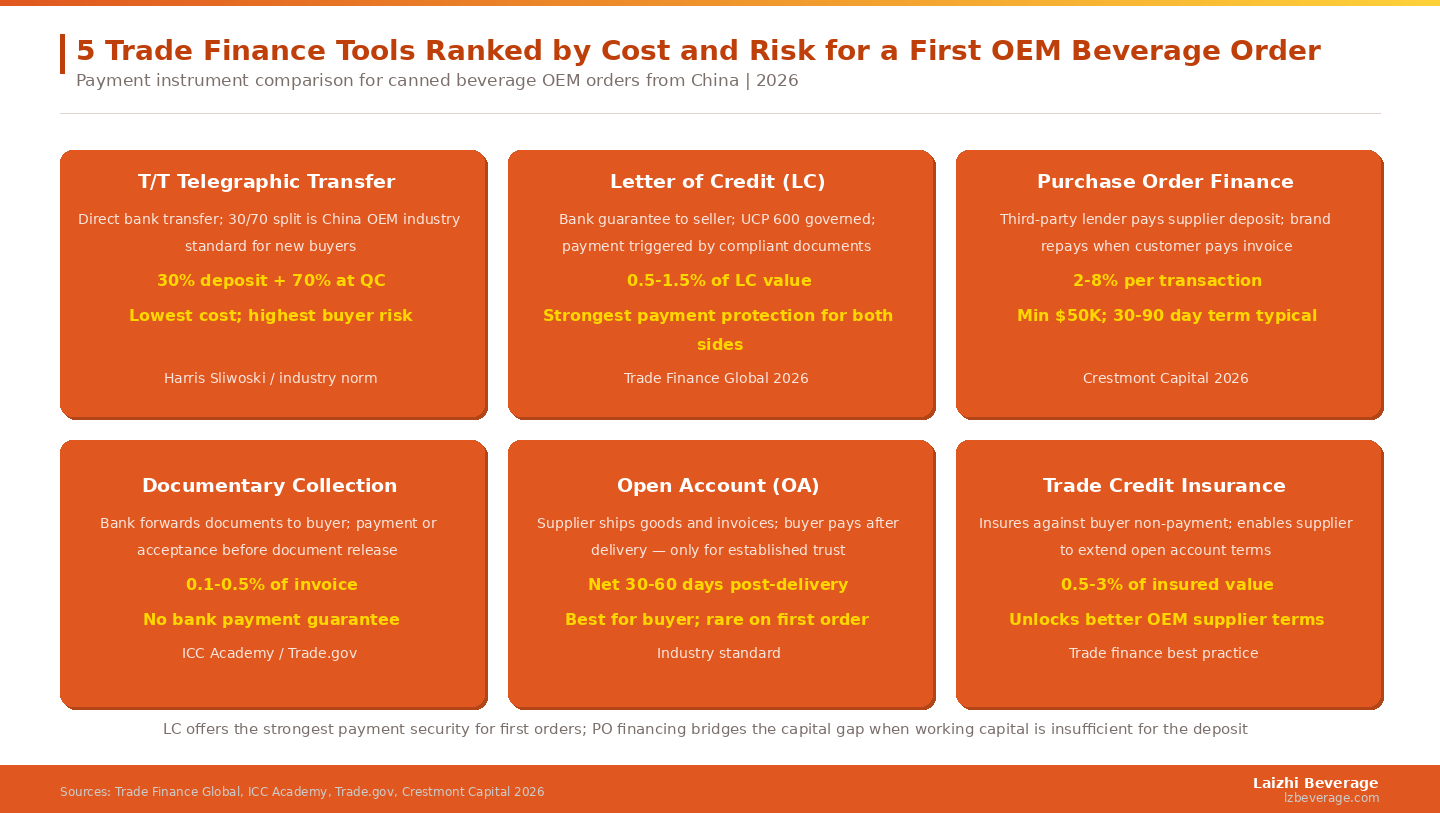
The 5 Trade Finance Instruments for OEM Beverage Orders
1. Telegraphic Transfer (T/T) — The Default Starting Point
The general standard in China for first-time importers tends to be 30% prepayment and 70% upon completion of production and QC inspection. For customized or private-label products — which include virtually all canned beverage OEM orders — the deposit may be higher (up to 50%) because the manufacturer's risk is elevated: custom-formulated beverages, custom can labels, and custom packaging cannot easily be resold to another buyer if the importer defaults.
T/T (Telegraphic Transfer) is a direct bank-to-bank wire transfer. It is fast (1–3 business days for international transfers), universally accepted, and the cheapest payment method in terms of instrument fees. It is also the riskiest for the buyer on a first order: once the deposit wire clears, you have transferred funds to the manufacturer with no bank-level protection against non-delivery, quality shortfall, or specification deviation. The risk mitigation for T/T on a first order is not financial — it is due diligence: factory audit, third-party pre-shipment inspection, and a well-written purchase agreement with jurisdiction and dispute clauses specified before the first wire is sent.
2. Letter of Credit (LC) — Maximum Protection, Both Ways
A Letter of Credit is a commitment by a bank on behalf of the buyer that payment will be made to the seller, provided the terms and conditions stated in the LC have been met, as evidenced by the presentation of specified documents. The seller (your OEM manufacturer) knows they will be paid as long as they ship compliant goods and present the required export documentation — commercial invoice, bill of lading, packing list, certificate of origin, and any inspection certificates specified in the LC terms.
LCs are governed by the UCP 600, published by the International Chamber of Commerce, which became effective July 1, 2007, and is recognized in 175 countries worldwide. For first-time OEM orders where the buyer-seller relationship has no established trust history, an LC provides the cleanest bilateral protection: the manufacturer's bank can confirm payment will be received; the buyer's bank can confirm the goods were shipped as specified before releasing funds. The cost — typically 0.5–1.5% of the LC face value — is a small premium for the risk reduction on a first cross-border transaction.
The practical limitation of LCs is documentation precision. Documents must be presented in strict compliance with the requirements stipulated in the LC — a minor discrepancy in a date, quantity, or document description can give the buyer's bank grounds to withhold payment, even when the goods have been correctly shipped. Working with an experienced trade finance banker (not just a general business banker) who can draft LC terms precisely is a prerequisite for using LCs effectively on your first order.
3. Purchase Order (PO) Financing — The Working Capital Bridge
PO financing is not a payment instrument in the same sense as an LC or T/T — it is a capital facility that enables a brand owner to fund a supplier payment using a confirmed purchase order as collateral. The structure works as follows: a confirmed retail purchase order is presented to a PO finance lender; the lender advances funds to pay the OEM supplier's deposit (and balance, in some structures); the goods are manufactured, shipped, and delivered to the retail buyer; the retail buyer pays; the brand owner repays the lender from those proceeds and retains the net margin.
A Miami-based distributor example illustrates the model: a $400,000 retail purchase order requiring $200,000 in supplier deposit was funded by a PO finance lender; goods were manufactured, shipped, the retailer paid 60 days later, and the lender was repaid from the proceeds. The brand owner net the margin on a deal they would otherwise have had to decline. International PO financing fees typically run 2–8% per transaction, with minimum transaction sizes often $50,000–$100,000.
For canned beverage OEM brands, PO financing is most viable when: you have a confirmed purchase order from a creditworthy retail buyer; your OEM order value is above $50,000; and your total transaction timeline (production + shipping + customer payment) can be clearly documented for the lender. PO finance is usually short-term, 30–90 days on average — the speed of the inventory cycle determines the actual financing period and therefore the total cost.
4. Documentary Collection (D/C) — The Middle Ground
A documentary collection is a transaction whereby the exporter entrusts the collection of payment to its bank (remitting bank), which sends the documents the buyer needs to the importer's bank (collecting bank), with instructions to release the documents to the buyer for payment. The key distinction from an LC is that no bank payment guarantee exists — the bank intermediates the document exchange, but if the buyer refuses to accept the documents and pay, the collecting bank has no contractual obligation to enforce payment.
Documentary collections come in two forms: Documents against Payment (D/P, also called sight draft), where the buyer must pay before receiving shipping documents; and Documents against Acceptance (D/A), where the buyer signs a bill of exchange promising future payment, and documents are released against that promise. D/C is significantly cheaper than an LC — typical fees are 0.1–0.5% of invoice value — and is appropriate for relationships where there is some established trust but insufficient history to justify open account terms. For a second or third OEM order with a manufacturer where the first T/T order delivered correctly and on time, D/C is a natural risk-adjusted step up that reduces the buyer's administrative burden without the full cost of an LC.
5. Open Account (OA) — The Long-Term Goal
Open account terms — where the supplier ships goods and invoices with net-30 or net-60 payment terms, receiving payment after the buyer has received and accepted the goods — are the optimal payment structure for the buyer. They represent zero tied-up capital on the production side, no instrument fees, and maximum cash flow flexibility. They are also extremely rare for first-time OEM orders and common only in mature supplier relationships where the manufacturer has years of reliable payment history with the specific buyer and a high degree of confidence in the buyer's creditworthiness. Some manufacturers will extend limited OA terms once a buyer has completed 3–5 orders with consistent, timely payment — but this is a relationship milestone, not a starting point.
Trade credit insurance can accelerate the transition to open account terms by providing the manufacturer with insurance coverage against buyer non-payment, effectively allowing them to offer OA terms to buyers they would otherwise require LC or T/T deposits from. For brands building a long-term OEM manufacturing relationship, trade credit insurance is worth investigating as a tool for unlocking better payment terms from your OEM partner as the relationship matures.
Choosing the Right Structure for Your First Order
| Situation |
Recommended Instrument |
Reason |
| First order, sufficient capital, first-time supplier relationship |
T/T 30/70 + third-party inspection |
Lowest cost; mitigate risk with due diligence, not instrument fees |
| First order, want maximum protection, unfamiliar supplier geography |
Letter of Credit |
UCP 600 framework protects both parties; worth the 0.5-1.5% premium |
| Confirmed retail purchase order, insufficient working capital for deposit |
PO Financing + T/T or LC to supplier |
Bridges the capital gap; lender pays supplier; repaid from retail proceeds |
| Second or third order with verified supplier, moderate risk tolerance |
Documentary Collection (D/P) |
Bank intermediation without full LC cost; balanced risk for established relationship |
| Mature OEM relationship (5+ orders), strong credit history |
Open Account with trade credit insurance |
Maximum cash flow efficiency; insurance unlocks OA terms from supplier |
Practical Steps: Setting Up Your First Trade Finance Arrangement
For T/T + Third-Party Inspection
Contact your business bank's trade or international division. Confirm the recipient bank details with your OEM manufacturer before initiating any wire. Engage a third-party inspection company (SGS, Bureau Veritas, or equivalent) to conduct pre-shipment inspection before you release the balance payment — this is the primary risk mitigation for T/T orders. Specify in your purchase agreement that the balance payment is conditional on passing this inspection.
For Letters of Credit
Contact your bank's trade finance or documentary credit department — not the general commercial banking team. Provide the LC draft terms to your OEM manufacturer for review before issuance; both parties need to agree on the required documents before the LC is issued. Common documents for a canned beverage OEM order include: commercial invoice, full set of clean ocean bills of lading, packing list, certificate of origin, phytosanitary/food safety certificate, and pre-shipment inspection certificate. We can provide the standard export documentation set required for LC presentations for clients who choose this payment structure.
For PO Financing
Confirm your retail buyer's creditworthiness — PO finance lenders advance funds based primarily on the creditworthiness of your customer, not your own. Prepare: the confirmed purchase order from your retail buyer; your OEM supplier's pro forma invoice; your company's financial statements; and a clear timeline from production through to customer payment. Lenders typically require 2–3 weeks to approve and fund a first PO finance transaction.
Next Steps Action Plan
- This week: Calculate your total cash commitment timeline for your first OEM order — from deposit wire to retail buyer payment — and identify whether you have sufficient working capital to bridge the full cycle without a trade finance facility.
- This week: Contact your bank's trade finance or international division and ask specifically about Letters of Credit and documentary collection facilities — general commercial bankers often cannot structure these instruments correctly.
- Next month: If you have a confirmed retail purchase order and insufficient working capital for the OEM deposit, approach at least two PO finance lenders with your confirmed order documentation — compare rates, minimum transaction sizes, and approval timelines before committing.
- Next month: Budget for a third-party pre-shipment inspection on your first T/T order — this is the most cost-effective risk mitigation available for deposit-based payment structures, typically costing $300–$800 per inspection.
- Before production: Review your OEM manufacturer's export documentation capabilities — ask specifically which Incoterms they can support (FOB, CIF, DAP), which country of origin certificates they can provide, and whether they have experience presenting documents under a Letter of Credit for your target import market.
Frequently Asked Questions
What is the standard payment term for a first canned beverage OEM order from China?
The industry standard for first-time OEM buyers is 30% T/T deposit before production begins, with the 70% balance payable when production passes QC inspection — typically before the container is loaded. For highly customized products like private-label beverages with custom formulations and printed cans, some manufacturers will request a 50% initial deposit due to the elevated resale risk if the buyer defaults. This is negotiable, particularly on larger order values, but should be approached after establishing the relationship rather than before.
When does a Letter of Credit make more sense than T/T for an OEM beverage order?
An LC makes more sense than T/T when: you are placing a first order with an OEM manufacturer in a geography where you have limited due diligence capability; your order value is large enough that the 0.5–1.5% LC fee is a minor fraction of the total risk exposure; your OEM manufacturer is experienced with LC documentation and has an established relationship with an international bank; or your own bank or investors require the additional protection that an LC provides as a condition of releasing capital.
Can I use purchase order financing if I don't have a large retail buyer?
PO financing is primarily structured around the creditworthiness of your confirmed customer — typically a named retail chain, distributor, or corporate buyer whose credit can be assessed. If your first sales are through e-commerce, small independent retail, or direct-to-consumer channels without a single creditworthy confirmed purchase order, PO financing is generally not accessible. Exploring energy drink and carbonated beverage OEM options at the right price points for your target channel helps define the order size — and therefore the financing structure — that applies to your specific situation. In that case, the alternative capital sources are invoice factoring (once you have receivables from creditworthy buyers), asset-based lending against inventory, or equity capital from investors. PO financing is specifically a tool for brands that have won purchase orders larger than their working capital can fund.
How do I protect myself if I use T/T and the goods don't meet my specification?
Three primary protections: first, engage a third-party inspection company to conduct pre-shipment inspection before releasing the balance payment — your purchase agreement should make the balance payment conditional on passing this inspection; second, specify your technical requirements (formulation, fill weight, carbonation, labeling) as precisely as possible in the purchase agreement, with clearly defined acceptance and rejection criteria; third, specify the governing jurisdiction and dispute resolution mechanism in the contract before the first order is placed. For canned beverage OEM orders, the inspection is particularly important for checking fill volumes, carbonation levels, label registration, and seam integrity — all of which are measurable against defined specifications. Understanding how OEM manufacturers approach quality documentation and pre-shipment sign-off is an important early conversation topic when evaluating production partners.


