The global carbonated beverage category is undergoing its most consequential transformation in decades. The carbonated beverages market reached $589.66 billion in 2026, but the distribution of that growth is changing radically: traditional cola volumes are under pressure in mature markets, while functional sodas, no-alcohol RTDs, and APAC-driven demand are pulling the category into entirely new territory. For brand owners and OEM partners planning product roadmaps in 2026, understanding which structural trends have real velocity — and which are noise — is the most important research investment to make.
What you'll get from reading this: A data-backed breakdown of the 10 trends that matter most in carbonated beverages in 2026, ranked by market impact and actionability, with direct implications for brand formulation, packaging, and manufacturing sourcing decisions.
Key Takeaways
- The global carbonated beverage market sits above $589B in 2026, but growth is bifurcating — APAC (9.84% CAGR) versus North America and Europe (2–5% CAGR).
- Sugar-free is no longer a niche — 44% of new carbonated drink launches in 2026 carry low-calorie claims, and zero-sugar cola variants are the single largest driver of value growth in North America.
- Functional ingredients (prebiotics, adaptogens, nootropics) are moving out of health food aisles into mainstream convenience channels, with the prebiotic soda market alone projected at $766 million by 2030.
- Private label carbonated beverages now hold 15% market share — the OEM-to-retail route is more viable in 2026 than at any prior point.
- Sustainable aluminum packaging has transitioned from differentiator to table stakes in European and premium retail markets globally.
When the data on sugar-free adoption (44% of new launches) is placed alongside the private label share figure (15% of CSD market), a pattern emerges that is not widely covered in standard market reports: the fastest-growing private label carbonated brands are not competing on price against incumbent colas — they are competing on formulation. A zero-sugar, prebiotic-infused craft soda in a recyclable slim can is capturing a consumer who would never have considered a supermarket own-brand drink five years ago. The formula for private label success in carbonated beverages in 2026 is not a lower price point; it is a credible functional positioning.
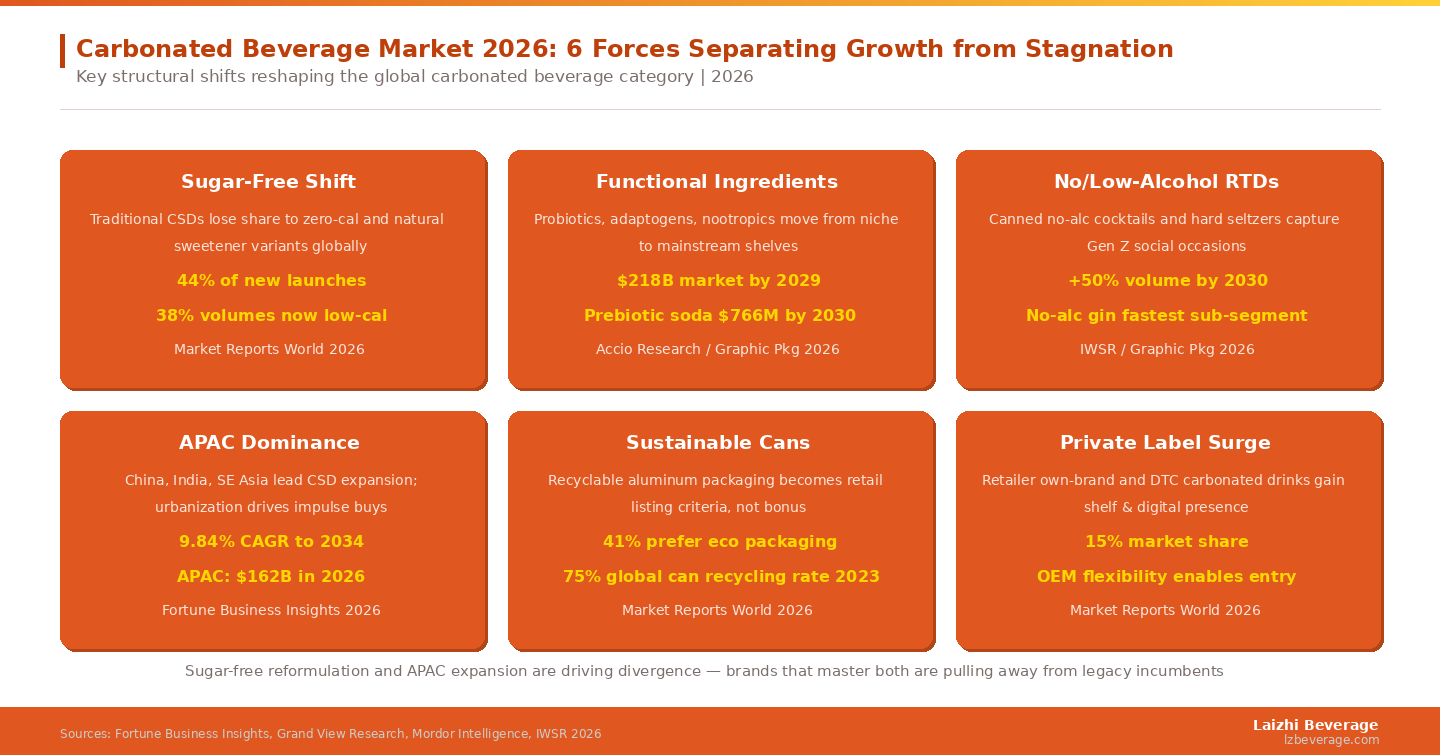
The 10 Trends Reshaping Carbonated Beverages in 2026
Trend 1: Sugar-Free Reformulation Becomes Non-Negotiable
The most structurally important trend in carbonated soft drinks is not a new flavor or a new format — it is the systematic removal of sugar. In North America, per-capita consumption of traditional sugary CSDs continues to decline as consumers shift toward zero-calorie alternatives. The global CSD market is growing at approximately 8.90% CAGR through 2034, but the majority of that growth is concentrated in zero-sugar cola variants, sugar-reduced lemonades, and sparkling waters. In Europe, sugar taxes in the UK, France, and Ireland have restructured CSD portfolios, effectively mandating reformulation for any brand seeking mass retail distribution. Brands entering the market in 2026 without a credible sugar-reduction strategy face an immediate barrier in at least three of the five largest revenue markets globally.
Trend 2: Functional Carbonation — Prebiotics, Adaptogens, and Nootropics
Functional carbonated beverages represent the single highest-growth sub-segment in the category. The prebiotic soda market alone is projected to reach $766 million by 2030, and the broader functional beverage category is expected to grow from $164.8 billion in 2024 to over $218 billion by 2029. PepsiCo's Prebiotic Cola, launched in July 2025, contains 5 grams of cane sugar and 30 calories — a marker that even global incumbents have accepted the functional repositioning of carbonated drinks. Brands like Bloom Pop (collagen-infused) and Mighty Pop (adaptogen-infused with ashwagandha) are pricing 30–50% above conventional soda and reporting strong repeat purchase rates. For OEM brand builders, this trend creates an opportunity: functional carbonated drink formulations are complexity-intensive and favor partners with in-house food science capability and flexible filling line infrastructure.
Trend 3: No- and Low-Alcohol RTDs Take Canned Format Share
The sober-curious movement, initially associated with millennials, has become a mainstream consumer behavior led by Gen Z. No-alcohol alternatives are forecast to grow by 50% in volume between 2025 and 2030, and the RTD canned format is the primary delivery mechanism for this growth. Non-alcoholic gin alternatives, canned mocktails, and low-ABV sparkling aperitifs are gaining permanent shelf presence in retail channels that previously stocked only traditional carbonated drinks and beer. The implication for brands: the line between "carbonated soft drink" and "sophisticated non-alcoholic RTD" is dissolving, and formulation briefs built for this intersection (complex botanicals, natural carbonation, no-sugar, premium packaging) represent significant white space.
Trend 4: APAC as the Growth Engine
Asia-Pacific accounts for $162.16 billion of the CSD market in 2026 and is growing at a 9.84% CAGR through 2034 — roughly four times the rate of North American value growth. China's RTD tea and soft drink market exceeded 49 billion units in 2024, growing 6.4% year-on-year. India's carbonated drink market is growing at double-digit rates, with a young urban demographic and expanding convenience retail as the primary drivers. For international brands, APAC is not a single market — flavor profiles, caffeine tolerance, packaging size preferences, and regulatory environments vary significantly between, say, Thailand (where functional claims require clinical substantiation) and India (where price sensitivity shapes format decisions more than functionality). Successful APAC market entry in carbonated beverages requires market-specific formulation and packaging strategies, not a global SKU approach.
Trend 5: Premiumization Through Craft and Botanical Profiles
Craft sodas and artisanal sparkling beverages are securing meaningful shelf space in specialty grocery and foodservice channels globally. Wealthy consumers are increasingly choosing craft sodas and sparkling drinks with botanical flavors, which offer a sense of sophistication and meet clean-label preferences. These premium carbonated beverages command 30–50% higher margin-per-unit and are less sensitive to promotional pricing cycles than mass-market colas. Botanical flavors — elderflower, yuzu, lychee, ginger, rose — are the fastest-growing flavor sub-segment in premium CSDs in both European and APAC markets. For brand builders, craft positioning requires consistent raw material sourcing, smaller-batch filling flexibility, and distinctive can artwork — all factors that influence OEM partner selection from the project outset.
Trend 6: Sustainable Packaging Becomes a Listing Requirement
What was a brand differentiator in 2020 has become a retail listing criterion in 2026. Aluminum cans with verified recycled content, deposit-return scheme compliance, and transparent lifecycle data are now required by major European grocery chains for new listing approvals. 41% of carbonated beverage consumers report that sustainable packaging actively influences their purchase decision. The International Aluminum Institute's 2023 data confirming a 75% global recycling rate for aluminum cans has become standard collateral in retail buyer presentations. Brands sourcing from OEM manufacturers should include recycled-content aluminum specification in their initial brief — retrofitting this requirement after packaging design is locked costs significantly more than building it in from day one.
Trend 7: Private Label Carbonated Drinks Gain Ground
Private label now accounts for approximately 15% of the global CSD market, a share that has been steadily expanding as manufacturer MOQ thresholds decrease and OEM production quality improves. The key shift in 2026 is that private label carbonated brands are no longer competing exclusively on price — they are competing on formulation. Retailer own-brands in the UK, Germany, and Netherlands are launching prebiotic sodas and botanical sparkling waters that sit beside, and sometimes outsell, branded equivalents. Exploring the full spectrum of canned RTD production options — from carbonated soft drinks to functional sparkling beverages — is the starting point for retail brands evaluating whether OEM manufacturing supports their growth model in 2026.
Trend 8: E-Commerce and DTC Reshape Distribution Logic
Online channels now account for approximately 18% of CSD market share, and the DTC model — where brands sell directly to consumers via subscription or direct order — is particularly well-suited to functional and premium carbonated beverage positioning. DTC brands avoid distributor margin compression, maintain direct consumer data relationships, and can test new SKUs at lower initial volumes. Routine-led formats — prebiotic soda, protein sparkling water, functional tea — succeed in DTC because they inherit purchase frequency from daily routines, making subscription retention significantly easier than for indulgence beverages. For OEM brand builders, DTC-first launches are increasingly the preferred market entry model, with retail expansion following only once product-market fit is validated.
Trend 9: Protein and Electrolyte Fortification Enters the CSD Category
The "proteinization" of beverages — historically limited to RTD protein shakes — is entering carbonated drinks. RTD coffee, flavored sparkling water, and even carbonated lemonades are incorporating protein claims as brands look to capture the post-workout and meal-replacement adjacency. PepsiCo's expansion of Bubly Burst with caffeinated versions is one signal of this trend; dedicated protein-carbonated brand launches represent another. The global RTD beverages market is growing toward $1.4 trillion by 2034, and carbonated formats capable of carrying functional protein claims are positioned in the faster-growing functional sub-segment of that trajectory. The formulation challenge — maintaining mouthfeel and clarity in a protein-fortified sparkling drink — is significant, favoring OEM partners with advanced food science capability.
Trend 10: Hyper-Localization of Flavor and Format
The global carbonated beverage category is fracturing along cultural lines in a way that mass-market global brands struggle to address. In Asia-Pacific, natural and organic energy drinks are projected to grow at 6.54% CAGR through 2031, and the specific flavors driving this growth — lychee in China, tamarind in South Asia, pandan in Southeast Asia, yuzu in Japan — are incompatible with a global SKU model. Brands that treat regional markets as smaller versions of global ones typically underperform on flavors, sizes, and channel placement simultaneously. The most competitive market entry strategies in 2026 pair a core functional positioning (sugar-free, prebiotic, clean-label) with region-specific flavor localization — and find OEM partners capable of executing both dimensions simultaneously at commercially viable production volumes.
What These Trends Mean for OEM Brand Builders
The convergence of these 10 trends points to a clear conclusion: the structural requirements for a successful carbonated beverage brand launch in 2026 are more demanding than at any prior point, but the market opportunity is correspondingly larger. The brands that will capture disproportionate growth are those that combine functional formulation credibility with sustainable packaging execution, APAC market understanding, and OEM manufacturing partnerships capable of delivering flexible MOQs and fast sample turnaround times. Learning how experienced OEM beverage manufacturers approach product development for new brand clients is a useful orientation step before committing to a formulation brief — the decision sequence matters as much as the decisions themselves.
Next Steps Action Plan
- This week: Identify which of the 10 trends above your target consumer and geography prioritize — functional ingredient claims require different OEM capabilities than premium craft positioning.
- This week: Audit whether your initial formulation brief includes sugar reduction and a functional ingredient axis — in 2026, these are baseline requirements, not optional enhancements.
- Next month: Confirm your target market's regulatory environment for functional ingredient claims (probiotics, adaptogens, caffeine) before locking in formulation specification.
- Next month: Specify recycled-content aluminum in your packaging brief if targeting European retail, Australian retail, or sustainability-positioned DTC channels.
- Before launch: Validate flavor localization strategy with in-market consumer testing — global flavor assumptions consistently underperform against locally relevant alternatives in APAC markets.
Frequently Asked Questions
What is the biggest trend in carbonated beverages in 2026?
Sugar-free and functional reformulation is the most structurally significant trend, driven by consumer health consciousness, regulatory sugar taxes in Europe, and retailer demand for clean-label credentials. This is not an emerging trend — 44% of new carbonated drink launches already carry low-calorie claims, making it an operational baseline for new market entrants.
Which carbonated beverage segment is growing fastest?
Functional carbonated beverages — including prebiotic sodas, adaptogen-infused sparkling drinks, and botanical carbonated RTDs — are growing fastest by value. The prebiotic soda market alone is projected at $766 million by 2030, and the broader functional beverage category is projected to exceed $218 billion by 2029, outgrowing traditional cola and flavored soda categories by a significant margin.
How relevant is Asia-Pacific for carbonated beverage brands in 2026?
Asia-Pacific is the single most important growth geography. The region accounts for $162.16 billion of CSD market revenue in 2026 and is growing at a 9.84% CAGR, roughly four times the rate of North American value growth. For any brand serious about scalable revenue growth in carbonated beverages, APAC market entry — with localized formulation and format strategy — is the highest-priority geographic investment in 2026.
Is private label viable for carbonated drink brands entering via OEM manufacturing?
Yes — and increasingly so. Private label now holds 15% of the global CSD market, and the trend favors brands that combine functional formulation positioning with OEM manufacturing flexibility. The brands succeeding in private label carbonated drinks in 2026 are not competing on price; they are competing on ingredient transparency, functional claims, and sustainable packaging — all criteria where a well-specified OEM production brief can deliver competitive parity with branded products.
What packaging format should a new carbonated beverage brand use in 2026?
Aluminum cans remain the format of choice for premium and functional positioning, driven by their superior recyclability credentials, consumer on-the-go alignment, and branding canvas advantage over PET bottles. For mainstream volume, PET retains a 59.23% packaging share globally but faces increasing recycled-content mandates that add cost. Brands targeting European retail or DTC sustainability-conscious consumers should default to aluminum cans with verified recycled content. Understanding how OEM manufacturers handle can format flexibility — between standard 355ml, slim 250ml, and specialty formats — is an early-stage decision with significant downstream implications.


