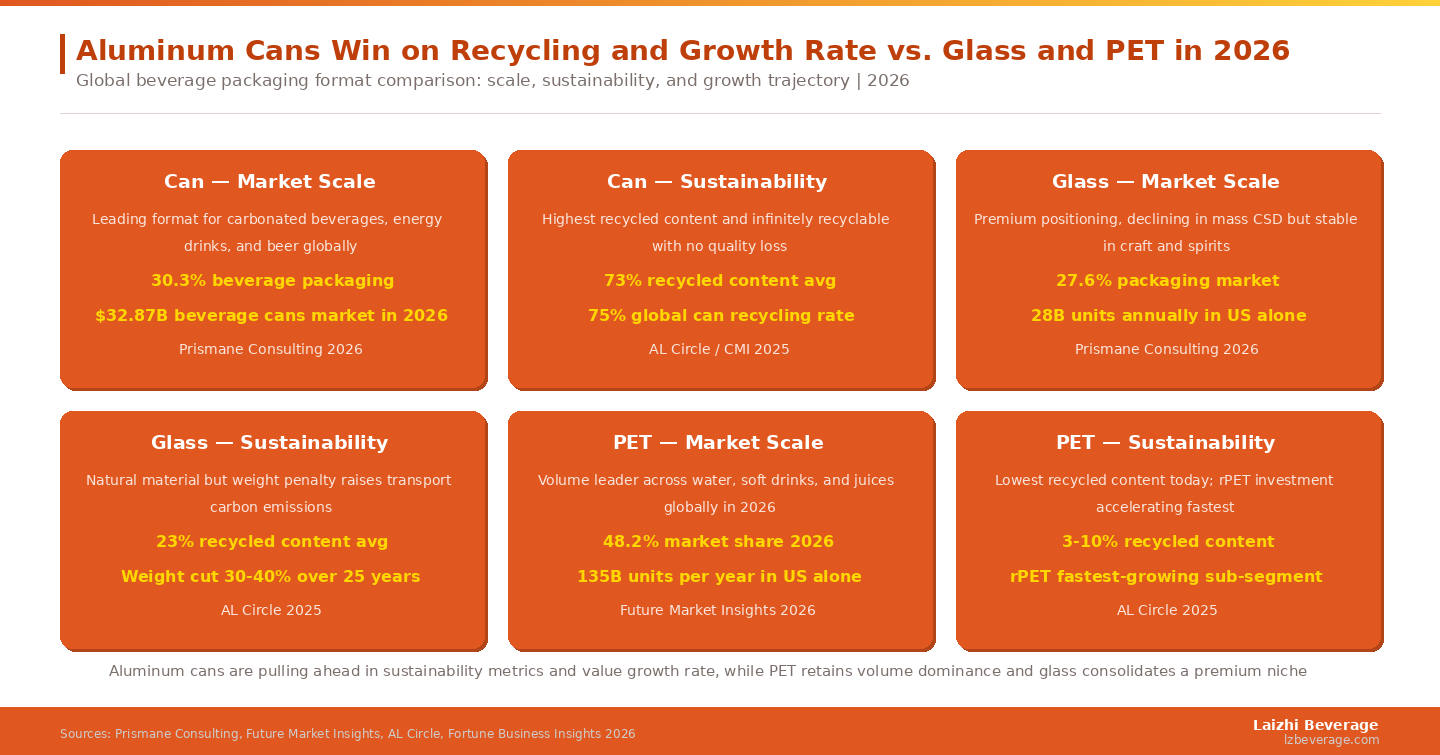
For brand owners launching or reformulating carbonated beverages in 2026, the packaging format decision is no longer a procurement afterthought — it is a strategic brand signal, a sustainability compliance issue, and a supply chain cost driver simultaneously. The global beverage packaging market is valued at $151.9 billion in 2026, and the distribution of share between aluminum cans (30.3%), glass (27.6%), and PET plastic (48.2%) is in active motion — driven by sustainability regulation, consumer preference shifts, and the economics of recycled content sourcing.
What you'll get from reading this: A data-grounded comparison of aluminum cans, glass bottles, and PET plastic for carbonated beverages in 2026 — covering market share, sustainability performance, cost dynamics, target use cases, and a practical packaging decision framework for brand owners working with OEM manufacturers.
Key Takeaways
- PET plastic leads by volume at 48.2% global beverage packaging market share in 2026, but faces the most regulatory pressure from recycled-content mandates and EPR laws.
- Aluminum cans are the fastest-growing format by value, with the beverage cans market growing at 6.76% CAGR to reach $55.47 billion by 2034 — driven by carbonated drinks, energy drinks, and beer.
- Aluminum commands the strongest sustainability credentials: 73% average recycled content versus glass at 23% and PET at just 3–10%.
- Glass is consolidating into premium, craft, and spirits niches, where its sensory and branding advantages justify higher per-unit cost and weight penalties.
- The 2026 packaging decision for most carbonated drink brands is not binary — it's a multi-format strategy that uses aluminum for grab-and-go premium, PET for volume retail, and glass for hospitality and limited-edition positioning.
Format by Format: The Data Behind the 2026 Packaging Landscape
Aluminum Cans: Value Growth Leader and Sustainability Benchmark
The global beverage cans market reached $32.87 billion in 2026 and is growing at a 6.76% CAGR through 2034 — significantly outpacing the overall beverage packaging market's 3.2% CAGR. Aluminum accounts for over 96% of beverage can material share, and in the US market alone, 110 billion aluminum cans are produced annually. The growth is concentrated in carbonated soft drinks (the largest end-use application), energy drinks, and the expanding RTD coffee and beer categories.
The aluminum can's sustainability narrative is its strongest commercial asset in 2026. Aluminum cans average 73% recycled content in production, compared to glass at 23% and PET at just 3–10%. The global aluminum can recycling rate is approximately 75%, and aluminum can be recycled infinitely without quality degradation — a fundamental material advantage that both glass and PET cannot replicate. In European and North American markets where Extended Producer Responsibility (EPR) regulations are tightening, the aluminum can's recycling infrastructure advantage translates directly into lower compliance cost for brands.
The can also benefits from a strong functional case for carbonated beverages: aluminum provides a complete barrier against light, oxygen, and temperature fluctuation — protecting carbonation, taste, and shelf life in a way that PET cannot match at the same cost-performance ratio. For energy drinks and premium carbonated functional beverages, this barrier performance is a formulation protection requirement, not just a packaging preference.
Placing the aluminum can's 73% average recycled content alongside the PET bottle's 3–10% creates a tension that sustainability-marketing researchers have not fully resolved: aluminum carries a higher per-unit energy cost in primary production, but when measured across a product's full lifecycle with realistic recycling rates accounted for, its circular advantage compounds rapidly across production cycles. Data from the Can Manufacturers Institute suggests that because aluminum is recycled back into new cans within 60 days on average, the effective carbon intensity of canned beverages decreases with each recycling cycle in a way that single-use PET, with its low actual recycling rate, does not. For brands communicating sustainability credentials to retail buyers or consumers, this is a practically useful distinction — but it requires citing verified data, not marketing language, to be credible.
Glass Bottles: Premium Niche Consolidation
Glass accounts for approximately 27.6% of the beverage packaging market, and in the US, approximately 28 billion glass bottle units are produced annually. Glass has lost significant volume share in mainstream carbonated soft drinks over the past decade — PET and aluminum are both lighter, cheaper to transport, and more suitable for high-speed automated filling lines at the scale required by major retailers. However, glass is not declining; it is consolidating into high-value niches where its properties create genuine competitive advantage: premium craft beverages, sparkling water, specialty carbonated mixers, hospitality-channel carbonated drinks, and limited-edition products where the material's premium sensory associations justify the cost premium.
The sustainability case for glass is contested. Glass containers have dropped 30–40% in weight over the past 25 years through lightweighting innovation, reducing the transport carbon penalty. Refillable glass bottle systems — standardized reuse models being piloted in Germany and expanding across Europe — offer a genuine carbon advantage when return rates are high. But glass's average 23% recycled content (compared to aluminum's 73%) and the fragility challenges in distribution logistics outside of controlled deposit-return systems mean it remains a niche choice for most new brand launches in mass carbonated beverages.
For OEM brand builders, glass is the right format choice when: the target channel is hospitality (HoReCa) or premium retail where shelf presence and tactile quality signal brand value; the product is a craft carbonated mixer, sparkling water, or limited-edition seasonal release; or the brand positioning explicitly centers on "natural" and "clean material" credentials where glass's simplicity (no liner, no mixed material) is a genuine formulation and marketing story. Glass is not the right format when cost per unit, filling line flexibility, or shipping logistics are primary production constraints.
PET Plastic: Volume Leader Under Regulatory Pressure
Plastic bottles are expected to hold a 48.2% market share in beverage packaging in 2026, and in the US market, PET accounts for 135 billion units annually — significantly more than aluminum (110B) or glass (28B). PET's dominance reflects its undeniable advantages in cost, weight, resealability, and filling-line flexibility at scale. For high-volume carbonated soft drink production serving price-sensitive mass retail markets, PET remains the default format.
However, PET faces more regulatory headwinds than any other packaging format in 2026. Mandated recycled-content targets are inflating input costs for PET production: state-level mandates in California and Washington require increasing percentages of recycled content in beverage containers, and the EU's Packaging and Packaging Waste Regulation (PPWR 2025) mandates fully recyclable packaging by 2030. Recycled PET (rPET) is the fastest-growing material segment in beverage packaging as brands scramble to meet these requirements — but rPET supply is currently constrained, and the price premium for food-grade rPET is adding 15–30% to PET packaging costs in markets with strong regulatory enforcement.
For OEM brand builders, PET remains the right choice when: cost per unit is the primary packaging constraint; the distribution channel requires large family-size formats (1L, 1.5L, 2L) that aluminum doesn't effectively serve; or the brand is targeting price-sensitive consumer segments where the PET cost advantage enables a retail price point that aluminum cannot. The strategic caveat is that brands selecting PET for 2026 product launches should proactively specify rPET content in their brief — both to future-proof against regulatory requirements and to communicate meaningful sustainability credentials to retail buyers who increasingly ask for this data in listing applications.
The 2026 Packaging Decision Framework: How to Choose
Choose Aluminum Cans When:
Your product is a carbonated energy drink, RTD coffee, beer, or premium functional sparkling beverage. Your target channel is convenience retail, grab-and-go, APAC modern trade, or GCC retail. Your brand positioning centers on sustainability, health, or premium quality credentials. Your production volume supports aluminum filling line economics (typically 50,000+ cans per run). You need the strongest barrier performance for carbonation retention across ambient distribution channels without cold chain.
Choose Glass When:
Your target channel is premium HoReCa, specialty retail, or direct-to-consumer gifting and limited-edition positioning. Your product is a craft carbonated mixer, premium sparkling water, or spirits-adjacent carbonated beverage. Your brand values align with "natural material" messaging where glass's simplicity (no liners, no composites) is a genuine brand story. Your distribution is within a controlled regional area where the weight and fragility of glass are manageable logistics challenges. Exploring the full range of carbonated RTD format options available through OEM manufacturers helps clarify when glass is the exception rather than the rule.
Choose PET When:
Cost-per-unit is the primary commercial constraint and volume targets require the lowest packaging cost. Your distribution requires large-format (1L+) family-size carbonated beverages where aluminum doesn't scale effectively. Your target market is emerging economies where PET infrastructure dominates and aluminum can recycling infrastructure is limited. You are launching in a market where PET is the category norm and consumer expectations align with the format. Specify rPET from the outset if there is any prospect of European or North American retail listing requirements in your three-year plan.
The Multi-Format Approach: What Leading Brands Are Actually Doing in 2026
The most commercially sophisticated approach to packaging format selection in 2026 is not choosing one format — it is deploying multiple formats across different channels and consumer occasions simultaneously. Beverage brands are increasingly using lightweight, sturdy, spill-resistant packaging like PET bottles and aluminum cans for e-commerce fulfillment, while reserving glass for hospitality channel and premium retail placement. A brand with sufficient OEM production flexibility can run the same core formulation in aluminum (for convenience and functional channels), PET (for volume retail and family formats), and glass (for premium and limited-edition positioning) — maximizing channel coverage without fragmenting formulation or ingredient supply.
This multi-format strategy is most accessible to brands working with OEM manufacturers that maintain multiple filling line configurations. Understanding which filling line formats an OEM manufacturer can service — and at what minimum order volume per format — is a critical early-stage question for brands planning a multi-channel carbonated beverage launch in 2026.
Next Steps Action Plan
- This week: Define your primary sales channel and target consumer — the channel determines the format (convenience = can; family retail = PET; premium hospitality = glass) before any formulation work begins.
- This week: Confirm whether your target markets have recycled-content mandates that affect PET packaging specifications — California, EU markets, and Australian states all have requirements that need to be built into your brief before production.
- Next month: Request filling line format availability and minimum order volumes for all three formats from your OEM manufacturer — multi-format strategy requires confirmed production capability before brand strategy is locked in.
- Next month: Specify rPET content percentage in any PET packaging brief for markets where sustainability credentials affect retail listing outcomes — this is a reactive cost at post-production if not specified upfront.
- Before launch: Develop a format-specific brand guideline for each packaging channel — the visual language, can size, label design, and consumer messaging should differ meaningfully between the aluminum convenience version and the glass premium version of the same beverage, even when the core formulation is identical.
Frequently Asked Questions
Which packaging format has the best sustainability credentials in 2026?
Aluminum cans lead on verified sustainability metrics: 73% average recycled content in production (versus glass 23%, PET 3–10%), a 75% global recycling rate, and infinite recyclability without quality degradation. The lifecycle analysis is more complex — PET has lower manufacturing energy intensity per unit — but aluminum's recycling infrastructure advantage compounds across production cycles in a way that PET's low actual recycling rate does not. For brands that need to substantiate sustainability credentials to retail buyers, aluminum's recycled content data is the most straightforward to cite and verify.
Is PET losing ground to aluminum cans in carbonated beverage packaging?
In volume terms, no — PET retains a 48.2% global market share and 135 billion annual US units, far exceeding aluminum. In value growth terms, yes — the beverage cans market is growing at 6.76% CAGR versus the overall beverage packaging market's 3.2%. The shift is category-specific: premium carbonated beverages, energy drinks, functional RTDs, and craft beer are migrating toward aluminum, while commodity carbonated soft drinks and still beverages remain predominantly in PET. The regulatory pressure on PET from recycled-content mandates is adding cost to PET production in developed markets, which over time may shift the cost-per-unit comparison that has historically favored PET.
When does a glass bottle add commercial value for a carbonated drink brand?
Glass adds commercial value in specific contexts: premium hospitality channel placement (where the tactile and visual premium of glass commands a higher price); craft and artisanal positioning where "natural material" messaging is a genuine brand claim; and limited-edition or seasonal products where packaging itself is a purchase motivator. Glass is rarely the right default choice for mass-market carbonated drink distribution — the weight, fragility, and cost-per-unit penalties are structurally difficult to justify outside premium niches. Brands using glass successfully in 2026 are treating it as a channel-specific format, not a brand-wide packaging choice.
How do I decide between aluminum can formats (250ml, 330ml, 355ml, 500ml) for a new carbonated drink?
Format selection should follow channel logic: 200–250ml slim cans suit premium energy drinks, functional beverages, and Asian convenience markets where smaller portion sizes align with on-the-go consumption and health positioning; 330ml is the European and APAC convenience standard for carbonated soft drinks and craft beer; 355ml (12 fl oz) is the North American standard; 500ml serves energy drink and sports drink consumers who require higher-volume single-serve formats. Confirm that your OEM manufacturer's filling lines are compatible with all target formats before selecting — format capability varies significantly between manufacturers, and retrofitting a production brief mid-project is costly. Learning how OEM manufacturers approach format selection and filling line compatibility at the project briefing stage prevents the most common and expensive production planning errors.


