Choosing a beer can size sounds simple. It is not. The format decision you make for your OEM beer order will determine your shelf placement, retail price point, regulatory compliance in export markets, shipping economics, and brand perception — all before a single consumer cracks the tab. The global beer cans market is valued at approximately USD 14.42 billion in 2026, growing toward USD 20.76 billion by 2035.
Choosing a beer can size sounds simple. It is not. The format decision you make for your OEM beer order will determine your shelf placement, retail price point, regulatory compliance in export markets, shipping economics, and brand perception — all before a single consumer cracks the tab. The global beer cans market is valued at approximately USD 14.42 billion in 2026, growing toward USD 20.76 billion by 2035. Within that growth, the battle of formats is intensifying as craft beer premiumization, health-driven portion control, and value-seeking consumers pull in different directions. This guide breaks down the three most commercially significant OEM can formats and helps you choose the one that matches your market.
Key Takeaways
- 330ml is the global standard — it accounts for the dominant share of international beer can exports and is accepted across retail, hospitality, and vending channels in over 70 countries.
- 500ml is the fastest-growing craft beer format, especially in European supermarkets, UK pub retail, and Asia-Pacific craft beer channels — forecast at a CAGR of 7.6% through 2035.
- 1000ml is a niche impulse format that works specifically in off-trade (retail) environments in Germany, Russia, and parts of Eastern Europe. Its primary value is shelf visibility, not volume efficiency.
- Aluminum remains the dominant material at roughly 75–89% of beer can production, and its recyclability advantage is increasingly critical in EU and UK markets with stricter circular economy mandates.
- Can format is a brand signal — slim/sleek 330ml cans carry a premium, health-conscious perception; tall 500ml cans signal value and craft quality; 1L cans signal affordability and impulse.
Understanding the Market Data Behind Each Format
The Medium Can Segment (330ml–500ml) Dominates Everything
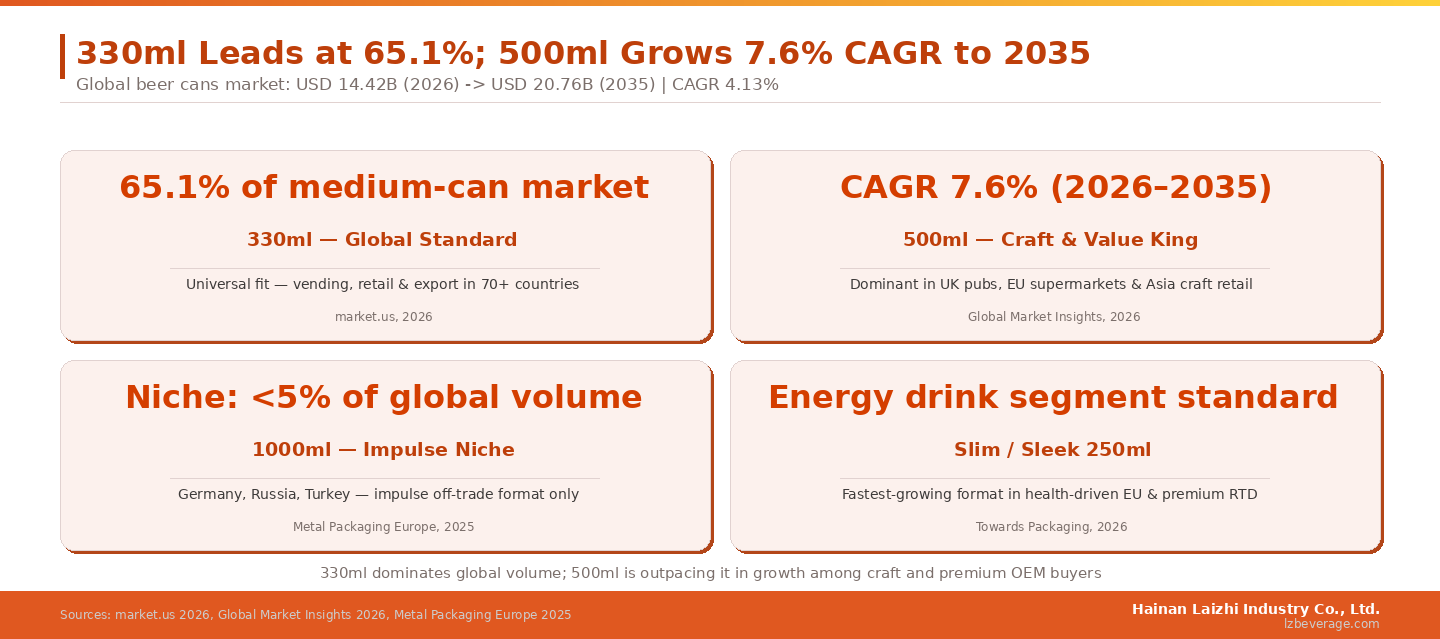
According to market.us research, medium-capacity cans in the 330ml–500ml range hold 65.1% of the total global beverage can market. This segment's dominance is structural: it aligns with single-serve consumption occasions across beer, energy drinks, and RTD cocktails. Medium cans fit standard refrigeration shelving formats and are accepted across all major retail and food service channels worldwide — making them the default OEM choice for export-oriented beer brands. Within this segment, 330ml and 500ml serve very different strategic purposes, and understanding which is right for your product requires looking at your distribution channel first.
330ml: The Export-Safe Global Standard
Why 330ml Became the Metric World's Universal Format
The 330ml can became the de facto global standard through a straightforward logic: it is the metric equivalent of the US 12-ounce (355ml) can, rounded to a clean one-third of a liter. When European and Asian beverage markets standardized around metric measurements, 330ml emerged as the most practical approximation of an established single-serve portion — and it stuck. Today, as KimEcopak explains, 330ml cans are accepted across virtually all vending machine formats, retail shelf configurations, and hospitality service standards in metric markets.
For OEM beverage brands targeting export markets, 330ml carries the lowest market-entry risk. It is accepted in Europe, Southeast Asia, the Middle East, Africa, and Latin America without any packaging format negotiation. It ships efficiently in standard carton configurations, typically 24 cans per case, which aligns with wholesale pricing norms and reduces per-unit logistics costs.
When 330ml Is the Right OEM Choice
The 330ml format is typically the right choice when your target distribution spans multiple markets — particularly when you need a single SKU to work in European specialty retail, Middle Eastern hospitality, and Southeast Asian convenience channels simultaneously. It is also the correct format for health-positioned products, sessionable craft beers designed for multiple occasions, and any product where "approachable" is a key brand value.
| Format |
Best Market Fit |
Typical Retail Price Point |
Cases per Pallet |
OEM MOQ Sensitivity |
| 330ml |
Global export, multi-market SKU |
€1.20–2.80 / can |
~50 cases (24-pack) |
Low — widely produced |
| 500ml |
Europe, UK, craft channels |
€1.80–4.50 / can |
~36 cases (24-pack) |
Medium |
| 1000ml |
Germany, Russia, Eastern Europe |
€2.50–6.00 / can |
~20 cases (12-pack) |
High — niche tooling |
| 250ml slim |
Premium RTD, NA beer, energy |
€1.50–3.50 / can |
~60 cases (24-pack) |
Low — standard tooling |
500ml: The Craft Beer OEM Sweet Spot
Why 500ml Has Become the Preferred Craft Beer Format
The 500ml can has a specific cultural resonance in European beer markets: it approximates a "pint" serving (568ml in the UK), carries a value perception for everyday drinkers, and simultaneously offers craft breweries enough canvas for premium label design. According to Global Market Insights, the 330ml–500ml segment is forecast to grow at 7.6% CAGR through 2035 — the strongest growth rate of any can capacity tier. That growth is being driven substantially by craft beer and RTD alcoholic cocktails expanding into European retail.
For OEM brands targeting UK supermarkets, German off-trade retail, Scandinavian specialty beer chains, or craft beer importers across continental Europe, the 500ml format is increasingly the default expectation. It also performs strongly in Asia-Pacific craft channels — particularly in Japan, South Korea, and premium craft retail in China — where it carries connotations of generosity and authentic brewing heritage. Explore Laizhi Beverage's beer OEM options including flexible 500ml production for export markets.
500ml Production Considerations for OEM Buyers
From a manufacturing standpoint, 500ml cans require different filling equipment configurations than 330ml — not dramatically different, but the transition adds complexity for manufacturers who run mixed-format lines. A well-equipped OEM facility running multiple production lines can switch between formats with relatively short changeover times, but buyers ordering across formats simultaneously should confirm changeover scheduling with their supplier to avoid delays. Quality control at the fill stage is also slightly more critical for 500ml, since the larger volume means any DO (dissolved oxygen) variation has a proportionally larger flavor impact over the product's shelf life.
1000ml: The Niche Impulse Format
When a 1-Liter Can Makes Commercial Sense
The 1000ml beer can is not a mainstream format — it is a specialized tool for specific market contexts. The clearest case study is Germany, where Carlsberg's launch of the 1-liter Tuborg can was specifically designed to capture impulse buyers in off-trade environments by being physically impossible to miss on the shelf. According to Metal Packaging Europe, the 1000ml format is found primarily in Germany, Turkey, and Russia — markets where large-format single-serve beer has an established cultural context and where price-per-milliliter is a conscious purchase driver.
For an OEM buyer, the 1000ml format requires careful justification. The tooling is more specialized, the shipping economics are less favorable on a per-can basis, and the regulatory picture is complicated — several European markets have restrictions or additional excise duty structures for large-format single-serve alcohol. Unless your distribution channel explicitly calls for 1-liter cans (for example, a German discount retail chain or a Russian hypermarket buyer), the business case rarely justifies the premium over standard formats.
OEM Decision Framework: Which Size to Choose
The Three Questions That Determine Your Format
Rather than defaulting to the cheapest or most familiar option, OEM buyers should answer three questions before committing to a can format. First: what is the primary distribution channel? Off-trade retail in Europe almost always calls for 500ml or 330ml; convenience stores globally default to 330ml; hospitality and events typically call for 330ml. Second: what is the brand position? Health-conscious, sessionable, and premium positioning all point to 330ml or slim; value and craft-authenticity positioning point to 500ml. Third: what is the target retail price? The can size directly constrains the price ladder you can use.
For brands working with a Chinese OEM manufacturer like Laizhi Beverage, one of the strategic advantages is the ability to run multiple format SKUs from the same production infrastructure — allowing a brand to launch a 330ml variant for global export and a 500ml variant for European specialty retail without sourcing from two separate suppliers. Learn more about Laizhi's multi-format production capabilities across 50 production lines.
Frequently Asked Questions
Which beer can size sells best globally for OEM private label?
The 330ml format sells the most units globally by volume, accounting for the largest share of international beer can exports. However, for premium and craft private-label positioning — particularly targeting European and UK retail — the 500ml format increasingly delivers better sell-through rates and higher margin per SKU.
Can I order both 330ml and 500ml sizes from the same OEM manufacturer?
Yes, and this is generally the most efficient approach for brands targeting multiple markets. A manufacturer running multiple filling lines can produce both formats from the same base formulation with different packaging parameters. Confirm format-switching capabilities and minimum order quantities per format during initial supplier qualification.
Are there regulatory restrictions on 1000ml beer cans in export markets?
Yes. Several European markets impose excise duty structures or single-serve alcohol limits that affect large-format cans differently than standard sizes. The UK, France, and several Scandinavian markets have specific rules worth verifying before committing to a 1L OEM order for those destinations. Always check regulatory requirements in your specific target export market.
Does can size affect shelf life for craft beer OEM?
Yes, marginally. Larger cans have a proportionally higher liquid-to-headspace ratio, which can provide slightly better CO₂ preservation over the product's shelf life. However, for most standard beer formulations, the difference between 330ml and 500ml shelf life is negligible if fill quality (dissolved oxygen control) is maintained. The formulation and fill process quality matters far more than the volume differential.
What is the minimum order quantity for custom-printed OEM beer cans in 500ml format?
MOQ varies by manufacturer and print method. Digital printing options allow lower MOQs (sometimes as low as a few thousand units), while offset-printed aluminum cans traditionally require larger minimums for cost efficiency. For export-scale production, working directly with a manufacturer that owns its canning line and printing capability — rather than coordinating between a can supplier and a contract filler — significantly reduces complexity and often total cost. Contact Laizhi Beverage to discuss your specific format and quantity requirements.

