The private label beverage industry is valued at over USD 80 billion globally, growing at a CAGR of 4–6%, driven by consumer trust in store brands, demand for specialty products, and the rise of e-commerce channels.
The private label beverage industry is valued at over USD 80 billion globally, growing at a CAGR of 4–6%, driven by consumer trust in store brands, demand for specialty products, and the rise of e-commerce channels. Within that broader market, private label canned beer occupies a particularly attractive position: it delivers premium brand perception at manufactured cost, allows rapid portfolio expansion without building a brewery, and scales flexibly from boutique retail to international distribution. This guide walks through every stage of the process — from initial brand strategy through your first export container — with specific attention to the decisions that separate a successful launch from a costly miss.
Key Takeaways
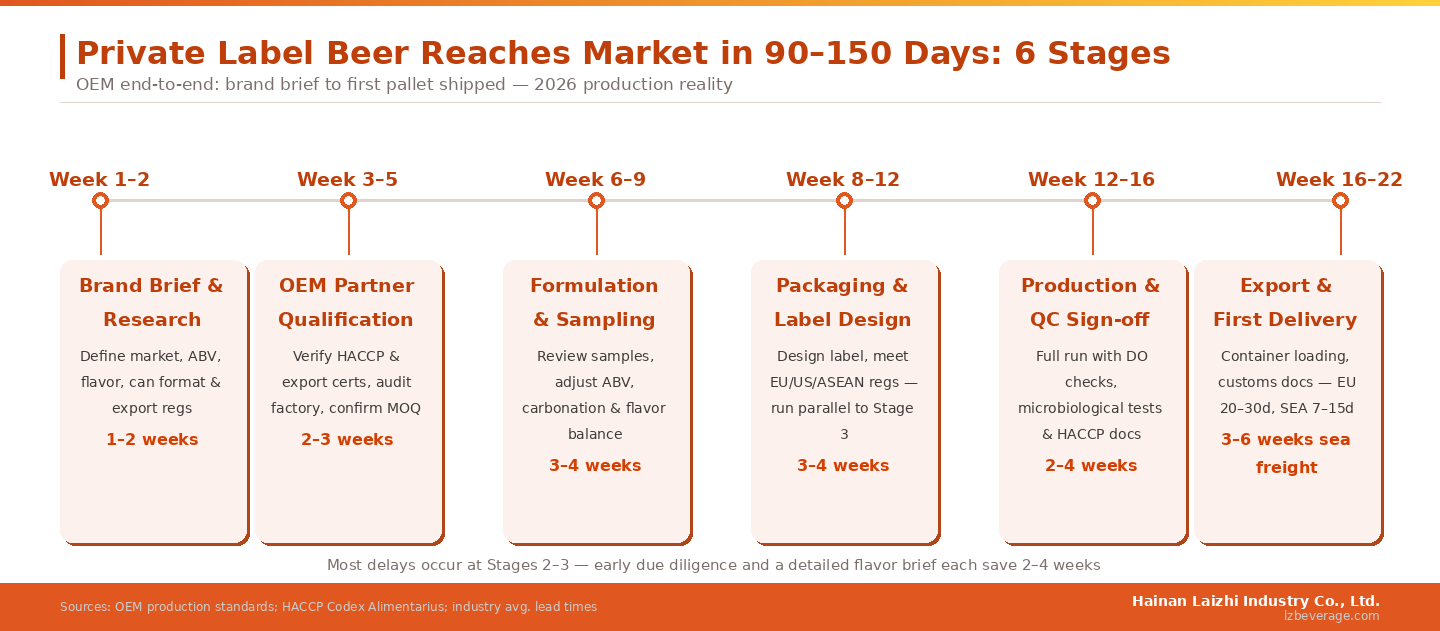
- A private label canned beer brand can realistically reach market in 90–150 days from initial brief to first delivery, assuming HACCP-certified OEM partner selection and parallel execution of packaging design and formulation.
- OEM partner certification is the single highest-stakes decision in the process — choosing a manufacturer without export certifications will block market entry in Europe, North America, and most of Asia Pacific.
- Formulation sampling typically takes 3–4 weeks and 1–3 revision rounds — compressing this phase by sending detailed flavor briefs upfront can save 2–4 weeks of project time.
- Packaging design and label compliance can run in parallel with formulation, reducing total timeline by 2–3 weeks compared to sequential execution.
- The private label beer market rewards differentiation — fruit-forward, low-ABV, and functional beer formulations are consistently outperforming generic lager launches in specialty retail channels in 2026.
Stage 1: Define Your Brand Strategy Before Talking to Any Manufacturer
The Four Decisions That Lock Your OEM Path
Most private label beer launches stall not during production but before it — because the buyer did not make four foundational decisions before approaching manufacturers. The first is target market: which country or region will this product be sold in, and what are that market's alcohol regulations, labeling requirements, and channel norms? The second is price positioning: is this product competing at mass-retail value, craft-premium, or ultra-premium? This determines formulation quality thresholds and allowable production costs. The third is flavor profile: standard lager, flavored beer, craft ales, or specialty styles like wheat or stout? This filters the OEM partner pool immediately. The fourth is can format: 330ml, 500ml, or specialty sizes? As we discussed in our beer OEM overview, format selection directly affects shelf placement and regulatory compliance in your target market.
Understanding Private Label vs. White Label vs. OEM/ODM
These three terms describe different levels of customization in contract beer production. White label means you buy a pre-existing beer formulation and apply your own branding — lowest cost, fastest time to market, lowest differentiation. Private label means the manufacturer produces a product specifically for your brand, which may involve adjustments to formulation, strength, and packaging — more differentiated, somewhat slower. OEM/ODM means you are co-developing the product from the recipe level up, with the manufacturer acting as your production partner throughout the full development cycle — highest differentiation, longest lead time, but the strongest foundation for a long-term beer brand. Most serious brand launches targeting retail and hospitality channels use the OEM/ODM model because it is the only approach that delivers genuine brand uniqueness.
Stage 2: Qualifying Your OEM Manufacturer
The Non-Negotiable Certification Checklist
Any manufacturer you work with for export-oriented private label beer must hold specific certifications. HACCP (Hazard Analysis and Critical Control Points) certification — ideally to Codex Alimentarius standards — is the foundational food safety credential. Without it, import into the EU, UK, Japan, and many Southeast Asian markets is either blocked or requires costly third-party verification on every shipment. Export certifications (country of origin documentation, health certificates, phytosanitary certificates where required) must be actively maintained, not just held. ISO 22000 is increasingly demanded by major retail chain buyers as a condition of supplier approval. A manufacturer with HACCP certification achieved before 2020 has demonstrated that quality management is structural, not performative.
Beyond certifications, evaluate production capacity relative to your planned scale. A manufacturer running 50 production lines at 1 million cans per day has a fundamentally different risk profile than a smaller facility — your order represents a proportionally smaller share of their output, reducing the likelihood of scheduling delays or quality shortcuts driven by capacity pressure. Learn about Laizhi Beverage's factory certifications and production scale — HACCP-certified since 2017, with export qualifications since 2018.
Red Flags in OEM Partner Evaluation
There are specific warning signs that experienced private label buyers learn to identify quickly. Manufacturers who cannot provide HACCP certification documentation on request should be eliminated from consideration immediately. Suppliers who insist on very high minimum order quantities for initial trial production are misaligned with the pilot-before-scale approach that is standard practice for responsible brand launches. Factories that cannot provide references from export customers in your target market region lack the export operations experience you need for smooth customs clearance. And any supplier who discourages factory audits is signaling that the physical reality of their facility does not match their marketing materials.
Stage 3: Formulation and Sample Development
Writing a Flavor Brief That Saves Weeks
The single biggest time-saver in the formulation phase is a detailed flavor brief submitted at the beginning of the process rather than relying on verbal description or a reference product. A good flavor brief specifies target ABV (e.g., 4.5%), bitterness preference (IBU range), desired sweetness level (referencing specific products the target consumer would know), key flavor notes in priority order, carbonation level (volumes of CO₂), color target (SRM or EBC range), and any ingredients to avoid. Manufacturers with an active R&D team can translate a detailed brief into a first sample much faster than when working from vague direction. The difference between a one-round and a three-round sampling process is almost always the quality of the initial brief.
What to Evaluate in Beer Samples
When evaluating samples, structure your assessment around five dimensions: aroma (does the flavor character come through clearly?), initial flavor (does the sweetness/bitterness balance match your target?), mid-palate (is there complexity or does it fall flat?), finish (is the aftertaste clean and aligned with the style?), and carbonation feel (too aggressive or too soft for the intended drinking occasion?). Take notes across multiple tasting sessions and temperatures — a beer that tastes excellent straight from the refrigerator may perform differently at room temperature, which matters for hospitality and events channels. Always evaluate samples with the target consumer audience in mind, not just personal preference.
Stage 4: Packaging, Label Design, and Regulatory Compliance
Running Design in Parallel With Formulation
One of the most common timeline inefficiencies in private label beer production is treating packaging design as something that starts after formulation approval. In reality, the can design process — logo development, label layout, regulatory information hierarchy, print-proofing — takes 3–4 weeks and can begin as soon as the beer's basic attributes are confirmed. Running design in parallel with late-stage formulation rounds compresses the overall project timeline by 2–3 weeks without adding any quality risk. The only element that must wait for final formulation approval is the precise alcohol content statement, which cannot be finalized until the production formulation is locked.
Regulatory Compliance by Target Market
Beer label requirements vary meaningfully by market and must be verified in detail before label artwork is finalized. EU markets require allergen information (barley malt, wheat if used), country of origin, responsible drinking statements, and exact ABV within ±0.5%. UK labels post-Brexit require UKCA marking for certain categories and UK importer details. US TTB requires Certificates of Label Approval (COLA) for any beer imported into the US — a process that takes 60–90 days and must be initiated well in advance. Southeast Asian markets vary widely: Thailand, Vietnam, and the Philippines each have specific alcohol labeling rules around health warnings, language requirements, and minimum type sizes. Work with a local import compliance consultant in your target market to verify requirements before committing to print.
Stage 5: Production, Quality Control, and Export Documentation
What Happens During a Production Run
A responsible OEM manufacturer runs in-line quality control throughout the fill process. Critical control points for canned beer production include: dissolved oxygen (DO) measurement at fill — DO above 0.1 ppm accelerates oxidative flavor degradation; seam integrity checks on random samples throughout the run; fill weight verification; and visual inspection for can defects. Post-production, representative samples from each batch should be retained and documented for traceability. HACCP-certified facilities generate this documentation automatically as part of their food safety management system — which is one reason why certification status is such a reliable proxy for production quality discipline.
For export orders, the production run documentation also forms the basis of the customs clearance package: Certificate of Analysis (COA), health certificate, certificate of origin, and packing list. A manufacturer with established export experience — particularly one that has been exporting to your target region for multiple years — will have these documentation processes streamlined. First-time exporters to a given market routinely underestimate documentation complexity, adding 1–3 weeks of delay at the customs stage. View Laizhi Beverage's industry resource library for more on export documentation for beverage manufacturers.
Stage 6: Distribution Strategy and Market Entry
Choosing Between Direct Import and Distributor Partnership
For most new private label beer brands entering an export market, working through an established distributor is the faster and lower-risk route compared to direct import. A local distributor brings existing retail relationships, logistics infrastructure, regulatory familiarity, and market knowledge that would take 12–18 months to build independently. The trade-off is margin: distributors typically operate on 25–40% gross margin, which must be factored into your pricing model at the formulation and production cost stage. If your production cost at a competitive OEM manufacturer is low enough to sustain distributor economics while hitting target retail price, the distributor model is almost always the right first step. Get a beer OEM quote from Laizhi Beverage to validate your cost model before committing to a distribution structure.
Frequently Asked Questions
How much does it cost to launch a private label canned beer brand?
Total launch investment varies widely based on volume, formulation complexity, and target market. At minimum order quantities for a single flavor and format, budget approximately USD 15,000–40,000 for a first production run including packaging design and basic export documentation. Brands targeting premium positioning or multiple SKUs simultaneously should budget USD 50,000–150,000 for a comprehensive market-entry launch. The largest cost variables are production volume (higher MOQ drives down per-unit cost significantly) and custom formulation complexity.
Do I need my own brewery to launch a private label beer brand?
No. The entire premise of OEM/ODM beer manufacturing is that you do not need your own production facility. A qualified contract manufacturer handles brewing, fermentation, filtration, canning, and packaging. Your investment goes into brand development, market positioning, regulatory compliance, and distribution — the activities that create long-term brand equity — rather than capital equipment that depreciates over time.
Can I launch a private label beer brand targeting multiple countries simultaneously?
Yes, but it requires careful label planning. Different countries have different alcohol labeling requirements, and the most efficient approach is to design a label architecture that accommodates country-specific requirements with targeted variable printing — for example, a core design with a country-specific back panel. This allows a single production run with minor label variations rather than entirely separate production runs per market.
How do I protect my private label beer formula from being copied?
In an OEM relationship, your formula is protected by the terms of your manufacturing agreement, not by patent. Standard OEM contracts include confidentiality clauses, exclusivity provisions for specific markets or channels, and non-compete restrictions that prevent the manufacturer from selling identical formulations to direct competitors. Review these terms carefully with a trade lawyer familiar with Chinese or origin-country commercial contracts before signing. For additional protection, register your brand name and label design as trademarks in your target markets before the first shipment arrives.

