The global fruit beer market is no longer a niche afterthought — it is one of the fastest-growing segments in the entire beverage industry. According to Persistence Market Research, the market is valued at approximately USD 375.1 million in 2026 and is projected to reach USD 520.8 million by 2033, at a compound annual growth rate of 4.8%.
The global fruit beer market is no longer a niche afterthought — it is one of the fastest-growing segments in the entire beverage industry. According to Persistence Market Research, the market is valued at approximately USD 375.1 million in 2026 and is projected to reach USD 520.8 million by 2033, at a compound annual growth rate of 4.8%. For OEM beverage brands, importers, and private-label buyers, understanding which fruit flavors are driving that growth — and which ones are emerging — is the difference between launching a winner and sitting on slow-moving inventory.
Key Takeaways
- Peach dominates the fruit beer category, commanding roughly 31.6% of global market share in 2026 due to its balanced sweetness and universal consumer appeal.
- Passionfruit is the breakout flavor of 2026, identified by Mintel's Flavourscape AI as "emerging with stable growth" — the sweet spot for early-mover OEM advantage.
- Asia Pacific is the fastest-growing regional market, fueled by urbanization, rising disposable income, and increasing appetite for premium flavored beverages.
- Over 65% of craft breweries introduced new fruit-infused variants between 2023 and 2025, signaling that flavor innovation is now a permanent competitive strategy, not a trend.
- Sour beers infused with tropical fruit are growing at roughly 20% year-over-year, creating strong OEM demand for low-bitterness, fruit-forward formulations.
Why 2026 Is a Pivotal Year for Fruit Beer OEM
The Generational Shift Behind the Numbers
The fruit beer surge is rooted in a fundamental shift in drinking preferences among millennials and Gen Z. Research cited by Beer Connoisseur indicates that approximately 64% of consumers aged 21 to 34 prefer fruit-flavored beer over traditional varieties — a generational preference for beverages that are less bitter, more refreshing, and visually appealing. These consumers are also driving the premium and sessionable ABV trends simultaneously, meaning a well-executed fruit lager at 4.5% ABV can satisfy health-consciousness, flavor curiosity, and social drinking occasions all at once.
For OEM brands sourcing canned beer, this matters directly. A buyer launching a private-label beer line for Southeast Asian convenience stores or European specialty retail must now think about fruit flavor not as an add-on but as a core SKU strategy. Browse Laizhi Beverage's full beer OEM product range to see how flexible, fruit-compatible formulations can be built from a foundation of HACCP-certified production.
Craft Brewers Conference 2026: What the Industry Is Actually Ordering
The 2026 Craft Brewers Conference (CBC) in Philadelphia offered one of the clearest real-world signals of where fruit beer flavor demand is heading. The Oregon Fruit team reported that marionberry was the single most talked-about fruit on the floor — a regional specialty berry with a flavor profile between blackberry and raspberry that carries strong novelty appeal. Cherries came in a close second, with interest spread across multiple variety types, while citrus flavors — particularly Sicilian lemon — dominated conversations around non-alcoholic and lighter-format beers.
This matters for OEM planning because the CBC is where small and mid-sized brands make their sourcing and formulation decisions for the next 12 to 18 months. The flavor intelligence coming out of Philadelphia maps almost directly to the OEM inquiry pipeline that follows.
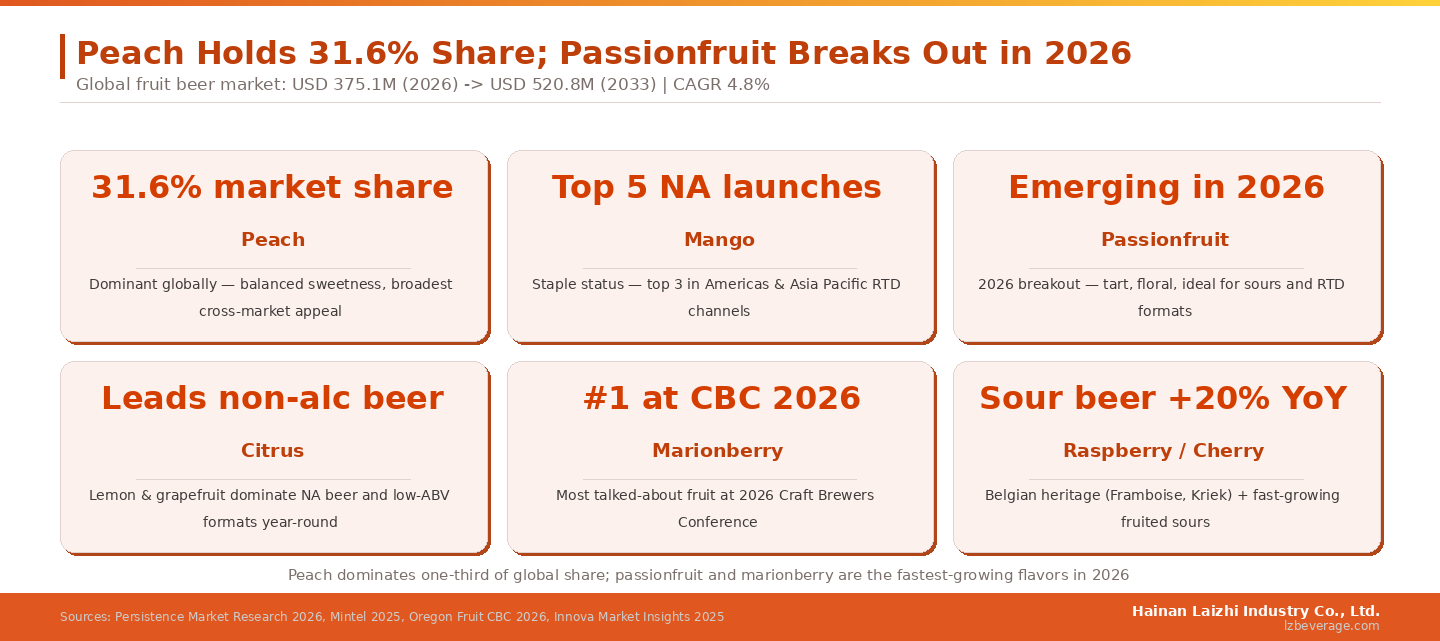
The Top Fruit Flavors for Canned Craft Beer in 2026
Peach: The Undisputed Category Leader
Peach holds approximately 31.6% of the global fruit beer segment, and the reasons are structurally sound: it delivers natural sweetness without cloying intensity, pairs effortlessly with wheat ale and lager bases, and carries cross-cultural familiarity across European, Asian, and North American markets. From an OEM formulation perspective, peach is the lowest-risk fruit flavor to source, scale, and export — which is precisely why it remains the foundation of most fruit beer portfolios.
Mango: From Trend to Staple
Mango has crossed the threshold from "trend" to "beverage staple." Mintel data shows it consistently ranks among the top five flavor components in juice-format launches across North America, and its adoption in craft beer — from hazy IPAs to wheat ales and sour Berliner Weisses — reflects genuine consumer pull, not just marketing novelty. For OEM buyers targeting convenience channels in Southeast Asia or the Middle East, mango offers proven sell-through velocity. The formulation challenge is achieving the right balance: too much mango sweetness masks hop character; too little and the branding promise falls flat.
Passionfruit: The 2026 Breakout Opportunity
According to Abstrax Hops' 2026 flavor intelligence report, passionfruit sits in the "emerging with stable growth" category in Mintel's Flavourscape AI — meaning it has not yet saturated the market but is accelerating. Its flavor profile (bright acidity, floral tartness, controlled sweetness) is a natural fit for fruited sours, RTDs, and lighter craft lager formulations. For brands that want to differentiate from the peach-and-mango crowded center of the market, passionfruit is the clearest OEM opportunity heading into late 2026 and 2027.
Citrus: The Non-Alcoholic Segment's Workhorse
Lemon and grapefruit occupy a unique position in the fruit beer landscape: they dominate the non-alcoholic and low-ABV format discussions, where their refreshing acidity compensates for the absence of ethanol-derived warmth. For OEM brands developing NA craft beer lines — a segment growing globally as consumers moderate — citrus flavors are the logical starting point. Sicilian lemon, in particular, drew significant attention at CBC 2026 for its ability to create a sophisticated, premium flavor signal in lighter formats.
Raspberry and Cherry: Heritage with New Life in Sour Beer
The traditional Belgian fruit beer styles — Framboise (raspberry) and Kriek (cherry) — continue to perform as premium, heritage-positioned SKUs. But the more interesting growth story is in the modern interpretation: fruited sour ales where raspberry and cherry provide tartness scaffolding for a new generation of experimental craft drinkers. Data from Bierfrucht's 2026 brewing innovation report places sour beer category growth at roughly 20% year-over-year — and raspberry and cherry remain the flavor anchors of that growth.
OEM Production Considerations for Fruit Beer
Formulation Method: Natural Fruit vs. Concentrate vs. Flavor System
There are three primary production approaches for fruit-flavored beer, each with different implications for OEM scale, cost, and consistency:
| Method |
MOQ Friendliness |
Flavor Authenticity |
Shelf Stability |
Best For |
| Whole / Fresh Fruit |
Low (complex logistics) |
Highest |
Variable by season |
Limited-edition, premium positioning |
| Aseptic Fruit Puree |
Medium |
High |
18–24 months |
Batch-consistent OEM production |
| Natural Flavor System (TTB-approved) |
High |
Good |
24–36 months |
High-volume, export-focused, mass retail |
For export-focused OEM production — which describes the typical customer profile for a Chinese beverage manufacturer like Laizhi — aseptic puree and natural flavor systems offer the best balance of authenticity, consistency, and scalability. Both approaches allow the label to carry "natural flavors" positioning, which resonates with health-conscious consumers in European and North American markets.
Canning Considerations for Fruit-Flavored Beer
Fruit-flavored beers present specific canning challenges that differ from standard lager production. Higher residual sugar content from fruit additions can trigger secondary fermentation in the can if dissolved oxygen and yeast control are not precise. Citrus-forward beers carry higher acidity that can interact with can linings over time, affecting flavor stability. A reliable OEM partner needs to have tight quality control at the fill stage — and food safety certifications like HACCP are specifically designed to address these process control points. Learn more about Laizhi's HACCP-certified production facility and how quality is maintained across 50 production lines.
Regional Demand Signals for 2026
Asia Pacific: The Growth Engine
Asia Pacific is the fastest-growing regional market for fruit beer globally, driven by urbanization, rising middle-class income, and a cultural affinity for lighter, sweeter beverages. Mango, lychee, and tropical blends perform strongly in Southeast Asia, while Japan and South Korea show growing appetite for premium citrus and peach formulations positioned as sessionable alternatives to traditional sake and soju. For OEM brands sourcing canned beer for Asian distribution, these flavor preferences translate directly into packaging and formulation decisions.
Europe: Premium Heritage Meets Craft Innovation
Europe holds 36.7% of the global fruit beer market and is characterized by a dual demand structure: traditional consumers seeking Belgian-heritage styles (Kriek, Framboise), and younger urban consumers attracted to modern fruited sours and craft IPA expressions. German and Scandinavian markets are showing particular interest in low-ABV fruit wheat beers that fit into moderation-driven drinking occasions.
Middle East and Africa: Emerging Import Opportunity
Non-alcoholic fruit beer has a specific and growing opportunity in markets where alcohol consumption is restricted. For OEM manufacturers with NA beer production capability, fruit-flavored variants offer a genuine market entry strategy for the Middle East — particularly in hospitality and retail channels catering to international tourists. Explore Laizhi's beer OEM options to discuss formulation flexibility for both alcoholic and non-alcoholic variants.
Frequently Asked Questions
What is the most popular fruit flavor for craft beer globally in 2026?
Peach is the most popular, holding approximately 31.6% of the global fruit beer market according to Persistence Market Research's 2026 data. Its balanced sweetness and broad cross-cultural appeal make it the safest and most commercially proven choice for OEM fruit beer production.
Which fruit beer flavor offers the best OEM differentiation opportunity?
Passionfruit currently offers the clearest differentiation window. It is classified as "emerging with stable growth" by Mintel's Flavourscape AI as of early 2026, meaning it has genuine consumer pull but has not yet reached saturation. Brands that launch a passionfruit-forward canned beer SKU now are positioned ahead of the mass-market adoption curve.
Can I order a custom fruit flavor combination for my private-label beer?
Yes — fruit-forward beer is one of the most flexible OEM categories from a formulation standpoint. Combinations like mango-passionfruit, peach-raspberry, or tropical citrus blends are all achievable with the right manufacturing partner. The key variables are minimum order quantity, flavor system selection (natural vs. concentrate), and export compliance requirements for your target market. Contact Laizhi Beverage to discuss custom formulation options and sampling.
Is fruit beer viable for export to markets with strict labeling requirements?
Yes, but the labeling approach matters. Fruit beers produced using natural flavor systems (TTB-approved in the US, compliant with EU Food Information Regulation) can carry "natural flavors" on the label, which is the most commercially accepted positioning. Aseptic fruit puree additions may allow "brewed with real [fruit]" claims in some markets, which carries stronger premium positioning. Always verify with the regulatory authority in your specific target market before finalizing label copy.
What minimum order quantities should I expect for fruit-flavored craft beer OEM?
This varies by manufacturer, but a flexible OEM partner should be able to accommodate small pilot batches for testing and larger production runs for commercial deployment. At Laizhi Beverage, MOQ flexibility is one of the core OEM value propositions — particularly important for brands launching new flavors where demand is still being validated. Visit Laizhi Beverage to discuss your specific volume requirements.

