Walk down the beverage aisle in any supermarket from Bangkok to Berlin and you will find the same phrase on label after label: "natural flavors." Consumer familiarity with the term is nearly universal. So is confusion about what it actually means. For OEM brand buyers sourcing carbonated canned drinks — whether energy drinks, sparkling water, or fruit sodas — understanding the distinction between natural and artificial flavors is no longer optional.
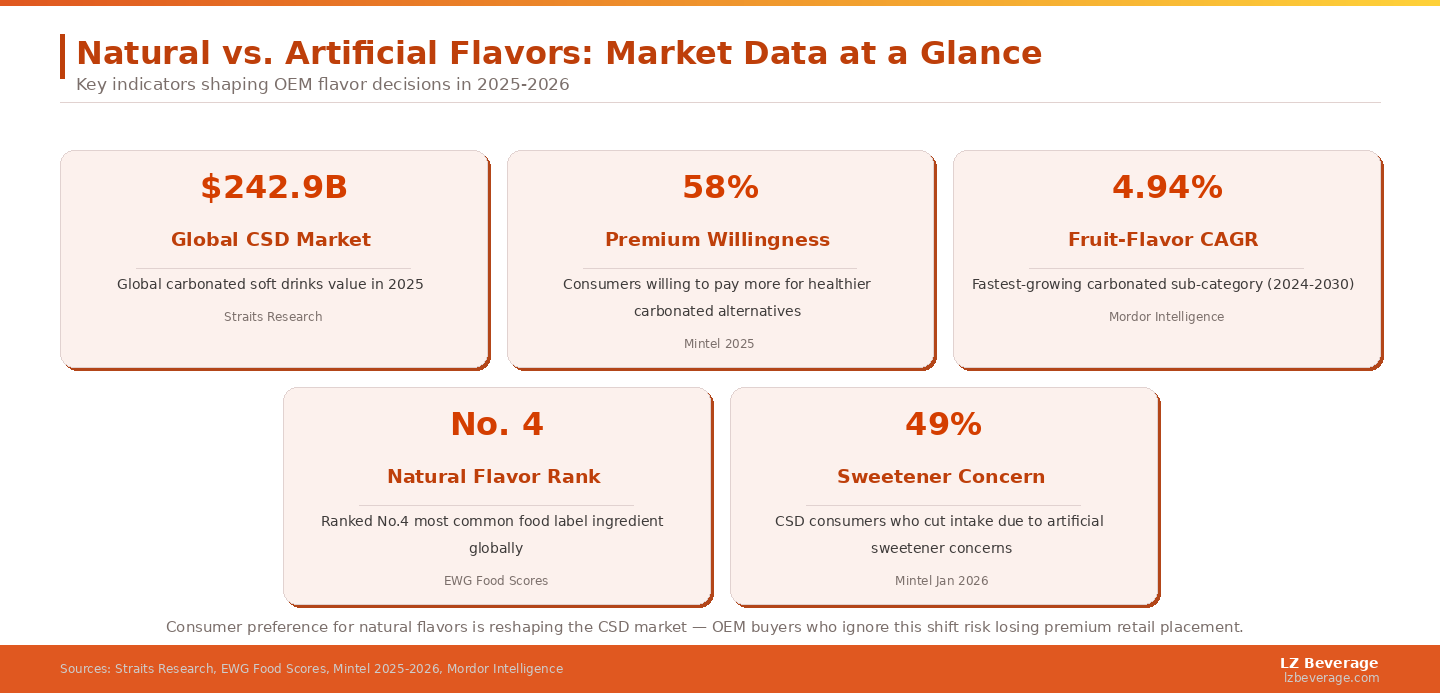
Walk down the beverage aisle in any supermarket from Bangkok to Berlin and you will find the same phrase on label after label: "natural flavors." Consumer familiarity with the term is nearly universal. So is confusion about what it actually means. For OEM brand buyers sourcing carbonated canned drinks — whether energy drinks, sparkling water, or fruit sodas — understanding the distinction between natural and artificial flavors is no longer optional. It sits at the intersection of regulatory compliance, product positioning, and shelf success. According to Straits Research, the global carbonated beverages market was valued at USD 499.33 billion in 2024 and is growing at a CAGR of 4.08% through 2033, with fruit-flavored carbonate formats — the segment most sensitive to flavor sourcing choices — recording the highest growth sub-category CAGR of 4.94%. Buyers who ignore the flavor labeling nuance now will face reformulation costs and regulatory hurdles later.
Key Takeaways
- FDA defines "natural flavor" narrowly by origin, not purity — the source must be natural, but processing aids like propylene glycol do not need to appear on labels.
- Artificial and natural flavors are chemically nearly identical — the difference is how the flavor molecule was obtained, not its molecular structure.
- Consumer backlash against artificial sweeteners and additives is measurable — Mintel data from early 2026 reports that 49% of CSD consumers reduced intake due to artificial sweetener concerns.
- EU organic regulations set stricter standards than the US, requiring certified organic flavors or natural extracts with no synthetic solvents for organically labeled products.
- Label claims drive purchasing — 58% of consumers are willing to pay a premium for healthier carbonated drink alternatives, creating a direct commercial incentive for natural-flavor positioning.
- OEM partners must be asked specific questions about flavor certificates, sub-ingredient disclosure, and compliance documentation before a sourcing decision is made.
Defining the Terms: What Regulators Actually Mean
Natural Flavor: The Official Definition and Its Blind Spots
The US Food and Drug Administration, under 21 CFR 101.22, defines a natural flavor as any flavoring substance derived from a plant, animal, seafood, dairy, or fermentation source — where the function is to impart flavor rather than nutrition. That sounds straightforward until you look at what the regulation leaves unsaid. According to the Environmental Working Group's Food Scores analysis, solvents, emulsifiers, flavor modifiers, and preservatives that carry the flavor compound can legally constitute 80 to 90 percent of a "natural flavor" mixture, yet none of these so-called "incidental additives" need to appear on the label. Propylene glycol, used as a solvent, is permitted in natural flavor mixtures. So is ethanol. Genetically engineered crop-derived ingredients may also qualify as "natural" under current FDA guidance because the agency has not fully closed that definitional gap.
What this means for buyers sourcing canned carbonated and RTD beverages is straightforward: a product label reading "natural mango flavor" does not guarantee you know everything that is in the flavor system. It confirms only that the primary flavor compound originated from a mango-derived source.
Artificial Flavor: More Similar Than You Think
Artificial flavors, by contrast, are synthesized chemically rather than extracted from natural source material. Here is the paradox: as University of Minnesota food science research has established, the main flavor molecule in a natural and artificial version of the same flavor is often chemically identical. The distinction lies in origin, not structure. An artificial strawberry flavor molecule and a natural strawberry flavor molecule may be the same compound — one produced by a biosynthetic pathway in a strawberry, the other assembled in a laboratory. Both carry the same caloric and nutritional non-value: neither adds meaningful nutrition to a product. The key regulatory difference is that artificial flavors must be labeled as artificial on the principal display panel, while natural flavors simply appear as "natural flavors" in the ingredient list, with no disclosure of the 50 to 100 chemical compounds that a complex flavor system may contain.
Market Signals: Why Buyers Must Align Flavor Strategy with Consumer Trends
The Health-Consciousness Shift Is Quantified
The commercial case for choosing natural flavors is no longer anecdotal. Beverage Industry's 2025 State of the Industry report, citing Mintel data, confirms that 58% of consumers are willing to pay a premium for healthier carbonated drink alternatives, and that 32% actively express interest in functional CSD innovations. Perhaps more telling for the OEM buyer: in early 2026, 49% of CSD category consumers reported reducing their intake specifically because of concerns about artificial sweeteners. That is nearly half your market self-limiting consumption on the basis of ingredient perception alone. The implication for product development is direct — a carbonated energy drink or fruit soda formulated with natural flavors and positioned with clean-label claims enters the market with a structural advantage in premium and health-conscious retail channels, which are precisely the fastest-growing distribution segments globally.
According to Grand View Research, Asia Pacific is projected to be the fastest-growing regional market for carbonated beverages between 2025 and 2030, driven by rising disposable incomes and Western brand influence — a trend that is especially important for export-oriented OEM brands where custom energy drink formulation for emerging markets is a growing service category.
European Buyers Face Stricter Certification Requirements
For brands targeting EU distribution, the regulatory environment is considerably more demanding than the US baseline. Under EU Regulation (EU) 2018/848 on organic production, products carrying an organic claim may only contain natural flavors produced from organic-certified sources or specific flavoring preparations. Non-certified natural flavors are not permitted. The regulation allows a maximum of 5% non-certified ingredients in any organic-labeled formulation — and for beverage compounds, where flavor dosage is high, that threshold is quickly consumed. Buyers planning EU-market launches for organically positioned carbonated drinks must therefore confirm with their OEM supplier that flavor systems used carry formal organic certification from an accredited EU body, not merely a supplier's "organic-compliant statement," which carries no legal equivalency. This is a distinction that Food Safety Tech's regulatory analysis flags as a persistent source of non-compliance among first-time exporters.
The OEM Buyer's Practical Checklist: Five Questions to Ask Your Manufacturer
Qualification Criteria That Determine Sourcing Risk
When evaluating an OEM partner's flavor sourcing capabilities, the following questions are not optional for a buyer who intends to launch in regulated markets. First, ask for the Certificate of Analysis (CoA) for each flavor system used, and confirm whether the certificate distinguishes natural flavors from processing aids. Second, request disclosure of whether any incidental additives — solvents, emulsifiers, or preservatives in the flavor mixture — are synthetic, and whether they appear on any restricted ingredient list in your target market. Third, for EU-organic ambitions, ask whether the OEM holds or can source flavor systems certified under USDA NOP or EU 2018/848 organic standards and what the documentation trail looks like. Fourth, clarify whether the formulation is proprietary to your brand or shared across multiple private-label accounts, as the answer affects traceability and reformulation flexibility. Fifth, confirm that the OEM has HACCP-certified production and a working quality management system that generates batch records for each flavor lot used. A manufacturer that cannot answer these questions with documentation is not an appropriate partner for market-compliant product launches.
Laizhi Beverage has operated with HACCP certification since 2017 and holds export qualification credentials established in 2018, providing the documentation infrastructure that buyers in regulated markets require. You can review the factory's quality credentials and production capabilities to understand the compliance baseline before requesting a sample or quote.
Natural vs. Artificial: A Comparison Across the Key Dimensions Buyers Care About
| Dimension |
Natural Flavor |
Artificial Flavor |
| Origin |
Plant, animal, or fermentation source |
Chemically synthesized in lab |
| Molecular structure |
Often identical to artificial equivalent |
Often identical to natural equivalent |
| Label disclosure |
Listed as "natural flavors" — sub-ingredients not required |
Must be labeled as "artificial flavor" on principal display panel |
| Cost to OEM buyer |
Generally higher; varies by source complexity |
Generally lower; easier synthetic production |
| Consumer perception |
Strongly preferred; associated with health and quality |
Increasingly problematic; linked to avoidance behavior |
| EU organic eligibility |
Yes, if certified organic-source flavor used |
No |
| OEM formulation flexibility |
High — wide variety of certifiable natural sources |
High — simpler to replicate at scale |
Frequently Asked Questions
Is a product with "natural flavors" always healthier than one with artificial flavors?
Not necessarily. The FDA definition of natural flavor governs origin, not health value. Natural flavors carry no inherent nutritional benefit over artificial ones — the same core molecules may be present in both. A carbonated drink with artificial flavors but no added sugar may be a nutritionally better choice than one with natural flavors but high fructose content. The health equation depends on the full formulation, not the flavor classification alone. For OEM buyers, this means "natural" is a positioning and regulatory choice, not a health guarantee that changes the product's macro profile.
Can an OEM produce a product with natural flavors that still qualifies for a "no artificial ingredients" claim?
Yes, with caveats. A product can carry a "no artificial flavors" claim if all flavor compounds originate from natural sources under FDA definitions. However, if any processing aids in the flavor mixture are synthetic (propylene glycol, synthetic preservatives), the "no artificial ingredients" phrasing becomes legally risky depending on jurisdiction. An experienced OEM partner with full sub-ingredient disclosure capability — and custom carbonated drink formulation expertise — can help buyers navigate exactly which claims are defensible for their target market before a label is printed.
Does choosing natural over artificial flavors significantly increase OEM production cost?
It depends on the flavor system. Complex natural fruit flavors extracted through multi-step processes typically cost more than their synthetic equivalents, but the premium is not uniform. Some natural flavor systems — particularly those derived from widely available citrus or tropical fruit sources — carry minimal cost premiums at commercial-scale OEM production volumes. The right OEM partner will present a side-by-side formulation cost comparison during the sampling phase rather than treating it as a fixed cost outcome. Industry analysts at Beverage Industry note that brands transparently communicating their ingredient sourcing choices are seeing stronger consumer resonance than those that simply absorb costs silently.
What documentation should I request from my OEM supplier to verify natural flavor authenticity?
Request the following: a Certificate of Analysis (CoA) for each flavor lot, a letter of guarantee from the flavor supplier confirming the natural origin and absence of prohibited processing aids for your target market, and — for organic claims — a valid organic certification document from an accredited certification body. For EU-bound products, this means EU 2018/848-compliant documentation. For US products, USDA NOP certification. A manufacturer that provides only a verbal assurance rather than a paper trail is not adequately positioned for regulated market entry. Explore the full LZ Beverage industry resource hub for further guidance on OEM compliance documentation standards.

