Flavor is the single most important purchase driver for carbonated drink consumers — and in 2026, the flavor landscape is moving faster than at any point in the past decade. According to Market Data Forecast, the global carbonated soft drinks market is projected to grow from USD 242.91 billion in 2025 to USD 367.26 billion by 2034 at a CAGR of 4.70%, with fruit-flavored formats explicitly identified as the fastest-growing product sub-category.
Flavor is the single most important purchase driver for carbonated drink consumers — and in 2026, the flavor landscape is moving faster than at any point in the past decade. According to Market Data Forecast, the global carbonated soft drinks market is projected to grow from USD 242.91 billion in 2025 to USD 367.26 billion by 2034 at a CAGR of 4.70%, with fruit-flavored formats explicitly identified as the fastest-growing product sub-category. For OEM brand buyers designing their next private-label SKU, understanding which fruit flavor profiles are gaining momentum — and which are already fading — is the difference between a product with a three-year shelf run and one that turns stale at six months. This guide maps the key fruit flavor trends shaping OEM procurement decisions in 2026, with specific data on emerging profiles, regional differences, and formulation implications.
Key Takeaways
- Classic citrus and berry flavors still anchor the category but no longer drive growth; exotic and hybrid profiles are where new volume is coming from.
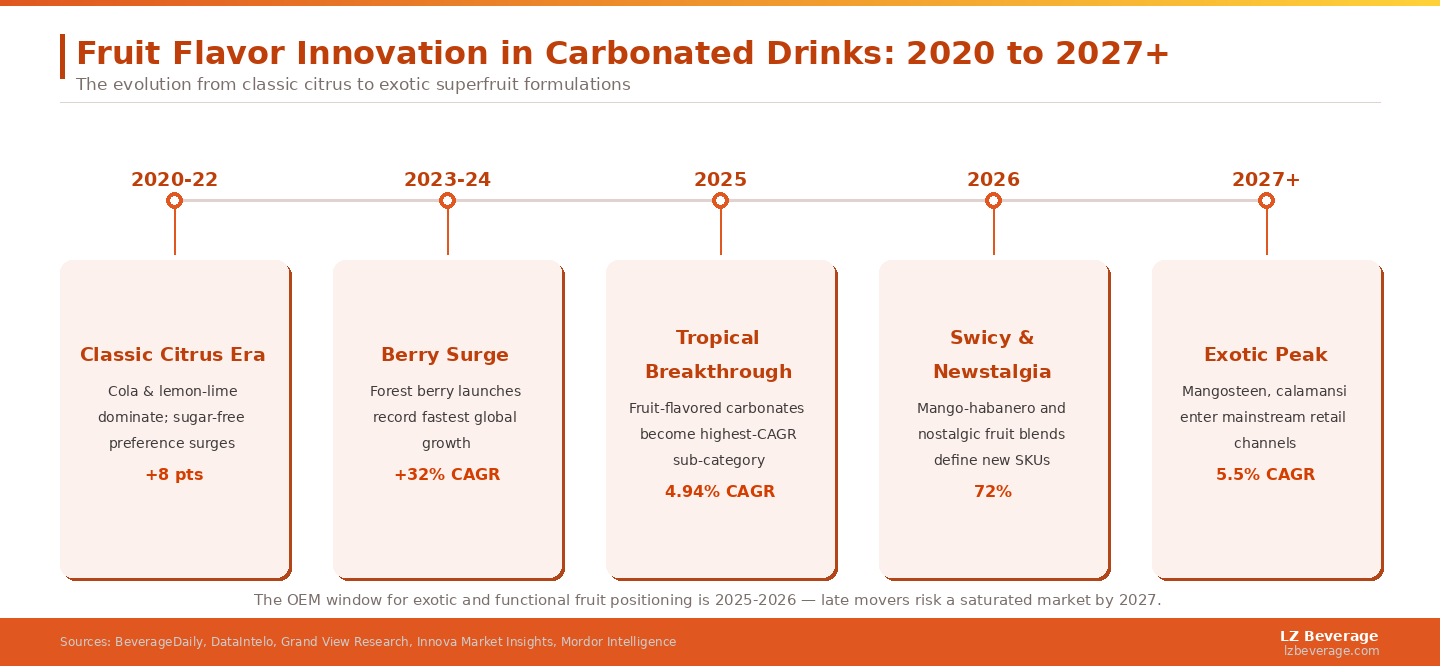
- Forest berry (elderberry, sea buckthorn, wild strawberry) recorded +32% CAGR in global product launches from 2021 to 2025, making it the single fastest-growing fruit flavor cluster in carbonated formats.
- Asian-inspired citrus — yuzu, calamansi, tangelo — has crossed from niche to mainstream positioning, especially in European and Southeast Asian markets.
- The "swicy" and "newstalgia" macrotrends (sweet-spicy and nostalgic-with-a-twist) are generating the most social media traction and retail innovation in 2026 carbonated beverages.
- Tropical superfruits (dragon fruit, camu camu, mangosteen) are in the early-adopter phase — a window of 12 to 18 months before they saturate premium distribution.
- 72% of consumers globally limit sugar intake, making fruit-flavor positioning only viable when paired with low-sugar or zero-sugar formulation.
The Macrotrend Context: Why Fruit Flavor Is the OEM Growth Vector in 2026
Consumer Palates Are Diversifying Faster Than SKU Cycles
The traditional soda market — cola plus lemon-lime — still represents the largest share of global carbonated volume. Cola alone accounts for approximately 47% of global carbonated beverage consumption. But growth is not coming from those categories. According to Innova Market Insights, 72% of consumers now actively limit sugar, and it is precisely the citrus and exotic flavor profiles — not cola or standard lemon-lime — that are driving the most consumer interest signals in the category. The fruit-flavored carbonated segment is where new money is entering, and OEM buyers who secure contracts in the right flavor families now will be positioned to supply the strongest-growth shelf slots through 2027 and beyond.
Meanwhile, DataIntelo's fruit-flavored soft drink market analysis projects the category at USD 125 billion in 2023 growing to USD 185 billion by 2032 at a CAGR of 4.5%, with Asia Pacific recording the fastest regional growth at 5.5% CAGR. This is the market context within which Laizhi Beverage operates its canned RTD and carbonated drink OEM service — specifically serving export-oriented buyers in Southeast Asia, the Middle East, and Europe who need fruit-flavored formulation expertise alongside certified manufacturing.
The Six Fruit Flavor Trends Shaping OEM Product Decisions in 2026
Trend 1: Forest Berries — The Fastest-Growing Cluster
Forest berry flavors — elderberry, sea buckthorn, damson, wild strawberry, and blackcurrant — recorded a staggering +32% CAGR in global product launches between 2021 and 2025, according to Beverage Daily's 2026 flavor trend report. The appeal is dual: these flavors carry strong nostalgic and foraging associations that resonate with European and North American consumers, while simultaneously delivering health-adjacent positioning through antioxidant marketing narratives. For OEM buyers, forest berry flavors are already moving from early-adopter to early-majority positioning — which means the window for launching a credible forest berry carbonated SKU without being the fifteenth brand in the set is closing. Brands entering in 2026 still have differentiation opportunity through unique berry combinations (sea buckthorn + blackcurrant, for example) or functional pairing (elder berry + vitamin C fortification).
Trend 2: Asian Citrus Crosses the Mainstream Threshold
Yuzu and calamansi, both long-established flavor workhorses in Japanese and Filipino/Southeast Asian markets respectively, have crossed the threshold from niche to mainstream in European and premium North American retail. According to the same Beverage Daily analysis, "exotic spins on citrus such as yuzu and calamansi have reached the mainstream," with Korean pear and lychee also accelerating. Tangelo — a citrus hybrid with a sweeter, less acidic profile than grapefruit — is identified as an emerging entry point for consumers not yet ready for the full yuzu intensity. For OEM buyers sourcing formulations for European retail distribution, a yuzu-lemon or calamansi-lime carbonated variant now represents a defensible product investment with existing market pull rather than speculative positioning.
Trend 3: Tropical Superfruits — The 12–18 Month Window
Dragon fruit, camu camu, and mangosteen are the three superfruit flavors that industry analysts identify as being in the early-adopter window of their adoption curves. According to Beverage Daily's January 2026 trend report, "pineapple is currently trending popular, and dragon fruit shows signs of becoming popular within the next 12–14 months. Mangosteen is another exotic fruit getting more attention, with a forecast of 24+ months before peak popularity." Camu camu — a tart, slightly floral Amazonian superfruit — is prized specifically in wellness drink and low-alcohol innovation. For OEM buyers with longer product development cycles, locking in a dragon fruit or camu camu formulation in H2 2026 positions the brand for a Q1 2027 shelf launch at peak consumer attention.
According to Grand View Research, tropical fruits — mango, pineapple, and guava — are projected to witness the fastest growth of any fruit type across the global fruit beverages category through 2033. For OEM buyers evaluating customized carbonated energy drink formulations with superfruit positioning, this data supports a multi-year market case, not just a 2026 trend play.
Trend 4: Swicy and Complex Hybrid Profiles
The sweet-spicy "swicy" flavor trend has matured beyond its novelty phase and is now generating genuinely differentiated sub-trends: swangy (spicy-sweet-tangy), swalty (sweet-salty), and swavory (sweet-savory). In carbonated drink formats, the most viable commercial expressions involve fruit-forward bases — mango habanero, guava jalapeño, passion fruit-ginger — where the sweetness of the fruit profile moderates the heat to levels appropriate for mass consumption. Capsaicin concentration in carbonated formats must be calibrated precisely: the target is a warming sensation rather than a burning one, and the carbonation itself amplifies heat perception by approximately 20% relative to still beverage equivalents. OEM buyers interested in swicy carbonated SKUs should ask their manufacturing partner for heat modulation experience specifically in carbonated formats, as it is a distinct technical requirement from still beverage production.
Trend 5: Newstalgia — Classic Fruit Flavors With Modern Identity
Nostalgia is one of the most commercially durable emotional narratives in beverage marketing, and in 2026 it is being deployed specifically around fruit profiles. Classic fruit punch flavors are being relaunched with guava additions; orange creamsicle profiles are being positioned with functional ingredient stacks (prebiotic fiber, vitamin C); cherry vanilla — a perennial performer — is re-emerging in zero-sugar formats. The newstalgia framework is particularly relevant for OEM buyers serving convenience store and impulse-purchase channels, where emotional familiarity is a faster decision trigger than health-claim education. Beverage Industry's 2025 State of Industry analysis notes that brands reimagining classics with cleaner ingredients are seeing the strongest consumer resonance — a direct brief for private-label buyers working with OEM partners who can reformulate heritage profiles with modern ingredient standards.
Trend 6: Functional-Fruit Fusion — The Premium Justification Layer
A fruit flavor profile alone is no longer sufficient to command a premium price position at retail. The strongest new carbonated drink launches in 2026 layer fruit flavors with functional ingredients: gut health (prebiotic fiber, probiotics), mental wellness (L-theanine, ashwagandha), or performance (electrolytes, B vitamins). The pairing logic is not arbitrary — coconut flavor links naturally with electrolyte positioning; citrus profiles pair with energy and focus; berry profiles support gut health narratives. According to Straits Research, fruit-flavored carbonated beverages are projected at the highest CAGR of 4.94% in the carbonated beverages market precisely because they anchor both the flavor-innovation and the functional-positioning trends simultaneously.
Regional Outlook: Where Fruit Flavor Innovation Has the Most OEM Opportunity
| Region |
Strongest Fruit Trend |
OEM Opportunity |
2025-2030 CAGR |
| Southeast Asia |
Calamansi, lychee, tropical blends |
High — familiar flavors + premiumization wave |
5.5%+ (APAC) |
| Europe |
Forest berries, yuzu, hedgerow |
High — organic certification increasingly required |
5.8% (Spain) |
| Middle East |
Guava, watermelon, citrus |
Moderate — price sensitivity; halal compliance key |
4–5% |
| North America |
Swicy fusion, newstalgia fruit punch |
High — functional + flavor premium viable |
3.6% |
| Africa |
Classic tropical, cola fruit blend |
Emerging — fastest volume growth globally; price-led |
8.12% |
From Trend Intelligence to OEM Brief: Converting Insights Into a Formulation Request
The Practical Steps for a Fruit Flavor OEM Engagement
Trend intelligence has commercial value only when it translates into a concrete product brief. The process begins by selecting one primary fruit flavor profile and one functional pairing based on your target market and distribution channel. For a Southeast Asian convenience store buyer, the brief might read: "calamansi-lime carbonated RTD, zero added sugar, with electrolyte fortification, 330ml can." For a European health food retailer, it might be: "elderberry-sea buckthorn sparkling water, natural flavors, organic-certified, 250ml can with low carbonation level." Once the profile is defined, share that brief with a manufacturing partner capable of formulation development, sampling, and compliance documentation. Laizhi Beverage's factory capability, running 50 production lines with 1 million cans per day capacity, is designed for exactly this type of bespoke flavor development at scale, with HACCP certification and export credentials already in place for the markets where these trends are strongest.
Frequently Asked Questions
Which fruit flavors are safest for an OEM buyer entering a new market without brand recognition?
Classic citrus profiles — lemon, lime, orange — remain the lowest-risk entry point in any market because consumer familiarity is established and there is no education barrier. However, they also offer the least differentiation advantage. A practical strategy is to use a classic fruit base (citrus or tropical berry) and add one distinguishing element: a secondary exotic note, a functional ingredient, or an unusual format (higher carbonation, lower sugar). This gives retail buyers a clear "first of its kind" narrative without requiring consumers to learn an entirely unfamiliar flavor. For established markets, this middle-ground approach consistently outperforms both pure heritage flavor relaunches and fully exotic formats in speed-to-reorder metrics.
How long does it typically take to develop a custom fruit flavor carbonated drink from brief to production-ready?
For a standard carbonated fruit-flavor formulation with no novel functional ingredients, the typical OEM cycle — from initial brief to approved sample — runs 4 to 8 weeks at a competent manufacturing partner. Subsequent steps (label design, regulatory review for the target market, production scheduling, and first shipment) add another 6 to 10 weeks, for a total go-to-market timeline of roughly 10 to 18 weeks from first contact. Complex formulations involving novel functional ingredients or organic-certified flavor systems can extend the development phase by an additional 4 to 6 weeks. Requesting a sample submission timeline as part of your initial supplier evaluation is a practical way to assess a manufacturing partner's realistic throughput. Explore the full LZ Beverage industry resource hub for more guidance on OEM timelines and process steps.
Is a tropical superfruit flavor like dragon fruit or camu camu difficult to formulate stably in a carbonated can?
Tropical superfruit natural flavor systems can present stability challenges in carbonated environments, specifically around heat treatment during pasteurization, interaction with carbonation at elevated pressure, and shelf-life color stability. These are surmountable with appropriate flavor encapsulation technology and formulation expertise, but they require a manufacturing partner with direct experience in carbonated tropical-fruit formats. When evaluating OEM partners, asking specifically whether they have produced commercial-volume runs of dragon fruit or camu camu carbonated products — and requesting batch records or references — is the most direct way to assess capability rather than relying on general formulation claims.

