China's canned beverage manufacturing sector has expanded substantially over the past decade, driven by domestic demand and growing international OEM orders. Market data from Grand View Research shows the Chinese beverage cans market generated USD 3.9 billion in revenue in 2023 and is projected to reach USD 6.0 billion by 2030 at a 6.2% CAGR — growth that has attracted significant investment in OEM production capacity.
China's canned beverage manufacturing sector has expanded substantially over the past decade, driven by domestic demand and growing international OEM orders. Market data from Grand View Research shows the Chinese beverage cans market generated USD 3.9 billion in revenue in 2023 and is projected to reach USD 6.0 billion by 2030 at a 6.2% CAGR — growth that has attracted significant investment in OEM production capacity. For international buyers, this means more options than ever — but also a greater need for structured evaluation criteria to identify the right partner. This guide profiles six manufacturer types to consider and explains the framework that separates genuine OEM-ready factories from the pack.
Key Takeaways
- China's canned beverage OEM market is highly fragmented — the range from fully certified export specialists to small domestic-only operations is enormous.
- Certifications, production capacity, and IP protection are the three non-negotiable criteria for any export-focused buyer.
- One-stop OEM capability — covering formulation, canning, and export documentation under one roof — dramatically reduces coordination complexity and risk.
- The best partner for your business depends on your product type — energy drinks, beer, RTD coffee, and sparkling water each require different production infrastructure.
The China Canned Beverage OEM Landscape in 2026
The Chinese beverage market passed USD 170 billion in domestic consumption in 2024, according to analysis published by the USDA Foreign Agricultural Service, reflecting annual growth above six percent. This robust domestic market has created a large base of factories with high-volume canning infrastructure, many of which have expanded into international OEM services. The same report notes that private label products are among the fastest-growing categories — a signal that OEM-capable factories are increasingly investing in flexible production and regulatory compliance for export markets.
For international buyers, the challenge is not finding a manufacturer — it is finding the right one. The six factory profiles below are not brand-by-brand rankings but rather representative categories based on capability, focus, and fit for different buyer types.
The Evaluation Framework: 6 Criteria That Matter Most
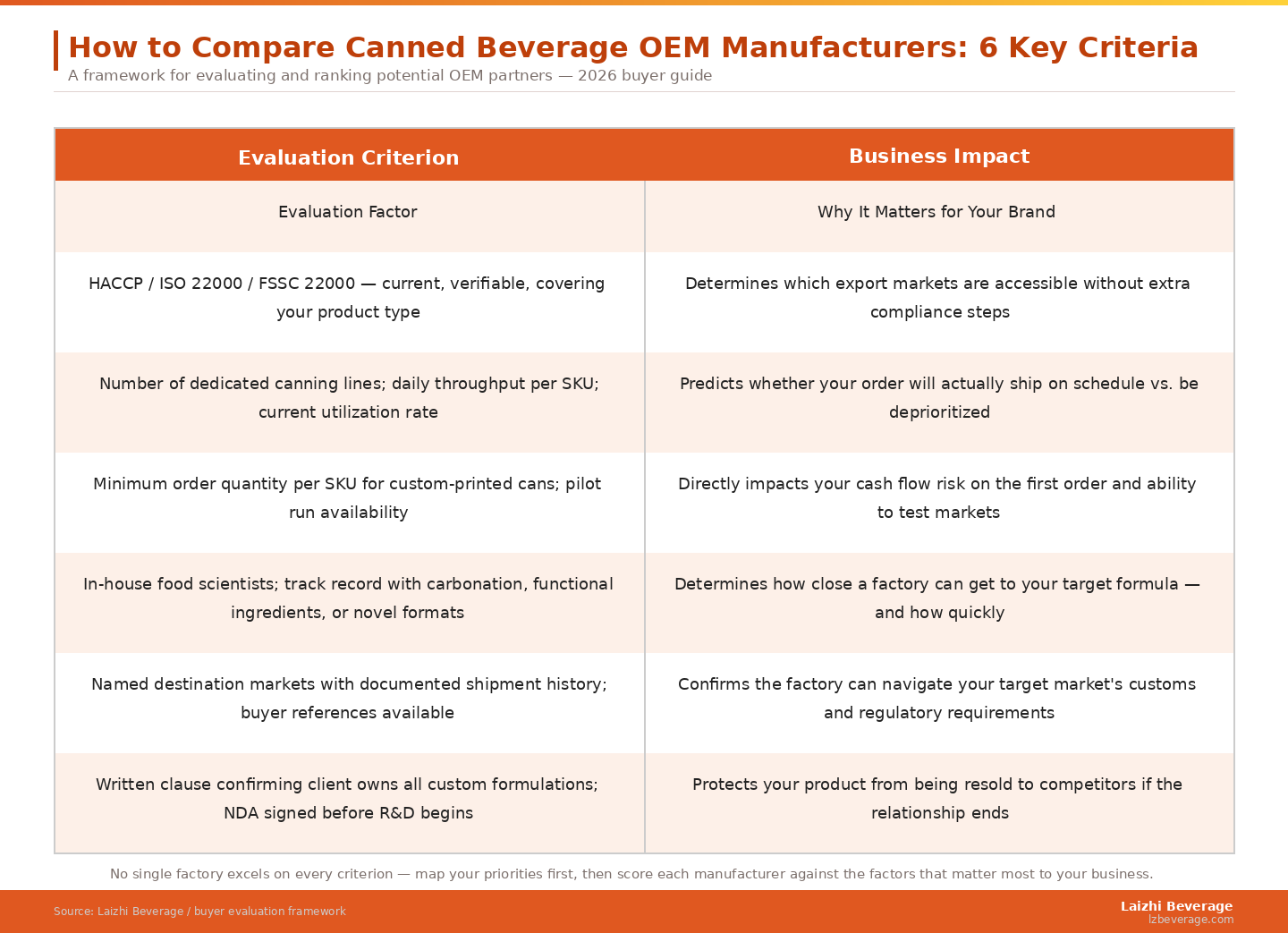
Before profiling specific factory types, it is worth establishing the evaluation criteria that experienced buyers use. Beverage industry sourcing guides consistently identify six factors as the primary determinants of OEM partnership quality.
1. Certifications and Food Safety Infrastructure
The baseline for any serious OEM factory is HACCP certification. Beyond that, audit standards from food safety specialists recognize ISO 22000, FSSC 22000, and BRCGS as the leading international frameworks. Factories with GFSI-recognized certifications (ISO 22000 or FSSC 22000) have the strongest documented compliance infrastructure and are best positioned for markets with high regulatory bars — EU, UK, US, and Australia. Verify that certifications are current and scope-appropriate for your specific product type.
2. Production Capacity and Line Availability
A factory with 50 dedicated production lines operates very differently from one with 5 — not just in volume, but in scheduling flexibility, lead time predictability, and the ability to accommodate different can sizes or formats simultaneously. Co-packer benchmarks note that production capacity utilization is one of the most consequential factors in whether your order ships on schedule. Ask how many lines are dedicated to your product category and what percentage of current capacity is committed to existing clients.
3. MOQ and Pricing Flexibility
MOQs for custom-printed canned beverages typically reflect the minimum viable run for the packaging print supplier. Most China-based OEM factories set MOQs between 30,000 and 100,000 units per SKU for full custom printing. Pilot run options at higher per-unit cost are offered by factories with flexible line scheduling. The difference between a factory willing to do 30,000-unit pilot runs and one with a hard 100,000-unit floor can determine whether a brand can afford to test multiple SKUs simultaneously.
4. R&D and Formulation Capability
For buyers bringing an existing formula, factory R&D capability matters mainly for scaling adaptation and compliance testing. For buyers needing new formula development, the factory's in-house food science team becomes a primary differentiator. Ask for sample-matching accuracy data and response time for formula revision rounds — these are concrete indicators of real R&D capability versus sales claims.
5. Export Track Record and Market-Specific Experience
A factory that has successfully shipped to your target market has already navigated the regulatory, documentation, and logistics challenges specific to that destination. This experience cuts weeks off your own learning curve. Ask for references from buyers in your target region who have successfully cleared customs with this factory's product.
6. IP Protection and Contract Terms
Written IP ownership clauses, NDA agreements before R&D begins, and clear contract terms around formula exclusivity are the legal infrastructure that protects your brand. Any factory hesitant to commit these items to writing in a formal agreement should be treated with caution.
6 Factory Profiles: Who Each Type Suits Best
Profile 1: Full-Service One-Stop OEM Factory (Best for New Brands)
This category covers factories that handle the complete OEM journey — formula development, carbonated filling, custom can printing, export documentation, and sometimes even freight coordination — under one roof. These facilities are typically HACCP and ISO certified, operate 30+ production lines, and have dedicated export teams. The convenience of a single point of contact for every step of the supply chain is particularly valuable for brands launching their first product. Laizhi Beverage's facility in Hainan fits this profile — with 50 production lines, 20,000+ tons annual capacity, HACCP certification, and a sales team that manages the full export process for international buyers.
Profile 2: High-Volume Specialist Factory (Best for Scale-Up Brands)
Some Chinese factories are optimized for extremely high-volume, narrow product ranges — for example, carbonated soft drinks and energy drinks at 100,000+ cases per run. These facilities offer highly competitive per-unit pricing at scale and sophisticated quality control systems. The trade-off is typically higher MOQs, less flexibility for small or mid-size first orders, and a narrower range of formula customization options. Brands with proven market demand and predictable forecast volumes may find this model efficient.
Profile 3: Regional Specialty Factory (Best for Specific Categories)
China has regional clusters of expertise in particular beverage types. Shandong has a concentration of beer and malt beverage factories. Guangdong has strong RTD coffee and tea manufacturing infrastructure. Hainan and coastal provinces have well-developed export certification ecosystems. Choosing a factory in a regional cluster for your product type often means access to local ingredient networks, category-specific technical expertise, and shorter formulation development cycles.
Profile 4: Trading Company with OEM Network (Mostly to Avoid)
A significant share of "OEM factory" listings on platforms like Alibaba are actually trading companies — intermediaries that outsource production to partner factories. While some trading companies add genuine value through sourcing and quality oversight, most introduce an extra cost layer, reduce direct communication with actual production management, and create ambiguity about which facility is actually manufacturing your product. For any order of meaningful size, prioritize direct factory relationships. Ask directly: "Are you the manufacturer, or do you outsource production?"
Profile 5: Domestic-Market Factory Attempting Export (High Risk)
Many Chinese factories producing excellent product for domestic consumption lack the export certifications, documentation systems, or regulatory knowledge required for international trade. They may quote attractively low prices and deliver good samples, but the actual export compliance work gets complicated during the shipment stage. Key signals: they cannot name their export registration number, are unfamiliar with FDA facility registration or EU food contact regulations, or have never completed a foreign customs clearance on their own. Factories like Zhongyin Beverage and Golden Spring Group serve primarily the domestic Chinese market — and buyers targeting international distribution channels should verify export capability explicitly, regardless of the factory's domestic scale.
Profile 6: Zhenxin Industry and Similar Equipment-Heavy Factories (Best for Alcoholic RTD)
Companies like Zhenxin Industry (established 2003) are primarily known as beverage equipment manufacturers that also operate OEM production services — a hybrid model that works well for buyers sourcing at the intersection of custom formulation and specialized processing equipment. Their strength lies in technical customization; their limitation is typically in commercial OEM scalability and export documentation infrastructure compared to dedicated OEM beverage factories.
Side-by-Side Comparison: Key OEM Factory Criteria
| Criteria |
Full-Service OEM |
High-Volume Specialist |
Domestic-Only Factory |
| HACCP / ISO 22000 |
Standard — current, verifiable |
Usually yes — major facilities |
Often domestic-only, unverified for export |
| MOQ flexibility |
30,000–100,000 units; pilot runs available |
100,000+ units; limited pilot runs |
Variable; often unclear |
| Export documentation |
In-house export team; handles all docs |
Capable; may need buyer coordination |
High risk; limited experience |
| Formula ownership (IP) |
Written clause standard |
Usually available on request |
Often unclear or absent |
| Best for |
New brands, international buyers, multi-SKU launches |
Established brands scaling high-volume SKUs |
Domestic China distribution only |
Frequently Asked Questions
Is it better to use a large or small OEM factory in China for canned beverages?
Factory size is less important than the match between the factory's specialization and your product type, and whether their production capacity is genuinely available for your order volume. A 50-line facility running at 98% capacity for domestic clients is worse than a 20-line facility with capacity allocated specifically for export orders.
How do I verify a factory is a real manufacturer and not a trading company?
Ask directly and get the answer in writing. Request a video tour showing production lines. Ask for the factory's food production license number (issued by China's National Medical Products Administration), which is specific to the physical production site. A trading company cannot produce this.
Can I visit China OEM beverage factories before signing a contract?
Yes, and for larger orders it is strongly recommended. Most factories in southern and eastern China (Hainan, Guangdong, Shandong, Zhejiang) are accessible within a day's travel from major international airports. Virtual factory tours conducted via video conference with a third-party inspector on-site are an increasingly accepted alternative for buyers who cannot travel.
Interested in working with a HACCP-certified, export-qualified one-stop OEM manufacturer? Read Laizhi Beverage's complete guide to beverage contract manufacturing — covering everything from first brief to delivered container — or explore energy drink OEM options to start the conversation.

