Minimum order quantity — MOQ — is one of the first terms a new beverage brand encounters when approaching an OEM manufacturer, and one of the most misunderstood. For many founders, an unexpectedly high MOQ is the obstacle that stops a product launch before it begins. For others, accepting a low MOQ without understanding the cost implications leads to unit economics that make the brand unviable.
Minimum order quantity — MOQ — is one of the first terms a new beverage brand encounters when approaching an OEM manufacturer, and one of the most misunderstood. For many founders, an unexpectedly high MOQ is the obstacle that stops a product launch before it begins. For others, accepting a low MOQ without understanding the cost implications leads to unit economics that make the brand unviable. This guide explains exactly what drives MOQs in canned beverage manufacturing, what realistic ranges look like across different product types and packaging formats, and how brands at different stages can approach MOQ negotiations intelligently.
Key Takeaways
- MOQs for canned beverages typically range from 5,000 to 50,000 units per SKU for standard production runs, with significant variation based on packaging customization, formulation complexity, and can size.
- MOQ is not arbitrary — it reflects the manufacturer's fixed production costs, ingredient procurement minimums, and packaging supplier requirements that must be covered for each run to be economically viable.
- Matching your MOQ to your validated sales forecast — not to the best available unit price — is the single most important MOQ decision a new brand makes.
What Is MOQ and Why Does It Exist in Canned Beverage Manufacturing?
Minimum order quantity refers to the smallest number of units a manufacturer will produce in a single production run. MOQs are not arbitrary numbers — they are calculated minimums that allow a manufacturer to cover fixed production costs while still offering the client a commercially viable unit price. Understanding this economics is the foundation for any productive MOQ negotiation.
Every production run involves fixed costs regardless of volume: machine setup and changeover time, QC testing of the batch, line cleaning between products, and the labor to supervise and document the run. These fixed costs are the same whether a factory produces 5,000 cans or 500,000 cans. The factory's MOQ is effectively the volume floor at which these fixed costs can be spread across enough units to make the run economically rational — for both the manufacturer and the client.
For canned beverages specifically, there is an additional MOQ layer that is less visible but equally important: packaging supplier minimums. Aluminum cans, lid stock, and custom-printed labels or printed cans are sourced from third-party suppliers who have their own MOQs. A factory offering custom-printed aluminum cans may require a minimum of 50,000 to 100,000 cans from its can supplier before accepting your order — and that supplier minimum becomes your effective MOQ, regardless of what the filling line itself can accommodate.
What Drives MOQ in Canned Beverage Production?
Production Line Setup Costs
Switching a canned beverage production line between products involves flushing the previous formulation, cleaning all contact surfaces, recalibrating carbonation and fill-weight settings, and verifying the first-off product to specification before releasing the full run. This changeover process typically takes two to four hours on a high-speed line, representing a significant fixed cost. The manufacturer recovers this cost across the units produced in the run — which means shorter runs produce a higher per-unit setup cost that must be reflected in pricing or MOQ requirements.
Ingredient Procurement Minimums
Specialty ingredients — caffeine, taurine, natural flavor concentrates, fruit juices, specific sweetener blends — are often purchased from ingredient suppliers who also impose MOQs. A manufacturer formulating a custom energy drink with a proprietary flavoring system may need to purchase a minimum 25kg batch of that flavor concentrate, regardless of the production volume requested. That ingredient minimum can translate directly into a production MOQ — there is no economic rationale to purchase more flavor than will be used in the production run.
Custom Packaging Commitments
Custom printed aluminum cans — where your brand graphics are printed directly onto the can body rather than applied as a label — typically require a separate MOQ commitment with the can manufacturer, independent of the filling factory's own requirements. Industry data suggests aluminum cans may start at around 2,000 to 5,000 cases per SKU from US co-packers, while Chinese OEM factories serving international brands typically work in unit-level MOQs of 5,000 to 50,000 per SKU. Custom can printing requirements at the can manufacturer level can push effective brand MOQs significantly higher.
Quality Testing and Compliance Requirements
Each production batch requires microbiological testing, carbonation level verification, fill-weight auditing, and often shelf-life validation samples. The cost of this testing is fixed per batch. For a factory to offer competitive unit pricing, the testing cost must be spread across a sufficient number of units — contributing to the MOQ floor that makes a production run economically viable for both parties.
Typical MOQ Ranges by Product Type and Format
| Product Type |
Packaging Format |
Typical MOQ Range |
Key MOQ Driver |
| Carbonated soft drink / soda |
330ml standard can |
10,000–50,000 units |
Can supplier + line setup |
| Energy drink |
250ml slim can |
5,000–30,000 units |
Specialty ingredients + can format |
| Craft beer / canned beer |
330ml or 500ml standard can |
10,000–100,000 units |
Fermentation batch size + can minimum |
| Sparkling juice |
250ml or 330ml slim can |
5,000–20,000 units |
Juice ingredient minimums |
| RTD coffee or tea |
250ml slim can |
5,000–25,000 units |
Extract/flavor concentrate minimums |
| Private label / stock formula |
Any standard can |
1,000–10,000 units |
Line setup only (pre-validated formula) |
Ranges above reflect industry benchmarks from multiple sources including PartnerSlate and Power Brands co-packing research. Actual MOQs depend on the specific factory, your target market, and the degree of customization in your product and packaging. Private label options — where you adopt an existing, pre-validated formula rather than developing a proprietary recipe — typically carry the lowest MOQs because they eliminate the ingredient sourcing and formulation validation costs from the equation. Browse LZ Beverage's product range to understand which categories support flexible MOQ options.
How MOQ Affects Unit Economics
The Cost Curve Relationship
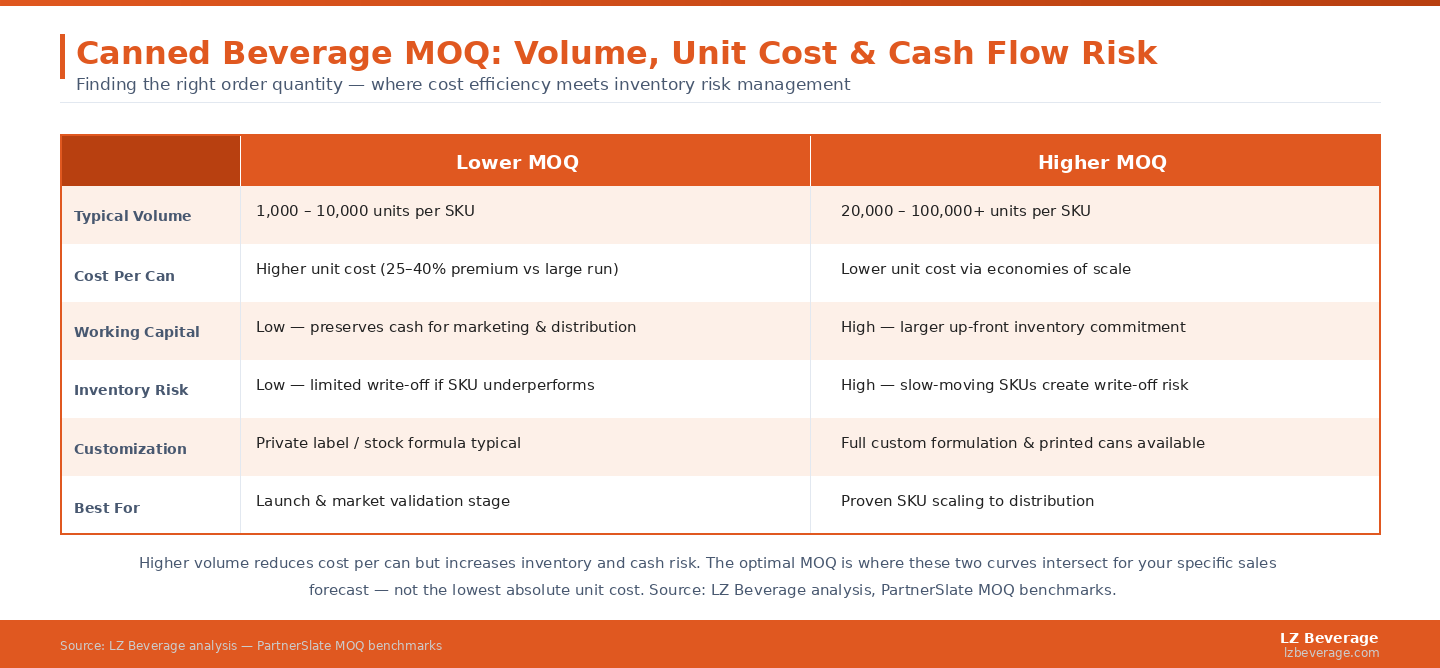
The relationship between MOQ and unit cost follows a predictable curve: each step up in volume reduces the per-unit cost, but the incremental savings diminish as volume increases. The largest cost reduction typically occurs between the minimum viable run and roughly twice that volume — after which marginal savings per additional unit become smaller. Understanding where you sit on this curve is essential for budgeting.
A brand ordering 5,000 units may pay 25–40% more per can than a brand ordering 50,000 units from the same factory. This differential must be factored into retail pricing strategy. If your target retail price requires a unit cost below what your realistic MOQ produces, you have one of three options: increase your order volume to a more efficient tier, accept lower margins in the early stage with a plan to reduce them at scale, or negotiate a pilot run arrangement that provides market validation before committing to a larger volume.
Cash Flow and Inventory Risk
Higher MOQs improve unit economics but concentrate financial risk. A 50,000-unit order that takes six months to sell ties up significantly more working capital than five 10,000-unit orders placed every six weeks. For new brands with uncertain demand, the inventory carrying cost and the risk of holding unsold product — especially for a new flavor or format — must be weighed against the unit cost savings from a larger run.
The principle here is direct: ordering too much inventory can strain cash flow and increase storage costs, while ordering too little raises production costs. The strategic MOQ is the one aligned with realistic sales forecasts, not the one that looks most favorable on a cost-per-unit spreadsheet. Contact the LZ Beverage team to discuss MOQ options that align with your brand's launch timeline and volume projections.
How New Brands Can Approach MOQ Negotiations
Strategy 1 — Start with a Private Label or Stock Formula
Brands that have not yet validated market demand for a specific flavor profile can often access lower MOQs by launching with a manufacturer's existing, validated formula rather than a fully custom recipe. This approach eliminates ingredient development costs and the associated procurement minimums, allowing the brand to launch at lower volume and use the sales data to inform a subsequent custom product development. It is a particularly effective strategy for entering a new geographic market where consumer preferences are still being tested.
Strategy 2 — Negotiate a Shared Production Run
Some OEM factories run shared production programs where multiple brands participate in a single production batch of a common base formula, with individual labels applied at packaging. This arrangement allows each brand to access far smaller unit quantities — sometimes as low as 1,000 to 3,000 units — while the factory meets its overall batch minimum across the combined client orders. Not all factories offer this model, and it typically limits customization options, but for a brand testing a new SKU or entering a market, it is a practical path to lower minimum commitments.
Strategy 3 — Build Volume Across Multiple SKUs
A brand launching two or three flavors simultaneously may be able to aggregate their combined volume to meet a factory's production minimum, even if each individual SKU would fall below it independently. Factories that understand brand-building and work with growth-stage clients often accept combined orders that meet the batch minimum across variants, particularly for brands demonstrating a credible distribution plan.
Strategy 4 — Accept Higher Per-Unit Cost for the First Run
For brands with strong conviction about a product's market fit — perhaps because they have validated demand through a white-label pilot or a successful Kickstarter campaign — accepting the higher per-unit cost of a smaller first run is a rational strategy. The cost premium buys market validation without the working capital risk of a large inventory commitment. Once the product velocity is confirmed, the second order can be placed at a volume that achieves the desired unit economics.
MOQ Glossary: Key Terms Every New Brand Should Know
| Term |
Definition |
Why It Matters |
| MOQ (Minimum Order Quantity) |
Smallest unit volume a factory will produce per run |
Sets your minimum financial commitment per SKU |
| SKU (Stock Keeping Unit) |
A single distinct product variant (flavor, size, packaging) |
MOQ applies per SKU — multiple flavors multiply the commitment |
| Pilot Run |
Small production batch for validation before full commercial order |
Allows quality validation at lower cost and risk |
| Unit Economics |
The cost and revenue per single unit sold |
MOQ directly affects the cost side of the equation |
| Private Label |
Branded product using manufacturer's existing formula |
Typically carries lower MOQ than custom formulation |
| Custom Formulation (ODM) |
Product developed from a proprietary brand recipe |
Higher MOQ due to ingredient procurement and validation costs |
| Conversion Cost |
Factory charge to transform inputs into finished cases |
Fixed per run; decreases per unit as volume increases |
Frequently Asked Questions
What is a typical MOQ for canned energy drinks from a Chinese OEM manufacturer?
For a custom energy drink formula in 250ml slim cans from a Chinese OEM factory, typical MOQs range from 5,000 to 30,000 units per SKU, depending on the factory's batch size requirements and whether custom-printed cans or labeled plain cans are used. Private label energy drink programs — where the brand adopts the factory's existing formula — can reduce the MOQ to as low as 1,000 to 5,000 units in some cases, since the formulation and ingredient procurement are already validated.
Can I negotiate MOQ with a canned beverage manufacturer?
Yes, and most professional manufacturers expect it. The most effective negotiation strategies involve aggregating volume across multiple SKUs, accepting higher per-unit pricing in exchange for a lower volume commitment, or agreeing to a pilot run at a premium before placing a full commercial order. The key is understanding why the factory has set the MOQ it has — once you understand the underlying cost structure, you can find creative ways to address the factory's economics without simply asking for a lower number.
How does MOQ differ between Chinese OEM factories and other sourcing regions?
Chinese OEM factories generally offer competitive MOQs for medium-to-large runs (10,000 units and above) due to the scale of China's aluminum can manufacturing infrastructure and the depth of its ingredient supply chains. Suppliers in Vietnam, India, and Southeast Asia sometimes offer lower MOQs for smaller initial runs, with MOQs starting at 1,000 to 5,000 units per SKU in some segments. For brands at very early stage, exploring multiple sourcing regions and comparing both MOQ and unit pricing is worthwhile — but always weighted against the additional supply chain management complexity of a new manufacturing geography.
Does a higher MOQ always mean better unit economics?
Not necessarily. The unit cost reduction from increasing MOQ follows a diminishing returns curve. Moving from 5,000 to 15,000 units typically delivers a larger per-unit saving than moving from 50,000 to 100,000 units. Beyond a certain volume threshold, the incremental cost reduction is marginal, while the inventory and cash flow risk continues to grow. The optimal MOQ is the one that produces viable unit economics at a volume your sales forecast can absorb within a reasonable timeframe — not simply the largest volume that produces the lowest cost per can.
What happens if my product doesn't sell and I'm stuck with MOQ inventory?
Unsold inventory from a minimum order commitment is one of the primary financial risks for new beverage brands. Mitigating strategies include: launching with a private label formula before investing in a custom recipe, using the first MOQ to validate demand before scaling, negotiating the shortest possible production lead time so you can sell existing stock before re-ordering, and being conservative rather than optimistic in your initial volume forecast. As a principle, it is better to sell out of your first run and re-order than to carry unsold inventory for six months while paying storage costs. Discuss flexible launch options with LZ Beverage to find an approach that matches your brand's current stage.

