China produces more aluminum cans annually than any other country, and its canned beverage OEM sector spans everything from high-volume carbonated drink factories to flexible co-packers specializing in craft beer, energy drinks, and functional RTD products.
China produces more aluminum cans annually than any other country, and its canned beverage OEM sector spans everything from high-volume carbonated drink factories to flexible co-packers specializing in craft beer, energy drinks, and functional RTD products. For global brand owners, this breadth is both an opportunity and a challenge: the right partner can take a brand from brief to export-ready in weeks, while the wrong choice can result in quality failures, compliance issues, or wasted capital. This guide walks through ten criteria that experienced buyers use to evaluate and select canned drink OEM factories in China — going beyond price comparison to the structural factors that determine long-term partnership success.
Key Takeaways
- Certification verification (HACCP, ISO 22000, export qualifications) is the non-negotiable baseline — never skip it, even for factories with impressive marketing materials.
- Production capability match — not price — should be your primary filter, since a factory unable to handle your format, fill type, or carbonation spec cannot serve you regardless of cost.
- Communication quality and responsiveness during the evaluation process is one of the most reliable predictors of how a factory will perform under pressure during production.
Why Factory Selection Defines Brand Outcomes
The selection of an OEM manufacturing partner is one of the most consequential decisions a beverage brand makes. A factory audit report from 2024 found that 59% of factories audited in China passed compliance reviews — which means 41% failed. Buyers who skip verification and choose purely on price or speed of response face a real statistical chance of partnering with a non-compliant facility. The downstream consequences — retailer delisting, shipment rejection at customs, consumer safety recalls — far outweigh any short-term cost savings from choosing the cheapest available option.
As one sourcing expert with 18 years of China factory auditing experience notes, choosing the right manufacturer is not about minimizing cost — it is about maximizing control, predictability, and trust. This framework operationalizes that principle into ten measurable criteria.
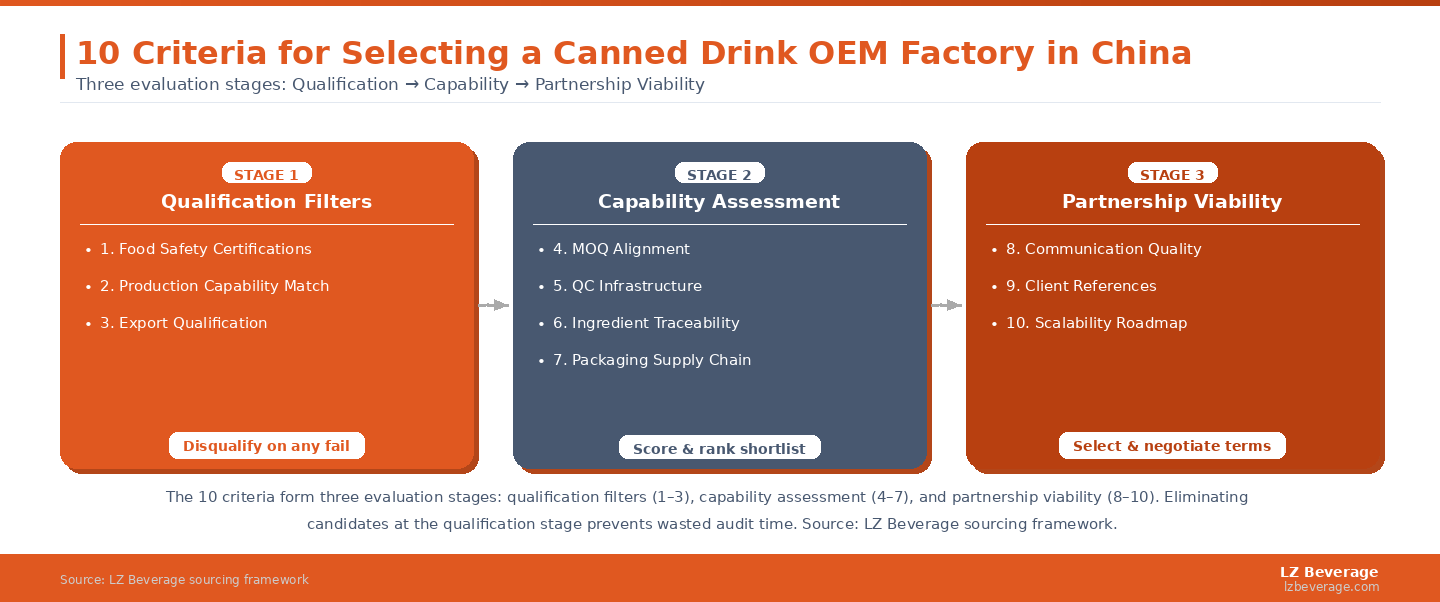
Criterion 1 — Food Safety Certifications and Compliance Status
Why Certifications Come First
Before evaluating any other dimension, verify that the factory holds the certifications required for your target market. For most international brands, this means HACCP certification at minimum, ideally accompanied by ISO 22000 (food safety management system) and GMP (Good Manufacturing Practice) documentation. HACCP provides hazard analysis and critical control point controls; ISO 22000 expands this to a full operational management system; GMP governs facility hygiene, equipment maintenance, and personnel practices.
For brands exporting to the United States, the factory or an importer of record must be registered with the FDA. For markets in the Middle East, Halal certification is often a distribution prerequisite. For premium natural products, organic accreditation may be required. The key discipline is to identify your target market's mandatory requirements before beginning factory outreach — and to treat any factory that cannot provide current, verifiable certificates as disqualified at the first stage, regardless of their pricing or responsiveness.
Verifying Certificates, Not Just Claiming Them
Certificate verification requires more than accepting a scanned PDF. According to quality inspection professionals, buyers should always request the certificate number, expiry date, and issuing body name — and then contact the certifying body directly to confirm validity. ISO 9001 certified plants should also demonstrate written procedures for checking products, written records from checks, and labeling of all materials during any factory visit. Factories that hold certificates but cannot produce these operational artifacts are likely treating certification as a box-ticking exercise rather than a genuine quality system. View LZ Beverage's factory credentials and certification history as a reference benchmark.
Criterion 2 — Production Capability Match to Your Specific Format
Carbonation, Fill Type, and Can Compatibility
Canned beverage production is not generic. A factory optimized for hot-fill juice products may lack the carbonation dosing and seaming equipment required for a sparkling energy drink. A facility specializing in 330ml standard cans may not be set up to run 250ml slim cans efficiently. Before requesting pricing, confirm that the factory operates the specific equipment your product requires: cold-fill for carbonated products, tunnel pasteurization or flash pasteurization for shelf-stable beverages, the correct seamer heads for your chosen can format, and CO₂ supply infrastructure for carbonation.
Asking a factory to run a product format it has not previously validated creates quality risk and production delay. A thorough capability match question at the outset — "Have you produced [product type] in [can format] before, and can you share a previous production run report?" — immediately separates experienced partners from those who will figure it out at your expense.
Line Speed, Efficiency, and Production Scheduling
Production capacity affects more than the maximum volume you can order — it affects your lead time, your position in the production queue, and whether the factory will prioritize your order or deprioritize it when a larger client places a rush request. Ask for confirmed line speed, current client roster scale, and typical scheduling lead time for a production run of your volume tier.
Criterion 3 — Export Qualification and Customs Track Record
Not All Factories Can Export to All Markets
Chinese canned beverage manufacturers must hold specific export qualifications to legally ship food products internationally. These include registration with China Customs, compliance with China's food safety export regulations, and often market-specific registrations for major destinations. A factory that produces excellent product but lacks proper export qualification will cause your shipment to be detained at the port of origin or rejected at the destination customs — outcomes that are both costly and reputationally damaging.
Request copies of the factory's export qualification certificate, ask which countries they have successfully shipped to in the past 12 months, and request at least two references from buyers in your target region. Active export history to your destination market is a meaningful quality signal that goes beyond paper qualifications.
Criterion 4 — Minimum Order Quantity Alignment with Your Volume
MOQ Is a Strategic Filter, Not Just a Logistical Detail
Minimum order quantities for canned beverages from Chinese OEM factories typically range from 5,000 to 50,000 units per SKU for standard production runs, with significant variation based on packaging customization, formulation complexity, and the factory's production line minimum batch size. Factories with very high MOQs — 100,000 units or above — are often optimized for large multinational clients and will deprioritize or refuse smaller brands outright.
Align your target MOQ with your realistic sales forecast for the first six months. A brand that commits to 50,000 cans of an untested flavor because the unit economics were compelling, but sells only 10,000 units, has destroyed working capital and potentially generated a write-off. The right MOQ is the one that matches your validated demand — not the one that produces the lowest unit cost. Request an energy drink OEM quote from LZ Beverage to understand realistic MOQ ranges for your format.
Criterion 5 — Quality Control Infrastructure and Testing Protocols
What Happens Inside the Factory Matters More Than the Samples
Factory samples are carefully prepared. What matters is the quality control system that governs every production run, including the ones you will never see. Ask specific questions about incoming ingredient testing, in-process quality checks (fill weight, carbonation level, seam integrity), final product micro-testing, and lot traceability systems. A factory with a documented quality management system — not just a policy document, but actual monitoring records, corrective action logs, and batch traceability data — is operating at a different quality level from one that describes its QC procedures verbally without documentation.
Third-party audit history is one of the most reliable indicators. Factories that have been audited by independent bodies such as QIMA, SGS, Bureau Veritas, or equivalent organizations have external validation of their processes. Ask for the most recent third-party audit report and review the findings — including any non-conformances and how they were resolved. A factory with no non-conformances in its audit history is either exceptionally well-run or has never been audited rigorously.
Criterion 6 — Ingredient Sourcing Transparency and Supply Chain Traceability
Know Where Your Ingredients Come From
The quality of a canned beverage depends on the quality of its ingredients — and OEM factories vary significantly in their ingredient sourcing rigor. Ask for certificates of analysis (COAs) for all major ingredients used in your formulation, confirm that the factory can provide supplier names and country of origin for key components, and verify that traceability extends back to raw material lots. Ingredient traceability is not just a quality practice — it is a regulatory requirement in most major export markets and a prerequisite for managing any recall or complaint situation efficiently.
Custom Formulation vs. Stock Formula Options
Some OEM factories offer proprietary formulas that brands can license and relabel; others work only from client-supplied specifications; and the best partners offer both. Clarify the factory's formulation model early in the discussion to ensure it aligns with your IP ownership expectations and branding strategy. If you are supplying your own formula, confirm that the factory has signed a non-disclosure agreement before receiving your recipe.
Criterion 7 — Packaging Procurement and Can Sourcing Infrastructure
Integrated vs. Fragmented Supply Chains
Canned beverage packaging involves aluminum cans, lid stock, labels or printed can decoration, capsules or crowns (for some formats), and outer carton packaging. Factories that source all these components through established, long-term supplier relationships offer two advantages: lower material costs from volume purchasing, and lower risk of packaging supply disruptions that delay your production run.
Ask the factory whether it sources cans directly from a can manufacturer or through a distributor, what its minimum packaging order commitment is, and whether it can accommodate fully custom printed cans (as opposed to paper labels on plain cans). Custom printed aluminum cans require a separate MOQ commitment with the can supplier — typically 50,000 to 100,000 units — and this timeline must be built into your overall production schedule.
Criterion 8 — Communication Quality and Response Standards
Responsiveness During Evaluation Predicts Performance Under Pressure
One of the most reliable ways to assess a Chinese OEM factory before placing an order is to observe how it communicates during the evaluation process. Factories that respond quickly, provide detailed technical answers to formulation questions, flag potential specification issues proactively, and communicate in clear written English are demonstrating the operational discipline that will matter when a production run has a quality issue and you need answers under time pressure.
Conversely, factories that provide only brochure-level responses, deflect specific technical questions, or go silent for days at a time during initial discussions are showing you exactly how they will communicate when something goes wrong mid-production. As sourcing research makes clear, the best factory is not the cheapest one — it is the one whose processes align with your standards, whose people answer tough questions without deflection, and whose track record speaks louder than their sales pitch.
Criterion 9 — References from Brands in Your Target Market
Peer Validation Cuts Through Marketing
Factory marketing materials and website testimonials are curated by definition. Request contact details for two or three brands that have shipped product from the factory to your target market in the past 12 months, and contact those references directly. Specific questions to ask include: Were production timelines met as quoted? Did the product match the approved sample quality? How did the factory respond when there was a problem? Was export documentation complete and accurate on the first shipment?
A factory that declines to provide references — citing client confidentiality — is raising a concern, not demonstrating discretion. Established, professionally run OEM factories maintain relationships with clients who are willing to validate their performance.
Criterion 10 — Scalability Roadmap and Long-Term Partnership Capability
Think Beyond the First Order
The first container you ship is a proof of concept. If the product succeeds, you will need to scale — potentially across multiple SKUs, higher volumes, and additional markets. Evaluate your potential OEM partner against your 18-month volume projection, not just your first order. Does the factory have the production capacity to support a three-times volume increase? Can it accommodate new flavor variants without extensive re-tooling? Does it have experience supporting international distribution expansion?
Factories that are a strong fit for your first order but will become a constraint at scale create a painful switching cost at the worst possible time — when your brand is growing and needs operational consistency, not a supplier transition. Explore LZ Beverage's full product range and 50-line production capacity to understand the scalability available for your brand. LZ Beverage's 20,000-ton annual production capacity and multiple product categories make it well-positioned to support brands from initial launch through international scale.
10-Criterion Evaluation Scorecard
| # |
Criterion |
Key Verification Action |
Disqualify If |
| 1 |
Food safety certifications |
Verify HACCP/ISO 22000 with issuing body |
Certificates expired or unverifiable |
| 2 |
Production capability match |
Request production run data for your format |
No prior experience with your fill type or can size |
| 3 |
Export qualification |
Request export cert + destination market references |
No active export history to your target market |
| 4 |
MOQ alignment |
Compare MOQ against 6-month sales forecast |
MOQ exceeds realistic demand by >2× |
| 5 |
QC infrastructure |
Request most recent third-party audit report |
No documented in-process QC records available |
| 6 |
Ingredient traceability |
Request COAs for key ingredients; check NDA willingness |
Cannot provide ingredient origin documentation |
| 7 |
Packaging supply chain |
Ask for can supplier name and custom print MOQ |
No direct relationship with can supplier |
| 8 |
Communication quality |
Send a detailed technical query; evaluate response depth |
Brochure-level answers to specific technical questions |
| 9 |
Client references |
Contact 2–3 references in your target market |
Declines to provide any verifiable references |
| 10 |
Scalability roadmap |
Ask capacity at 3× current volume; assess multi-SKU capability |
Factory cannot support projected growth trajectory |
Frequently Asked Questions
How long does factory evaluation take for a canned drink OEM in China?
A thorough evaluation — including document verification, technical Q&A, a virtual or physical audit, sample testing, and reference checks — typically requires 4 to 8 weeks. Compressing this timeline by skipping steps increases risk disproportionately. The 4-week minimum reflects the time needed to receive, test, and evaluate product samples; certification verification can often be done in parallel.
Should I visit a Chinese OEM factory in person before placing an order?
For first orders above a certain threshold — typically equivalent to USD 20,000 or more — an in-person factory visit or a professionally conducted third-party audit is strongly advisable. Virtual tours are a reasonable first step, but they can be staged; an on-site audit examines equipment condition, worker safety, raw material storage, and actual production flow in real time. Third-party audit firms such as QIMA operate throughout China and typically charge USD 250 to 400 per audit with a full written report.
What is the most common mistake brands make when choosing a Chinese canned drink OEM?
The most common mistake is prioritizing price in the initial shortlist. Price is an outcome of capability, certification status, MOQ, and service scope — not a standalone criterion. Brands that start with price comparisons routinely end up with factories whose actual cost-of-quality (including defect remediation, compliance failures, and reshipment costs) far exceeds the savings on unit economics. Define your non-negotiable criteria first, apply them as filters, and then compare price among the factories that pass all filters.
How do I protect my recipe when working with a Chinese OEM factory?
Sign a non-disclosure agreement (NDA) before sharing any formula details, and ensure the NDA covers both the factory entity and its employees. For proprietary formulations with significant IP value, consider working with a Chinese IP attorney to register your formula-related intellectual property locally before beginning production discussions. Strong NDAs and clear recipe transfer protocols are foundational to protecting IP in any OEM arrangement.

