Launching a private label canned drink brand has never been more accessible — or more competitive. The barriers to market entry have dropped: OEM factories offer flexible MOQs, digital printing technology allows small-run custom cans, and global logistics infrastructure means a factory in China can deliver to a distributor in Europe or the Middle East in three to four weeks by sea. What has not changed is the cost of getting the fundamentals wrong.
Launching a private label canned drink brand has never been more accessible — or more competitive. The barriers to market entry have dropped: OEM factories offer flexible MOQs, digital printing technology allows small-run custom cans, and global logistics infrastructure means a factory in China can deliver to a distributor in Europe or the Middle East in three to four weeks by sea. What has not changed is the cost of getting the fundamentals wrong. This guide covers every step from concept validation to first container delivery, in the order they need to happen and with the decision criteria that actually matter.
Key Takeaways
- The eight-step OEM launch process runs 16–20 weeks from concept to first delivery; build your retail or distribution commitments around this timeline.
- Cans are advancing at a 5.75% CAGR through 2031 — functional, low-sugar, and RTD categories are growing fastest.
- Regulatory compliance (label review, certifications, import requirements) is the most commonly skipped step and the most expensive mistake.
- Starting with ODM to validate demand before investing in OEM custom formula development reduces risk for most first-time brand owners.
Why 2026 Is a Favorable Year to Launch a Canned Drink Brand
The global beverage market is undergoing structural transformation that benefits new entrants. According to industry data, the beverages market was valued at USD 2.03 trillion in 2026 and is projected to grow at a 5.65% compound annual rate through 2031. Cans specifically are gaining share within this growth: they expand at a 5.75% CAGR through the same period, driven by recyclability advantages, superior carbonation retention, and on-the-go convenience that resonates with both developed and emerging market consumers.
More importantly for brand owners, large corporations are telling you where consumer demand is heading with their acquisition activity. PepsiCo's 2025 acquisition of prebiotic soda brand Poppi and Keurig Dr Pepper's investment in Ghost Beverages signal that functional, better-for-you canned beverages are the highest-growth segment of the category. These are not niche trends — they are becoming core shelf space. For an independent brand, this means entering a category where large players are actively buying growth rather than building it, which creates space for differentiated smaller brands that are faster to market and more niche-specific.
The 8-Step Private Label Launch Process
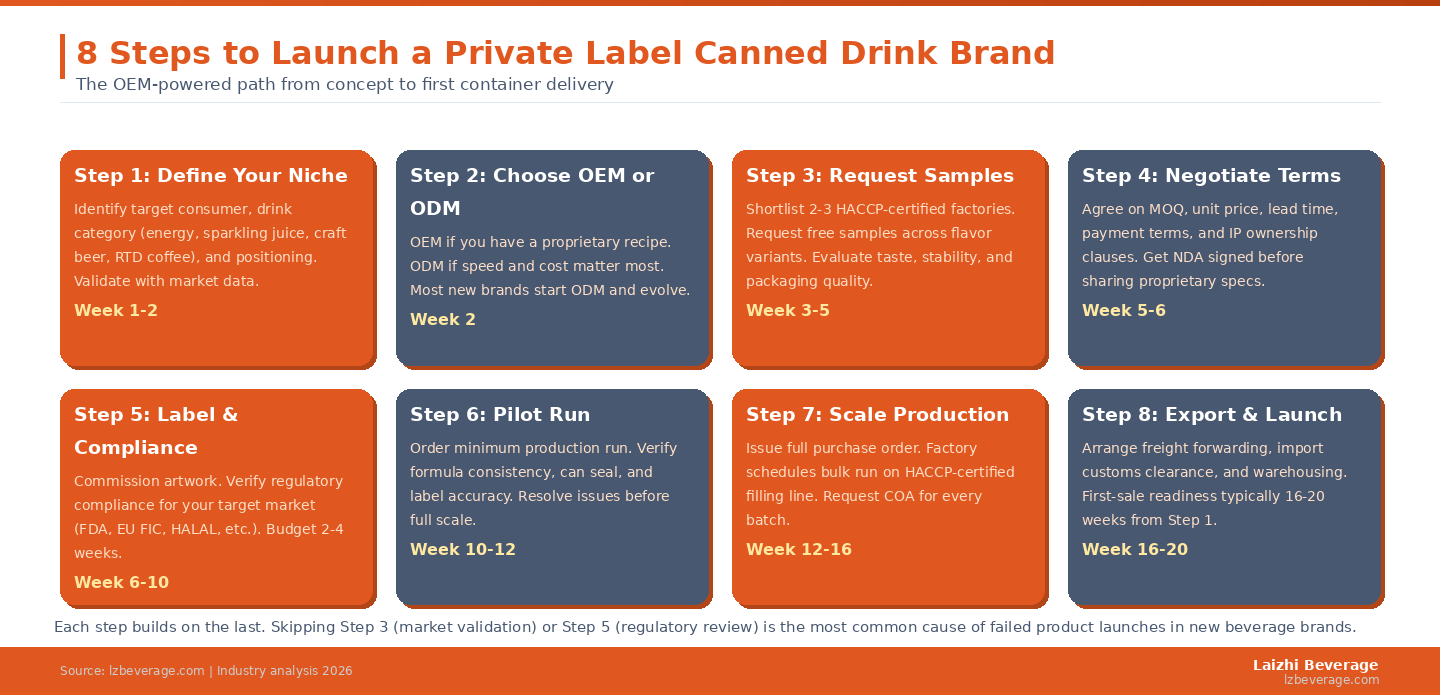
Step 1: Define Your Niche with Precision
Vague positioning is the most expensive mistake a new canned drink brand can make, because every downstream decision — formula, packaging format, label claims, target factory — flows from it. "A healthy energy drink" is not a niche. "A low-sugar, adaptogen-infused sparkling energy drink targeting gym-going women in Southeast Asia, priced at $2.50 retail" is a niche. The more precisely you define the target consumer, the drink's functional purpose, the retail channel, and the price point, the more efficiently a factory can help you develop or select the right product.
Use market data to validate your niche before committing to it. The global energy and sports drinks market reached approximately USD 208 billion in 2024 and is estimated to grow to over USD 248 billion by 2029. Cans accounted for 82.4% of global energy drinks market revenue in 2024. These numbers confirm the category's scale, but the opportunity for a new brand is in the white space within it — the specific flavor profiles, functional claims, or regional markets that the dominant players have not yet claimed. Laizhi Beverage's industry resources cover trends across energy drinks, RTD coffee, tea, and carbonated beverages that can inform your niche selection.
Step 2: Choose OEM or ODM
This decision should be made once your niche is defined, not before. If your competitive advantage is a unique formula — a proprietary botanical blend, a specific functional ingredient combination, a taste profile developed through consumer testing — choose OEM and protect that formula with a signed NDA before sharing any specifications. If your competitive advantage is speed to market, regional distribution access, or price competitiveness, choose ODM and select from the factory's existing formula library.
For most first-time brand owners, ODM is the lower-risk starting point. It eliminates the R&D timeline, reduces upfront cost, and lets you focus your limited capital on branding, marketing, and channel development. Once you have proven that your target consumer buys your product repeatedly, the case for upgrading to a proprietary OEM formula is much easier to make — and fund.
Step 3: Request Samples from Shortlisted Factories
Never evaluate an OEM or ODM factory on its pitch deck alone. Request samples before any substantive commercial discussion. Specifically: request samples of its existing products in the category you intend to launch, request samples of any pilot formulas it proposes for your brief, and evaluate both the liquid and the packaging separately. Check carbonation consistency across multiple cans from the same batch. Assess the can seam integrity. Review the label printing quality. Taste for off-flavors, metallic notes, or inconsistencies that indicate ingredient quality issues.
Shortlist two to three factories for sample evaluation, not one. The comparative exercise gives you a baseline for quality and makes your final factory selection a data-driven decision rather than a relationship decision. A HACCP-certified factory like Laizhi Beverage, which has been producing export-ready beverages since 2005, will welcome sample evaluation as a standard part of the qualification process. Review factory credentials and production capabilities before requesting samples to ensure the factory operates at the right scale for your volume requirements.
Step 4: Negotiate Contract Terms
Price is one of five things you need to nail in your factory contract. The others are MOQ and batch size flexibility, lead time commitments and penalties for delay, IP ownership and NDA provisions, and quality standards with documented rejection criteria. Get each of these in writing. Verbal agreements with factory sales representatives have no legal standing when your shipment arrives with quality defects or three weeks late.
On IP: if you are doing OEM, ensure the agreement explicitly states that the formula developed for you is your exclusive property and cannot be disclosed or sold to any third party. If you are doing ODM, ensure any exclusivity clause defines the scope precisely — territory, channel, time period — rather than leaving ambiguity that the factory can exploit. Payment terms of 30% deposit, 70% balance against bill of lading are standard for first orders; negotiate toward better terms as the relationship matures.
Step 5: Label Design and Regulatory Compliance
This is the step that most new brand owners underestimate, and the most common reason for shipment delays, import rejections, and product recalls. Every market you sell into has specific label requirements. In the United States, the FDA requires a Nutrition Facts panel in a specific format, a specific ingredient list order, net contents declared in both metric and US customary units, and — for beverages containing caffeine — a clear caffeine per serving declaration. The EU requires compliance with the Food Information to Consumers regulation, which has its own mandatory fields, minimum font sizes, and allergen declaration format. Middle Eastern markets require HALAL certification on the label and on the factory's documentation.
Commission a regulatory consultant or use a specialized label compliance service to review your artwork before it goes to print. The cost of a compliance review — typically USD 1,500 to USD 3,000 — is trivially small compared to the cost of reprinting thousands of labels or, worse, having a shipment detained at customs. Build four weeks into your launch timeline for label finalization and compliance review. This step cannot be rushed.
Step 6: Pilot Production Run
Before committing to your full commercial order, run a pilot production batch. The purpose is to verify that the formula consistency achieved in the sample phase is replicated at commercial filling line speed and volume. Variables that affect taste and stability in production — filling temperature, carbonation injection pressure, seaming speed — are all different at scale than in a lab environment. The pilot run surfaces these differences when the cost of correction is low (before you have paid for 50,000 cases of product).
Request the COA for your pilot batch and compare it against the stability test parameters established during sample approval. If carbonation levels, pH, or Brix readings deviate from approved parameters, investigate the cause before scaling. Factories that conduct rigorous pilot runs — with documented in-line quality checkpoints — are demonstrating exactly the operational discipline you want in a long-term manufacturing partner.
Step 7: Full-Scale Production
Your purchase order for full-scale production should reference the approved pilot batch COA as the quality benchmark. Specify batch size, packaging format, label version, filling line (if the factory has multiple lines with different capabilities), and delivery date requirements. Confirm the factory's production schedule in writing, along with any agreed penalties for late delivery. For Chinese factories exporting to international markets, confirm that the factory's export license and HACCP certificate remain current at the time of production — both have renewal cycles and can lapse.
During production, request photos or video of the filling line operating. This is now standard practice for international buyers and serves two purposes: it confirms your order is in production, and it documents that the factory's hygiene and production protocols are being followed. Reputable factories such as Laizhi Beverage, which operates 50 production lines with a daily output of 1 million cans, accommodate this request as standard.
Step 8: Export, Freight, and First Delivery
Export logistics from China involves several parallel workstreams: the factory prepares the shipping marks, packing list, commercial invoice, certificate of origin, and phytosanitary or health certificates required by your destination market. You or your freight forwarder arranges ocean or air freight booking, insurance, and the import customs filing in your destination country. For most markets, ocean freight in a 20-foot container is the most cost-efficient format for a first commercial order. Transit time from major Chinese ports to Southeast Asia runs approximately five to seven days; to the Middle East, ten to fifteen days; to Europe, twenty-five to thirty days.
Plan your cash flow around the delivery timeline. Payment to the factory typically occurs at bill of lading issuance; your stock will be in transit for several more weeks before it can be sold. For a first container, a conservative sales forecast horizon should account for the full transit, unloading, and distribution pipeline before expecting any revenue recovery from the production investment.
| Step |
Timeline |
Key Output |
| 1. Define Niche |
Week 1–2 |
Validated product brief |
| 2. Choose OEM/ODM |
Week 2 |
Manufacturing model decision |
| 3. Request Samples |
Week 3–5 |
Factory shortlist + approved sample |
| 4. Negotiate Terms |
Week 5–6 |
Signed contract + NDA |
| 5. Label & Compliance |
Week 6–10 |
Approved artwork + regulatory sign-off |
| 6. Pilot Run |
Week 10–12 |
Pilot COA + approval |
| 7. Full Production |
Week 12–16 |
Commercial batch + COA |
| 8. Export & Delivery |
Week 16–20 |
Stock in your warehouse |
Common Budget Mistakes on a First Private Label Launch
Underbudgeting for Compliance and Artwork
Label design, regulatory review, and any required certifications (HALAL, organic, non-GMO) carry real costs that new brand owners frequently exclude from their launch budget. A professional label design costs USD 1,500 to USD 5,000 depending on complexity. A regulatory compliance review costs USD 1,500 to USD 3,000. HALAL certification for a product line costs approximately USD 2,000 to USD 5,000 through an accredited body. These costs are non-negotiable for market access — they are not areas to cut.
Treating the Factory Quote as the Total Cost
The factory's FOB (Free on Board) price covers production and loading onto a vessel at a Chinese port. It does not cover ocean freight, import duties, destination port handling, inland freight to your warehouse, or import broker fees. On a typical 20-foot container, these additional logistics costs commonly add 20% to 35% to the ex-factory unit cost. Your margin calculations must include the full landed cost, not the factory quote.
Frequently Asked Questions
How much does it cost to launch a private label canned drink brand?
Total first-launch costs depend heavily on volume and product complexity, but a realistic baseline for a small commercial launch — one SKU, one container, targeting a regional market — runs USD 30,000 to USD 80,000, including factory cost, freight, label design, regulatory compliance, and a small marketing reserve. Brands with lower MOQ ODM arrangements can launch closer to the bottom of that range; OEM custom development adds upfront costs before any production spending begins.
What can sizes should I launch in?
For most markets, 250ml and 330ml are the two safest starting formats. The 250ml size dominates energy drink and single-serve functional beverage segments in Europe, the Middle East, and Asia. The 330ml size is the standard for carbonated soft drinks, craft beer, and sparkling juice across most retail channels globally. The 500ml size suits energy drink brands competing on value or targeting gym and convenience channels. Launching in a single format first reduces inventory complexity and minimizes the tooling investment required for custom artwork approval.
Do I need to visit the factory in China before placing an order?
A factory audit — either in person or by a qualified third-party inspector — is strongly recommended before your first purchase order. Video audits conducted by professional inspection firms are a widely accepted alternative for brands that cannot travel. The audit should verify that certifications displayed on the factory's documentation are current, that production hygiene meets HACCP standards, and that the filling line capacity matches the factory's stated claims. Factories with nothing to hide welcome audits; reluctance is a disqualifying signal.
What is the minimum order quantity for a private label canned drink from China?
MOQs vary by factory, product type, and whether you are using OEM or ODM. For ODM canned beverages, MOQs of 5,000 to 10,000 cases per SKU are achievable with established factories offering shared-line production. For OEM custom development, the MOQ is typically higher — often 15,000 to 25,000 cases for the initial run — to justify the dedicated line scheduling and custom ingredient procurement involved. Contact Laizhi Beverage's team to discuss MOQ requirements for your specific product category and target volume.
How do I ensure my canned drink formula is protected when working with a factory?
Three steps protect your formula. First, sign a Non-Disclosure Agreement before sharing any specific formulation details — this is a standard document for professional factories and a refusal to sign it should disqualify a factory immediately. Second, in your manufacturing agreement, explicitly state that the formula developed for your brand is your exclusive property and cannot be shared with, disclosed to, or sold to any third party. Third, register any truly novel ingredient combinations as trade secrets in your home jurisdiction where applicable. These steps do not prevent all IP risk, but they create a legal and contractual framework that makes unauthorized use of your formula a documentable breach of contract.

