You have decided to launch a canned beverage brand. You know you need a manufacturing partner. Now comes the question every new brand owner faces, usually too late: should you go OEM or ODM? These two models lead to fundamentally different outcomes for your formula, your IP, your timeline, and your budget — and the wrong choice at this stage is difficult and expensive to reverse.
You have decided to launch a canned beverage brand. You know you need a manufacturing partner. Now comes the question every new brand owner faces, usually too late: should you go OEM or ODM? These two models lead to fundamentally different outcomes for your formula, your IP, your timeline, and your budget — and the wrong choice at this stage is difficult and expensive to reverse. This guide breaks down the practical differences between OEM and ODM in canned beverage manufacturing, using the six dimensions that actually determine which model fits your business.
Key Takeaways
- OEM means you bring the formula; ODM means the factory brings the formula. That single difference drives everything else.
- ODM offers faster time to market (4–8 weeks vs 3–6 months) and lower upfront cost, but limited exclusivity.
- OEM gives you full IP ownership and deeper differentiation, but requires more capital and patience upfront.
- The smartest path for most new brands is ODM to validate demand, then OEM once the winning SKU is identified.
Defining the Two Models
What OEM Actually Means for a Beverage Brand
In a canned beverage OEM arrangement, you — the brand owner — are the originating party. You provide a product brief that defines the target taste, the nutritional profile, the ingredient constraints, and the can format. The factory's R&D team develops a formula to that brief, iterates it through sampling, runs stability tests, and then manufactures the approved product at scale. The formula, once finalized and documented, belongs to you. The factory manufactured it, but it cannot sell that formulation to your competitors without your permission.
This model requires you to bring a concept and a clear specification. You do not need a completed food scientist's recipe — a well-articulated sensory brief and nutrition target are enough to start the OEM development process. But you do need to invest time in sample review and approval cycles. That investment is what generates the proprietary product that becomes a defensible brand asset.
What ODM Means for a Beverage Brand
In an ODM arrangement, the factory already holds the formula. It has a library of pre-developed, shelf-stable, production-ready recipes — energy drink bases, sparkling juice variants, carbonated tea formulas, and more. You select from this library, apply your branding, choose your packaging format, and you are into production. The factory owns the underlying formula IP. You own your label, your brand, and — depending on your contract — potentially a degree of exclusivity for your territory or market segment.
ODM is not a lesser model. It is a different strategic tool. The world's largest supermarket chains use ODM to build private label programs that compete directly with national brands, and they do so deliberately: speed and cost efficiency matter more to their objectives than formula uniqueness. For a new brand testing its first market entry, ODM's pre-validated formulas and compressed timelines are genuine advantages, not compromises.
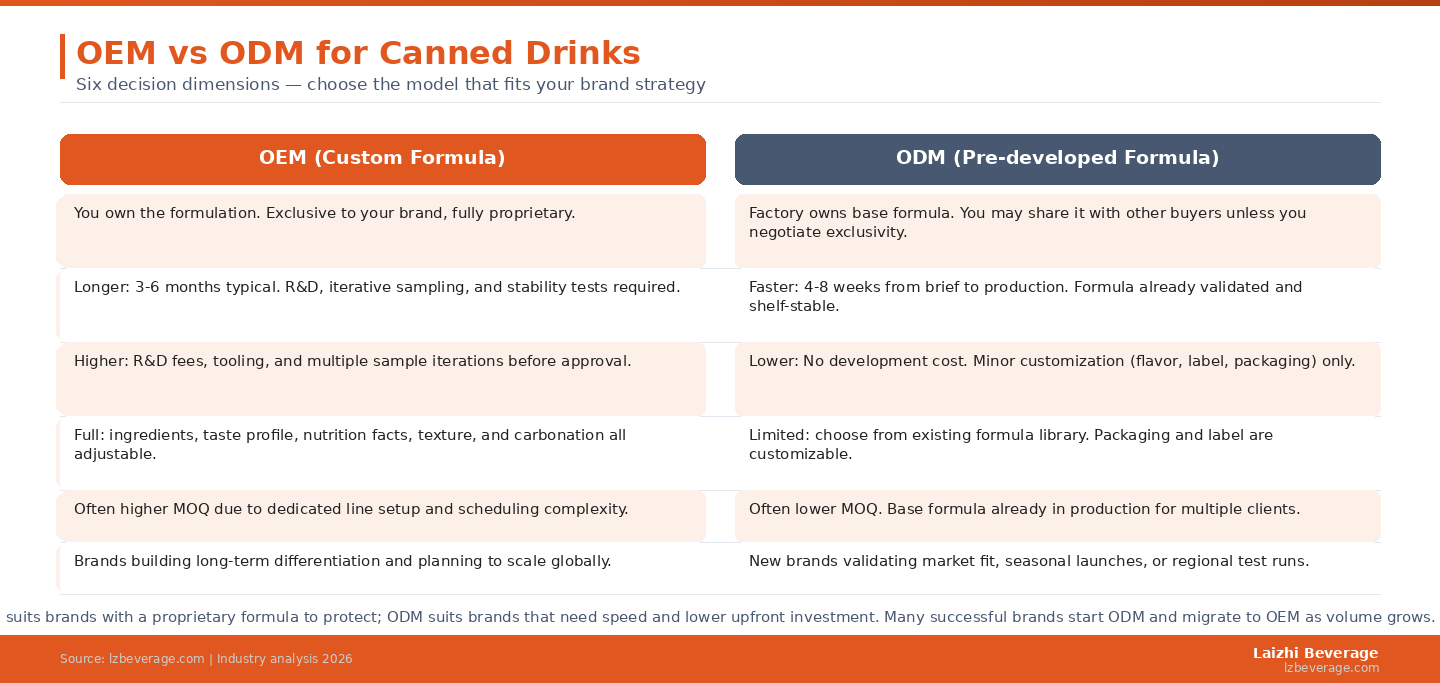
Six Dimensions That Define the OEM vs ODM Decision
1. Formula IP and Exclusivity
This is the decisive dimension. Under OEM, the formulation you develop with the factory is yours. The factory cannot sell that exact product to another buyer. Under ODM, the factory owns the base formula and may supply similar products to multiple clients simultaneously. Exclusivity clauses can be negotiated in ODM contracts — a factory might agree not to sell the same formula in your territory for a defined period — but these clauses are narrower protections than full IP ownership.
If your brand's competitive advantage depends on a unique taste that cannot be replicated easily, OEM is the only model that protects it. If your brand's competitive advantage is price, distribution, or marketing rather than the drink itself, ODM exclusivity may be sufficient.
2. Time to Market
OEM requires R&D cycles, iterative sampling, and stability testing. A realistic OEM timeline from brief to first production run is three to six months. ODM compresses this to four to eight weeks from brief to production because the formula has already been developed and validated. For brands with a seasonal window, a retail listing deadline, or an investor milestone tied to product availability, this time difference can be the deciding factor entirely.
3. Upfront Cost Structure
OEM carries higher upfront costs. R&D fees, sample production costs, stability testing charges, and additional tooling for custom packaging elements all accrue before a single commercial unit is produced. ODM minimizes or eliminates these costs: formula development is already amortized across the factory's client base. For brands operating with constrained capital — which describes most new beverage startups — the ODM cost structure allows production to begin at a stage when OEM development would still be ongoing.
4. Customization Depth
OEM allows full specification: ingredients, taste profile, sugar content, carbonation level, preservative approach, color, mouthfeel, and nutritional claims are all adjustable to the brand owner's requirements. ODM restricts customization to the surface: label design, packaging format, flavor name, and minor adjustments within the factory's existing formula parameters. A brand that wants to launch a zero-sugar, adaptogen-infused sparkling tea with a specific botanical flavor profile has a detailed proprietary brief — that is an OEM project. A brand that wants a competitively priced sparkling citrus drink for a regional retail chain can find what it needs in an ODM library.
5. Minimum Order Quantity
OEM projects typically carry higher MOQs. Dedicated scheduling on a filling line, procurement of custom ingredients, and the setup overhead of a fully custom run all justify the factory's requirement for larger minimum batches. ODM orders can often begin at lower MOQs because the factory is already running that formula for other clients and can batch multiple buyers' orders into a single production run efficiently. For brands entering a market at low volume to test demand, ODM's lower MOQ threshold materially reduces inventory and working capital risk.
6. Long-Term Brand Building
This dimension is often underweighted by new brand owners focused on the immediate launch. OEM creates a proprietary product that becomes harder to copy as your brand scales and your formula becomes a recognized flavor profile. ODM creates a branded product built on a shared foundation — which is entirely fine for many business models but does mean that a competitor with more marketing spend or better distribution can effectively match your product without doing any development work.
| Dimension |
OEM |
ODM |
| Formula IP |
Brand owner |
Factory (exclusivity negotiable) |
| Time to Market |
3–6 months |
4–8 weeks |
| Upfront Cost |
Higher (R&D + sampling) |
Lower (label + packaging only) |
| Customization |
Full (formula, taste, nutrition) |
Limited (label, packaging, minor flavor tweaks) |
| MOQ |
Higher |
Often lower |
| Best For |
Long-term differentiation, global scale |
Rapid launch, market testing, cost efficiency |
The Hybrid Approach: Starting ODM, Migrating to OEM
Why the Sequential Strategy Works
The most commercially sound approach for many new brands is to use ODM to validate market demand and then invest in OEM once the winning SKU has been identified. This approach works because the two biggest risks in a new beverage launch are product-market fit and capital efficiency. ODM addresses both: you learn quickly at low cost whether your target consumer wants your drink. Once you have real sales data confirming which flavor, which format, and which channel generate repeat purchases, you have a much stronger brief for the OEM development process. You are no longer specifying a product you believe will sell — you are refining a product you know sells.
Laizhi Beverage offers both ODM and full OEM custom canned beverage manufacturing, which means a brand can begin with an ODM product from the existing portfolio and transition to a custom OEM formula without switching factories. This continuity — keeping the manufacturing relationship while upgrading the product model — significantly reduces the transition risk that brands face when they graduate from validation to proprietary production.
When to Commit Directly to OEM
If your brand's core value proposition is the formula itself — a genuinely novel functional ingredient combination, a proprietary fermentation process, a flavor profile developed by a renowned food scientist — then starting with ODM wastes time and potentially dilutes the brand story before it can be told authentically. Brands in this position should go directly to OEM, invest in the development cycle, and treat the formula as a protected asset from day one. The same applies to brands that have already validated a formula in another packaging format (bottled, draft, or home-brew) and are now scaling into canned production: they already know the product works, so the ODM validation step is redundant.
How to Evaluate a Factory for Either Model
Certifications as a Quality Signal
Whether you are pursuing OEM or ODM, the factory's certification stack determines which markets your product can enter. HACCP is the baseline for most professional markets. ISO 22000 adds a systems-level food safety management layer. Export licenses specific to the US, EU, Middle East, or Southeast Asian markets indicate the factory has already cleared the regulatory bar in those channels. Laizhi Beverage holds HACCP certification (since 2017) and export qualification (since 2018), with a production capacity of 1 million cans per day across 50 lines — a scale that supports both small-batch ODM launches and high-volume OEM production runs.
Sample Quality as a Process Indicator
A factory's samples are the best evidence of what your commercial production will look like. Request samples of existing ODM products before you share your OEM brief. Evaluate consistency across multiple cans from the same batch. Check carbonation retention after 24 hours at room temperature. Taste for off-flavors that indicate poor ingredient quality or contamination. A factory that cannot produce consistent, high-quality samples for its existing portfolio will not suddenly improve for your custom product.
Frequently Asked Questions
Can I switch from ODM to OEM with the same factory?
Yes, and this is the recommended approach. Starting an ODM relationship with a factory that also offers OEM capability allows you to build trust and learn the factory's production systems before committing to a full custom development project. The transition requires signing a new development agreement and investing in the R&D and sampling cycles, but the factory already understands your quality expectations and market requirements.
Who owns the formula in an ODM arrangement if I negotiate an exclusivity clause?
The factory owns the base formulation, but the exclusivity clause prevents them from selling that formulation — or products substantially identical to it — within the defined scope (your territory, your sales channel, or for a defined period). You do not acquire IP ownership of the formula, but you gain the functional benefit of market exclusivity. Ensure the clause is specific about what constitutes a "substantially identical" product to prevent the factory from making trivial modifications and selling to competitors anyway.
How much more expensive is OEM than ODM?
The upfront premium for OEM typically includes R&D fees (ranging from a few hundred to several thousand dollars depending on formula complexity), multiple sample production runs, stability testing charges, and potentially additional tooling. On a per-unit basis over a full production run, the unit cost difference between OEM and ODM is often smaller than expected — because a well-specified OEM formula can be optimized for efficient production. The real cost of OEM is time and management attention, not only dollars.
What is white label, and how does it differ from ODM?
White label is essentially ODM with no customization at all — you apply your brand to a generic product sold identically to multiple buyers. ODM typically allows at least some packaging customization and potentially minor formula adjustments within the factory's existing parameters. In practice, the terms are often used interchangeably, and what matters is whether you can negotiate any degree of exclusivity and what level of packaging differentiation the factory will support.

