Every canned drink on a retail shelf — energy drinks, sparkling waters, craft beers, RTD coffees — was manufactured somewhere. Most of them were not produced by the brand that sells them. Instead, they were made under an arrangement called OEM: Original Equipment Manufacturing. If you are building a beverage brand in 2026 and want to put your product in a can without owning a factory, understanding canned beverage OEM is the single most important concept to master before you spend a dollar.
Every canned drink on a retail shelf — energy drinks, sparkling waters, craft beers, RTD coffees — was manufactured somewhere. Most of them were not produced by the brand that sells them. Instead, they were made under an arrangement called OEM: Original Equipment Manufacturing. If you are building a beverage brand in 2026 and want to put your product in a can without owning a factory, understanding canned beverage OEM is the single most important concept to master before you spend a dollar.
Key Takeaways
- Canned beverage OEM means a factory produces drinks to your specification, under your brand — you own the IP, they own the equipment.
- The global beverage cans market is valued at USD 35.7 billion in 2025 and growing at a 4.9% CAGR, creating strong demand for flexible OEM capacity.
- A full OEM engagement typically runs 14–18 weeks from brief to export-ready container.
- HACCP certification, COA documentation, and export licenses are the three non-negotiable compliance requirements when sourcing from a Chinese OEM factory.
What OEM Means in the Beverage Industry
The Core Definition
OEM stands for Original Equipment Manufacturer. In the beverage context, however, the term has evolved beyond its industrial origins. When brand owners and procurement managers talk about a "canned beverage OEM," they mean a factory that produces finished, packaged drinks to the brand owner's specifications. The brand owner provides — or approves — the formulation, the packaging design, and the label. The factory provides the equipment, the filling line, the quality systems, and the labor. The resulting product is sold under the brand owner's name, not the factory's.
This distinction matters. The brand is the OEM in the strict technical sense — it is the "original" company specifying the product. The factory is the contract manufacturer. In common industry usage, however, most buyers refer to the factory itself as "the OEM," and you will encounter both conventions. What matters practically is the outcome: you own the recipe and the brand; the factory executes production.
OEM vs. Co-Packing vs. Private Label
These three terms overlap, and the confusion costs new brand owners real money. Co-packing refers to the act of filling and sealing cans, typically with a formula the brand has already developed elsewhere. Private label usually refers to purchasing a manufacturer's existing product and applying your own label, with little or no formula customization. OEM is the broadest arrangement: it can include formula development, ingredient sourcing, filling, sealing, labeling, and export documentation — all executed by the factory against your brief. Think of OEM as the full-service model and co-packing as the narrower production-only version.
For brands entering the canned beverage space from outside the industry, understanding these distinctions through industry resources before signing any manufacturing contract will prevent expensive misalignments in scope and pricing.
Why the Canned Beverage OEM Model Is Dominant in 2026
Market Scale Makes Owned Production Impractical for Most Brands
The global beverage cans market was valued at USD 35.7 billion in 2025 and is projected to reach USD 57.5 billion by 2035, growing at a compound annual rate of 4.9%. Carbonated soft drinks alone hold a 48.2% share of all canned beverage applications. Asia Pacific leads globally with a 41.6% market share worth USD 14.9 billion. These figures reflect enormous industrial capacity concentrated in specialized factories — capacity that would cost a new brand hundreds of millions of dollars to replicate independently.
Building a beverage filling line requires not just capital for equipment but years to achieve certifications like HACCP, ISO 22000, and export licensing. Most brand owners — whether they are launching a DTC energy drink or building a retail chain's private label line — cannot absorb that lead time or capital expenditure. OEM partnerships solve both problems simultaneously.
The Functional Beverage Surge Drives OEM Demand
Beyond raw market size, product innovation is accelerating demand for flexible OEM capacity. PepsiCo's acquisition of prebiotic soda brand Poppi for USD 1.95 billion in 2025 and Keurig Dr Pepper's acquisition of Ghost Beverages for USD 990 million signal that functional, better-for-you beverages have moved from niche to core corporate strategy. For independent brand owners, this creates both an opportunity and a time pressure: launching a functional canned drink requires a manufacturing partner with R&D capability, and that partner must already have stable supply chains for ingredients like prebiotic fiber, adaptogens, and natural caffeine sources.
Experienced OEM factories in China have invested heavily in exactly this capability. Laizhi Beverage (lzbeverage.com), for example, operates 50 production lines with an annual capacity of 200,000 tonnes, covering energy drinks, RTD coffee, tea, fruit juice, and carbonated beverages — all under one roof. Brands looking to launch a custom energy drink can leverage this existing infrastructure rather than building from zero.
How the Canned Beverage OEM Process Works
The Six-Stage Production Sequence
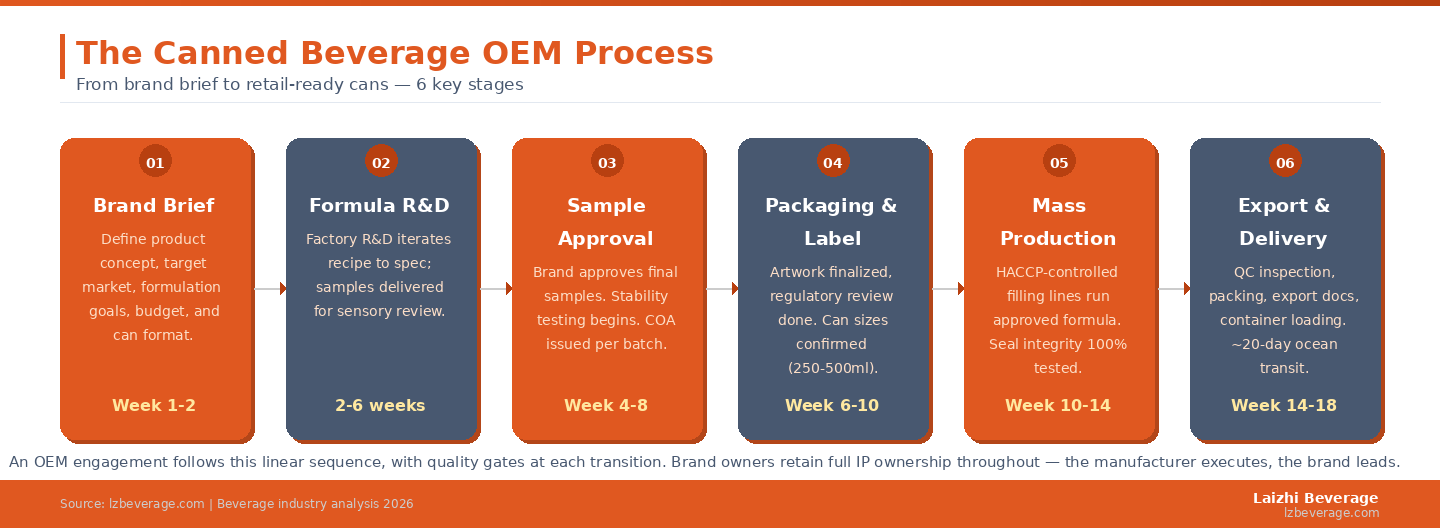
A professional canned beverage OEM engagement runs through six stages. The process begins with your brand brief: a document that defines your target consumer, desired taste profile, category (carbonated energy, sparkling juice, etc.), nutritional goals, preferred can format (250ml, 330ml, or 500ml), and budget range. This brief drives every downstream decision, so the more specific it is, the faster the process moves.
Formula R&D follows. The factory's food scientists take your brief and develop a working recipe. Expect two to four sample iterations across two to six weeks. When samples meet your approval, stability testing begins — this is the factory's verification that your formula will maintain its taste, color, and carbonation throughout the product's intended shelf life. A Certificate of Analysis (COA) documents the results. Packaging and label artwork can run in parallel with stability testing. Regulatory review — verifying that your label copy meets the requirements of your target market, whether the US, EU, Middle East, or Southeast Asia — should happen at this stage, not after printing. Mass production and export follow once all approvals are in place.
What You Own and What the Factory Owns
Intellectual property allocation is the most frequently misunderstood aspect of OEM agreements. Under a properly structured OEM contract, you own the formulation you briefed or co-developed. The factory owns the manufacturing processes, equipment, and trade secrets that make production possible. Your recipe should be protected by a Non-Disclosure Agreement signed before any detailed formula discussions begin. If a factory is reluctant to sign an NDA, treat that as a disqualifying red flag.
| What the Brand Owner Owns |
What the Factory Provides |
| Product formulation and recipe |
Filling equipment and production lines |
| Brand name, logo, and trademarks |
HACCP certification and quality systems |
| Packaging design and artwork |
Raw material sourcing and supply chain |
| Target market and distribution strategy |
Export licensing and documentation |
| Pricing and channel relationships |
Trained workforce and line management |
Certifications That Define a Credible OEM Partner
HACCP: The Non-Negotiable Baseline
Hazard Analysis and Critical Control Points (HACCP) is the internationally recognized food safety management framework for identifying and controlling biological, chemical, and physical hazards in food production. Any OEM factory you work with must hold a current HACCP certificate. It is not a marketing credential — it is proof that the factory has systematically mapped every point in its process where contamination could occur and has installed verified controls at each of those points. For brand owners exporting to the US, EU, or Australia, your import broker will ask for this document before the shipment clears customs.
Beyond HACCP, look for ISO 22000 (food safety management systems), GMP (Good Manufacturing Practice), and — if your target markets include Muslim-majority countries — HALAL certification. Factories with export licenses specifically issued for target markets are even more valuable: they have already gone through the regulatory scrutiny your products will face at the border. Review Laizhi Beverage's certifications and factory capabilities to understand what a fully credentialed OEM partner looks like in practice.
Common Mistakes Brand Owners Make with OEM
Underestimating Lead Time
The single most common planning error is treating 18 weeks as a pessimistic estimate rather than a realistic one. Stability testing alone takes four to eight weeks and cannot be rushed — accelerating it risks shipping a product whose carbonation or flavor degrades before the consumer buys it. Brands that commit to retail window dates before completing sample approval frequently miss their launch windows entirely. Build your production calendar backward from your target launch date, not forward from today.
Skipping Formula IP Protection
Sending a proprietary formulation to a factory before signing an NDA is the equivalent of publishing it. Even in established OEM markets, recipe leakage does occur. The fix is simple: require a signed NDA before sharing any formula details. Reputable factories accept this as standard practice; the ones that push back are telling you something important.
Evaluating Only on Price
Unit cost is one dimension of OEM value, not the whole picture. A factory that quotes 15% lower than competitors but lacks HACCP certification, cannot provide COA documentation, or has a six-month backlog on its filling lines will cost you far more than the savings in compliance failures, shipment rejections, or delayed launches. Evaluate OEM partners on certifications, capacity, sample quality, communication responsiveness, and audit history — then negotiate price within that qualified set.
Browse Laizhi Beverage's full product range to see the breadth of canned beverage categories that a full-service OEM factory can cover for your brand.
Frequently Asked Questions
What is the difference between OEM and ODM for canned beverages?
OEM means the brand owner specifies or owns the formulation and the factory manufactures it. ODM means the factory already has pre-developed formulas that the brand owner selects, customizes lightly, and labels. OEM offers stronger IP protection and deeper product differentiation. ODM offers faster time to market and lower upfront cost. Many brands use ODM to launch and migrate to OEM once they have validated demand.
How long does a canned beverage OEM order take?
From initial brief to container delivery, a standard OEM order runs 14 to 18 weeks. The main variables are sample iteration speed (dependent on how quickly the brand provides feedback) and stability testing duration (four to eight weeks, non-negotiable). Brands that have already completed formula development and have approved artwork can compress this to 10 to 12 weeks for re-orders.
What is the minimum order quantity (MOQ) for canned beverage OEM?
MOQ varies by factory and product type. For canned carbonated beverages, typical MOQs run from 5,000 to 20,000 cases per SKU for an initial production run. Factories with multiple clients and shared filling lines can sometimes accommodate lower MOQs for ODM products. For OEM custom formulas, MOQs tend to be higher because dedicated line scheduling and raw material procurement are involved.
Do I need to visit the factory before placing an OEM order?
A factory visit or third-party audit is strongly recommended before your first production order. It lets you verify certifications are current, observe hygiene standards firsthand, and assess production capacity. If a factory declines audit requests, that is a disqualifying signal. Remote video audits have become an accepted alternative for brands that cannot travel, provided a qualified inspector conducts the review.
What documents should I receive from a canned beverage OEM factory?
At minimum, request: Certificate of Analysis (COA) for each production batch, HACCP certificate, export license for your destination market, ingredient declaration and allergen statement, nutritional facts panel, and a sample of the shipping marks and packing list format. For regulated markets like the US, an FDA facility registration number is also required.

