Minimum order quantity is the first question every beverage brand asks — and one of the most misunderstood. The answer is not a single number. It depends on your production model (white label, private label, or fully custom OEM), your factory's canning line configuration, and whether your manufacturer integrates can production with beverage filling.
Minimum order quantity is the first question every beverage brand asks — and one of the most misunderstood. The answer is not a single number. It depends on your production model (white label, private label, or fully custom OEM), your factory's canning line configuration, and whether your manufacturer integrates can production with beverage filling. Grand View Research reports that canned formats account for 88.5% of global energy drink revenue in 2025, making the can format non-negotiable for most market entries — which means understanding the MOQ landscape for aluminum cans is a prerequisite for any OEM buyer placing their first order.
Key Takeaways
- MOQ for canned energy drinks ranges from 5,000 units (white label) to 500,000+ cans (full custom OEM) — a 50-fold spread that directly determines your launch cost structure.
- The type of production — white label, private label, or custom OEM — is the single biggest MOQ driver, ahead of factory size or geography.
- Multi-SKU consolidation can reduce per-flavor MOQ by approximately 40%, making it the most practical tool for brands launching multiple flavors simultaneously.
- An 8–12 week lead time from formula sign-off to first production is standard for custom OEM canned energy drinks — plan accordingly for market launches.
- Pilot batches (10,000–30,000 cans) are available at most HACCP-certified factories at a 20–30% cost premium, useful for market validation before a full container order.
Why MOQ Matters More for Cans Than Any Other Format
The Economics Behind Canning Line Setup Costs
Aluminum canning is capital-intensive. A single filling and seaming line involves precision engineering — the fill weight, carbonation pressure, seaming torque, and pasteurization parameters must all be locked and tested before a production run begins. Setup costs for a new SKU typically include line changeover, formula preparation, and quality control sampling across the first several hundred units — none of which produces sellable product. These fixed costs are amortized across the entire production run, which is why per-can unit economics improve dramatically as volume increases. According to Market Data Forecast, aluminum cans already offer a 20% transport efficiency advantage over PET and 40% over glass — but extracting this cost advantage on the production side requires minimum volumes that justify the line setup investment.
This dynamic explains why most canning facilities set higher MOQs than bottle-filling operations. It is not a commercial barrier — it is a reflection of how canning line economics work. For OEM buyers, this means the question to ask is not "can you lower the MOQ?" but "how can I structure my order to make the economics work at your minimum?" Exploring canned energy drink OEM configurations before your first factory inquiry will save significant time in negotiations.
How MOQ Differs by Production Type
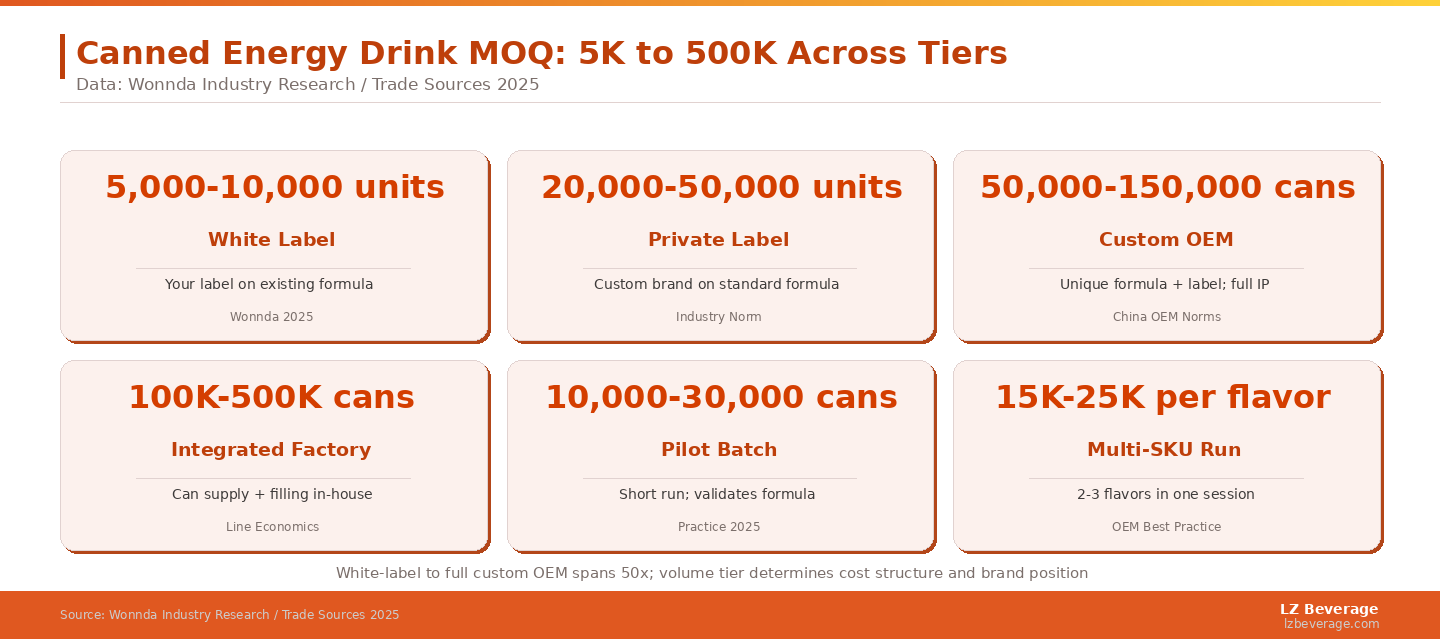
The industry distinguishes three core production models for private label energy drinks. White label refers to a finished, off-the-shelf formula where the buyer simply applies their own label — the formula, can design, and packaging spec are already fixed. Private label adds brand identity customization: the buyer specifies label design, color scheme, and sometimes can size, but the underlying formula remains the manufacturer's standard product. Custom OEM (or ODM when the factory develops the formula) gives the buyer full ownership of the recipe, packaging specifications, and intellectual property — but requires the highest minimum volume to justify R&D and stability testing investment. According to industry benchmark data compiled by Wonnda, white label typically starts at 5,000–10,000 units, private label at 20,000–50,000, and custom OEM for aluminum cans can require 50,000 to 250,000 cans per SKU.
Breaking Down the 4 MOQ Tiers for Canned Energy Drinks
Tier 1 — White Label: The Fastest Entry Point
White label offers the lowest MOQ and the shortest lead time. A buyer selects from an existing formula catalog, approves label artwork, and receives production-ready cans within two to four weeks. The tradeoff is product differentiation: many white label buyers are selling an identical formula to other brands in different markets. For buyers entering a new territory to test consumer response before committing to a proprietary formulation, white label is the rational starting point. MOQ of 5,000–10,000 cans is achievable at most factories with existing can stock on hand.
Tier 2 — Private Label: Your Brand, Their Formula
Private label allows a buyer to own the brand identity without developing a new formula. The manufacturer's existing recipe is used, but the label, can design, and potentially the flavor variant selection are customized. MOQ typically rises to 20,000–50,000 units because the can lithography or shrink-sleeve printing run has its own minimum. For buyers launching a regional brand with a defined consumer proposition, private label represents the most cost-effective way to enter the market with differentiated packaging while maintaining manageable upfront capital requirements.
Tier 3 — Custom OEM: Full Formula and Packaging Ownership
Custom OEM is the correct model when a buyer wants to own the formulation — whether to support specific functional claims ("contains 100mg of green tea caffeine"), meet import market regulations that restrict synthetic ingredients, or differentiate on taste versus competing private label brands. The MOQ rises to 50,000–150,000 cans per SKU because the factory must invest in formula development, stability testing (typically 3–6 months at accelerated conditions), and regulatory documentation before the first production run. The lead time from formula sign-off to first deliverable production is 8–12 weeks. Factories with in-house R&D teams and HACCP certification can significantly compress this timeline by running formulation and stability work in parallel.
Tier 4 — Integrated Factory (Cans + Filling): Maximum Cost Efficiency
The highest-volume tier applies to buyers sourcing from factories that integrate aluminum can manufacturing with beverage filling — eliminating the third-party can supply chain and associated logistics costs. At 100,000–500,000 cans per run, per-unit economics improve substantially: industry models suggest that scaling from 100,000 to 500,000 units can reduce per-unit production cost by 60% or more, with production costs for standard energy drink cans ranging from approximately USD 0.30–0.70 per can at commercial scale depending on formula complexity, as fixed costs are spread across a larger volume base. This tier is most relevant for brands launching across multiple markets simultaneously or consolidating production for a seasonal campaign. Understanding what to look for in a production partner with integrated can supply is an important step before requesting quotes at this volume tier.
How to Negotiate a Lower MOQ Without Sacrificing Quality
Consolidate SKUs Into a Single Production Run
The most effective MOQ reduction strategy for multi-flavor launches is SKU consolidation. The natural and organic energy drink segment is growing at 7.07% CAGR, meaning first-movers who lock in production capacity today gain shelf space and distribution advantages ahead of peak demand. Instead of placing separate orders for each flavor — each of which must independently meet the per-SKU minimum — a buyer commits to a combined volume across flavors and runs them back-to-back on the same production line. If the factory's per-SKU MOQ is 50,000 cans and a buyer wants three flavors, the total order of 150,000 cans across three SKUs often qualifies for the same unit economics as a 150,000-can single-SKU order. The practical per-flavor MOQ in this scenario drops to approximately 30,000–50,000 cans rather than 50,000 per flavor in isolation. Confirm with the factory whether their quoted MOQ is per-SKU or per-order, as this distinction affects total capital commitment significantly.
Commit to a Repeat Purchase Agreement
Factories set MOQs partly to ensure their production planning is predictable. A buyer who commits to a repeat purchase schedule — for example, two orders per year over 24 months — reduces the factory's risk of a one-time customer who never reorders. In exchange, factories will often lower the first-run MOQ or offer the first run at white label terms while the buyer builds volume for a subsequent custom OEM run. According to global energy drink market analysis, Asia-Pacific is growing at approximately 13% CAGR annually — buyers establishing volume commitments in 2025–2026 are entering ahead of the steepest demand curve, which gives them meaningful leverage in MOQ negotiations.
What to Ask a Factory Before Signing an OEM Agreement
Before committing to a production partner for canned energy drinks, these five questions will reveal whether their MOQ structure is genuinely flexible or simply negotiating posture. First: is the MOQ per-SKU or per-order? Second: is can supply integrated into the factory or sourced from a third party (which adds logistics costs and supply risk)? Third: what is the minimum pilot batch size, and can pilot batches use the same formula as the planned full production run? Fourth: does the quoted MOQ include or exclude label/artwork setup costs? Fifth: what certifications cover the full production scope — HACCP, export registration, and if applicable, organic or halal certification for target markets? A factory that can answer all five questions clearly and in writing is demonstrating the operational transparency that protects a buyer's first production investment. Request information about energy drink OEM capabilities and certification documentation before proceeding to formulation discussion.
Frequently Asked Questions
What is the minimum order quantity for canned energy drinks from a Chinese OEM factory?
For a fully custom OEM canned energy drink from a Chinese manufacturer with integrated aluminum can supply, expect a per-SKU MOQ of 100,000–500,000 cans for a first-production run. Factories with flexible production lines may accommodate pilot batches of 10,000–30,000 cans at a cost premium of 20–30%. White label (existing formula) typically starts at 5,000–10,000 cans. Always confirm whether the quoted MOQ is per-SKU or per-order before building your financial model.
Why do aluminum cans require higher MOQ than bottles or pouches?
Canning lines require a setup investment — line changeover, carbonation parameter setting, seaming calibration, and quality control sampling — that is spread across the entire production run. The fixed cost per unit is significantly higher at low volumes, making canning economically inefficient below certain minimums. Additionally, printed aluminum cans (with lithographed branding) or shrink-sleeve printing typically have their own minimum runs of 50,000–100,000 units, which compounds the MOQ requirement. Bottles and pouches often use pressure-sensitive or wrap-around labels with much lower print minimums, enabling lower overall MOQ.
Can I launch two flavors of canned energy drink with a lower combined MOQ?
Yes. Multi-SKU consolidation — running two or three flavors back-to-back in the same production session — is the standard approach for managing MOQ across a product portfolio. Depending on the factory's scheduling flexibility, per-flavor MOQ in a consolidated run can be 30–40% lower than a standalone single-flavor order. Discuss this with the factory before finalizing your first order specification; not all facilities can accommodate same-session multi-SKU runs without additional setup fees.
What is the typical lead time from sample approval to first production for custom OEM canned energy drinks?
For a custom OEM energy drink in aluminum cans, plan for 8–12 weeks from formula and artwork sign-off to the first production batch being ready for inspection. This timeline includes formula stability testing (accelerated), can printing or sleeve production, and production scheduling. Reorders of approved formulas typically run 2–4 weeks once raw materials are confirmed available. Building this timeline into your market launch calendar — and adding a two-week buffer for shipping to export markets — is standard project planning practice for first-time OEM buyers.

