The global energy drink market was valued at USD 85.25 billion in 2025 and is on track to exceed USD 125 billion by 2030 at a CAGR of 8.0%, according to Grand View Research. Despite that scale, the market is far from closed to new entrants. Private-label energy drink brands have captured approximately 17% of B2B channel sales globally, carving out profitable positions through targeted niche positioning, differentiated formulation, and cost-competitive OEM sourcing.
The global energy drink market was valued at USD 85.25 billion in 2025 and is on track to exceed USD 125 billion by 2030 at a CAGR of 8.0%, according to Grand View Research. Despite that scale, the market is far from closed to new entrants. Private-label energy drink brands have captured approximately 17% of B2B channel sales globally, carving out profitable positions through targeted niche positioning, differentiated formulation, and cost-competitive OEM sourcing. For a brand owner, distributor, or importer who wants to launch a canned energy drink under their own label, understanding how the OEM production model works — and how to use it effectively — is the most commercially important first step. This guide explains what canned energy drink OEM means, how it differs from ODM, what the end-to-end launch process looks like, how much it costs, and what separates successful brand launches from expensive failures.
Key Takeaways
- OEM means the manufacturer produces to your specification — you own the brand and define the formula; they execute. ODM means you select from existing formulas and add your branding.
- The global energy drink market is growing at 8% CAGR, with Asia Pacific the fastest-growing region at 9.7% — giving OEM buyers in emerging markets a structural tailwind.
- A canned energy drink OEM launch requires six sequential steps: market positioning, formula decision, regulatory mapping, manufacturer selection, sample and validation, and commercial launch.
- HACCP certification is the minimum quality floor when selecting an OEM manufacturer — export credential verification is a non-negotiable additional requirement for international distribution.
- The typical per-can production cost at commercial scale is USD 0.20 to 0.50, with functional ingredients, carbonation, and can specification as the primary cost drivers.
- Brands that skip regulatory mapping before formulation are the majority of those who face relaunches — compliance must precede production, not follow it.
OEM vs. ODM: Understanding the Models Before You Choose
What OEM Energy Drink Production Actually Means
In the beverage industry, OEM (Original Equipment Manufacturer) refers to a production model where the manufacturing facility produces a product according to the buyer's specification. In a true OEM energy drink engagement: you define the formula (either through your own R&D or through collaboration with the manufacturer's team), you own the brand, you specify the packaging format, and the manufacturer operates as an execution partner. The formula IP belongs to you, assuming your contract is correctly structured. ODM (Original Design Manufacturer) means the manufacturer has pre-developed formulas and packaging concepts from which you select — you add your brand to their existing product. ODM is faster and lower-cost at entry; OEM is more differentiated and more defensible. The distinction matters commercially because ODM products can be made identically by multiple brands (lowering your price floor in retail competition), while OEM products can carry unique formulation claims that are genuinely exclusive to your brand. According to Fortune Business Insights, private label energy drink brands now capture approximately 17% of B2B sales — a share driven largely by brands who have used OEM manufacturing to build genuine product differentiation.
The Hybrid Approach: Catalog Base + Custom Flavor
A practical middle ground that most first-time energy drink brand owners choose is the hybrid model: a manufacturer's proven functional base formula (caffeine, taurine, B vitamins, acid system, carbonation) combined with a custom flavor system and your branding. This approach reduces development time by 4 to 6 weeks compared to full custom OEM, while still giving you a flavor-driven differentiation point that ODM competitors do not share. The flavor IP (the specific fruit or botanical combination) becomes your differentiator, even if the functional core of the formula is shared infrastructure. This is a legitimate strategic position for brands whose market differentiation comes from flavor, packaging, and positioning rather than from novel functional ingredient claims.
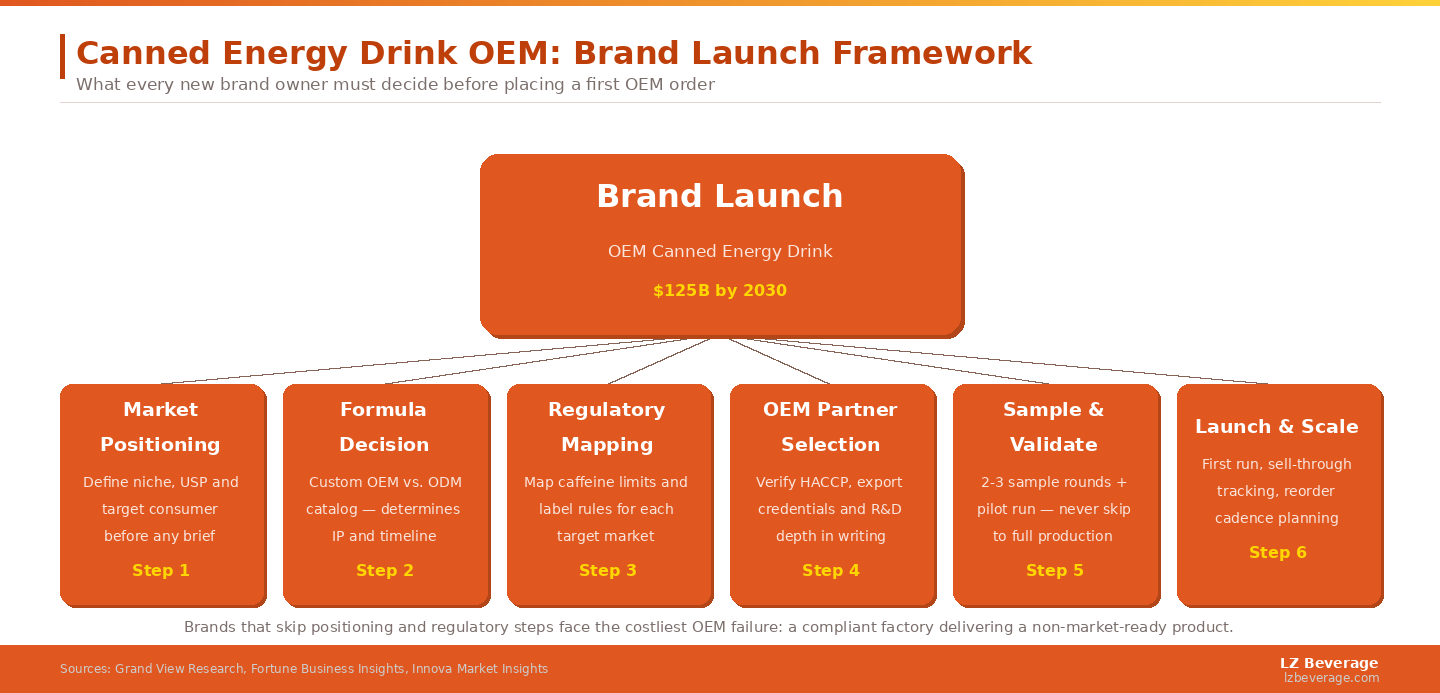
The Six-Step OEM Energy Drink Launch Process
Step 1: Market Positioning — Who Drinks Your Brand and Why
Before writing a formulation brief or contacting a manufacturer, the most commercially important work is defining your market position. The energy drink category is highly segmented: mainstream high-caffeine (Red Bull/Monster comparable), natural/clean-label (guarana-sourced caffeine, stevia-sweetened), pre-workout performance, gaming and cognitive focus, relaxation/calm energy (adaptogens + reduced caffeine), and zero-sugar functional (prebiotic + caffeine). According to Innova Market Insights, 72% of consumers globally limit sugar intake — which means a zero-sugar or natural-sweetener positioning is no longer a niche choice but a prerequisite for broad retail acceptance. Defining your segment determines your ingredient specification, your regulatory framework, your price point, and your packaging brief. Attempting to write a brief without this positioning step results in a generic formula that fits no retail slot particularly well.
Step 2: Formula Decision — Custom, Catalog, or Hybrid
Once your market position is defined, you need to decide how much formulation investment you want to make. The three options — full custom OEM formulation, ODM catalog selection, or hybrid base + custom flavor — represent a trade-off between development time, cost, and differentiation. Full custom OEM development from a qualified R&D team takes 8 to 14 weeks and requires investment in a development fee (typically separate from production cost). ODM selection can be completed in 2 to 4 weeks with no development fee, but delivers a formula that is not exclusive to your brand. The hybrid approach sits at 4 to 8 weeks. For buyers targeting premium or health-focused distribution channels, the investment in a custom or hybrid formulation is commercially justified — these channels require ingredient transparency and differentiation that only custom OEM enables. For buyers targeting price-led convenience store channels where energy drink category awareness is low, ODM can be a rational entry strategy for a first product.
Step 3: Regulatory Mapping — Before Production, Not After
Regulatory compliance must be determined before formulation is finalized, not after samples are approved. The key regulatory parameters for a canned energy drink vary significantly by target market. According to Wikipedia's regulatory overview of energy drinks, the EFSA caps caffeine at 320mg per liter in the EU (80mg per 250ml standard can); Australia and New Zealand apply the same limit; Canada restricts to 180mg per serving; India's FSSAI sets 200mg per liter. Beyond caffeine, ingredient permission lists for taurine, glucuronolactone, herbal extracts (guarana, ginseng, yerba mate), and specific B vitamin forms vary by market. Mandatory warning label requirements also differ — the EU requires "High caffeine content — not recommended for children, pregnant women, caffeine-sensitive persons" on any product exceeding 150mg/L. A brand owner who finalizes formulation for the EU at 350mg/L caffeine (because they tested in a non-regulated market first) must reformulate before EU launch — a costly and time-consuming error that regulatory mapping prevents. Laizhi Beverage's export credentials, established in 2018, include the documentation infrastructure for multi-market compliance review.
Step 4: Selecting the Right OEM Manufacturer
The manufacturer evaluation process is the step that most first-time brand owners underinvest in. The criteria that separate adequate from excellent OEM partners for canned energy drinks are: HACCP certification (the minimum quality floor for any food-contact production environment); export qualification credentials specific to your target markets; R&D team depth sufficient to conduct in-house stability testing rather than requiring third-party labs; can seaming and carbonation filling equipment calibrated for energy drink carbonation levels (typically 3.0–4.0 volumes of CO2); and lot-level Certificate of Analysis documentation for functional ingredients. The practical evaluation process involves requesting answers to these questions in writing, reviewing production capability documentation, and requesting references from existing export accounts in similar markets to yours. Laizhi Beverage's custom energy drink OEM service operates across 50 production lines at 1 million cans per day capacity with HACCP certification since 2017 and verified export credentials.
What Does It Actually Cost to Launch a Private-Label Canned Energy Drink?
Cost Components at Each Stage
| Cost Component |
Typical Range |
Notes |
| Formulation Development |
$0 (ODM) — $5,000–$20,000 (custom) |
Custom fee often credited back against production volume |
| Packaging Design |
$2,000–$10,000 |
Label artwork; manufacturer supplies template in most cases |
| First Production Run (MOQ) |
$10,000–$100,000+ |
Depends on MOQ and per-can cost; $0.20–$0.50/can typical |
| Regulatory Review / Legal |
$3,000–$10,000 |
Label compliance review; import permits in target market |
| Logistics (First Order) |
$1,500–$5,000+ |
Sea freight for canned goods; varies by destination and volume |
| Marketing (Launch Phase) |
$5,000–$50,000+ |
Highly variable; social, sampling, trade distribution |
Total first-launch investment for a well-prepared entry into a single market (not including ongoing marketing budget) typically falls in the range of USD 30,000 to 150,000, depending on whether custom or ODM formulation is chosen, the MOQ size, and the target market's regulatory complexity. The Beverage Industry data showing that 58% of consumers will pay a premium for health-positioned functional beverages supports the business case for the additional investment in custom formulation over ODM — the premium positioning enables the margin structure that justifies it.
The OEM Quality Checklist: What to Demand From Your Manufacturer
Five Non-Negotiable Documentation Items Before Signing Any OEM Contract
Before placing a first order with any canned energy drink OEM manufacturer, obtain the following in writing: a copy of the facility's current HACCP certification (verify the issuing body and expiry date); a list of countries to which the facility has previously exported and confirmation that export documentation for your target market is available; a sample Certificate of Analysis from a recent production batch of a similar energy drink, showing caffeine concentration, microbial results, pH, and Brix; a written statement on formula IP ownership that specifies whether you will receive full formula documentation (ingredient names and concentrations) and whether you are free to take that formula to another manufacturer; and a production capacity statement confirming the facility can fulfill your projected annual volume at your MOQ step-up points without a lead time increase greater than 30 days. Explore the full LZ Beverage resource hub for more guidance on OEM contract documentation standards for beverage manufacturing.
Frequently Asked Questions
How is OEM different from white-label energy drinks?
White-label and ODM are often used interchangeably — both refer to a pre-made product that the buyer brands. OEM technically means the manufacturer produces to the buyer's specification. In practice, many manufacturers offer a spectrum: pure white-label (existing product, your label only), ODM (select from catalog formulas, add branding), and OEM (custom formula, full production). The most important practical question is whether you will receive a formula specification document that you own — if you cannot get that, you are in an ODM or white-label arrangement regardless of what the manufacturer calls it.
What is the realistic minimum order quantity (MOQ) for a first canned energy drink OEM run?
MOQ for canned carbonated energy drinks at a full-scale OEM manufacturer typically starts at 20,000 to 50,000 cans for a first production run. Some facilities offer lower MOQs of 5,000 to 10,000 cans at a higher per-unit cost for market-testing purposes. The economics shift significantly at volume — the per-can ingredient and production cost at 20,000 units is typically 30 to 50% higher than at 100,000 units, because setup costs are amortized over fewer units. For an initial market test, the higher per-unit cost at low MOQ is worth accepting rather than over-ordering a formula that the market may require adjustment after launch. Ask your OEM partner to provide a cost comparison at two or three MOQ tiers before committing.
How long does it take from first contact with an OEM manufacturer to having product in my warehouse?
For a custom or hybrid OEM energy drink engagement at a competent manufacturer: 4 to 8 weeks for formulation and sample rounds, 1 to 2 weeks for label artwork finalization and regulatory pre-review, 2 to 4 weeks for pilot and commercial production scheduling, and 2 to 5 weeks for sea freight depending on destination. Total timeline: 9 to 19 weeks from first contact to warehouse receipt, assuming no sample rejection requiring reformulation and no regulatory complications in the target market. ODM selection compresses the formulation phase to 1 to 2 weeks, bringing the total timeline to roughly 6 to 12 weeks. Building a 3-week buffer into any launch timeline for unexpected delays (seaming adjustment, ingredient supply lead time, customs clearance variance) is standard industry practice for experienced importers.

