The global energy drink market is one of the most commercially attractive segments in the beverage industry — and one of the most technically demanding for OEM buyers to navigate. According to Grand View Research, the global energy drinks market was valued at USD 85.25 billion in 2025 and is projected to reach USD 125.11 billion by 2030 at a CAGR of 8.0%.
The global energy drink market is one of the most commercially attractive segments in the beverage industry — and one of the most technically demanding for OEM buyers to navigate. According to Grand View Research, the global energy drinks market was valued at USD 85.25 billion in 2025 and is projected to reach USD 125.11 billion by 2030 at a CAGR of 8.0%. Asia Pacific is the fastest-growing regional market at a projected CAGR of 9.7%, making it directly relevant for export-oriented OEM buyers sourcing from China-based manufacturers. But behind that commercial growth lies formulation complexity that differentiates successful private-label launches from the ones that stall at regulatory review or fail on shelf: the right ingredient stack, the right function claim architecture, and the right OEM partnership to translate both into a compliant, scalable, market-ready product.
Key Takeaways
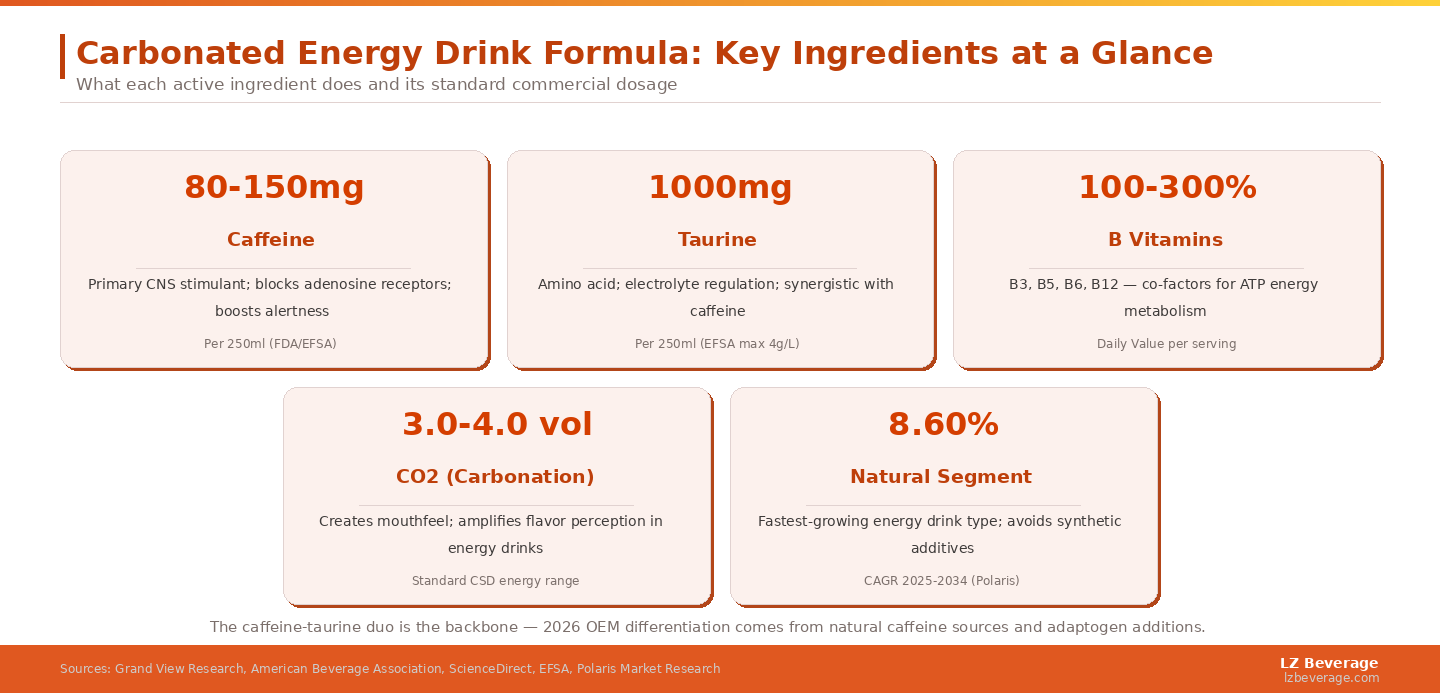
- Caffeine is the core active ingredient — standard commercial dosage is 80 to 150mg per 250ml can, with the exact level calibrated to function claim and target regulatory market.
- Taurine and B vitamins are the functional partners to caffeine — taurine at 1000mg per 250ml and B vitamins at 100–300% of daily value are the industry-standard supporting stack.
- Regulatory caffeine limits vary by market — EFSA caps energy drinks at 320mg/L in the EU; Australia/New Zealand apply the same limit; India FSSAI caps at 200mg/L; understanding your target market's limit must precede formulation design.
- The carbonation level in an energy drink is a formulation engineering decision, not just a sensory preference — it affects how caffeine and flavor compounds release on the palate.
- Function claims must be supported by the actual ingredient concentrations in your formula — "boosts energy" is valid when caffeine is present at efficacious dosage; "enhances focus" is increasingly scrutinized by regulators in Europe and requires clinical-grade ingredient levels.
- Natural and clean-label positioning is the growth vector — the natural energy drink segment is growing at 8.60% CAGR globally, outpacing the conventional segment.
The Core Ingredient Stack: What Every Carbonated Energy Drink Contains
Caffeine: The Primary Functional Driver
Caffeine is the central nervous system stimulant that defines the energy drink category. It works by blocking adenosine receptors in the brain — adenosine is the neurotransmitter responsible for promoting sleep and relaxation, so its inhibition generates heightened alertness, faster reaction time, and reduced perception of fatigue. According to the American Beverage Association, a typical 16oz energy drink contains approximately 160mg of caffeine — comparable to a cup of home-brewed coffee and roughly half the caffeine of the same volume from a coffeehouse coffee. Whether the caffeine is synthetic or naturally derived (from guarana, green tea, or yerba mate), it is chemically identical and produces identical effects. For OEM buyers, the choice between synthetic and natural caffeine is primarily a labeling and positioning decision: natural caffeine from guarana or green tea extract commands a cleaner-label narrative and supports premium pricing, at a higher ingredient cost and with more complex supply chain management. The standard dosage range is 80 to 150mg per 250ml can for mainstream markets, with some performance-targeted formulas reaching 200mg per can in markets where this is permitted.
Taurine: The Functional Partner
Taurine is a sulfur-containing amino acid found abundantly in human muscle, brain, and cardiovascular tissue. Despite persistent consumer mythology, taurine in commercial energy drinks is synthetically produced (not derived from animal sources) and is considered safe for human consumption by regulatory agencies globally. In energy drink formulation, taurine is typically included at 1000mg per 250ml can — a concentration based on the Red Bull formula that has become an industry standard reference point. According to ScienceDirect's comprehensive energy drink overview, the synergistic interaction between caffeine and taurine has been associated with performance benefits beyond what caffeine alone delivers. Research cited in peer-reviewed literature suggests that the combination produces effects — particularly on secondary memory and attentional speed — that are not fully explained by caffeine's independent action. The EU market's maximum permitted level for taurine in energy drinks is 4000mg per liter (1000mg per 250ml can), which aligns with the standard formulation.
B Vitamins: The Metabolic Support Layer
B vitamins — most commonly niacin (B3), pantothenic acid (B5), pyridoxine (B6), and cyanocobalamin (B12) — are included in energy drink formulas because of their role in cellular energy metabolism: specifically, they are co-factors in the conversion of macronutrients into adenosine triphosphate (ATP), the cellular energy currency. Including B vitamins at 100 to 300% of the daily reference value on the label supports the energy claim narrative and is permitted without additional clinical substantiation in most markets. For OEM buyers, B vitamin selection must account for stability in acidic carbonated environments — some B vitamin forms are pH-sensitive and may degrade over the product's shelf life if not properly stabilized. Requesting stability data for the specific B vitamin forms and concentrations used in your manufacturer's formulation — tested at the target pH of 3.0 to 3.5 — is a standard quality question that any competent OEM R&D team should be able to answer.
Regulatory Limits: The Framework That Determines What You Can Formulate
Caffeine Limits by Target Market
| Market |
Caffeine Limit |
Key Labeling Requirement |
| European Union |
320mg/L (80mg per 250ml) |
"High caffeine content — not recommended for children, pregnant women, caffeine-sensitive persons" |
| Australia / New Zealand |
320mg/L |
Max 2 cans per day advisory; mandatory caffeine disclosure |
| United States |
No federal limit for beverages (FDA monitors) |
Caffeine must be listed; amount not required but recommended |
| India (FSSAI) |
200mg/L (50mg per 250ml) |
"Not recommended for children, pregnant women, caffeine-sensitive persons"; max 500ml/day advisory |
| Canada |
Max 180mg per serving |
Health Canada advisory for pregnant women and children |
According to Wikipedia's comprehensive energy drink regulatory overview, many countries are strengthening restrictions: England is planning to ban under-16s from buying energy drinks, and Poland, Spain, and Argentina have all introduced category-specific taxes or sales restrictions. For OEM buyers developing a formula for multi-market distribution, the most conservative regulatory framework (typically EU at 320mg/L caffeine) should govern the master formula, with market-specific variants created where permitted limits are higher.
Function Claims: What You Can Say and What Requires Evidence
Claim Hierarchy for Carbonated Energy Drinks
Function claims on energy drink labels exist on a regulatory spectrum from broadly permitted to heavily regulated. In the EU, the European Food Safety Authority (EFSA) has approved specific health claims for caffeine that OEM buyers can use on compliant formulations: caffeine contributes to an increase in endurance performance; caffeine contributes to the reduction of the rated perceived exertion/effort during exercise; caffeine helps increase alertness and improve concentration. Each of these claims requires the product to contain a minimum threshold of caffeine (specified in the EFSA authorization) and the serving size to deliver the relevant dose. Claims that go beyond these pre-approved statements — "improves memory," "boosts cognitive performance," "enhances mental endurance" — require clinical substantiation that most private-label brands cannot provide. The practical framework for OEM buyers: use ingredient concentrations that enable EFSA-authorized claims, keep claims conservative and compliance-anchored, and avoid any implied disease prevention or treatment claims (which are prohibited in all markets regardless of ingredient concentrations).
The OEM Production Process for Carbonated Energy Drinks
What Makes Energy Drink Manufacturing Technically Distinct
Energy drink OEM production differs from standard carbonated soft drink production in three key ways. First, the functional ingredient dissolution step is more sensitive — caffeine, taurine, and B vitamins must be fully dissolved at specific temperature and mixing parameters to ensure homogeneous distribution across the production batch. Hot processing used to dissolve functional ingredients must be followed by careful cooling before carbonation to prevent CO2 loss. Second, the pH management is more critical — the acidic environment required for microbial stability interacts with certain B vitamin forms and caffeine's slightly bitter taste, requiring careful acid system selection and buffering. Third, the ingredient declaration and batch documentation requirements are more extensive because functional ingredients require Certificate of Analysis documentation for each lot to support label claims. Laizhi Beverage's HACCP-certified production infrastructure includes the lot-level documentation and QC protocols that buyers in regulated markets require for functional beverage production.
The Natural and Clean-Label Reformulation Opportunity for 2026
The fastest-growing segment of the energy drink market globally is the natural and organic segment, growing at 8.60% CAGR from 2025 to 2034 according to Market Data Forecast. This creates a direct OEM product development opportunity: replacing synthetic caffeine with guarana or green tea extract, replacing artificial sweeteners with stevia or monk fruit, removing artificial colors (replacing with fruit juice concentrate or natural beta-carotene), and eliminating artificial preservatives in favor of acidification-based stabilization. None of these ingredient substitutions is technically trivial — guarana caffeine release kinetics differ from synthetic caffeine; natural sweeteners have different Maillard reaction profiles during pasteurization; natural colors are less stable at the acidic pH of energy drinks than artificial alternatives. But for OEM buyers targeting European or premium-channel distribution, the formulation investment is justified by the premium price point and the growing retailer preference for clean-label functional beverages. Laizhi Beverage's custom energy drink OEM service supports natural ingredient formulation as a standard capability, not a specialty offering. According to Beverage Industry, 58% of consumers are willing to pay more for health-positioned alternatives — a data point that directly supports the business case for natural reformulation at an OEM level.
Frequently Asked Questions
Can I develop a zero-sugar carbonated energy drink that still tastes like a mainstream energy drink?
Yes, and this is one of the most commercially active formulation briefs in the current market. The technical challenge is that sugar provides not just sweetness but also body, mouthfeel, and flavor carrier capacity. In zero-sugar formulations, high-intensity sweeteners — stevia, acesulfame-K, erythritol, or sucralose — provide sweetness but typically leave a thinner mouthfeel. This is addressed through functional bulking agents (maltodextrin at low concentrations, or inulin), which restore body without adding significant calories. Carbonation level can also be increased slightly to compensate for the thinner mouthfeel, though this requires adjustment of the filling line settings. A competent OEM partner with specific zero-sugar energy drink formulation experience — not just zero-sugar carbonated water experience — will navigate this without extensive reformulation rounds.
What is the difference between a pre-workout energy drink and a standard energy drink from an OEM formulation perspective?
Pre-workout formulations typically differ in three ways: higher caffeine concentration (up to 200mg per serving or more, market dependent), the addition of performance-specific amino acids (BCAAs — leucine, isoleucine, valine; or beta-alanine, L-citrulline, L-arginine), and often a higher electrolyte loading. These additional ingredients introduce formulation complexity around dissolution, pH stability, and flavor masking — BCAAs in particular have a bitter amino acid taste that must be masked effectively in a carbonated format. From an OEM procurement perspective, pre-workout formulations also carry different regulatory classification risk in some markets: products with very high caffeine or ergogenic amino acid concentrations may be classified as food supplements rather than beverages, which triggers different labeling and distribution channel requirements. Confirming the regulatory classification of your formula in each target market before finalizing the ingredient specification is a prerequisite step that your OEM partner should facilitate.
How do I ensure my OEM energy drink formula is compliant in both the EU and Southeast Asia simultaneously?
Design to the most restrictive framework — which is typically the EU — and your formula will be compliant in most Southeast Asian markets where limits are equal or less stringent. The critical parameter is caffeine: 320mg/L maximum is the EU standard, and most ASEAN markets operate within this range. The key divergence is in specific ingredient approvals: some markets restrict glucuronolactone, inositol, or specific herbal extracts that may be permitted in others. Before finalizing any multi-market formula, request a market-by-market ingredient compliance check from your OEM partner covering all active and excipient ingredients. Explore the LZ Beverage resource hub for further guidance on export compliance documentation for energy drink products.

